
notre dame-usc is always a win-win
The reaction out of South Bend this week has been relief mixed with a little bit of grumbling, and it's easy to understand why. For eight months, Pete Bevacqua and Notre Dame held the line on two things: they wanted to keep playing USC, and they wanted to keep playing USC the way the series has always been played, in the fall, not as a season-opening exhibition wedged between conference obligations. In the end, Notre Dame got the first thing and gave up the second. On paper, that looks like USC got what it wanted and Notre Dame folded.
Look closer, though, and the calculation makes a lot more sense than a simple capitulation.
Start with the obvious point: this deal covers four games, from 2030 to 2033. That is a long way off, and a lot about the sport is going to change between now and then, starting with the College Football Playoff itself. The current 12-team format is already being renegotiated behind closed doors, with the Big Ten pushing hard for a 24-team playoff and the SEC holding out for 16. Bevacqua sat on that Management Committee throughout the process, and by the spring, he had shifted from Notre Dame's earlier position favoring a leaner 16-team field to aligning with Big Ten commissioner Tony Petitti's 24-team push, alongside the ACC and Big 12.
That alignment matters here. If the sport ends up in a 24-team playoff by 2029, the stakes of any single September loss look completely different than they do today. A Week 1 defeat in the Coliseum in 2030 is a much smaller threat to Notre Dame's season in a 24-team world than a late-November loss would have been under the old 12-team model, where seeding and at-large math could hinge on exactly the kind of game USC wanted to avoid. Bevacqua didn't just agree to move the game. He agreed to move it into a playoff environment he has spent the better part of a year helping redesign in Notre Dame's favor. That's not caving. That's negotiating with information the public didn't have at the time.
It's also worth remembering who Pete Bevacqua is, and where he came from. Before he ever set foot in the athletic director's office, Bevacqua spent five years, from 2018 to 2023, as chairman of NBC Sports. In that role, he was the network's chief steward of Notre Dame's own broadcast deal, and in his final year at NBC, he also helped negotiate the seven-year agreement that gave the Big Ten its new Saturday Night football window on the network. He didn't just watch the Big Ten and NBC build a relationship from the outside. He helped build it himself.
Bevacqua helped negotiate Notre Dame's own NBC extension, locking Irish football in through 2029, in the months before he formally became athletic director, working on it as a special assistant fresh off his NBC tenure. That extension landed roughly a year after the Big Ten's own NBC deal was finalized as part of the conference's broader realignment push. Two of the sport's most prominent brands ended up under the same broadcast roof within about a year of each other, with Bevacqua sitting at the center of both relationships, first as the executive negotiating from NBC's side, then as the administrator negotiating from Notre Dame's. Add in his more recent alignment with Big Ten commissioner Tony Petitti on 24-team playoff expansion, and a pattern starts to emerge: on the issues that matter most to how Notre Dame is scheduled, seeded, and broadcast, Bevacqua's instincts keep pointing toward the same conference and the same network he spent years working for.
None of that means the USC agreement was secretly a media play. But it's not unreasonable for Notre Dame fans to notice that the man negotiating the calendar also happens to be the person in the industry most fluent in how television money and playoff positioning actually move together. A Week 1 Notre Dame-USC game on NBC, in an expanded playoff world where that result carries less weight, looks a lot more like a Bevacqua decision than it does a Freeman one.
This isn't the first time a Notre Dame athletic director has made a decision that didn't sit well with the fan base in the moment. Jack Swarbrick spent parts of his 15-year tenure fielding the same kind of frustration, whether it was keeping Notre Dame out of a conference while the sport consolidated around them, or agreeing to a 12-team playoff format that guaranteed the Irish could never earn a first-round bye even while ranked in the top four, a concession he made willingly to preserve independence. Both decisions looked, in real time, like Notre Dame giving something up.
They don't look that way now. Swarbrick's tenure is remembered for helping architect the College Football Playoff itself, for a $400 million renovation of Notre Dame Stadium, for setting in motion the Jack and Kathy Shields Family Hall that opens this fall, and for a run of ten national championships across five sports, the most of any athletic director in school history. The short-term grumbling didn't define the legacy. The long-term positioning did.
Bevacqua is still early in writing his own chapter, and the USC calendar concession is exactly the kind of decision that will look better or worse depending on how the next five years of playoff expansion, media rights, and Big Ten influence actually play out. If he's right about where the sport is headed, moving the rivalry to September will look like foresight. If he's wrong, it will look like the same short-term concession Notre Dame fans are frustrated about today. Swarbrick's early moves invited exactly that kind of doubt, too, right up until they didn't.
While the athletic directors argued over calendars, Marcus Freeman never treated this as complicated. Asked repeatedly across the standoff when he wanted to play USC, his answer never moved: anytime, anywhere. Start of the season, middle of the season, end of the season, it didn't matter to him. That stance was easy to dismiss as a coach staying above the fray, but it also happened to be exactly right. The game itself is the asset. The calendar slot is negotiable.
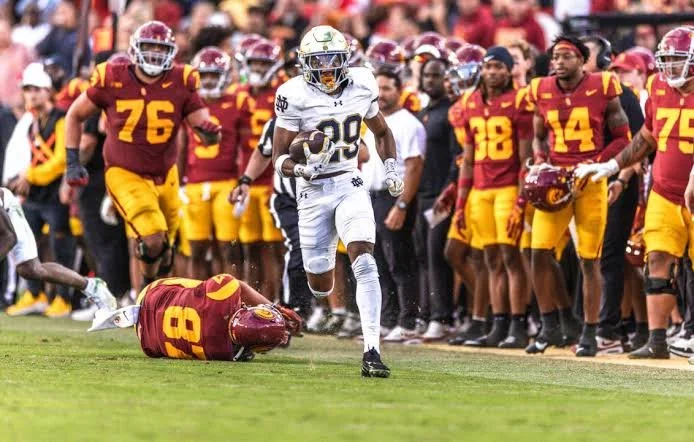
And Freeman has the results to back up that confidence. Notre Dame has won seven of the last eight meetings with USC, including the last three by double digits, and Freeman is 3-1 against the Trojans since taking over the program. That seven-out-of-eight run is the best stretch Notre Dame has had in this series since the Irish won 11 straight from 1983 to 1993, a streak that stretched to 13 games without a loss, including a tie, before USC finally broke through in 1996. In a rivalry that has swung back and forth across a full century, that is rarefied company. If the last decade of this series says anything, it's that the Irish don't need a late-season setting to beat USC. They've been doing it in October just fine. Whatever emotional weight Notre Dame fans attach to keeping the rivalry in its historic November window, the on-field evidence suggests it was never really a competitive advantage Notre Dame was giving up. It was a tradition, and traditions are worth fighting for, but they're not the same as leverage.
It's worth asking what USC's insistence on an early-season date really buys the Trojans, beyond a psychological hedge against playoff math. Lincoln Riley framed the demand around conference scheduling obligations, and that's a fair, practical concern for a program four years into life in the Big Ten. But Riley is also 1-3 against Notre Dame in his tenure, and nothing about swapping November for August changes personnel, coaching, or the gap that has defined this series recently. USC didn't negotiate its way to a competitive edge. It negotiated its way to a calendar preference, on a series it has been losing anyway.
Give Jen Cohen and Lincoln Riley their due, too. Whatever frustration Notre Dame fans feel about the outcome, USC picked about as good a moment as it could have to hold firm on scheduling.
The Big Ten has won the last three national championships, Michigan in 2023, Ohio State in 2024, and Indiana in 2025, and the conference has been the loudest, most organized voice pushing for a bigger, more lucrative playoff ever since. Riley and Cohen had a real argument to lean on. A nine-game conference schedule in what is, right now, the sport's deepest and most talked-about league is a legitimately different burden than the schedules most of USC's peers are carrying, and a difficult trip to Notre Dame in mid-October or a Thanksgiving-weekend game in South Bend could plausibly be framed as an unfair addition on top of that gauntlet. That argument was always going to land better in a year the Big Ten was stacking championship trophies than it would have in a down year for the conference. USC found the argument and the moment at the same time.
It's worth noting, though, that the nine-game conference schedule itself isn't new for USC. The Pac-12 played a nine-game conference slate for most of its existence, and USC carried that same workload every year it played Notre Dame as a Pac-12 and Pac-10 member, including plenty of seasons when the Los Angeles meeting fell in its traditional late-November spot. Nobody at USC argued back then that a nine-game conference schedule made a late-season trip to South Bend, or a home date against the Irish right before the Pac-12 title game, an unfair burden. The complaint only surfaced once USC's nine-game schedule came with a Big Ten logo attached to it. That doesn't make the argument wrong on its merits, the Big Ten is a heavier week-to-week league than the Pac-12 ever was, but it does mean the schedule itself was never really the issue. The conference was.
Then USC did the harder part: it waited. Riley and Cohen let Notre Dame walk right up to the edge, and past it. When the deal fell through in December, Notre Dame didn't just accept a pause. It went out and scheduled BYU for the next two years, the clearest possible signal that the Irish were prepared to move on from the series altogether if USC wouldn't bend. That's the moment USC was betting on. Rather than chase Notre Dame back to the table, USC let the schedule speak for itself and waited to see whether the Irish fan base, and Notre Dame's own broader interests, would tolerate actually losing the rivalry for good.
They didn't. And that's really the story of how this got resolved. Notre Dame pushed all its chips to the middle of the table in December, essentially betting that USC needed the game as much as Notre Dame did. USC called. When the two sides came back around in the spring, it was Notre Dame that blinked first on the scheduling issue that had caused the whole standoff, not USC. In poker terms, Notre Dame didn't lose the hand outright. It's still in the game, the rivalry survived, and Bevacqua has a real case that the broader board (playoff expansion, media positioning) favors Notre Dame more than the headline suggests. But this particular hand went to USC. Notre Dame folded a strong position to stay at the table, preserving its chips for the next hand rather than pushing the standoff further.
Notre Dame's real interest here was never the specific week. It was making sure the 100-year relationship with USC didn't quietly die during a scheduling dispute, the way too many great rivalries have been allowed to wither in the realignment era. Bevacqua said as much when the deal was announced, choosing to emphasize what Notre Dame held onto rather than what it gave up: the true home-and-home format, with games played at the Coliseum and at Notre Dame Stadium, not at some neutral corporate site. "That's the way it should be," he said. He wasn't wrong to spend the week framing it that way.
Notre Dame didn't get everything it wanted out of this negotiation. But it kept the rivalry, kept the venues, and did it while the ground under the sport's postseason is shifting toward a format that will make an early-season loss to USC far less costly than it would have been in 2025. Bevacqua played a longer game than the calendar suggests, and Freeman's teams have already shown they don't need a specific month to beat USC. Notre Dame fans grumbling about the timing should look at the whole board, not just the one square that changed.