
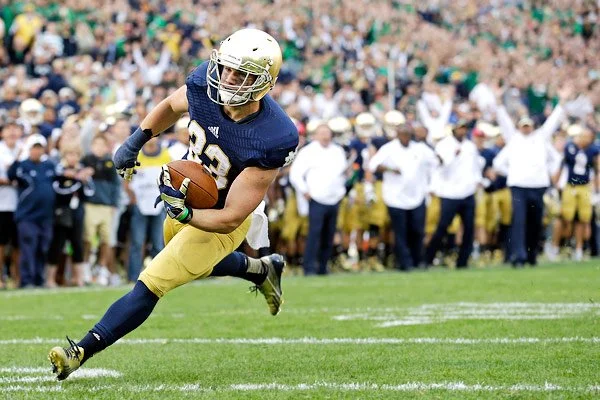
Irish dominate rival Purdue 49-10, keep Shillelagh Trophy and close out perfect September
WEST LAFAYETTE, Ind. – Notre Dame needed just one half to settle its rivalry game with Purdue.
The No. 3 Irish scored touchdowns on four straight drives to close the first half and took a 35-0 lead into the locker room. They beat the Boilermakers 49-10 on Saturday at Ross-Ade Stadium.
The win kept the Shillelagh Trophy in South Bend and pushed Notre Dame's winning streak to 14, all by double digits. The Irish have now beaten Purdue 11 straight times, and they open October unbeaten for the first time since 2021.
"I'm proud of those guys. Rivalry game," Freeman said.
Bryce Young set the tone by sacking Purdue quarterback Ryan Browne on the first play of the game. Purdue answered with a long, 12-play opening drive that reached the Notre Dame 47. Notre Dame took control on Purdue's second possession, stopping a fake punt a yard short near midfield.
Four plays later, Carr hit Micah Gilbert down the seam for a 27-yard touchdown. On the next drive, Gilbert turned a short slant into a 56-yard gain. Aneyas Williams then broke a 22-yard touchdown run on the first play of the second quarter, the first 20-yard run by an Irish back this season.
The Irish kept going from there. A fourth-down conversion on a designed Carr run kept the next drive alive deep in Notre Dame territory, and Carr finished it himself with a 1-yard touchdown run around the left end.
Then the defense scored. Young came off the edge, sacked Browne, and forced a fumble. Linebacker Drayk Bowen scooped it up and returned it 15 yards for his first career touchdown.
Carr capped the half with a 3-yard touchdown pass to Nolan James Jr. with 29 seconds left. Notre Dame outgained Purdue 273-90 in the first half and held the Boilermakers to 12 rushing yards.
The third quarter was the only sloppy stretch of the day. Carr threw his first interception since November 2025, which was also Notre Dame's first turnover of the season, and Purdue kicked a field goal. The Irish answered with two fourth-quarter touchdowns, starting with Carr's 2-yard pass to Cooper Flanagan for a 42-3 lead.
The reserves took over with about 11 minutes left. Purdue scored its only touchdown against Notre Dame's deep backups with six seconds remaining, a 14-yard pass from Evans Chuba to Bisi Owens.
Carr finished 14 of 22 for 237 yards with three touchdown passes, one rushing touchdown and one interception. It was the second straight week he had both a passing and a rushing touchdown. Williams ran 14 times for 80 yards, and the Irish had their best rushing day of the season. Gilbert caught two passes for 83 yards and a score. Young finished with four tackles, two sacks and a forced fumble.
Purdue managed only 218 total yards. Browne completed 18 of 28 passes for 111 yards. The loss was Purdue's third straight and dropped the Boilermakers to 1-3.
Notre Dame now leads the all-time series 62-26-2.
Key Stats:
Carr: 14 of 22, 237 yards, 3 TD, 1 INT; 1 rushing TD
Williams: 14 carries, 80 yards, 1 TD
Gilbert: 2 catches, 83 yards, 1 TD
Young: 4 tackles, 2 sacks, 1 forced fumble
Bowen: 15-yard fumble return for a TD
First-half yards: Notre Dame 273, Purdue 90
Purdue total yards: 218
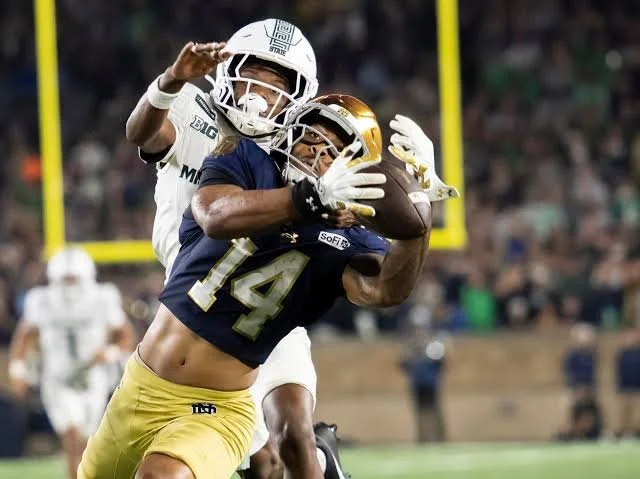
Gilbert's big night, defense carry Notre Dame past Michigan State 27-10
NOTRE DAME, Ind. – It was a rainy night and not always pretty, but No. 3 Notre Dame found a way.
Micah Gilbert caught eight passes for 170 yards and Nolan James Jr. ran for a career-high 121 yards. The Irish defense held Michigan State to 40 yards in the second half, and Notre Dame beat the Spartans 27-10 on Saturday night to keep the Megaphone Trophy.
The win was Notre Dame's 13th straight, all by at least 10 points. That broke the school record of 12 straight double-digit wins set under Knute Rockne in 1921-22.
"It wasn't perfect, as everybody saw, but it was a good victory," Freeman said.
Gilbert made his presence felt on the very first snap, catching a 61-yard pass from Carr. The run game stalled from there, and the Irish settled for a Spencer Porath field goal. Michigan State went three-and-out with a sack of quarterback Alessio Milivojevic. Notre Dame then went 75 yards in 10 plays, helped by a fourth-down catch from Gilbert, and James scored from 2 yards out for a 10-0 lead.
The Irish also tried a trick play that didn't work. After a holding penalty wiped out a punt, special teams coordinator Marty Biagi called a reverse on the redo, and freshman receiver Brayden Robinson came up a yard short. Freeman said afterward that he liked the call but didn't like how it was executed.
Aneyas Williams' touchdown run pushed the lead to 17-3, but Williams was flagged for unsportsmanlike conduct while celebrating. Michigan State then needed only three plays to go 68 yards for a touchdown, and the Spartans trailed only 17-10 at halftime. Freeman said after the game that his team has to be smarter, and that celebrations belong on the sideline.
The second half belonged to Notre Dame. Adon Shuler intercepted a pass on Michigan State's first play of the third quarter. James broke a 17-yard run, then the longest by an Irish back this season, and Porath added another field goal.
Early in the fourth quarter, Notre Dame sacked Milivojevic on back-to-back plays. The second sack knocked the ball loose, though Michigan State recovered. The Irish then put the game away on a long, clock-draining drive that started at their own 6. Gilbert had catches of 28 and 39 yards, and Carr finished it with a 3-yard touchdown run for a 27-10 lead with about 11 minutes left.
James was slow to get going, with only 23 yards on nine carries in the first half. He got stronger as the game went on, and he gained his final 52 yards on eight straight carries to run out the clock. He finished with 121 yards on 26 carries.
Gilbert came into the night with 14 career catches. His 170 yards were the most by an Irish receiver in years and the best receiving game of Freeman's tenure. Freeman called it a team effort, crediting Carr's throws and the protection up front.
Freeman added that if the Irish keep protecting the ball and winning the turnover battle, "we have a chance to be really good."
Notre Dame didn't turn it over and had the ball for 37:02. Michigan State finished with 167 total yards and only 44 on the ground, none after halftime. Milivojevic completed 9 of 17 passes for 123 yards with two interceptions, one each by Shuler and Luke Talich.
Spartans coach Pat Fitzgerald said Notre Dame's fast start hurt his team's chances. "They have a darn good football team," he said.
Key Stats:
Carr: 18 of 24, 234 yards; 1 rushing TD
Gilbert: 8 catches, 170 yards, long of 61
James: 26 carries, 121 yards, 1 TD
Faison: 5 catches, 38 yards
Total yards: Notre Dame 395, Michigan State 167
Rushing yards: Notre Dame 161, Michigan State 44
Turnovers: Notre Dame 0, Michigan State 2
Time of possession: Notre Dame 37:02
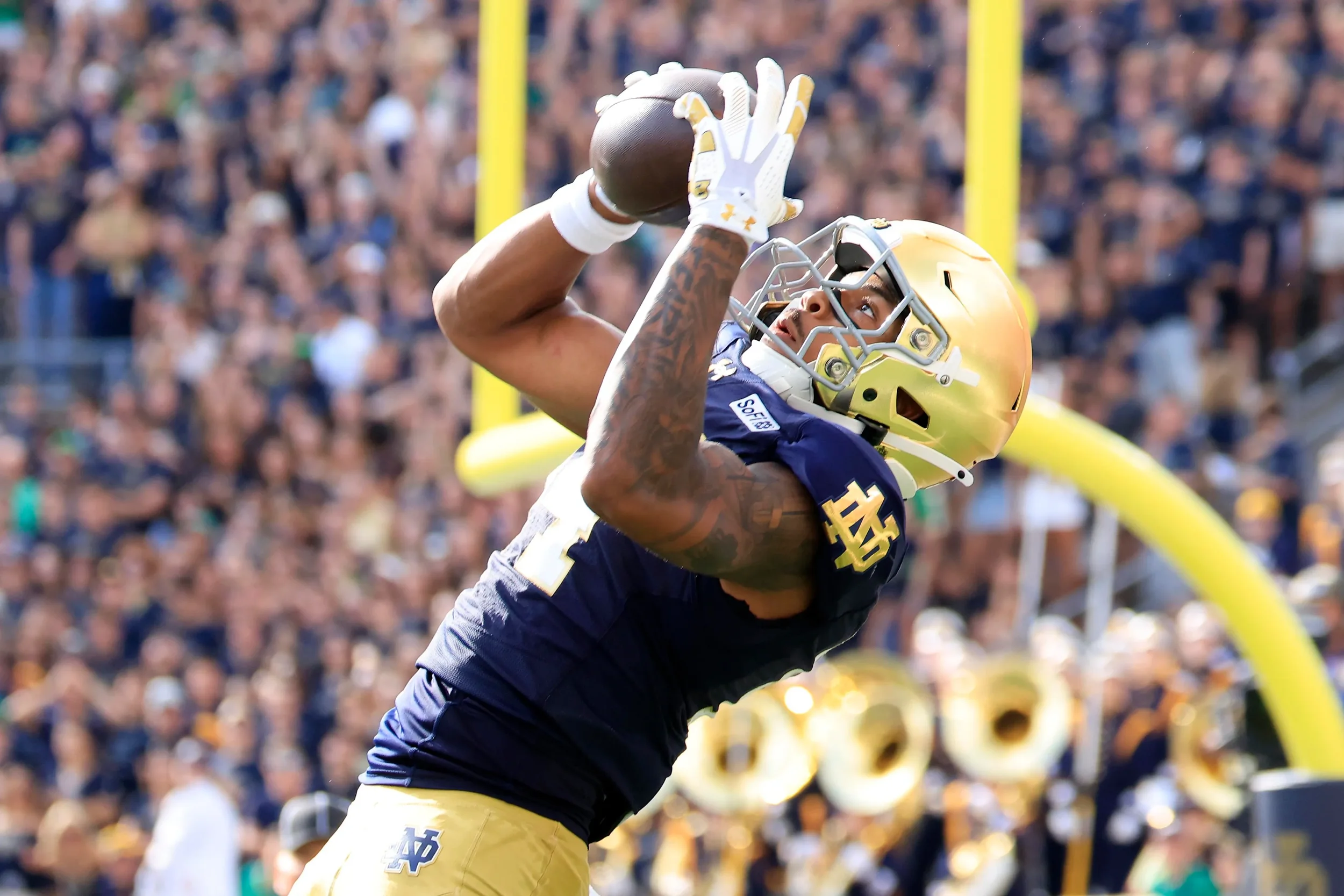
Carr throws four TDs as Notre Dame blanks Rice 52-0 in home opener
NOTRE DAME, Ind. – It took Notre Dame 14 seconds to score in its home opener. It took less than a half to put the game away.
The No. 3 Irish forced four fumbles, scored on six straight drives, and beat Rice 52-0 on Saturday at Notre Dame Stadium. It was Notre Dame's first shutout since 2022.
The tone was set on Rice's first offensive play. Safety Adon Shuler drilled running back Davis Lane and knocked the ball loose. Boubacar Traore scooped it up and ran 24 yards for a touchdown.
"Whenever the opportunity comes, I try to make the most of it," Traore said.
Freeman credited Shuler, one of his captains, for that kind of play.
"He's playing extremely physical, which is a choice," Freeman said.
From there, the offense took over. CJ Carr hit Jordan Faison for a 25-yard touchdown on a three-play drive. On the next possession, he found Faison again on an 11-yard bubble screen. Nolan James Jr. ran for two second-quarter touchdowns. Carr then hit Micah Gilbert for a 39-yard score just before halftime to make it 42-0.
Notre Dame's defense forced three first-half fumbles, and the offense turned all three into touchdowns.
Freeman said the plan was to take more shots downfield than the Irish had against Wisconsin, and to throw deep if Rice played man coverage. Carr completed 16 of 20 passes for 253 yards and four touchdowns before giving way in the third quarter. His fourth touchdown was a 2-yard pass to Cooper Flanagan to open the second half.
"His decisions are impeccable," Freeman said.
Freeman said Carr consistently put the offense in the right protections and made the right checks at the line, and that he did it even better than in the opener.
Carr said he is more comfortable and confident in his second season as the starter. He credited both the young receivers and veterans like Faison.
"It's something we're striving for every game," Carr said.
The rout gave Notre Dame a long look at its young players. Freshman quarterbacks Noah Grubbs and Teddy Jarrard combined to go 9 of 13 for 107 yards. Freshman running back Jonaz Walton led the team with 48 rushing yards on eight carries. Twelve different players caught a pass.
The reserves on defense also kept the shutout alive. Freshman defensive lineman Rodney Dunham recovered a fumble at the Notre Dame 16 to end Rice's only real scoring chance.
Rice quarterback Jacurri Brown completed 8 of 12 passes for 64 yards. Notre Dame outgained the Owls 478-128 and had eight tackles for loss, including 2.5 from Bryce Young. It was Rice's worst loss since a 58-0 defeat at Texas in 2021.
Freeman still wasn't satisfied. He pointed to a face mask penalty and a false start as plays where Notre Dame beat itself, and he promised a list of things to fix when the team met that week.
Key Stats:
Carr: 16 of 20, 253 yards, 4 TD
Faison: 4 catches, 54 yards, 2 TD
Gilbert: 39-yard TD catch
James: 2 rushing TD
Walton: 8 carries, 48 yards
Grubbs and Jarrard: combined 9 of 13, 107 yards
Total yards: Notre Dame 478, Rice 128
Turnovers forced: 4 (all fumbles), turned into 21 points
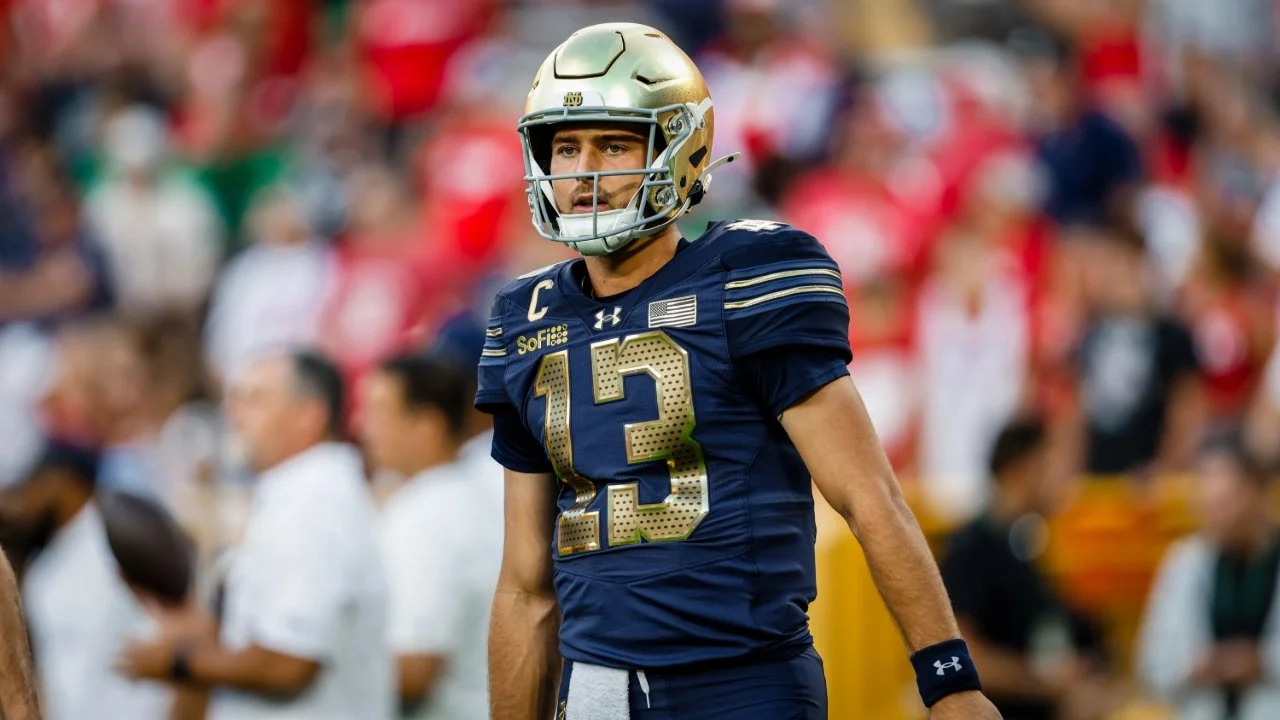
Irish shake off slow start, roll past Wisconsin 41-13 at Lambeau Field
GREEN BAY, Wis. – For one half Sunday night, Notre Dame's season opener looked more like a fight than the expected cruise. The second half looked like what the No. 4 Irish expected all along.
Notre Dame scored 28 points after halftime and held Wisconsin to one field goal over the final two quarters in a 41-13 win at Lambeau Field. The crowd of 75,939 was split roughly evenly between Badgers red and Irish navy. The Irish then celebrated with Lambeau Leaps into the student section.
It was not a clean start. Notre Dame's first drive opened with a false start and ended with Carr being sacked and fumbling. The Irish recovered, but Wisconsin blocked the ensuing punt, and Gavin Lahm kicked a 27-yard field goal for a 3-0 lead.
Notre Dame answered with a 52-yard field goal from Spencer Porath, a transfer from Purdue making his Irish debut. On the next kickoff, Wisconsin's Harrison Bortolotti muffed the return, and Notre Dame's Kahanu Kia recovered at the Badgers' 13. A personal foul moved the ball to the 6. Two plays later, Carr found tight end James Flanigan for a 3-yard touchdown. Flanigan is a Green Bay native whose father and grandfather both played for the Packers.
Wisconsin tied it 10-10 when quarterback Colton Joseph hit Malachi Coleman for a 28-yard touchdown. Porath's 26-yard field goal put Notre Dame back in front 13-10 with 8:53 left in the half, but the Irish didn't score again before the break.
The Irish ran for only 29 yards on 1.8 yards per carry in the first half. At halftime, Freeman told his players to drop their preconceived ideas about how the game would go. Wisconsin was coming off a 4-8 season, but it was going to be a battle, and he had been telling them that all week.
"Sometimes, you don't believe it till you're in it," Freeman said.
They believed it after halftime. Notre Dame opened the third quarter with a nine-play, 70-yard drive that Aneyas Williams finished with a 3-yard run. Nolan James Jr. kept the drive alive with a 7-yard run and a 28-yard catch.
Then the defense delivered the biggest play of the night. Cornerback DJ McKinney, who transferred from Colorado this offseason, intercepted Joseph and returned it 55 yards for a touchdown and a 27-10 lead.
Lahm added a second field goal late in the third quarter, but that was all Wisconsin could manage. Williams scored again on a 5-yard run in the fourth quarter, and James capped the night with a 28-yard touchdown catch from Carr in the final two minutes.
Carr said that near the end of the first half, he could tell, "We're going to be just fine."
Carr finished 19 of 29 for 239 yards and two touchdowns. In the second half he was 10 of 13 for 133 yards, and Freeman praised how well he got the offense out of bad down-and-distance situations at the line.
The biggest question going in was how the Irish would replace first-round NFL picks Jeremiyah Love and Jadarian Price. The early answer was by committee. Williams ran 20 times for 90 yards and two scores. James added 19 rushing yards and 67 receiving yards. Notre Dame finished with 111 rushing yards after halftime adjustments by the staff and the line.
Joseph finished 19 of 30 for 217 yards and a touchdown, and the Irish sacked him twice.
There were concerns, too. Safety Brauntae Johnson and defensive lineman Jason Onye both missed the second half with injuries, and Freeman had no update after the game.
With the win, Notre Dame moved to 13-0 all-time in Shamrock Series games.
Key Stats:
Carr: 19 of 29, 239 yards, 2 TD
Williams: 20 carries, 90 yards, 2 TD
James: 7 carries, 19 yards; 4 catches, 67 yards, 1 TD
Porath: 2 of 2 on field goals (52, 26)
McKinney: 55-yard interception return for a TD
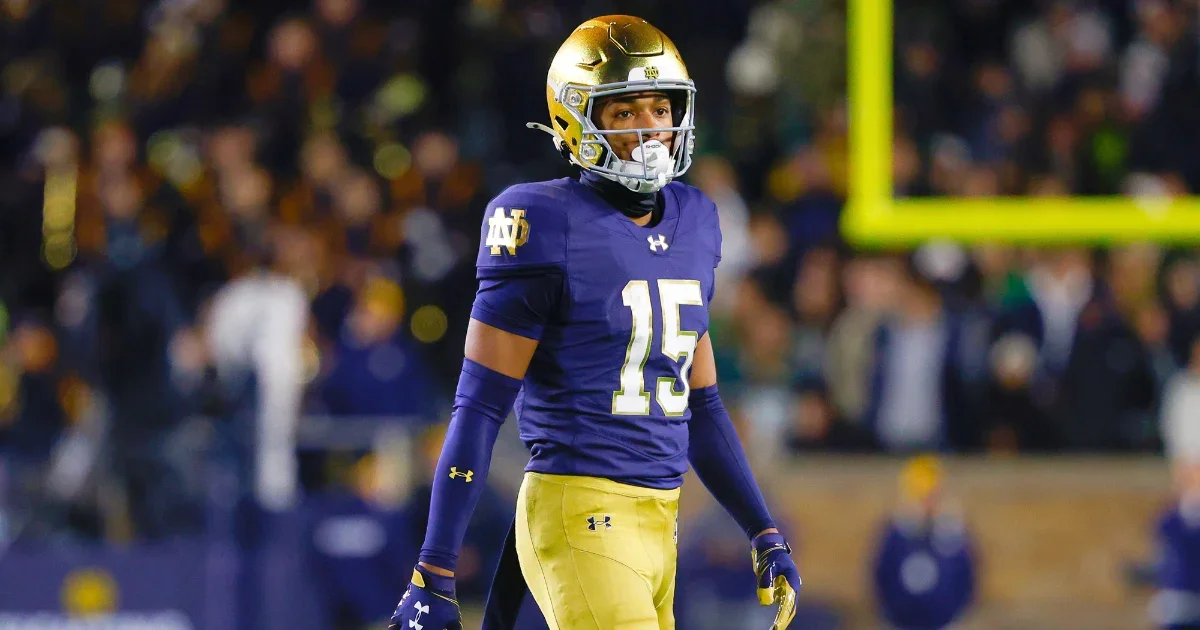
Four Irish Earn Spots on Sporting News Preseason All-America Teams
Notre Dame landed four players on Sporting News' 2026 Preseason All-America teams, with cornerback Leonard Moore and safety Brauntae Johnson earning first-team honors and linebacker Drayk Bowen and offensive lineman Anthonie Knapp landing on the second team.
The honors reflect more than individual talent. Notre Dame's defense allowed 17.6 points per game across the full 2025 season, 11th nationally, but was dramatically better down the stretch, holding its final nine opponents to just 14.1 points per game and never allowing a single team to reach 30 points in that span. That late-season form is exactly the kind of defensive foundation the sport's two most recent champions were built on, and it's why the return of Moore, Johnson and Bowen matters so much for Notre Dame's 2026 outlook. Behind them, Knapp and an offensive line that helped power one of the most efficient rushing attacks in the country give the Irish a rare combination heading into the fall: a proven, veteran identity on both sides of the ball.
Leonard Moore
Moore enters the season coming off a unanimous All-American 2025 campaign. He started 10 games and led Notre Dame with five interceptions, tied for the seventh-most in the country, while adding 31.0 total tackles, a forced fumble and seven pass breakups.
His advanced metrics backed up the tape. Moore posted a 91.8 PFF grade and a 92.5 coverage grade, both of which led the nation, and he allowed just a 45.9 passer rating to opposing quarterbacks when targeted. He has already been named to the Walter Camp Preseason First Team All-America team this summer.
The Round Rock, Texas, native had his signature performance against Boise State last October, forcing three turnovers, two interceptions and a forced fumble, for his first career multi-interception game. He also added six solo tackles in that game and was named the Walter Camp FBS Defensive Player of the Week and the Jim Thorpe Award Defensive Back of the Week for his performance.
Why he matters for a title run: Notre Dame finished as the first team left out of the 12-team playoff field in 2025, despite a defense that closed the season allowing just 14.1 points per game over its final nine opponents. Moore, the nation's top-graded coverage corner, is the single biggest reason opposing offenses couldn't find a way to attack the perimeter during that stretch. A shutdown corner who erases half the field lets a defensive coordinator get more aggressive everywhere else, and every recent national champion has needed a defensive back or edge piece capable of exactly that kind of one-on-one dominance.
Brauntae Johnson
Johnson played in all 10 games available to him last season with eight starts, finishing fourth on the team with 48.0 total tackles and recording four interceptions, the second-most on the roster behind Moore.
His breakout moment came against Pittsburgh last November, when he returned an interception 49 yards for a touchdown in the fourth quarter, his first career pick-six. He also logged his first career half-sack in that game and was named the Walter Camp National FBS Defensive Player of the Week and the Shaun Alexander Freshman Player of the Week. The Fort Wayne, Indiana, native closed out his season with FWAA Freshman All-America honors.
Why he matters for a title run: Johnson gives Notre Dame a rare luxury, a second high-level takeaway threat on the back end alongside Moore, and the tandem combined for nine of the team's interceptions in 2025. Both of the recent 12-team playoff champions won largely on the strength of defenses that created a steady stream of possessions for their offense, and Johnson's ability to turn coverage reps into points, as he showed against Pittsburgh, is the kind of explosive-play upside that turns a good defense into a championship one.
Drayk Bowen
A team captain last season, Bowen started all 12 games and led Notre Dame with 67 total tackles, 33 solo and 34 assisted, while adding three and a half sacks and four pass breakups.
The St. John, Indiana, product turned in a career night at Boston College last November, recording 14 tackles, all of them solo. It was the most tackles by a Notre Dame defender since Alohi Gilman's 18 against Clemson in the 2018 College Football Playoff semifinal, and it stood as the most by any player in the country at that point in the season.
Why he matters for a title run: As a captain and the team's leading tackler, Bowen is the piece that ties the whole defense together, the player calling checks and setting the front against the run so that Moore and Johnson can play aggressively on the back end. The stinginess Notre Dame's defense showed down the stretch, holding nine straight opponents under 30 points, started up front and at linebacker, and a defense that controls the run without needing extra bodies in the box is exactly what allowed Ohio State and Indiana to play ahead of schedule and dictate tempo in their own championship runs. Bowen returning as a captain and every-down presence gives Notre Dame that same identity heading into 2026.
Anthonie Knapp
Knapp has started all 29 games he's played in his Notre Dame career across the past two seasons, including all 12 games at left tackle in 2025. He was named to the 2026 Walter Camp Preseason All-America First Team this June and was added to the Outland Trophy Watch List earlier this week.
Knapp and the rest of the offensive line helped power a Notre Dame rushing attack that averaged 5.69 yards per carry, tied for the third-best mark in the FBS and the second-highest yards-per-carry average in a single season in program history. The Irish offense ranked sixth among Power Four programs at 203.4 rushing yards per game while allowing just 1.00 sacks per game, the eighth-lowest total in the country.
Why he matters for a title run: Both Ohio State's 2024 title team and Indiana's 2025 title team were built on a two-back rushing attack that let their quarterbacks play with an advantage, and Notre Dame's blocking up front, with Knapp protecting the blind side, is precisely what turned that same formula into the second-most efficient rushing season in program history in 2025. A left tackle who has started every game he's played for two straight seasons brings the kind of continuity and protection that both keeps a young quarterback upright and gives a two-back rotation room to work, the same foundation the last two national champions used to win it all.
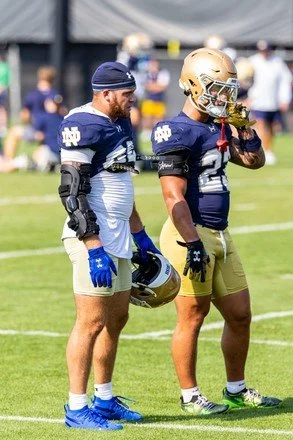
Notre dame’s title tandem at rb?
Jeremiyah Love and Jadarian Price spent 2025 running like the engine of a national title team. By the time the season ended, Notre Dame didn't have a national title, a playoff berth, or even a bowl game to point to. The numbers tell a story that doesn't quite add up, and it starts with a simple comparison to the two teams that actually won the trophy.
The Numbers Line Up. The Result Didn't.
Ohio State's 2024 championship rushing attack, TreVeyon Henderson and Quinshon Judkins, combined for 2,076 yards and 24 touchdowns. Indiana's 2025 championship tandem, Roman Hemby and Kaelon Black, combined for 2,160 yards and 17 touchdowns across their full playoff run. Both were built around a shutdown defense, a good-not-great passing game, and a two-back rushing attack doing the heavy lifting underneath it.
Notre Dame's Love and Price combined for 2,046 rushing yards and 29 rushing touchdowns in 2025. That's within shouting distance of Ohio State's yardage total and actually ahead of both title teams in touchdowns, by a wide margin. Love alone rushed for 1,372 yards and 18 scores on 199 carries, a 6.9 yards-per-carry average, and finished third in Heisman voting. Price added 674 yards and 11 more scores on just 113 carries, a 6.0 average, while also scoring twice on kickoff returns. Statistically, this was a title-caliber backfield sitting behind a defense that, by season's end, was allowing single digits per game in stretches and a redshirt freshman quarterback in CJ Carr who threw for 2,741 yards, 24 touchdowns and only 6 interceptions.
And Notre Dame missed the playoff entirely.
Did They Miss the Opportunity?
The short answer is yes, and it wasn't really the running backs' fault. Notre Dame opened the season 0-2, with back-to-back losses to Miami and Texas A&M decided by a combined four points, before Love and Price were fully unleashed. In that Miami opener, the tandem combined for just 16 carries and 78 yards, fewer touches than CJ Carr got as a first-time starter, as the staff leaned on bubble screens instead of establishing the run. Once the coaching staff committed to the ground game in earnest, Notre Dame won ten straight, and the backfield numbers from that stretch on look every bit like a championship rushing attack.
The math is almost cruel in hindsight. Notre Dame had the fourth-best odds in the country to win the national title according to some models, and still finished on the wrong side of the committee's final cutline, passed over in favor of No. 9 seed Alabama and No. 10 seed Miami in the last week of the selection process. The Irish opted out of a bowl game altogether rather than play a lesser postseason game after missing the field they felt they belonged in.
So yes, this was an opportunity missed, but a specific and narrow one: two winnable games in September buried a team that, by rushing production alone, matched or beat the two teams that actually cut down the nets. Ohio State and Indiana didn't have appreciably better rushing attacks than Notre Dame did. They just didn't lose games in September that a fully-loaded playoff team couldn't afford to lose. The lesson isn't that Love and Price weren't good enough. It's that in a 12-team field, there's still no margin for a bad start, no matter how good the roster gets by November.
The 2026 Room: A Passing Attack About to Overshadow the Backfield Again
Both Love and Price are gone, off to the NFL as the first two running backs drafted in this year's class, the first time any school has produced that exact draft-day distinction. That leaves a very different-looking backfield heading into fall camp, and once again, the storyline threatens to be about the quarterback, not the running backs.
CJ Carr returns as a redshirt sophomore and the presumptive Heisman frontrunner after a 24-touchdown, 6-interception debut season, completing two-thirds of his passes. For the first time since Ian Book in 2020, Notre Dame enters a season with a proven, returning starting quarterback, and the offseason conversation around South Bend has understandably centered on Carr and an offense built to feature him. It's almost the same dynamic that played out at both Ohio State and Indiana, where Will Howard and Fernando Mendoza (a Heisman winner himself) got most of the offseason attention while a two-back rushing committee quietly did just as much to win the title. If Notre Dame's backfield produces anywhere near what it did in 2025, it's likely to happen again in the shadow of Carr's passing numbers rather than in front of them.
Aneyas Williams: The Known Quantity
The presumptive lead back is Aneyas Williams, a junior who has spent two years watching and learning behind Love and Price. His numbers are modest by necessity. As a true freshman in 2024, he carried 34 times for 219 yards and 2 touchdowns, adding 18 catches for 172 yards, a full complementary season buried on the depth chart. In 2025, playing behind two established stars and dealing with limited opportunity, he carried just 24 times for 224 yards and 5 touchdowns, an eye-catching 9.3 yards per carry in a small sample, plus 2 catches for 40 yards. His career line sits at 58 carries, 443 yards, 7.6 yards per carry, and 7 touchdowns, along with 20 catches for 212 yards. He also has three career touchdown runs of 50-plus yards, evidence of real explosive ability whenever he has gotten the ball.
The obvious question is what Williams looks like with a real workload instead of a rotational one.
Projecting Williams at a Title-Team Workload
Here's where the Ohio State and Indiana tandems become useful benchmarks. Individually, the four backs who made up those two championship duos carried the ball at these volumes:
Quinshon Judkins: 194 carries
TreVeyon Henderson: roughly 143 carries
Roman Hemby: 230 carries
Kaelon Black: 186 carries
That averages out to roughly 188 carries per back across the two title tandems, essentially a season-long "one half of the tandem" workload. Give Williams that same number of carries and run it through his two different levels of efficiency, and the range is striking.
At his more proven, larger-sample 2024 rate of 6.4 yards per carry, 188 carries projects to roughly 1,200 yards. At his smaller-sample, considerably hotter 2025 rate of 9.3 yards per carry, the same workload would put him near 1,750 yards, almost certainly not sustainable at that per-carry clip once defenses build a full season of tape on him as the featured back, but a real signal of his ceiling. A reasonable midpoint, blending his two seasons and accounting for the fact that per-carry averages almost always come down as workload goes up, lands Williams somewhere in the 1,100 to 1,250 yard range on a true one-back-of-a-tandem workload, right in the same neighborhood Judkins, Henderson, Hemby and Black all occupied in their title seasons.
That's not a guarantee. It's a data point. But it says Williams doesn't need to reinvent himself to hit a title-caliber level of production. He just needs the carries, something he's never actually had at Notre Dame.
Who Joins Williams to Form the 2026 Tandem?
This is the more unsettled question, and it will likely be answered in fall camp rather than on paper.
The clearest option right now is redshirt sophomore Nolan James Jr., who made the most of a chaotic spring. With injuries wiping out much of the depth chart, including Williams for stretches and Young for the entire spring, James stepped into the lead role in team drills and made the most of it. He impressed evaluators with his pass protection, his hands out of the backfield and his overall feel for the position, exactly the traits new running backs coach Ja'Juan Seider prizes most in a back. His actual production on the field so far is thin, just 14 carries for 37 yards as a redshirt freshman in 2025, along with a single catch for 19 yards, a clear product of buried depth-chart status behind Love, Price and Williams rather than any real limitation. But the spring buzz is real, and coaches have already signaled he'll get a genuine chance to claim the No. 2 job, if not push for the top spot outright, once fall camp opens.
The most talented option might still be redshirt sophomore Kedren Young, a big back with what evaluators call some of the best "lead back" skills in the room, impressive feet and vision for his size. Young was in position to be the team's short-yardage back in 2025 before a season-ending knee injury in fall camp wiped out his year entirely, and he also missed all of spring practice in 2026 while recovering. If he's fully healthy by August, he brings a different, more physical style than Williams and would give Notre Dame the same kind of contrasting two-back look that Ohio State ran with Henderson's speed and Judkins' power.
Young's return matters for a specific reason beyond raw talent: Notre Dame had a real, documented problem finishing drives in 2025, and it's the exact area where a bigger, more physical back could move the needle. The Irish ranked 119th nationally in red-zone scoring percentage, and while some of that was a broken kicking operation, the offense had its own issues closing games out. Notre Dame failed to score at all on eight separate first-and-goal situations during the season, and on third-and-short specifically, the line converted just 12 of 27 snaps, a number both the coaching staff and outside analysts flagged as a real structural weakness. Jadarian Price, for all his explosiveness, fumbled three times inside the 10-yard line and lost two of them, and Notre Dame simply never settled on an identity in short-yardage situations, caught between power runs, RPOs, and a young quarterback who didn't yet have the same downhill rushing threat that Riley Leonard provided the year before.
A healthy Young is a direct answer to that problem. Evaluators specifically point to his frame and contact balance as goal-line tools that neither Williams nor James clearly offer in the same way, the classic short-area, north-south power back who can be trusted to fall forward for the tough yard instead of trying to bounce a run outside where there's no room to work. Pairing that skill set with what should be a deeper, more experienced offensive line in 2026 makes the fit even more promising. Notre Dame returns six linemen with career starts, including three who opened last season as starters, giving Joe Rudolph a bigger, more physically imposing group to work with than the patchwork line that struggled to consistently move people at the goal line in 2025. If that combination clicks, Young isn't just a wildcard for touches. He's a potential fix for the single biggest flaw in Notre Dame's 2025 offense.
The complication for Young is that health is not guaranteed, and James's spring showing means the No. 2 job is no longer a formality even if Young returns at full strength.
There's also a wildcard element behind them: incoming freshmen Jonaz Walton and Javian Osborne, both highly regarded prospects Seider recruited specifically for his scheme, plus a coaching philosophy worth watching closely. Seider ran a strict two-man rotation at Penn State, where Nicholas Singleton and Kaytron Allen combined for nearly 90 percent of the running back snaps in 2024. If he applies that same approach at Notre Dame, the room won't stay a four- or five-man committee for long. It will likely collapse into exactly the kind of tandem Ohio State and Indiana rode to championships, and all the noise this fall will be about which two names end up in it.
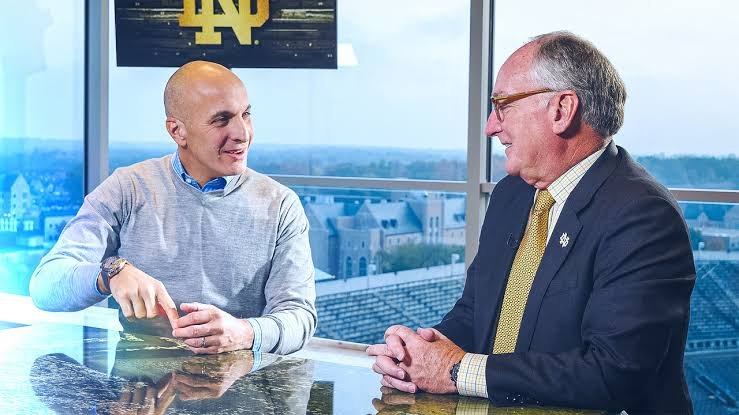
notre dame-usc is always a win-win
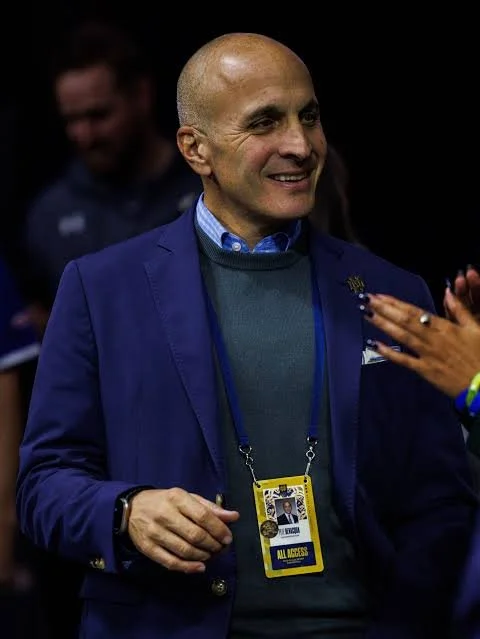
The reaction out of South Bend this week has been relief mixed with a little bit of grumbling, and it's easy to understand why. For eight months, Pete Bevacqua and Notre Dame held the line on two things: they wanted to keep playing USC, and they wanted to keep playing USC the way the series has always been played, in the fall, not as a season-opening exhibition wedged between conference obligations. In the end, Notre Dame got the first thing and gave up the second. On paper, that looks like USC got what it wanted and Notre Dame folded.
Look closer, though, and the calculation makes a lot more sense than a simple capitulation.
Start with the obvious point: this deal covers four games, from 2030 to 2033. That is a long way off, and a lot about the sport is going to change between now and then, starting with the College Football Playoff itself. The current 12-team format is already being renegotiated behind closed doors, with the Big Ten pushing hard for a 24-team playoff and the SEC holding out for 16. Bevacqua sat on that Management Committee throughout the process, and by the spring, he had shifted from Notre Dame's earlier position favoring a leaner 16-team field to aligning with Big Ten commissioner Tony Petitti's 24-team push, alongside the ACC and Big 12.
That alignment matters here. If the sport ends up in a 24-team playoff by 2029, the stakes of any single September loss look completely different than they do today. A Week 1 defeat in the Coliseum in 2030 is a much smaller threat to Notre Dame's season in a 24-team world than a late-November loss would have been under the old 12-team model, where seeding and at-large math could hinge on exactly the kind of game USC wanted to avoid. Bevacqua didn't just agree to move the game. He agreed to move it into a playoff environment he has spent the better part of a year helping redesign in Notre Dame's favor. That's not caving. That's negotiating with information the public didn't have at the time.
It's also worth remembering who Pete Bevacqua is, and where he came from. Before he ever set foot in the athletic director's office, Bevacqua spent five years, from 2018 to 2023, as chairman of NBC Sports. In that role, he was the network's chief steward of Notre Dame's own broadcast deal, and in his final year at NBC, he also helped negotiate the seven-year agreement that gave the Big Ten its new Saturday Night football window on the network. He didn't just watch the Big Ten and NBC build a relationship from the outside. He helped build it himself.
Bevacqua helped negotiate Notre Dame's own NBC extension, locking Irish football in through 2029, in the months before he formally became athletic director, working on it as a special assistant fresh off his NBC tenure. That extension landed roughly a year after the Big Ten's own NBC deal was finalized as part of the conference's broader realignment push. Two of the sport's most prominent brands ended up under the same broadcast roof within about a year of each other, with Bevacqua sitting at the center of both relationships, first as the executive negotiating from NBC's side, then as the administrator negotiating from Notre Dame's. Add in his more recent alignment with Big Ten commissioner Tony Petitti on 24-team playoff expansion, and a pattern starts to emerge: on the issues that matter most to how Notre Dame is scheduled, seeded, and broadcast, Bevacqua's instincts keep pointing toward the same conference and the same network he spent years working for.
None of that means the USC agreement was secretly a media play. But it's not unreasonable for Notre Dame fans to notice that the man negotiating the calendar also happens to be the person in the industry most fluent in how television money and playoff positioning actually move together. A Week 1 Notre Dame-USC game on NBC, in an expanded playoff world where that result carries less weight, looks a lot more like a Bevacqua decision than it does a Freeman one.
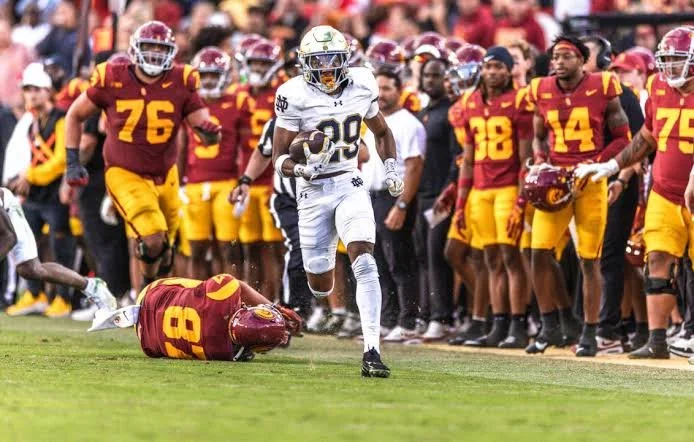
This isn't the first time a Notre Dame athletic director has made a decision that didn't sit well with the fan base in the moment. Jack Swarbrick spent parts of his 15-year tenure fielding the same kind of frustration, whether it was keeping Notre Dame out of a conference while the sport consolidated around them, or agreeing to a 12-team playoff format that guaranteed the Irish could never earn a first-round bye even while ranked in the top four, a concession he made willingly to preserve independence. Both decisions looked, in real time, like Notre Dame giving something up.
They don't look that way now. Swarbrick's tenure is remembered for helping architect the College Football Playoff itself, for a $400 million renovation of Notre Dame Stadium, for setting in motion the Jack and Kathy Shields Family Hall that opens this fall, and for a run of ten national championships across five sports, the most of any athletic director in school history. The short-term grumbling didn't define the legacy. The long-term positioning did.
Bevacqua is still early in writing his own chapter, and the USC calendar concession is exactly the kind of decision that will look better or worse depending on how the next five years of playoff expansion, media rights, and Big Ten influence actually play out. If he's right about where the sport is headed, moving the rivalry to September will look like foresight. If he's wrong, it will look like the same short-term concession Notre Dame fans are frustrated about today. Swarbrick's early moves invited exactly that kind of doubt, too, right up until they didn't.
While the athletic directors argued over calendars, Marcus Freeman never treated this as complicated. Asked repeatedly across the standoff when he wanted to play USC, his answer never moved: anytime, anywhere. Start of the season, middle of the season, end of the season, it didn't matter to him. That stance was easy to dismiss as a coach staying above the fray, but it also happened to be exactly right. The game itself is the asset. The calendar slot is negotiable.
And Freeman has the results to back up that confidence. Notre Dame has won seven of the last eight meetings with USC, including the last three by double digits, and Freeman is 3-1 against the Trojans since taking over the program. That seven-out-of-eight run is the best stretch Notre Dame has had in this series since the Irish won 11 straight from 1983 to 1993, a streak that stretched to 13 games without a loss, including a tie, before USC finally broke through in 1996. In a rivalry that has swung back and forth across a full century, that is rarefied company. If the last decade of this series says anything, it's that the Irish don't need a late-season setting to beat USC. They've been doing it in October just fine. Whatever emotional weight Notre Dame fans attach to keeping the rivalry in its historic November window, the on-field evidence suggests it was never really a competitive advantage Notre Dame was giving up. It was a tradition, and traditions are worth fighting for, but they're not the same as leverage.
It's worth asking what USC's insistence on an early-season date really buys the Trojans, beyond a psychological hedge against playoff math. Lincoln Riley framed the demand around conference scheduling obligations, and that's a fair, practical concern for a program four years into life in the Big Ten. But Riley is also 1-3 against Notre Dame in his tenure, and nothing about swapping November for August changes personnel, coaching, or the gap that has defined this series recently. USC didn't negotiate its way to a competitive edge. It negotiated its way to a calendar preference, on a series it has been losing anyway.
Give Jen Cohen and Lincoln Riley their due, too. Whatever frustration Notre Dame fans feel about the outcome, USC picked about as good a moment as it could have to hold firm on scheduling.
The Big Ten has won the last three national championships, Michigan in 2023, Ohio State in 2024, and Indiana in 2025, and the conference has been the loudest, most organized voice pushing for a bigger, more lucrative playoff ever since. Riley and Cohen had a real argument to lean on. A nine-game conference schedule in what is, right now, the sport's deepest and most talked-about league is a legitimately different burden than the schedules most of USC's peers are carrying, and a difficult trip to Notre Dame in mid-October or a Thanksgiving-weekend game in South Bend could plausibly be framed as an unfair addition on top of that gauntlet. That argument was always going to land better in a year the Big Ten was stacking championship trophies than it would have in a down year for the conference. USC found the argument and the moment at the same time.
It's worth noting, though, that the nine-game conference schedule itself isn't new for USC. The Pac-12 played a nine-game conference slate for most of its existence, and USC carried that same workload every year it played Notre Dame as a Pac-12 and Pac-10 member, including plenty of seasons when the Los Angeles meeting fell in its traditional late-November spot. Nobody at USC argued back then that a nine-game conference schedule made a late-season trip to South Bend, or a home date against the Irish right before the Pac-12 title game, an unfair burden. The complaint only surfaced once USC's nine-game schedule came with a Big Ten logo attached to it. That doesn't make the argument wrong on its merits, the Big Ten is a heavier week-to-week league than the Pac-12 ever was, but it does mean the schedule itself was never really the issue. The conference was.
Then USC did the harder part: it waited. Riley and Cohen let Notre Dame walk right up to the edge, and past it. When the deal fell through in December, Notre Dame didn't just accept a pause. It went out and scheduled BYU for the next two years, the clearest possible signal that the Irish were prepared to move on from the series altogether if USC wouldn't bend. That's the moment USC was betting on. Rather than chase Notre Dame back to the table, USC let the schedule speak for itself and waited to see whether the Irish fan base, and Notre Dame's own broader interests, would tolerate actually losing the rivalry for good.
They didn't. And that's really the story of how this got resolved. Notre Dame pushed all its chips to the middle of the table in December, essentially betting that USC needed the game as much as Notre Dame did. USC called. When the two sides came back around in the spring, it was Notre Dame that blinked first on the scheduling issue that had caused the whole standoff, not USC. In poker terms, Notre Dame didn't lose the hand outright. It's still in the game, the rivalry survived, and Bevacqua has a real case that the broader board (playoff expansion, media positioning) favors Notre Dame more than the headline suggests. But this particular hand went to USC. Notre Dame folded a strong position to stay at the table, preserving its chips for the next hand rather than pushing the standoff further.
Notre Dame's real interest here was never the specific week. It was making sure the 100-year relationship with USC didn't quietly die during a scheduling dispute, the way too many great rivalries have been allowed to wither in the realignment era. Bevacqua said as much when the deal was announced, choosing to emphasize what Notre Dame held onto rather than what it gave up: the true home-and-home format, with games played at the Coliseum and at Notre Dame Stadium, not at some neutral corporate site. "That's the way it should be," he said. He wasn't wrong to spend the week framing it that way.
Notre Dame didn't get everything it wanted out of this negotiation. But it kept the rivalry, kept the venues, and did it while the ground under the sport's postseason is shifting toward a format that will make an early-season loss to USC far less costly than it would have been in 2025. Bevacqua played a longer game than the calendar suggests, and Freeman's teams have already shown they don't need a specific month to beat USC. Notre Dame fans grumbling about the timing should look at the whole board, not just the one square that changed.
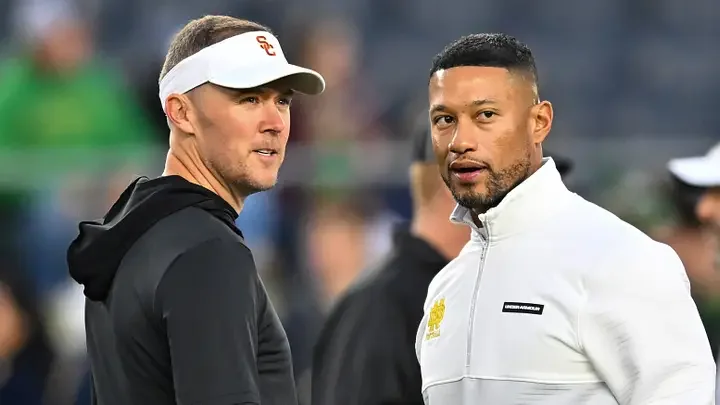
The Rivalry Returns: notre dame vs. usc
For the first time in a century, college football's most storied intersectional rivalry went dark. On Aug. 3, 2026, it came back to life, but not on the terms either side originally wanted.
Notre Dame and USC announced a four-game home-and-home series running from 2030 to 2033, ending an eight-month standoff that had wiped "the greatest intersectional rivalry in college football" off both schedules from 2026 through 2029. The deal preserves the century-old tradition, but it comes with a concession Notre Dame fought hard to avoid: every game will be played in the opening weeks of the season, not in its historic late-fall slot.
The path back to the table ran through an unrelated scheduling move. Notre Dame had lined up a home-and-home series with Indiana set to begin in 2030, but the Hoosiers ultimately backed out of that agreement. With that open date back on the board, conversations between Notre Dame and USC picked back up, and the Indiana cancellation is widely seen as the catalyst that reignited talks and ultimately cleared the way for this week's announcement.
The rivalry dates to 1926, when Knute Rockne led his team by train across the country for a 13-12 win. Since then, Notre Dame and USC had met every year but four (three during World War II and one during the COVID-shortened 2020 season), building the series into the most decorated in the sport, with a combined haul of national championships, Heisman winners and NFL draft picks unmatched by any other rivalry.
That streak nearly ended for good in December 2025. Despite months of negotiations, the two schools couldn't agree on terms for what would have been the 97th meeting, and on Dec. 22, Notre Dame confirmed it had filled its open 2026 date with a home-and-home series against BYU instead. USC coach Lincoln Riley didn't hide his frustration, telling reporters at the Alamo Bowl that Notre Dame had reneged on its own rhetoric.
"We took Notre Dame at their word that they would play us anytime, anywhere," Riley said. "Had Notre Dame lived up to their word and played us anytime, anywhere, we would be playing them the next two years, and looking ahead after that, hopefully continuing the series."
The two schools put out a joint statement the same week trying to soften the blow: "USC and Notre Dame recognize how special our rivalry is to our fans, our teams, and college football, and our institutions will continue working towards bringing back the Battle for the Jeweled Shillelagh."
At the root of the collapse was a scheduling philosophy clash. USC, now in the Big Ten, wanted the game moved earlier in the season, worried that a late-season loss to Notre Dame could damage its College Football Playoff positioning. Notre Dame, an independent with a standing scheduling agreement tied to the CFP, wanted to keep the game where it had lived for a century, in the heart of the fall.
Through it all, Marcus Freeman never wavered publicly. Long before the deal fell apart, Freeman made clear he wanted the series preserved regardless of timing.
"Where I feel about USC is very clear, would love to play 'em every single year," Freeman said in the fall of 2025. "Don't matter when we play 'em, I would love to continue the rivalry as long as I'm the head coach here. I think rivalries are great for college football. I think they're great for sports."
He repeated the sentiment even more bluntly weeks later: "It's pretty black and white for me. You want my opinion? I want to play them every single year. When? I don't care. I don't care when we play them. Start of the season, middle of the season, end of the season, I don't care. I want to play USC every year because it's great for college football."
Notre Dame athletic director Pete Bevacqua echoed that stance throughout 2025, at one point calling the standoff a matter of principle rather than logistics. "We want to play USC every year," Bevacqua said last summer. "As I've said in the past, I just think that would be a horrible thing if we don't. I think it would be bad for us. I think it would be bad for college football."
Riley's public tone was cooler and more measured by comparison. Asked directly about the rivalry's outlook during the pause, he offered little: "We will at the appropriate time." At Big Ten Media Days in the summer of 2026, with the series still in limbo, he insisted nothing had changed from his end and reiterated that USC's conference obligations limited its flexibility on scheduling.
Talks quietly resumed in the spring of 2026, according to the Los Angeles Times, with Notre Dame signaling for the first time that it was willing to discuss playing the game earlier in the season, the compromise that ultimately unlocked the agreement.
The terms announced Aug. 3 give USC most of what it had been asking for. Notre Dame will travel to the Los Angeles Memorial Coliseum for a Week 1 matchup on Aug. 31, 2030, before USC visits Notre Dame Stadium for Week 1 of the 2031 season on Aug. 30. The 2032 and 2033 meetings will each fall within the first three weeks of their respective seasons, with exact dates still to be finalized. Notre Dame's previously scheduled home-and-home with Indiana was scrapped to make room.
Riley confirmed the framework at USC's media day, framing it as a matter of conference obligation rather than preference. "We felt like the best thing for our program was to play this game early in the season," Riley said. "We're a part of a conference, we have a conference schedule to answer to. We don't make our own schedule."
Bevacqua, for his part, chose to emphasize what Notre Dame did preserve, the traditional home-and-home format, with no neutral-site games, rather than dwell on the calendar concession.
"I think it's great for Notre Dame, great for USC and great for college football," Bevacqua said. "We want to play USC in Notre Dame Stadium, and they want to play us in L.A. Memorial Coliseum. And frankly, that's the way it should be."
When the series resumes, it will do so as the second-most-played matchup in Notre Dame program history, trailing only the Irish's series with Navy. Notre Dame holds a 53-38-5 all-time edge, including a 30-14-1 mark at home, and enters the layoff having won eight of the last 10 meetings. Freeman is 3-1 against USC as head coach, with double-digit wins in each of his last three tries.
The teams will once again play for the Jeweled Shillelagh, the trophy presented by the Notre Dame Club of Los Angeles since 1952. Green-jeweled shamrocks mark Irish wins, and ruby-jeweled Trojan heads mark USC's.
For four years, none of that history will be added to. But after a standoff that at one point looked like it might end a 100-year tradition for good, both programs found enough common ground to keep the rivalry alive, even if it now kicks off the season instead of closing it.
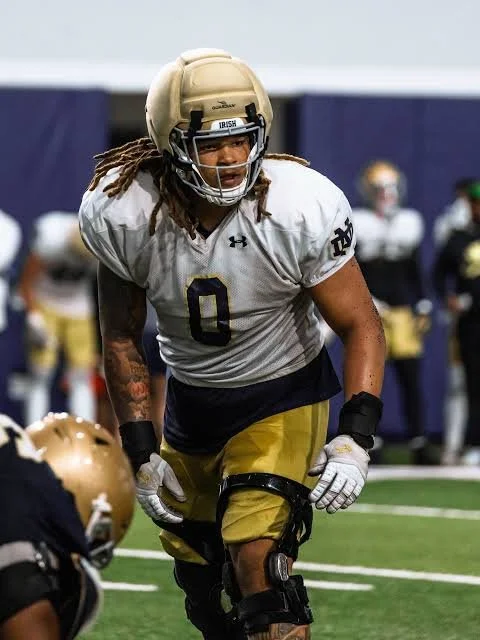
fall camp position battles on defense
Notre Dame returns the most experienced and productive roster in the country this fall, according to ESPN, and the bulk of that returning production lives on the defensive side of the ball. With players like Drayk Bowen, Adon Shuler, Leonard Moore, Boubacar Traore, Kyngstonn Viliamu-Asa, Brauntae Johnson, Jaiden Ausberry, and Christian Gray all back in South Bend, it is a good bet that this defense will pick up right where it left off a season ago.
But in order for this unit to reach its full potential, it will need several position battles to sort themselves out during fall camp. Unlike a year ago, when defensive coordinator Chris Ash was still installing a new scheme and asking his players to learn an entirely new system on the fly, this year's group enters camp with a full season of experience in Ash's defense already under its belt. That familiarity should, in theory, mean fewer mental errors, faster recognition, and a defense that is collectively further along than it was at this exact point last summer. Because so many players already know where they are supposed to be and why, the competition at every open spot should be sharper and more consequential, not less, since the margin for separating one player from another will increasingly come down to execution rather than simply who understands the defense best.
The majority of the position battles on Notre Dame's defense will be for a spot in the rotation, especially up front, but there are a few genuine battles for a place in the starting lineup, and it starts with a Colorado transfer in the secondary.
Cornerback
Outside of Moore starting in the boundary, there is not a settled starting lineup for the Fighting Irish cornerbacks heading into camp. The expectation is that Gray slides inside to nickel corner and Colorado transfer DJ McKinney steps in at field corner, but if there is one thing everyone around this program has learned about head coach Marcus Freeman, it is that nothing on this team is given. Everything is earned. McKinney has to come in and win the job in fall camp. It will not simply be handed to him because of his transfer pedigree or his level of experience at his previous school, and Freeman's track record of making players prove themselves regardless of reputation means this competition should be treated as a real one, not a formality.
Sophomore Dallas Golden is also in contention to start at either field corner or nickel. Golden was not able to finish spring practice due to injury, but he will be back for fall camp to battle for a spot with the first team defense. His absence during the spring gave McKinney and others a head start in terms of installation reps, but a healthy Golden brings real talent back into the mix, and how quickly he can knock off the rust after missing significant time will be one of the more interesting subplots of the entire camp. With Gray sliding inside, Moore locked in on the boundary, and McKinney and Golden both fighting for the remaining outside spot, this is a room with legitimate competition at every level, and the fact that most of these players already understand Ash's coverage rules from a year in the system means the separation should come down to pure execution on the field rather than who can pick up the scheme the fastest.
Defensive Line Rotation
There is going to be a position battle across the entire defensive line this fall. The two starting ends will likely be Traore and Bryce Young, but outside of that pairing, the rest of the rotation is genuinely up for debate. The battle for the starting defensive tackle positions, and the pecking order behind them, will be extremely competitive throughout camp. Will two or three players end up dominating the vast majority of snaps, or will the rotation go deeper, with players like Jason Onye, Elijah Hughes, Armel Mukam, Tionne Gray, and Francis Brewu all carving out meaningful roles? That question alone could shape how Notre Dame's front holds up over the course of a long season, since a deeper rotation typically means fresher legs and more consistent pressure in the fourth quarter.
On the edge, the questions are just as significant. Odds are that Alabama transfer Keon Keeley will be part of that rotation given his pedigree, but who joins him remains one of the most compelling storylines of camp. Will it be Loghan Thomas, a player who has waited for his opportunity, or one of the talented true freshmen working their way into the mix for the first time? Fall camp in the defensive trenches figures to be exceptionally competitive, and because so much of this group already has a year of Ash's fronts and stunts under its belt, the coaching staff should be able to evaluate these battles on pure ability and technique rather than simply who has absorbed the playbook fastest. That is exactly the kind of environment that tends to produce the sharpest, most meaningful competition, since players who are comfortable in the scheme can focus entirely on winning individual reps rather than just avoiding mental mistakes.
Safety Depth
Notre Dame returns arguably the best safety duo in the country with Shuler and Johnson both back in the defensive backfield. That pairing alone gives the Irish a foundation most programs in the country would envy, and it allows the coaching staff the luxury of using fall camp to develop depth rather than scramble to fill a hole at the position. Senior Luke Talich is also back after rotating in at safety throughout the 2025 season, giving Notre Dame a proven third option who already has meaningful game experience in Ash's system and can be trusted in a variety of roles within the defense.
The more interesting question is whether anyone else in that room forces the issue and pushes for real playing time behind that established trio. Will redshirt freshman Ethan Long make the jump that so many young defensive backs are asked to make between their first and second years in the program? Or will it be true freshman Joey O'Brien, who was already making a push during spring practice before a lower body injury slowed his momentum, who ultimately breaks through? The Irish have some of the best depth in the secondary in the country, and with Shuler, Johnson, and Talich all already comfortable in Ash's system, the door is open for a younger player to separate himself purely through camp performance rather than needing to simply catch up on scheme install. That is precisely the kind of internal competition that raises a position group's ceiling, and it is why Notre Dame's safety room could end up being one of the deepest and most productive units on the entire roster by the time the season begins.
What It All Means
Taken together, these three position battles, at cornerback, along the defensive line, and in the safety room behind an already elite starting duo, will go a long way toward determining just how dominant Notre Dame's defense can be in the fall. This is a unit that returns more experience and production than almost any other in the country, and because so much of that experience comes with a full year in Chris Ash's system already installed, the players competing for jobs this August should be noticeably further ahead than they were twelve months ago. Comfort with the scheme should translate into faster, more instinctive football, and it should also mean that every one of these camp battles is decided on merit and execution rather than who is still catching up on installation.
That combination, a roster full of returning talent that already understands what is being asked of it, is exactly the kind of environment that tends to produce the most competitive and consequential fall camps. Notre Dame's coaching staff will have the luxury of picking the best players rather than simply the players who know the defense, and that should make for genuinely fascinating position battles across the board as the Irish look to build on last season's dramatic turnaround and push even further as a defensive unit in 2026.
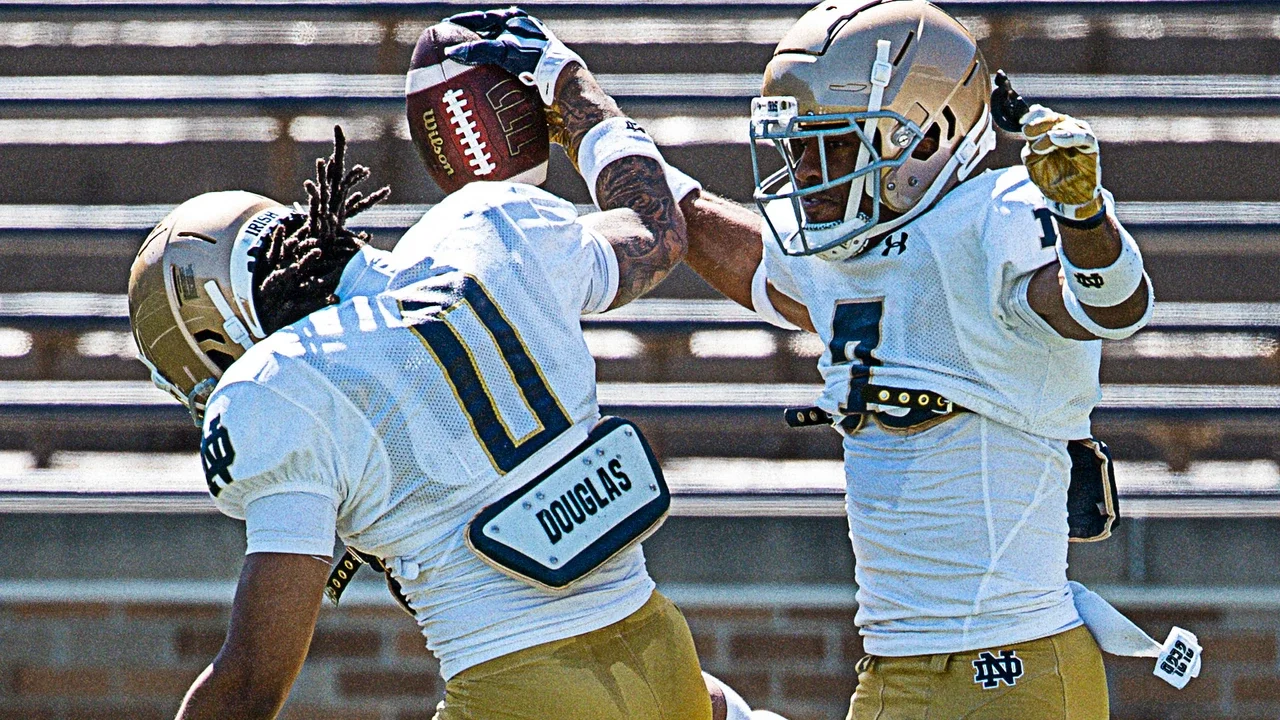
fall camp Position Battles on offense
Notre Dame is 42 days from kicking off its 2026 season against Wisconsin at Lambeau Field, and for the first time in Marcus Freeman's tenure, fall camp won't be defined by a quarterback competition. CJ Carr locked down the job a year ago and started all 12 games as a true freshman. But the absence of drama at quarterback doesn't mean fall camp will be quiet. Several other spots on this offense are wide open, and the players fighting for them have already left a data trail this spring worth digging into.
Running Back
Junior Aneyas Williams enters fall camp as the presumptive lead back, and the numbers back up why. Over two seasons behind Jeremiyah Love and Jadarian Price, Williams has piled up 58 carries for 443 yards, 20 catches for 212 yards and seven total touchdowns, a career average north of 7.5 yards per carry. His 2025 season alone saw him rush for 224 yards and five touchdowns on 24 carries, a 9.3 yards-per-carry average, to go with two catches for 40 yards. He backed that up this spring: despite being limited for most of camp by an elbow injury, Williams led the team in rushing at the Blue-Gold Game and found the end zone, then followed it up with 38 yards on 10 carries, a touchdown and three catches out of the backfield in the spring finale.
The real intrigue is what happens behind him. Redshirt sophomore Kedren Young was a top-100 recruit out of Lufkin, Texas, and looked like a potential difference-maker as a true freshman before a torn ACL wiped out his entire 2025 season. As of late March, Young was seven months into recovery, had just begun running again and was targeting a return to game shape by summer workouts. Position coach Ja'Juan Seider has been careful with his timeline, but the belief inside the building is that a healthy Young could push Williams for the top job rather than settle for a complementary role. Some evaluators see his combination of size, power and explosiveness as the element capable of pushing this running back room from good to excellent if he's fully healthy.
Behind those two, the picture is murkier. In that same Blue-Gold Game, true freshman Jonaz Walton emerged as a legitimate factor, rushing for 33 yards on 11 carries with a touchdown of his own, with Williams and Walton combining for the bulk of the workload. Redshirt freshman Nolan James Jr. and newcomer Javian Osborne round out a room that is as deep as it is unsettled, meaning fall camp reps could carry real consequences for who's active on gamedays.
Boundary Receiver
With Malachi Fields gone, Notre Dame is turning to a boundary receiver competition built almost entirely around transfer talent and physical upside. Ohio State transfer Quincy Porter arrives as a former five-star recruit who was rated the No. 13 overall player nationally and the No. 2 receiver in the 2025 class, and at 6-foot-4 with a rare wingspan, he profiles exactly like the boundary target Notre Dame's staff covets. His production at Ohio State was limited by the depth chart, not lack of talent: he played roughly 57 offensive snaps as a freshman behind Jeremiah Smith, Carnell Tate and Brandon Inniss, one of the most talented receiver rooms in the country, finishing with four catches for 59 yards. Notably, Smith himself, one of the best receivers in college football, called Porter the "next one" at Ohio State before Porter ever left Columbus.
Redshirt sophomores Micah Gilbert and Cam Williams round out the competition, and while their spring production hasn't generated the same buzz, both have the size and physical tools the staff wants at the position. Given the uncertainty, offensive coordinator Mike Denbrock may lean toward a rotation rather than naming a clear-cut starter, which would make fall camp less about crowning a No. 1 and more about establishing snap share.
Slot Receiver
Few storylines are as tied to injury history as the slot receiver competition between Jaden Greathouse and Ohio State transfer Mylan Graham. Greathouse was electric during Notre Dame's 2024 College Football Playoff run, but 2025 was almost entirely lost to a hamstring injury: he played in only a handful of games and finished with just four receptions for 73 yards on the year, a steep drop from his 2024 season total of 43 catches for 576 yards and three touchdowns.
That opening is exactly what Graham capitalized on. A former five-star recruit who saw limited playing time in two years at Ohio State, Graham arrived at Notre Dame and, due to Greathouse's lingering hamstring issue, became the No. 1 slot receiver throughout spring practice, quickly turning into a go-to target for CJ Carr. Scouting notes from the spring were also quick to push back on a perceived weakness from his Ohio State tape: the drop issues some had flagged around Graham simply didn't show up this spring, as he looked like a sure-handed receiver throughout camp. That performance has fueled real hype that Graham could emerge as Notre Dame's top overall receiver in 2026, not just its top slot option.
Greathouse, for his part, is healthy again and has taken on more of a leadership role in the receiver room this offseason. But until he proves he can stay on the field for a full season, an uncomfortable question hangs over the position: is this actually a two-man competition, or is it Graham's job to lose?
Tight End
Redshirt junior Cooper Flanagan looks like the only true lock at any offensive skill position outside quarterback and running back. Flanagan missed almost all of 2025 recovering from an Achilles injury, but before that, he was already establishing himself as one of Notre Dame's best run-blocking tight ends, having played 262 snaps across 13 games in 2024, mostly as a blocker, and graded out by Pro Football Focus as one of the team's highest-rated run blockers over Notre Dame's final four games of that season.
With Eli Raridon off to the NFL, the receiving production at tight end is now up for grabs, and recent Notre Dame history suggests it's realistic for someone in this room to break out. Analysts have pointed to a clear pattern: Notre Dame tight ends have historically taken a modest role in year one before erupting the following season, as Raridon himself went from 11 catches for 90 yards and two touchdowns in 2024 to 32 receptions for 482 yards in 2025. Flanagan is the most likely candidate to follow that path in the run game, but the pass-catching questions are wide open behind him. Redshirt freshman James Flanigan flashed as a blocker last season but has yet to record his first collegiate catch, Arkansas transfer Ty Washington profiles as more of a steady depth option, and true freshman Ian Premer and Jack Larsen give the staff even more bodies to evaluate. Fall camp will likely determine less "who starts" and more "who earns the No. 2 tight end reps behind Flanagan.
Backup Quarterback
There's no competition atop the quarterback depth chart, marking the first time in Freeman's tenure Notre Dame enters a season with an established returning starter. But the No. 2 job is a legitimate three-way battle between redshirt freshman Blake Hebert and true freshmen Noah Grubbs and Teddy Jarrard, none of whom has thrown a competitive pass in college. Hebert did get spring game reps, connecting on an 8-yard touchdown pass during the Blue-Gold Game, giving him a small but real head start over the two true freshmen heading into camp. But Grubbs made his own case this spring, flashing some genuinely impressive throws mixed in with the expected freshman miscues. That combination of upside and inconsistency is exactly what you'd expect from a true freshman, but it's also enough to suggest he'll have a real shot at pushing Hebert for the No. 2 job once fall camp begins. It's an unusual dynamic: the most consequential backup quarterback battle of Freeman's tenure so far, decided entirely without a single game snap to lean on for any of the three competitors.
The Bottom Line
Without a quarterback competition to dominate headlines, this year's fall camp battles are more spread out, but arguably carry just as much weight for how Notre Dame's offense will look in September. The running back room has its floor set with Williams but a real ceiling if Young returns to form. The receiver competitions are shaped almost entirely by two Ohio State transfers who are already outproducing expectations. And the tight end room has its anchor in Flanagan, but no clarity behind him. All of it will get sorted out over the next six weeks, and how it shakes out will go a long way toward determining whether Notre Dame's offense takes a step forward or take a step back from a 2025 team that fell just short of the Playoff.
The Patch on the Sleeve: notre dame fans have been debating
For nearly a century, Notre Dame Stadium has been defined as much by what isn't there as by what is. No billboards lining the concourse. No corporate signage bolted to the scoreboard. No names on the backs of jerseys. In a sport that has otherwise been wallpapered in advertising since the 1990s, Notre Dame turned the absence of ads into its own kind of brand: a promise that some things are bigger than a sponsorship check.
That promise just got its first real test. On July 28, 2026, Notre Dame announced a six-year partnership with SoFi worth a reported $18 to $20 million per year, the largest jersey patch deal in college sports history. For the first time ever, a corporate logo, not a school crest, not an apparel brand, will appear on Fighting Irish uniforms across every sport.
The reaction from the fan base has been immediate, loud and split right down the middle.
To understand why this feels different to so many Notre Dame fans, you have to understand what the program has spent decades protecting. Notre Dame Stadium's lack of advertising isn't an accident or an oversight. It's a deliberate policy, one the university has pointed to for years as proof that Notre Dame plays by different rules than everyone else. Fans in South Bend didn't just tolerate that restraint. Many built their entire relationship with the program around it.
So when the patch was announced, the backlash wasn't really about a two-inch square of fabric. One fan summed up the sentiment on social media by joking the school could rebrand itself as "SoFightingIrishAreForSale." Sports radio host Chris "Mad Dog" Russo took a similar tone on air, arguing that this kind of move belongs to programs like Ohio State, not to a team defined by Knute Rockne, Lou Holtz and a century of mythology. The underlying complaint isn't really financial. It's existential. If Notre Dame will put a bank's logo on the jersey, what, fans are asking, is actually still off-limits?
There's also a symbolic irony that hasn't been lost on critics: Notre Dame has always resisted putting player names on the backs of jerseys, treating the program and the "Notre Dame" lettering across the chest as bigger than any individual. Now the front of that same jersey carries a financial company's name instead. To skeptics, that's not a neutral change. It's a value statement about what the university considers sacred and what it doesn't.
But plenty of Notre Dame fans, and the university itself, would argue that comparing a jersey patch to stadium advertising misunderstands what tradition Notre Dame actually promised to protect.
Notre Dame Stadium is treated as hallowed ground, and it still is. There is no in-stadium advertising, no ribbon boards flashing sponsor logos, no naming-rights deal attached to the building itself, and nothing in this agreement changes that. The university drew that line publicly and held it even while negotiating the SoFi deal, which suggests the stadium wasn't a bargaining chip at all. It was simply never on the table. The jersey patch lives in a completely different category: it's a uniform element, not a stadium fixture, and it follows a format that has become standard across almost the entire sport. Ohio State signed a similar deal with Chase the same week. Other blue bloods have already normalized the practice. In that light, Notre Dame isn't leading a race to commercialize college football. It's arriving several years late to a race that had already been run.
Viewed that way, the apparel line is arguably the one place Notre Dame could expand revenue without touching anything sacred. The stadium stays untouchable. The uniform, on the other hand, is simply a product, one that happens to be worth more right now than it has ever been. Notre Dame's national television deal, its independent status, its 39 national championships and a fan base that spans the country rather than a single region have made the Fighting Irish brand more valuable today than at almost any point in program history. A patch that would be worth a fraction as much on a regional program's jersey commands a premium on Notre Dame's precisely because the brand itself has never been cheapened. In that sense, the timing isn't a coincidence. It's Notre Dame recognizing that its uniform, not its stadium, is the asset built for this exact moment, and cashing in on it while the value is at its peak.
There's also a financial argument that's hard to dismiss. College athletics has entered an era of revenue sharing, NIL payments and rising costs across every sport, not just football. An $18 to $20 million annual infusion doesn't just pad a marketing budget. It can fund scholarships, financial literacy programs and walk-on support across all 26 of Notre Dame's varsity programs, many of which will never generate their own sponsorship revenue. Framed that way, the patch isn't a betrayal of the "student-athlete first" identity Notre Dame has always claimed. It's arguably a more efficient way to fund it.
Even some fans who dislike the patch on principle have landed here. Commentary from Notre Dame-focused outlets has noted that a small, contained logo may be an easier trade-off to accept than the alternatives: rising ticket prices, donor pressure or cuts to smaller sports that don't generate revenue on their own.
The honest answer is that both readings can be true at once, and that's exactly why the reaction has been so split.
The jersey patch does represent a real boundary crossed. Notre Dame spent decades marketing its restraint as part of its identity, and this is the first time a non-apparel corporate brand has ever appeared on a Fighting Irish uniform. Pretending that's a trivial change ignores how deliberately the university built its brand around not doing exactly this.
At the same time, the university does appear to be drawing a new, more modern line rather than erasing the old one. Stadium advertising, the more sacred and more visible tradition, remains untouched. The no-names-on-jerseys policy remains untouched. What changed is the uniform's front, in a format nearly every major program has already adopted, tied to a fund explicitly built around scholarships and athlete development rather than pure advertising revenue.
Whether that distinction holds probably depends less on financial logic and more on how the deal actually plays out. If the SoFi patch is the only visible change, and Notre Dame Stadium stays free of the in-venue advertising that defines Saturdays at most other programs, this may end up looking like a narrow, well-managed compromise rather than the start of a slide. If this is instead the first of several corporate logos that creep onto the jersey, the scoreboard, the tunnel or the field itself over the next few years, fans who are uneasy right now will have been right to worry.
For a program built on the idea that some things shouldn't be for sale, the SoFi deal isn't proof that Notre Dame has abandoned that idea. It's proof that the university found the one asset it could monetize without touching the thing it actually considers untouchable. The stadium remains hallowed ground. The jersey, at a moment when the Notre Dame brand has never been worth more, became the revenue play instead. Whether that's a reasonable modernization or the first crack in the dam is a question Notre Dame fans will likely keep arguing about for a long time, and one only the next few years of decisions will really answer.
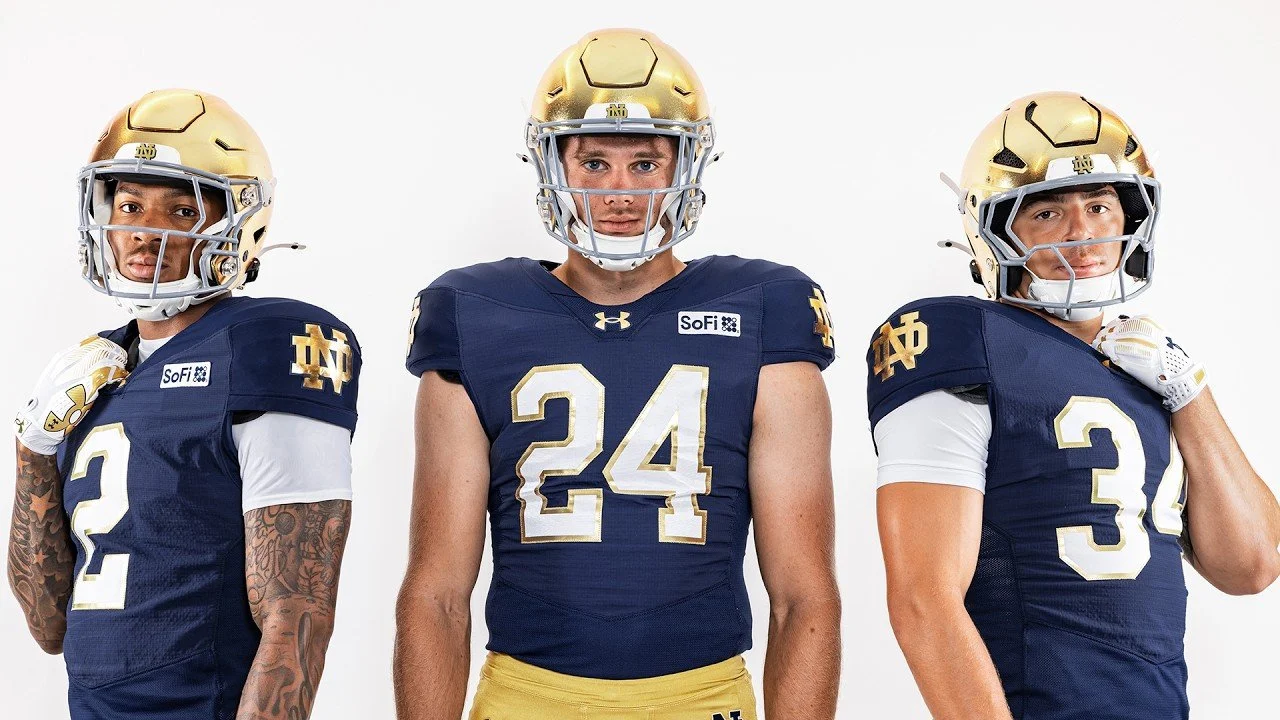
Notre Dame and SoFi Launch Landmark Multi-Year Partnership
Notre Dame Athletics has entered a new era of college sports business, announcing a multi-year partnership with SoFi Technologies that makes the fintech company the university's official financial services partner and puts a corporate logo on a Fighting Irish jersey for the first time in program history.
The deal, announced July 28, 2026, is reportedly worth $18 to $20 million annually over six years, making it the largest jersey patch agreement in college sports. But framed by Notre Dame athletic director Pete Bevacqua, the partnership is about far more than a patch on a sleeve. It's a long-term investment in the athletes who wear the uniform.
A Deal Built Around "4 for Forever"
At the center of the announcement is Notre Dame's "4 for Forever" promise, the department's pledge to support athletes not just during their playing days but well beyond graduation. According to Bevacqua, that mission is exactly what made SoFi the right partner.
"Our '4 for Forever' promise at Notre Dame is paramount to providing the best student-athlete experience in the country," Bevacqua said. "SoFi shares in this commitment to developing strong, ambitious leaders who are set up for success at Notre Dame and beyond. Together, our relationship will create lasting value for our student-athletes and their families for generations to come."
SoFi CEO Anthony Noto echoed that sentiment, drawing a direct line between the company's customer base and Notre Dame's athletes.
"Notre Dame has spent generations developing champions in the classroom and on the field," Noto said. "The grit, discipline and determination of Notre Dame's student-athletes reflect the same ambition we see in our members every day. We are proud to partner with Notre Dame Athletics to help inspire the next generation and create opportunities that will shape their financial futures."
What Athletes Actually Get
The partnership isn't just a branding exercise. It comes with concrete new resources for Notre Dame's roughly 750 student-athletes across 26 varsity programs:
SoFi Champions Scholarship: A new scholarship program specifically for walk-on athletes. Each year, one male and one female walk-on who exemplify ambition, resilience, leadership and service will each receive a full-tuition scholarship for one year.
Student-Athlete Services Hub: SoFi will bring its financial education tools, planning resources, personalized guidance and products directly to athletes, giving them practical help managing money while in school and preparing for life after Notre Dame.
An annual fund, tied directly to the "4 for Forever" promise, supporting scholarships, financial education, career development and other opportunities across every Notre Dame sport, not just football.
For athletes in Olympic sports (fencing, rowing, lacrosse, swimming) who don't have access to the same NIL earning potential as football players, that financial literacy support and scholarship access could matter just as much as the headline dollar figure.
Why This Helps Recruiting
The timing and structure of the deal also send a message to recruits and their families. Notre Dame has long marketed itself as a program that develops the "whole person," academically, athletically and professionally, rather than just a football factory. This partnership gives that pitch financial teeth.
A few ways it strengthens Notre Dame's hand on the recruiting trail:
Tangible post-career value. Recruits and parents increasingly weigh what a program offers beyond eligibility. A structured financial-planning resource, run by a $20 billion-plus fintech company, is a differentiator most athletic departments can't match.
Support for non-revenue sports. Because the deal spans all 26 varsity programs rather than just football, it reinforces Notre Dame's pitch to recruits in sports like hockey, soccer and track that they're not an afterthought in the department's investment.
Protecting walk-on culture. The SoFi Champions Scholarship specifically elevates walk-ons, a group central to Notre Dame's program identity (see: "Rudy"), signaling to preferred walk-ons that there's a real path to being recognized and rewarded.
Financial firepower for NIL competition. In an era where roster retention is often about money, an $18 to $20 million annual infusion strengthens Notre Dame's overall athletic budget, freeing up resources that can indirectly support NIL collectives and facilities in a hyper-competitive market.
Preserving What Makes Notre Dame Different
Notably, the university drew a clear line: Notre Dame Stadium itself will remain free of in-stadium corporate advertising, keeping the game-day atmosphere intact even as the uniform itself changes. The SoFi logo appears only as a patch on Fighting Irish uniforms across sports (the first non-apparel brand ever to do so), rather than as signage inside the stadium.
Notre Dame Global Partnerships (NDGP), a joint venture between Legends Global and JMI Sports, brokered the agreement on behalf of the athletic department.
For a program that has resisted this kind of commercialization longer than almost anyone in college sports, the SoFi deal is a signal. Notre Dame is willing to modernize its revenue strategy, but only in a way that's still wrapped in its own institutional identity: student-athlete development, academic success and a program history that includes 39 national championships and one of the best graduation rates in the country.
Notre Dame Lands Elite 2028 Edge Rusher Darieon Prescott
Notre Dame added one of the most coveted defensive prospects in the entire 2028 recruiting class on Monday afternoon, as Bolingbrook, Illinois, edge rusher Darieon Prescott announced his commitment to the Fighting Irish live on The Pat McAfee Show, choosing Notre Dame over finalists Oregon and Texas A&M. The announcement capped a recruitment that stretched back nearly a full calendar year and included four separate trips to South Bend, each one drawing Prescott closer to the program that ultimately won him over.
Prescott is widely considered a future five star prospect and one of the top overall players in the entire 2028 class, regardless of position. His commitment continues what has become a stunning run of elite defensive line recruiting for Notre Dame under head coach Marcus Freeman and, most recently, new defensive line coach Charlie Partridge.
Speaking live on The Pat McAfee Show alongside his parents, Prescott explained in detail why he chose Notre Dame after narrowing his list to three elite programs.
"I love Notre Dame," Prescott said. "I love everything about it, the environment, the intensity they play with during practice and games, the coaching staff and the players. I enjoy everything about Notre Dame. I love how highly they value academics and how strong the culture is. At Bolingbrook, we talk about responsibility, accountability and culture, and I feel that Notre Dame has the same motto. Whether it's academics, football or anything, Notre Dame carries itself really well."
Prescott, who cannot formally sign a National Letter of Intent until December 2027, made clear that his decision to commit so early in the process, ahead of even his junior season of high school football, was intentional. He wanted to plant a flag for the rest of his recruiting class.
"I just really wanted to set the tone for the 2028 class," Prescott told ESPN. "Being a highly rated recruit, I want them to know when it's time, it's time. I don't want them to wait it out. I got the feeling that this is right and I'm making my move." He echoed that sentiment in comments to other outlets after the announcement, adding, "I'm focused on Notre Dame. Being one of the top players in the 2028 class, I wanted to set the tone. God helped show me that it was the right time to commit."
Shortly after Prescott's announcement went public, Freeman himself made a surprise appearance on the same broadcast. NCAA rules prevented him from commenting directly on Prescott or any specific recruit, but the timing of his cameo was widely understood as a celebration of the commitment. Asked by McAfee what he looks for in a recruit generally, Freeman offered a glimpse into the program's broader recruiting philosophy.
"We're looking for the best football players in the country who fit this place," Freeman said. "We're not a big city. It's a small college town where you have to go to class and will be challenged academically."
While Prescott had been on Notre Dame's radar since the fall of 2025, when he made game day visits for the Purdue and USC games under the recruitment of then assistant coach Al Washington, it was a spring visit in March that many around the program now point to as the true turning point in his recruitment.
Prescott was originally scheduled to spend a busy weekend crisscrossing the country, with two days planned in College Station to see Texas A&M before heading on to Nebraska. He was not due back in South Bend until the end of April. But as the weekend approached, Prescott made the decision to rearrange his entire schedule so he could get back to Notre Dame sooner, a move that immediately signaled to the Irish coaching staff just how serious his interest had become.
"I had to get back there earlier," Prescott told Irish Breakdown at the time. "I had to change my schedule. I wanted to see the Irish practice, see the culture and revisit with the coaches and staff. The love at Notre Dame is different, and they kept trying to get me down there sooner, and I wanted to come."
That March 28 visit, which allowed Prescott to watch Notre Dame's spring practice up close, became a defining moment in his recruitment for reasons that went beyond football. Prescott and his father spent extended time that weekend with Freeman personally, a conversation Prescott later described as pivotal to how he viewed the program and its head coach.
"He's someone I truly respect in football," Prescott said of Freeman following the visit. "He's a great coach and outside of football, he's a great father. He knows what it takes to make it, and he's a great example to his players. He holds his players to a high standard, but he's just like them, because he holds himself to a standard too. He helped us understand everything about Notre Dame football."
The visit left such an impression that Prescott began planning his return to campus before he had even left South Bend that weekend, a sign that Notre Dame had firmly established itself as the frontrunner in his recruitment even with two other blue chip programs still very much in the mix.
Prescott made good on that plan, returning to Notre Dame's campus on June 18 for what became his fourth visit to South Bend in less than a year, and the trip that ultimately sealed his decision. It was during that visit that Prescott spent significant time with Partridge, Notre Dame's first year defensive line coach, in a conversation Prescott later identified as the exact moment he knew where he wanted to commit.
"It was definitely during that conversation with Coach Partridge," Prescott said when asked when it clicked for him that Notre Dame was the right choice. "We were talking for a long time."
Reflecting on that same trip afterward, Prescott made clear that the consistency of his experience in South Bend, visit after visit, had become the deciding factor over programs like Oregon and Texas A&M, both of which hosted him for visits of their own earlier in June.
"I loved the experience in South Bend," Prescott said. "The coaches and staff were great, and the environment and experience were wonderful. Going there more and more is an eye opener for me and my family with how great the Irish are. They are continuing to improve on my list of committable places. Coach Partridge and Coach Freeman are great guys and great coaches who know their stuff. Go Irish."
He also credited the film sessions and coaching style he witnessed firsthand during that visit as a major factor in his growing comfort with the program. "I just got to see the way that they coached, watched film and got to have a good conversation with Coach Partridge and Coach Freeman," Prescott told ESPN. "It was just a really good experience. Going on other visits, I always feel different when I came to Notre Dame, especially the environment."
By the time Prescott set his commitment date for July 27, live on ESPN, the outcome was considered close to a formality among those who had followed his recruitment closely, even with Oregon and Texas A&M still technically in contention.
Prescott's recruiting profile places him firmly among the elite prospects in the entire 2028 class, regardless of position, across every major recruiting service.
On the Rivals Industry Ranking, Prescott sits at No. 18 overall nationally and No. 5 among edge rushers in the class. On 247Sports, he ranks as the No. 18 overall prospect and No. 5 edge rusher on the composite rankings, while his individual 247Sports ranking has him even higher, at No. 7 overall nationally and No. 3 among edge rushers, a number widely expected to push him into outright five star territory as his recruitment progresses. ESPN slots Prescott at No. 36 overall in its SC Next ESPN Junior 300 and rates him as the No. 7 edge rusher in the class. Across every service, Prescott ranks as one of the very best players to come out of the state of Illinois in recent memory, with 247Sports composite rankings placing him as the top player in the state for the 2028 cycle.
Physically, Prescott has undergone a dramatic transformation over the past year. Listed at 6 foot 4 and around 220 pounds during his freshman season, he has since added roughly 30 to 35 pounds of mass, now checking in between 250 and 255 pounds depending on the source, while retaining the same first step quickness and closing speed that made him a priority recruit in the first place. Bolingbrook defensive line coach Jon Binish, who works with Prescott daily, described the transformation simply: Prescott matured physically, hasn't lost a step off the ball, and hasn't lost the speed that scouts were drawn to in the first place.
Prescott's on field production, as recorded via MaxPreps for his sophomore season at Bolingbrook High School, backs up every bit of the recruiting hype. He finished the year with 65 total tackles, 14 tackles for loss, 5 sacks, 26 quarterback hurries, 8 pass breakups, 3 forced fumbles, 2 fumble recoveries, and 2 blocked kicks, a remarkably complete statistical profile for an edge rusher still just entering his junior season. The production earned him a spot on Rivals' Sophomore All America Second Team, further validating his status as one of the top underclassmen in the country regardless of class.
More than any single ranking or statistic, Prescott's recruitment ultimately came down to relationships, specifically the ones he built with Partridge and Freeman over the course of his four visits to campus. Partridge, who joined Notre Dame's staff in January, wasted little time establishing himself as one of the most effective recruiters on the defensive side of the ball, and Prescott's commitment marks yet another notable name added to his growing list of blue chip pledges in his first several months on the job.
Freeman, for his part, continued a pattern that has defined his tenure at Notre Dame: building personal, father to father relationships with the families of his top targets, not just selling a football program but a broader environment and value system that resonated with Prescott and his parents across multiple visits. The bond between Prescott and Freeman, cemented during that pivotal March conversation and reinforced again in June, proved to be every bit as important to the recruitment as anything that happened on the practice field.
Prescott's commitment also continues a broader trend for the Fighting Irish along the defensive line. He joins a 2028 class that already includes kicker Owen Davies and three star safety Andre Jones, and his pledge follows a run of elite edge rushers committing to Notre Dame in consecutive recruiting cycles, including five star prospects in the 2026 and 2027 classes before him. Together, that trio represents what many recruiting analysts already consider the best stretch of edge rusher recruiting in Notre Dame history, a run that shows little sign of slowing down under Freeman and Partridge.
Prescott has already indicated he plans to make multiple return trips to South Bend this fall, even with his commitment locked in, a sign of just how much the relationships built over the past year continue to mean to him as his recruitment moves forward.
4-star DT Brayden parks chooses notre dame over oregon
For nearly three years, Brayden Parks was one of the most coveted names on Notre Dame's board. On Thursday, that pursuit finally came to an end when the four-star Brother Rice defensive tackle put pen to paper — or, in this case, made his announcement on a CBS Sports special — and chose the Fighting Irish over Oregon in one of the more drawn-out recruitments of the 2027 cycle.
Speaking with Irish Breakdown afterward, Parks summed up just how long the process had felt: "Everything feels like a relief, honestly. I've been going through this recruiting process since my freshman year — coaches reaching out, trying to contact my family, all that. But now that it's over, I feel relieved. From that camp last year until now, man, it feels like it's finally come true."
But to understand why this commitment means so much to Notre Dame's program, you have to go back to where it started: a performance at Irish Invasion that first turned heads in South Bend, and a coaching relationship that very nearly didn't survive to see the finish line.
Long before Parks became a household name in recruiting circles, Notre Dame's staff had circled him as a priority target. That belief was reinforced during his showing at Irish Invasion in the summer of 2025, Notre Dame's marquee on-campus recruiting camp. Evaluators who watched him that day came away convinced that his twitch and explosiveness at his size — he was already pushing 305 pounds — put him in a different tier than most interior linemen his age. It's the kind of performance that gets internally referenced for years afterward whenever a staff needs a reminder of why a prospect was worth fighting for.
That early standout showing set the tone for what would become one of the more significant recruiting battles of the cycle, and it cemented a truth that would hold for the better part of two years: Notre Dame was not going to let Brayden Parks leave the board without a fight.
The Washington-Sebastian Connection
At the heart of Notre Dame's pursuit was the relationship Parks built with then-defensive line coach Al Washington and defensive line assistant Nick Sebastian. Washington, who joined Marcus Freeman's original 2022 staff after previously coaching linebackers at Ohio State and Michigan, built a reputation as one of the more respected recruiters in the country — he was later recognized as a top-10 recruiter nationally for his work on the 2026 class. Sebastian, who followed Washington to South Bend from Columbus that same year, became just as central to the Chicagoland pipeline, playing a lead role in landing five-star edge Rodney Dunham for the 2026 class.
For a Chicago prospect like Parks, that combination mattered. Washington and Sebastian weren't just recruiting him from a distance — they were regulars in the building at Brother Rice, familiar faces who built the kind of trust that's hard to replicate overnight. It's the kind of groundwork that had Notre Dame firmly entrenched as the perceived frontrunner for much of Parks' recruitment, well before his final decision ever became a two-team race.
Parks himself made that clear speaking with Irish Breakdown after his announcement, describing just how far back the relationship went: "I've been talking to Coach Washington since my freshman year, the first time I went out there. He's been there since I started this whole thing." When Washington's move to the NFL came up, Parks didn't hesitate to speak well of it: "I'm happy for him. It's a huge step up in his career. I'm grateful for what he did, and Coach P picked up right where he left off."
A Crack in the Foundation
Then came January.
In the span of about a week, Notre Dame's defensive staff was gutted by the NFL. Secondary coach Mike Mickens left for the Baltimore Ravens on January 25. Days later, Washington — who had just been shifted from defensive line coach to linebackers coach following Max Bullough's departure — announced he was leaving to coach linebackers for the Miami Dolphins under new head coach Jeff Hafley. It marked the third defensive assistant Notre Dame lost to the NFL in a matter of weeks, and it meant the Irish would be replacing position coaches at every level of the defense heading into 2026.
Freeman moved quickly to stabilize the room, hiring veteran defensive line coach Charlie Partridge to take over up front. But for a recruitment as relationship-driven as Parks', Washington's exit still mattered. It didn't sever the pipeline — Sebastian stayed on and remained a constant presence — but it did open a window that programs like Oregon were happy to climb through. Over the following months, the Ducks built real momentum, and at various points the industry buzz around Parks trended firmly in Oregon's direction. Ohio State and Michigan also lingered in the periphery of the process without ever fully displacing the top two.
What had once looked like it might be a formality turned into a genuine dogfight. The last several months of Parks' recruitment played out like an endurance test rather than a sprint — visits, momentum swings, and a decision date that kept extending as both Notre Dame and Oregon dug in for the long haul.
Closing the Gap
When Washington left, he didn't just leave behind a coaching vacancy — he left behind a standard. Sources close to the program had made clear that Washington and Notre Dame were prepared to do whatever it took to land Parks, and it fell on Charlie Partridge to carry that same energy into the final stretch without missing a beat.
Partridge didn't waste time trying to build something from scratch. But it wasn't a one-way effort. Rather than treating the coaching change as something that put the burden of relationship-building entirely on the new guy, Parks did his own homework on Partridge before they'd even met in person — digging into his background, his coaching stops, his track record in the NFL. It's a small detail, but it says a lot: Parks wasn't just being recruited by Notre Dame at that point, he was actively buying in. That kind of initiative from a prospect is often as telling as anything a coaching staff can do, and it's part of why the Irish never fully lost their footing even after Washington's departure.
That effort paid off in a memory Parks says he'll carry for a while. Recalling the first time the two actually met in person, he told Irish Breakdown: "The first time I actually met him, we were in my head coach's office taking a picture, and he tried to demonstrate a double-team drill — next thing you know, he slipped and busted his head open on the TV. That's one of those long-lasting memories me and Coach P will have forever."
Partridge and Sebastian didn't let the momentum stay with Oregon for long. Notre Dame hosted Parks for a pivotal official visit in June, part of a loaded weekend built around several of the program's top remaining defensive line targets for the cycle. By July, Parks had trimmed his list to two: Notre Dame and Oregon.
He set his commitment date for Thursday, July 23, and after weeks of speculation that could have gone either way, he chose the Irish.
By the Numbers
Recruiting services have tracked Parks closely throughout his high school career, and while individual grades have varied slightly by outlet, the four-star consensus has been consistent for over a year:
247Sports: Ranked him among the top defensive linemen in the 2027 class and the No. 7 prospect in Illinois, with 247Sports' individual metric rating him even higher than the industry composite.
Rivals: Slotted him as the No. 185 overall prospect, the No. 22 defensive lineman, and the No. 7 player in the state of Illinois in its industry ranking.
ESPN: Included Parks in its national recruiting rankings as one of the top interior defensive line prospects in the cycle, maintaining a recruiting profile that tracked his offer list as it grew to more than 40 schools.
On the field, MaxPreps logged Parks with 44 total tackles, six tackles for loss and two sacks as a junior in 2025 across 13 games, helping anchor a Brother Rice defense that won the CCL/ESCC Blue title and an IHSA 7A state championship. He was named the conference's Defensive Player of the Year for his efforts — a testament to an interior presence that scouts describe as disruptive against both the run and the pass, with an advanced hand-usage package for a player his age.
The Scene at Brother Rice
The energy inside the athletic building on commitment day was hard to miss. The school's top-ranked baseball team was in the middle of a summer league game outside, and the football team had just wrapped its final practice of the summer session before the state-mandated dead period ahead of fall camp. Walking past the locker room, players were still peeling off practice gear, showering, and changing into shirts and ties for the ceremony — more than a few of them trading excited chatter about Notre Dame and Marcus Freeman as they made their way toward the school's forum.
Throughout the process, Marcus Freeman was a steadying influence for Parks, and it went beyond what the program could offer on the field. Parks pointed to what Notre Dame provides outside of football as a major factor in his decision, and Freeman stood out among the other head coaches recruiting him for the way he showed genuine care for him as a person, not just as a football player. "Coach Freeman is a great person in general. He's a player's coach — he cares more about the person than the football player. That's one of the reasons I wanted to play for a guy like that. He cares about you and your family, not just when things are good, but whatever you're going through."
By the time the forum filled with teammates, coaches, administrators and family, the moment carried a weight that went beyond recruiting. The Brother Rice community is still grieving the loss of 2026 graduate and former football player Patrick Noonan, who died in a car accident on July 18 — just days before Parks' announcement. It was the kind of backdrop that made clear this was about more than one player's decision; it was a program and a school leaning on each other.
Parks took the moment in stride, thanking God, his parents, his sister, extended family, coaches, teachers and teammates before revealing the news — unzipping his jacket to show the Notre Dame logo underneath, officially closing the book on one of the more hard-fought recruitments in recent Chicago history. Asked what Fighting Irish fans should expect from their newest commit, Parks kept it simple: "They're getting a smart, disciplined, dominant defensive lineman."
What It Means Going Forward
Parks becomes the latest piece in what's shaping up as one of the more talented defensive line hauls of the Freeman era. He also arrives with family ties to the program, adding another layer to a recruitment that, in the end, came full circle back to where it started — with the relationships Notre Dame built long before the rest of the country came calling.
Parks' commitment also puts into focus just how much ground Notre Dame has made up in Chicago under Freeman. He joins St. Patrick's David Folorunsho and Mount Carmel's Roman Igwebuike as three of the best defensive prospects to come out of the city in this cycle — all of them products of programs that compete within the same Chicago Catholic League football alignment. Landing all three gives the Irish a defensive haul that's arguably the best in the entire 2027 class, and it's the kind of local sweep Notre Dame hasn't been able to pull off in years.
That matters because Notre Dame needed exactly this kind of moment. For a stretch under Freeman, the program had drifted to the outside looking in on some of Chicago's premier talent, watching top-tier recruits build relationships elsewhere before the Irish ever got a real shot. Parks' commitment — paired with Folorunsho and Igwebuike — signals that the hard work Freeman and his staff have put in has shifted the calculus. Notre Dame is no longer playing catch-up in its own backyard; it's back to being the offer Chicago kids grow up dreaming about.
The early returns for 2028 back that up. Notre Dame is already involved with several of the top uncommitted prospects in the Chicagoland area, and the brand is shining brightest with two names that happen to be Parks' own teammates at Brother Rice: five-star edge Kameron McGee and four-star tight end Jack McNamara. Both have been building relationships with the Irish staff, and having their own guy already in South Bend only strengthens Notre Dame's hand.
And Parks doesn't plan on sitting back and watching it happen from a distance. He made clear after his announcement that he considers this a homecoming, and that recruiting his own teammates to join him at Notre Dame is very much part of the plan.
But this moment wasn't just significant for Notre Dame. It carried just as much weight back home at Brother Rice.
For years, the standard in the Chicago Catholic League has been Mt. Carmel, the program Casey Quedenfeld and the Crusaders have been chasing since he took over. Brother Rice's rise — capped by last fall's IHSA 7A state championship — has started to close that gap, and Parks has become the face of that ascension. A recruit of his caliber, drawing this level of national attention, is a signal that Brother Rice can now stand toe to toe with the league's traditional powerhouse rather than living in its shadow.
Parks is also, by a wide margin, the highest-rated recruit to come through the program in recent memory, and the reaction inside the forum made clear how much that means to the people around him. When he pulled back his jacket to reveal the Notre Dame logo, the room didn't just applaud politely — it erupted, teammates and classmates included, a reflection of just how beloved he is inside that building and how much his teammates had been waiting for this moment right alongside him.
It wasn't a clean, wire-to-wire recruitment. Washington's departure tested it, Oregon pushed it to the brink, and the final months demanded patience from a coaching staff that refused to let go. But for Notre Dame — and for Brother Rice — Brayden Parks was always worth the fight.
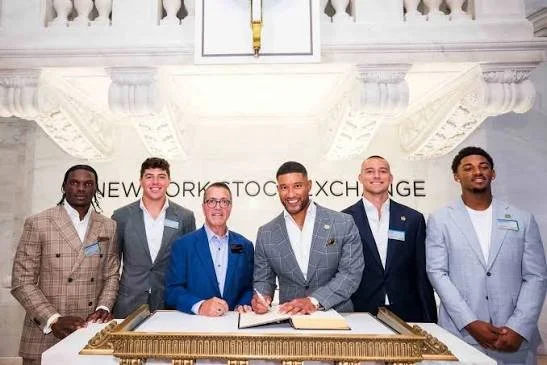
Notre Dame hits Wall Street: Freeman, Carr, Moore Kick Off NYC Media Blitz
Notre Dame football's biggest names traded South Bend for the concrete canyons of Manhattan this week, launching a whirlwind New York media tour that opened in the most on-brand way possible for a program synonymous with tradition: ringing the bell at the New York Stock Exchange.
Head coach Marcus Freeman was joined on the trading floor by quarterback CJ Carr, cornerback Leonard Moore, linebacker Drayk Bowen and safety Adon Shuler for the closing bell ceremony, where the group used the moment to remind the Big Apple who was in town with a "Let's Go Irish" chant that got much of the floor chanting along, with a Notre Dame banner draped behind them as a backdrop. It capped a day that had already included stops on ESPN doing a variety of interviews before the group made its way to the Exchange.
The quartet's trip to New York was no accident. Notre Dame announced that quarterback CJ Carr, linebacker Drayk Bowen, safety Adon Shuler and cornerback Leonard Moore would represent the program on its annual media tour around the city's major outlets, with appearances lined up on shows like ESPN's SportsCenter and NFL Network's Good Morning Football. As one Notre Dame outlet noted, the group also doubles as a strong hint at this year's leadership structure — Bowen and Shuler return as captains from 2025, while Carr and Moore, both just second-year players last season, were too young to hold the title but easily could have.
Carr, the presumptive Heisman frontrunner, got the first big spotlight moment, sitting down with Rich Eisen to walk through his path to South Bend — including the story of his father initially hiding Michigan's offer letter from him, and how it was former offensive coordinator Tommy Rees who recruited him hardest and showed him the most love, a pull that, combined with Marcus Freeman's own recruiting effort, ultimately landed Carr with the Irish over his grandfather Lloyd Carr's alma mater. Carr also used the sit-down to frame the mindset for the upcoming season, discussing how Notre Dame plans to keep using the disappointing end to 2025 as motivation heading into 2026.
The tour continued into Friday morning, when Freeman and Moore stopped by the Today Show. Asked about the "Here Come the Irish" refrain that blares over the loudspeaker as Notre Dame takes the field — now also the title of the program's in-house Peacock series — Freeman kept it simple: "It was there before I got there. As you take the field, they play over the loudspeaker 'Here Come the Irish.' We take the field, so I think it's pretty simple to make that the title of the show."
Freeman was also asked what it's been like having a camera crew shadow the program for that same series, and admitted the adjustment took some time. "Yeah, it took some convincing to think about all the cameras, the mics and the distractions. We really started to implement it last spring. It was a good trial run and it became like they were a part of the team, you didn't notice they were there. They feel like they were part of the staff and I think everybody kind of dropped their guards and it just became natural," he said.
The New York swing comes on the heels of a spring in which Moore made headlines of his own, telling reporters in South Bend that Notre Dame was on something of a "revenge tour" after last year's College Football Playoff snub. Moore said the defensive backs took a lot of the blame following Notre Dame's loss to Miami, in which Hurricanes quarterback Carson Beck completed 20 of 30 passes for 205 yards and two touchdowns without an interception, and didn't sugarcoat how Freeman responded. "He told us we was weak, we was soft," Moore said, "all that type of stuff. It's serious to him, too. That's something he's not used to seeing from us."
Freeman, for his part, waved off any notion that revenge is the operative word internally, preaching focus on the present instead. "We spend too much time daydreaming about Miami, we're going to lose to Wisconsin," he said, referencing Notre Dame's Sept. 6 season opener. "You've got to focus on the task right at hand. That's no different than saying, can we go back to the national championship? If we want to focus on the national championship, we're going to lose the opportunity we have right here. It's my job to make sure I'm directing the focus where it needs to be."
With the bell-ringing and morning show circuit behind them, the group's New York run is expected to continue over the next several days, with more national appearances on tap as Notre Dame — with a Heisman-caliber quarterback, an All-American cornerback and a coach determined to keep the noise pointed forward rather than backward — begins building the case for a 2026 season with, in Freeman's words, no doubt left to leave.
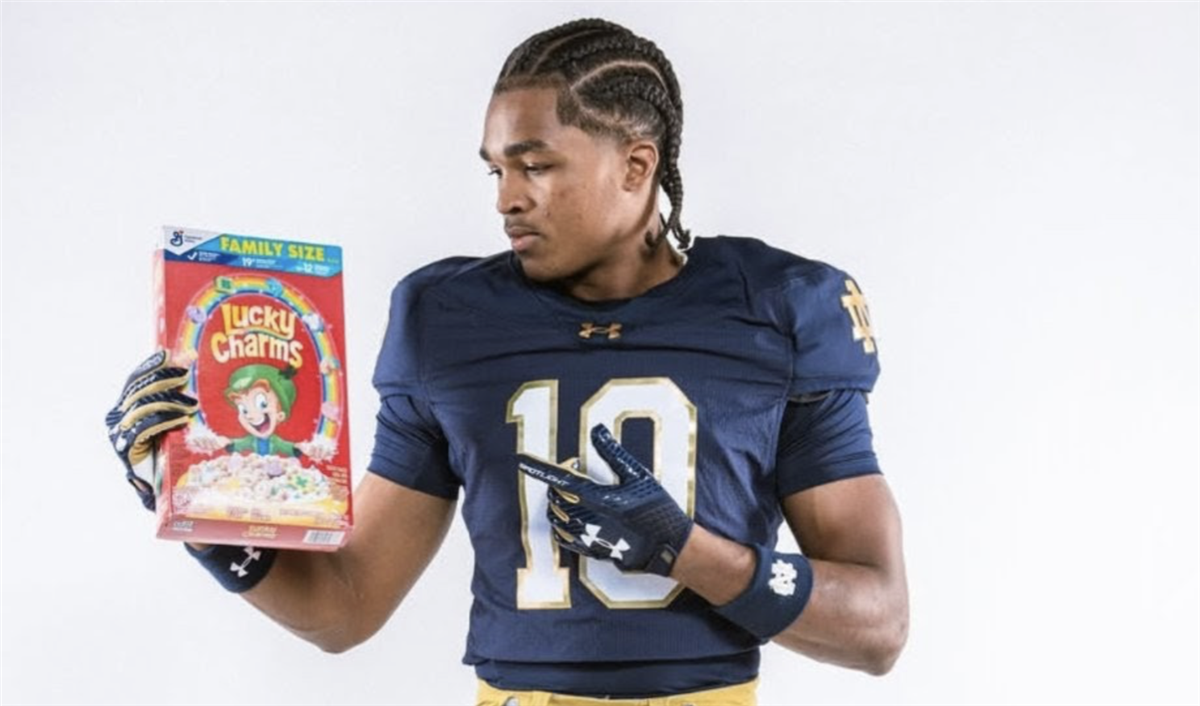
Four-Star Chicago Linebacker Roman Igwebuike Commits to Notre Dame
Notre Dame football landed one of its most important remaining targets in the 2027 recruiting class on Saturday when four-star linebacker Roman Igwebuike, a standout at Mount Carmel High School in Chicago, announced his commitment to the Fighting Irish on the CBS Sports College Football YouTube channel.
The 6-foot-3, 220-pound Igwebuike chose Marcus Freeman's program over a finalist group that included Clemson, Indiana, Missouri and Tennessee, capping a recruitment that also drew serious interest from Ohio State, Oregon, Michigan, Georgia and dozens of other blue bloods. He becomes Notre Dame's 22nd commitment in the 2027 cycle and the lone linebacker in a class already ranked No. 2 nationally.
Explaining his decision, Igwebuike pointed to the culture Freeman has built in South Bend as much as anything else. "Just the culture and the program!" Igwebuike said of his commitment to Notre Dame. "Also playing for a ex-linebacker as my head coach is a big deal to me. The community and off-the-field success told me it was right. The way they take care of their players and their networking is unmatched."
A recruitment that had to be rebuilt from scratch
Igwebuike's path to South Bend was anything but a straight line, and the shift didn't happen until relatively late in the process. Notre Dame's original offer came last October while he was on campus for the Boise State game, but the relationship never gained real traction under then-linebackers coach Max Bullough, who departed the program after the 2025 season and had made little meaningful push for the Chicago native during his tenure. For a prospect fielding calls from nearly every major program in the country, Notre Dame was, for a time, an afterthought rather than a priority.
That changed in January 2026, when the Irish hired Brian Jean-Mary — previously Michigan's linebackers coach — to run the position room. Jean-Mary made Igwebuike a target from his very first weeks on staff, and paired with Freeman's own credibility as a former college linebacker, Notre Dame walked back into the recruitment with a fundamentally different pitch than the one it had offered six months earlier.
Igwebuike took five official visits over a roughly six-week stretch: Indiana in May, Clemson at the end of May, Missouri in early June, Notre Dame on June 12, and Tennessee on June 19. The June 12 trip to South Bend proved to be the turning point. It was during that visit that Igwebuike and the new staff had the direct conversations needed to clear up exactly where he stood — addressing head-on the uneven communication of the previous regime and making clear that, under Jean-Mary and Freeman, he wasn't just a name on a board but the room's top target. Notre Dame had already hosted him once before, in April during jersey scrimmage weekend, but the official visit in June was where the Chicago native said he found clarity on where he wanted to play his college football.
The production behind the profile
Igwebuike's MaxPreps career profile tells the story of a player who has started for Mount Carmel every year of high school and grown into the role. He debuted as a freshman outside linebacker in 2023 at 6-foot-2, 215 pounds, helping the Caravan to a 13-1 record and a No. 2 state ranking. As a sophomore in 2024, still 6-foot-2 and 215 pounds, he moved into the middle linebacker spot and helped Mount Carmel to an 11-3 finish and a No. 3 state ranking.
The breakout came as a junior in 2025, when Igwebuike — now up to 6-foot-3 and 225 pounds — anchored the middle of a Mount Carmel defense that went a perfect 14-0 and won the Illinois Class 8A state championship. He finished the season with 115 tackles, 13.5 tackles for loss, seven sacks, 17 quarterback pressures, three forced fumbles, one fumble recovery, two interceptions and three pass breakups, production that earned him first-team all-conference honors in the Chicago Catholic League Blue and helped push him into four-star territory nationally.
What it means for the class
The commitment fills a real hole on Notre Dame's board — it's the program's first linebacker pledge in the 2027 cycle since previous commit Amarri Irvin flipped to Virginia Tech — and gives Jean-Mary his first signature win since taking over the room. It also carries symbolic weight for a staff intent on tightening its grip on Chicago recruiting: Igwebuike joins defensive lineman David Folorunsho as the second Illinois pledge in the class, keeping two of the Chicago Catholic League's best defenders committed close to home.
With Igwebuike now in the fold, Notre Dame will look to hold his commitment through a long runway to signing day — a stretch during which programs like Clemson and Tennessee, both of whom hosted him for official visits, are unlikely to fully step away. But after a recruitment that needed a full coaching change to get back on track, the Irish have their answer at linebacker, and a Chicago pipeline that's showing real signs of life.
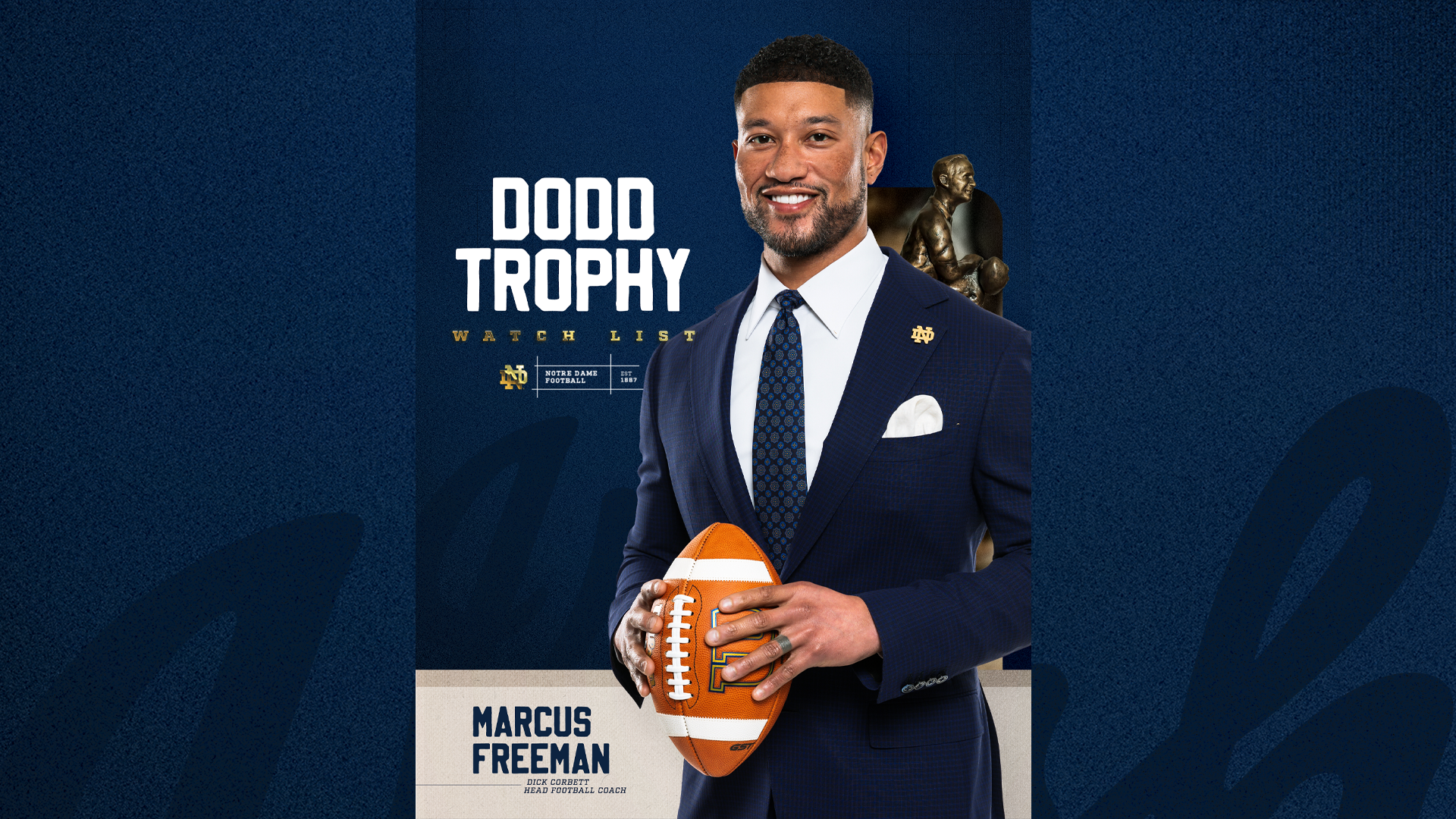
Marcus Freeman Named to 2026 Dodd Trophy Watch List
Notre Dame head football coach Marcus Freeman has been named to the 2026 Dick Corbett Dodd Trophy Watch List, the award's selection committee announced. It marks the second consecutive year Freeman has landed on the list, having won the honor outright in 2024.
The Dodd Trophy recognizes the head coach of a team that combines success on the field with a commitment to scholarship, leadership and integrity — the three pillars that defined the coaching philosophy of the award's namesake, legendary Georgia Tech coach Bobby Dodd. Freeman is one of four coaches on this year's watch list who have previously won the award, joining Indiana's Curt Cignetti (2025), Willie Fritz (2022) and Kirk Ferentz (2015).
Freeman enters his fifth season at the helm of the Fighting Irish with a 43-12 overall record, including a 5-2 mark in postseason play. Notre Dame has posted three consecutive seasons of at least 10 wins under his leadership, and his 43 victories are the most by any head coach through his first four seasons in program history.
A résumé already full of hardware
Freeman's nomination continues what has become a well-stocked trophy case built almost entirely on the strength of his 2024 campaign, when he led Notre Dame to a program-best 14-2 record, a 13-game winning streak and a berth in the CFP National Championship Game — a 34-23 loss to Ohio State that still marked the program's highest final AP ranking (No. 2) since 1993. That season alone netted Freeman a sweep of the sport's top individual coaching honors: the 2024 Dodd Trophy, the Paul "Bear" Bryant Coach of the Year Award, the George Munger College Coach of the Year Award, the National Coalition of Minority Football Coaches' College Coach of the Year honor, the Ted Ginn Sr. Coach of the Year Award from the National Alliance of African American Athletes, and recognition as honorary head coach of the 2024 AFCA Allstate Good Works Team.
The path to that peak wasn't linear. Freeman's first season in 2022 began with him becoming the first Notre Dame head coach to open a career with three losses, before the Irish rattled off nine wins in their next eleven games — highlighted by a 35-14 upset of No. 4 Clemson — to finish 9-4 and cap the year with a Gator Bowl win over South Carolina. Year two brought a reversal of fortune: Notre Dame opened 2023 with four straight wins and finished 10-3, punctuated by a 48-20 rout of Heisman winner Caleb Williams and USC. His third season delivered another gut-check moment, a stunning home loss to Northern Illinois as heavy favorites, but Freeman steadied the program to reel off ten straight wins and reach the College Football Playoff, a run that included victories over Indiana, Georgia and Penn State before the national title game appearance.
Individually, Freeman has now collected six major national coach of the year honors in just four seasons on the sideline, all stemming from that 2024 season, and has been a semifinalist or watch-list honoree in the years since as Notre Dame has sustained its success — including a combined 26-4 record over the past two seasons, a stretch that also drew interest from multiple NFL teams during the offseason.
Players thriving under his watch
Freeman's coaching accolades have been matched by what his players have accomplished. He coached 2025 Heisman Trophy finalist running back Jeremiyah Love, who also became Notre Dame's first-ever Doak Walker Award winner as the nation's top running back. Love was joined by junior cornerback Leonard Moore as a unanimous All-American in 2025, making Notre Dame one of just three programs nationally to produce multiple unanimous All-Americans that season. A year earlier, safety Xavier Watts earned consensus All-America honors for the second time in his career, making him just the second Irish player since 1993 to be a two-time consensus honoree. Freeman has also developed breakout freshmen, including safety Tae Johnson, who earned FWAA Freshman All-America recognition.
Team success by the numbers
The 2025 Fighting Irish were among the nation's best across the board, finishing second in scoring offense (41.8 points per game), fourth in interceptions (21), fourth in turnover margin (+1.08), fifth in net punting (43.32), eighth in yards per pass completion (14.11), eighth in sacks allowed per game (1.00), ninth in blocked punts (2) and ninth in passing efficiency defense (108.80).
The Dodd Trophy winner is typically announced later in the season after the watch list is trimmed down through the fall. Freeman's inclusion adds another line to an already crowded résumé, and reinforces Notre Dame's standing as a program built for sustained contention as it heads into the 2026 season.
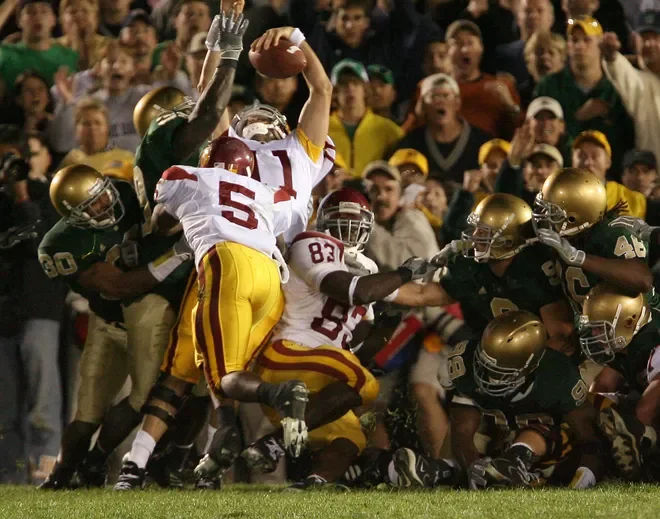
Notre Dame's Greatest Games Since 2000
When Fox Sports' Joel Klatt ranked his top college football games since 2000, he put the 2005 Notre Dame–USC "Bush Push" game at No. 1 — and it's easy to see why the topic sparked a real "I remember watching it" reaction. That game alone is a masterclass in what makes a great football game: constant lead changes, a Heisman winner, a bitter rivalry, and an all-time controversial finish. But it's far from the only Notre Dame game from the last 25 years that belongs in the conversation. Here's a look at some of the games that define the Irish's modern era.
The Heartbreak: USC, 2005 — "The Bush Push"
This is the one that still stings, and the one that still gets brought up on podcasts two decades later. Unranked, four-and-one Notre Dame — in year one under Charlie Weis — hosted a USC team riding a 27-game win streak with two Heisman winners in the backfield. The lead changed hands throughout, with the Irish up 31-28 in the final minutes. USC drove into range, appeared to be stopped short of the goal line as time expired, and then Reggie Bush shoved quarterback Matt Leinart into the end zone on the game's final play — a shove that wasn't a penalty under the rules at the time. USC escaped 34-31. It remains one of the most replayed, most argued-about finishes in the sport's history, and it's the game most associated with Notre Dame in any "greatest games" conversation since 2000.
The Statement Win: Oklahoma, 2012
Notre Dame's 2012 season is remembered for the eventual national title game loss to Alabama, but the game that actually made that season feel real was a road win over Oklahoma. It was widely seen as the moment that vaulted the Irish from "surprising and undefeated" to legitimate national title contender — the win that made the rest of the country start taking Brian Kelly's team seriously. Notre Dame ran the table the rest of the regular season on the strength of that statement.
The Signature Upset: No. 1 Clemson, 2020
If Bush Push is Notre Dame's most famous loss of the era, the 2020 double-overtime win over top-ranked Clemson is arguably its most famous modern win. With Trevor Lawrence out due to COVID-19 and freshman D.J. Uiagalelei starting in his place, Notre Dame jumped out early, survived a furious Clemson rally that forced overtime, and then rode three touchdown runs from Kyren Williams — including the eventual game-winner — to a 47-40 victory. It ended Clemson's 36-game regular-season winning streak and gave Notre Dame its first win over an AP No. 1 team since 1993. Fans stormed the field in the middle of a pandemic; it was, by most accounts, the loudest Notre Dame Stadium had been in over a decade.
The Blowout Statement: USC, 2017
Not every great game has to come down to the final play. Notre Dame's 49-14 demolition of USC in 2017 stands out simply because of how rare it is for both programs to be ranked in the top 15 at the same time, as they were that October — the first time that had happened since the 2006 meeting. The Irish took control early and never let up, and it remains one of the most convincing wins of the rivalry's modern stretch.
The Road Classic: LSU, 2014 Music City Bowl
Notre Dame limped into this game on a four-game losing streak with Brian Kelly's job security being questioned nationally, a seven-point underdog against an LSU team with Leonard Fournette in the backfield. Instead, the Irish took the opening drive down the field for a touchdown and held on for a 31-28 win that's remembered less for the stakes and more for simply being an excellent, hard-fought football game at a moment the program badly needed one.
The Defensive Grind: Stanford, 2012
Before the Oklahoma win vaulted Notre Dame into title contention, the Irish had to get through Stanford — and they did it in overtime, 20-13, with a goal-line stand that's become one of the most replayed defensive sequences of the Kelly era. It wasn't flashy. It was Notre Dame playing exactly the kind of physical, run-the-ball, control-the-clock football that had, for years, been Stanford's own signature — and beating the Cardinal at their own game.
Why These Games Still Matter
What ties all of these together isn't just the final score — it's that each one reflects something bigger about where the program stood at that moment. Bush Push was Notre Dame announcing it was ready to compete with the sport's best again under a new coach. Oklahoma and Stanford in 2012 were the turning point that took the Irish to a national title game. LSU in 2014 was survival. Clemson in 2020 was proof the program could still win the biggest possible regular-season game against a genuine blueblood.
Twenty-five years in, it says something about Notre Dame's place in the sport that a Fox Sports analyst's list of the best games since 2000 — a list covering hundreds of games across every conference — still runs straight through South Bend.
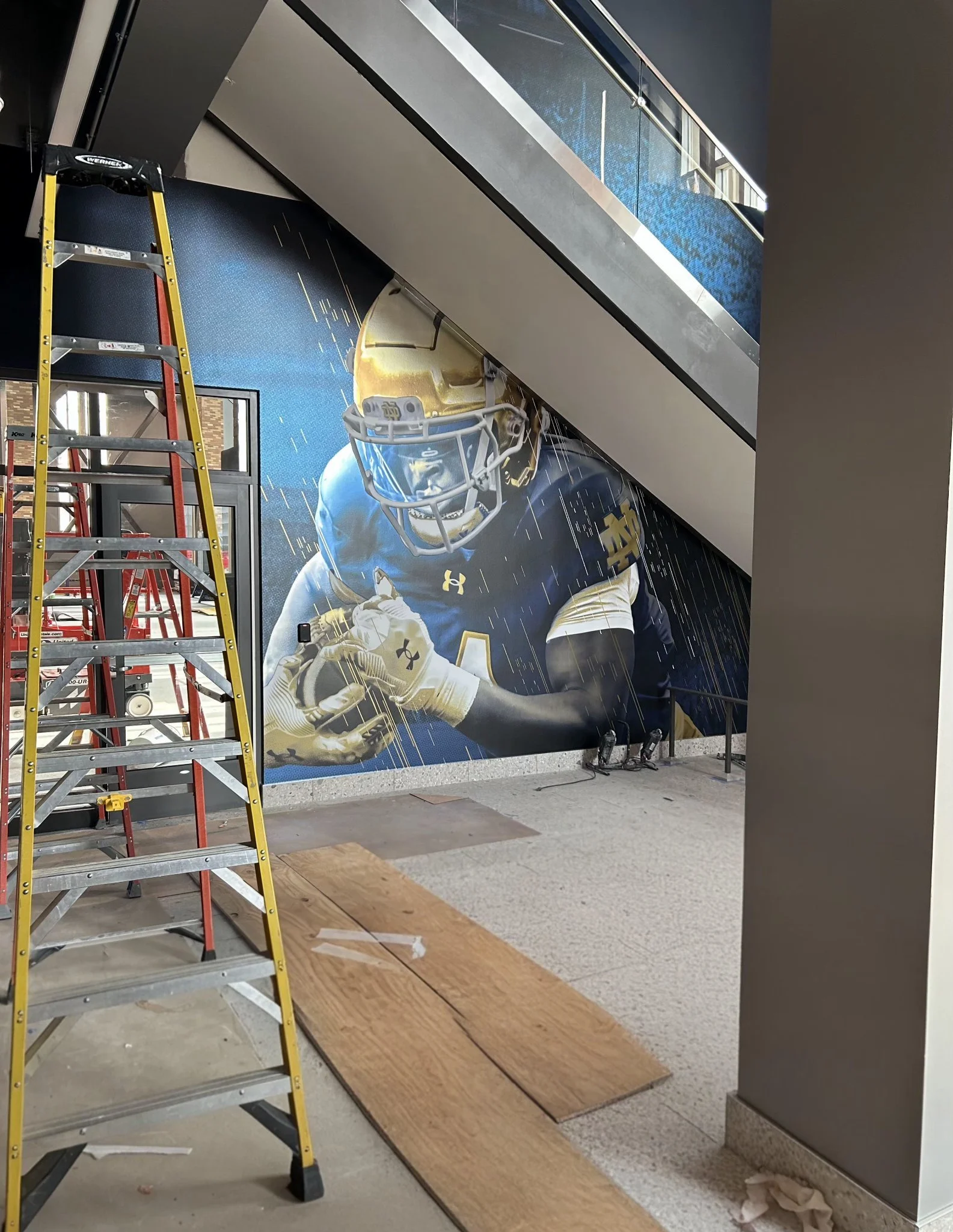
Shields Family Hall: How Notre Dame's New Football Home Reshapes the Program — On the Field and Off
When Notre Dame broke ground on the Jack and Kathy Shields Family Hall in the spring of 2024, it wasn't just another shovel-in-the-dirt photo op. It was a statement. Set to open this fall on Courtney Lane, the 150,000-square-foot facility represents a nearly 50% increase in football-dedicated space over the current Guglielmino Athletics Complex — and it arrives at a moment when facilities have become one of the clearest battlegrounds in college football's arms race.
What's Actually Inside
Shields Hall isn't just bigger locker rooms and shinier weight equipment. According to the university, the building will house advanced training and sports medicine facilities, an equipment room built around body-scanning and fabrication technology, and — maybe most notably — an on-site player nutrition area designed to let the program prepare meals directly rather than trucking them in from elsewhere on campus, as has been the case for years.
That last piece matters more than it might sound. Notre Dame athletic officials have talked about wanting the nutrition space to "foster community between teams and model healthy eating," which points to a broader philosophy: this building isn't just about building bigger, faster players. It's about building an environment players actually want to spend time in.
The project is being funded by a group of former Irish players led by ex-linebacker Jack Shields, along with fellow former players Pat Eilers and Dave Butler. That detail carries its own weight — it's not corporate money or a naming-rights deal with an outside company. It's alumni who played the game reinvesting in the infrastructure of the program that shaped them.
The On-Field Case: Closing the Facilities Gap
For years, Notre Dame's brass — including former AD Jack Swarbrick and head coach Marcus Freeman — have insisted facilities weren't the reason the program hadn't broken through to a national title. But "not the reason we're losing" and "not worth fixing" are two different things, and the athletic department has clearly decided this is a lever worth pulling.
Consider the timeline: the $400 million Crossroads renovation of Notre Dame Stadium in 2018, the Irish Athletics Center indoor practice facility in 2020, and now Shields Hall. That's a decade-plus of continuous, deliberate investment. Athletic director Pete Bevacqua has framed it directly — the goal is putting Notre Dame's infrastructure "on par with the big-hitting programs across the country, and then some."
Notably, Notre Dame officials reportedly toured Clemson's football facility before playing the Tigers, a small but telling detail — measuring yourself against the programs you're trying to beat, then building past them.
The Recruiting Angle
This is where a building starts to translate into actual roster talent. All-American cornerback Ben Morrison put it plainly at the groundbreaking ceremony: recruits notice. He spoke about how the Irish Athletics Center influenced his own decision to come to Notre Dame, closing his remarks with a simple line — facilities do matter.
That's not just a player being polite for the cameras. In modern recruiting, five-star prospects and their families are touring multiple campuses, often within days of each other, and physical impressions matter — the weight room, the nutrition setup, the sense that a program is investing in you specifically for the next four or five years. A tired, cramped, hand-me-down facility sends one message. A brand-new, purpose-built space with body-scanning tech and an in-house culinary operation sends another. Shields Hall gives Notre Dame's coaching staff a tangible, walkable answer to the "why here" question that comes up on every visit.
The Part Worth Watching: Notre Dame's Unusual Campus Culture
Here's where Notre Dame's situation is genuinely different from most of its Power Four peers, and it's worth sitting with for a second.
At a lot of major programs, football players increasingly operate in something close to a separate ecosystem — their own dorms, their own dining, their own daily orbit that barely intersects with the broader student body. Notre Dame has historically resisted that model. Its student-athletes live in the dorm system, eat in the dining halls, sit in the same classrooms, and are woven into campus life in a way that's become something of a point of pride for the university — part of the broader "student-athlete" identity Notre Dame likes to sell as central to its brand.
Shields Hall, by design, pulls more of a player's day-to-day life — training, meals, recovery, treatment — onto a self-contained football campus. That's the right move competitively. It's also a structural shift away from the integration that's long made Notre Dame's culture distinct.
None of this means Notre Dame is abandoning that identity overnight. But it's a dynamic worth monitoring as the building comes online this fall: as football life becomes more self-contained and professionalized, does the historic closeness between athletes and the broader student body hold, or does it quietly start to erode? Programs that have gone further down this road elsewhere have sometimes found that the more insulated an athletic operation becomes, the harder it gets to maintain that everyday connection to campus life — even when no one intends for that to happen.
For a program that has long branded itself as different from the professionalized model of college football, that tension between building a championship-level operation and preserving what makes Notre Dame Notre Dame is one of the more interesting subplots to watch once the doors open.
Bottom Line
Shields Hall is a clear, tangible investment in on-field performance and a legitimate recruiting weapon — the kind of facility that shows up in a highlight reel during an official visit and closes the gap with programs Notre Dame is chasing. But its bigger, quieter story might be about the second-order effects: what happens to Notre Dame's uniquely integrated culture as the football program becomes more self-contained. Worth watching once the building opens its doors this fall.
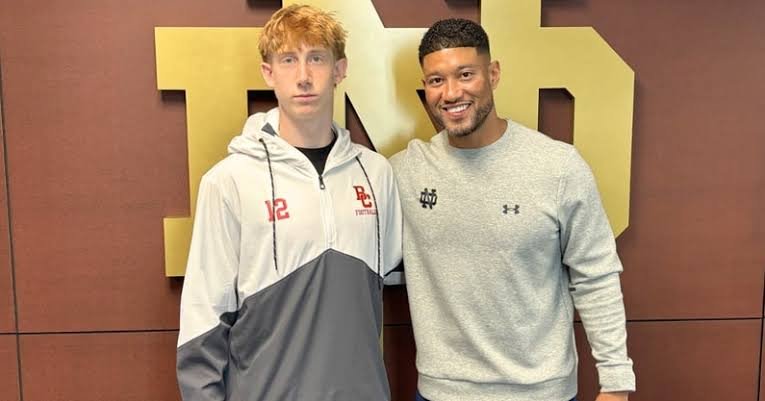
‘28 4-star qb trey tagliaferri decommits
Notre Dame thought it had solved its quarterback puzzle for the 2028 class. Instead, the Irish are right back where they started — and the way it unraveled has raised real questions about how the staff handled the position this cycle.
A Commitment That Barely Lasted a Week
Trey Tagliaferri, a four-star quarterback out of Bergen Catholic in Oradell, New Jersey, visited South Bend on June 21 and silently committed to Notre Dame that weekend. He made it public on June 25, telling reporters the visit had sealed the deal. "Great people, a great place and a place that seems like really a family and all together," he said of the program at the time.
Six days later, on July 1, Tagliaferri reversed course and announced his decommitment. It's one of the shortest-lived pledges in recent Notre Dame recruiting history, and it left head coach Marcus Freeman, quarterbacks coach Gino Guidugli and the offensive staff needing to regroup at the sport's most important position.
Tagliaferri is no afterthought of a recruit. In 11 games during his first year as a starter, he completed 131 of 211 passes (62 percent) for 2,215 yards with 29 touchdowns against just three interceptions, adding a rushing score as well. He picked up All-State third-team and All-Bergen County first-team honors and enters his junior year rated anywhere from a three-star, No. 19 quarterback on 247Sports to a four-star, top-15 passer on the 247Sports Composite and Rivals industry rankings — a consensus top-20 quarterback nationally with 34 offers to his name.
The Oklahoma Connection
The most telling detail in this saga is who benefited from it. Almost immediately after Tagliaferri walked back his Notre Dame commitment, Rivals' prediction model shot to a 93.3 percent likelihood he ends up at Oklahoma, as Steve Wiltfong of On3/Rivals logged crystal ball picks sending him to Norman. Sooner Illustrated reported that Oklahoma "had quite a bit to do" with the flip, having pushed hard for Tagliaferri even while he was technically committed to the Irish.
That tracks with reporting on how this recruitment actually developed. Tagliaferri has been fond of Oklahoma for a long time, and the Sooners likely would have been the favorite from the jump had they pursued him earlier. Before Notre Dame entered the picture, there was real doubt about whether Oklahoma even viewed Tagliaferri as a lock at the position. Once he was off the board with the Irish, though, Oklahoma suddenly got serious — and once he was back on the market, the Sooners moved fast.
It's a pattern college football has seen before: a recruit uses a competing commitment to force a program's hand, then leverages that offer to get the outcome he wanted from his actual top choice all along. Whether or not that was the calculated intent here, the optics line up. Tagliaferri picked Notre Dame over Oklahoma and Penn State when he committed on Father's Day weekend — and then, less than a week later, all signs point to Oklahoma anyway.
Odd Timing From the Start
Beyond the flip itself, the timeline raises questions about Notre Dame's approach at quarterback this cycle. When Tagliaferri committed, the Irish still had active offers out to two other 2028 passers: Kingston Preyear, the No. 44 overall prospect and a top-five quarterback nationally who had visited South Bend and left with strong impressions of the program, and Lukas Prock, a Hun School (Princeton, N.J.) product with 39 offers who threw for over 4,300 yards as a sophomore.
The Irish staff reportedly made a deliberate call to lock in Tagliaferri rather than wait on Preyear, who had opted to keep his recruitment open a bit longer. Notre Dame has typically preferred to secure its quarterback target well ahead of schedule — the program has made a habit of getting its 2028-caliber signal-callers on board early, mirroring how it wrapped up commitments from Champ Monds and Teddy Jarrard in advance of their own cycles. Taking the more "available" quarterback in Tagliaferri, rather than continuing to build with a higher-ranked target like Preyear who still had Notre Dame near the top of his list, is now looking like a curious decision in hindsight — the staff prioritized getting a name in the class over letting a stronger recruitment play out.
It's also not the first time Notre Dame has been burned by uncertainty at the position. The program's experience with Deuce Knight in the 2025 cycle reportedly shaped this year's approach, pushing the staff toward wanting a "safer," lower-maintenance commitment. Instead, Tagliaferri turned into the exact kind of instability the staff was trying to avoid.
Where Does That Leave Notre Dame?
The Preyear outcome is a complicating factor for any plan to simply pivot back to him. Around the same time Tagliaferri was reversing course, Preyear announced he had trimmed his list to three finalists — Alabama, Florida and Vanderbilt — with a commitment date set for July 10. Notre Dame did not make the cut. Preyear had, in fact, been a silent Notre Dame commit earlier in the process, but his father reportedly encouraged him to slow down and gather more information before locking anything in, and that pause ultimately steered him toward an SEC-only finalist list. In other words, the quarterback many assumed would be Notre Dame's fallback option has already moved on, and it looks like a straight three-team race in his home region from here.
That leaves Prock as the more realistic in-house target still on the board, along with whatever new names the staff evaluates over the rest of the summer. Notre Dame does have other quarterbacks already ticketed for the program in future classes — Blake Hebert, Noah Grubbs, Teddy Jarrard and Champ Monds are all part of the pipeline — which takes some of the sting out of an empty spot in the 2028 class for now. But after landing and then immediately losing its presumptive 2028 quarterback, and watching its other top target trim Notre Dame off her list days later, the Irish staff is facing a real choice: continue chasing Prock and whichever late-emerging names surface, or take a step back entirely and re-evaluate the board at the position before committing to anyone else this cycle.
Given how quickly Tagliaferri's commitment came together and how quickly it fell apart, patience may be the more valuable asset than speed the next time around.