
Three Irish Named to Walter Camp Preseason All-America Team
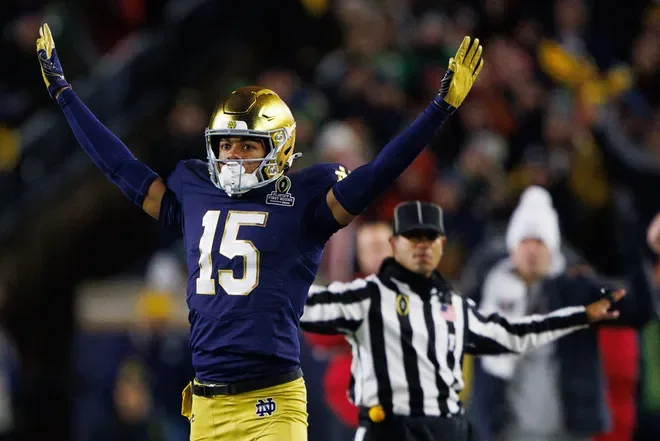
Notre Dame will head into the 2026 season with three players already carrying preseason All-America recognition. Offensive lineman Anthonie Knapp, safety Leonard Moore and defensive back Kyngston Viliamu-Asa were all tabbed for the Walter Camp Preseason All-America Team, the organization announced Tuesday from New Haven, Connecticut. Knapp and Moore were tapped for the first team, while Viliamu-Asa landed on the second team.
Founded in 1889, Walter Camp fields the oldest All-America team in college football and remains one of the five organizations whose selections factor into a player's consensus and unanimous All-America status. With three honorees on this year's list, Notre Dame is one of only six programs nationally to place at least that many players on the preseason team — an early signal of how much talent is returning to South Bend this fall.
Anthonie Knapp
Knapp picks up his first Walter Camp preseason nod after starting along Notre Dame's offensive line in 27 games across the last two seasons. He was a driving force behind a rushing attack that ranked among the most efficient in the country a year ago, with the Irish averaging 5.7 yards per carry — tied for third-best in the FBS. Notre Dame topped 200 rushing yards per game and averaged 7.3 yards per play behind Knapp's work up front, underscoring just how much the ground game leaned on his group.
Leonard Moore
Moore returns to the first team for a second consecutive year after a breakout, unanimous All-American campaign. In 10 starts, he paced the Irish with five interceptions — tied for seventh-most nationally — while adding 31.0 total tackles, a forced fumble and seven pass breakups. His signature moment came against Boise State last October, when he came away with three takeaways (two interceptions and a forced fumble) to go with six solo tackles, a performance that earned him both Walter Camp FBS Defensive Player of the Week and Jim Thorpe Award Defensive Back of the Week honors. Moore was also named to the Lott Impact Trophy Watch List last month.
Kyngston Viliamu-Asa
Viliamu-Asa earns his first career preseason All-America honor after a productive sophomore season that saw him appear in 11 games, including two starts, before a late-season injury ended his year early. The Inland Empire, California, native still finished fourth on the team with 48.0 total tackles, adding 7.5 tackles for loss, three sacks, an interception, two pass breakups and five quarterback hurries. Like Moore, he was named to the Lott Impact Trophy Watch List in May.
With this trio already drawing national recognition before a snap of the 2026 season, Notre Dame's offensive and defensive fronts look poised to anchor another competitive campaign under Marcus Freeman.
Notre Dame's 2026 Offensive Line Has the Makings of Joe Rudolph's Best Unit Yet
Marcus Freeman's vision for Notre Dame football has always started in the same place. Before the skill positions, before the quarterback, before the coordinators and the scheme and the recruiting rankings — it starts in the trenches. It starts with the offensive line setting a physical tone that makes everything else the Fighting Irish want to do on offense not just possible but inevitable.
That vision has been building toward something in South Bend. The recruiting has been elite. The talent in the room has been undeniable. And now, entering 2026, the pieces are finally aligned in a way that makes the question not whether Notre Dame's offensive line can be great — but whether this specific group, with this specific configuration, in this specific season, can be the best offensive line Joe Rudolph has assembled since arriving at Notre Dame in 2023.
The answer depends significantly on two players — Will Black and Guerby Lambert, a pair of bookend tackles with tremendous upside whose development in 2026 could define not just this season but the entire trajectory of Rudolph's Notre Dame tenure. If Black and Lambert fulfill the expectations that their physical profiles and recruiting pedigrees have always suggested were coming, this offensive line has the talent, the experience and the positional construction to be a genuinely dominant unit — the kind that powers a rushing attack, protects an elite quarterback and gives an offensive coordinator with Mike Denbrock's résumé everything he needs to operate at the highest level.
Everything starts up front. In 2026, Notre Dame's offensive line has the chance to prove that the vision and the reality are finally the same thing.
Experience
The foundation of Notre Dame's 2026 offensive line case is a combination that championship units are built on — experienced interior players providing stability and continuity alongside new starting tackles with the kind of upside that changes what a unit can become at its ceiling.
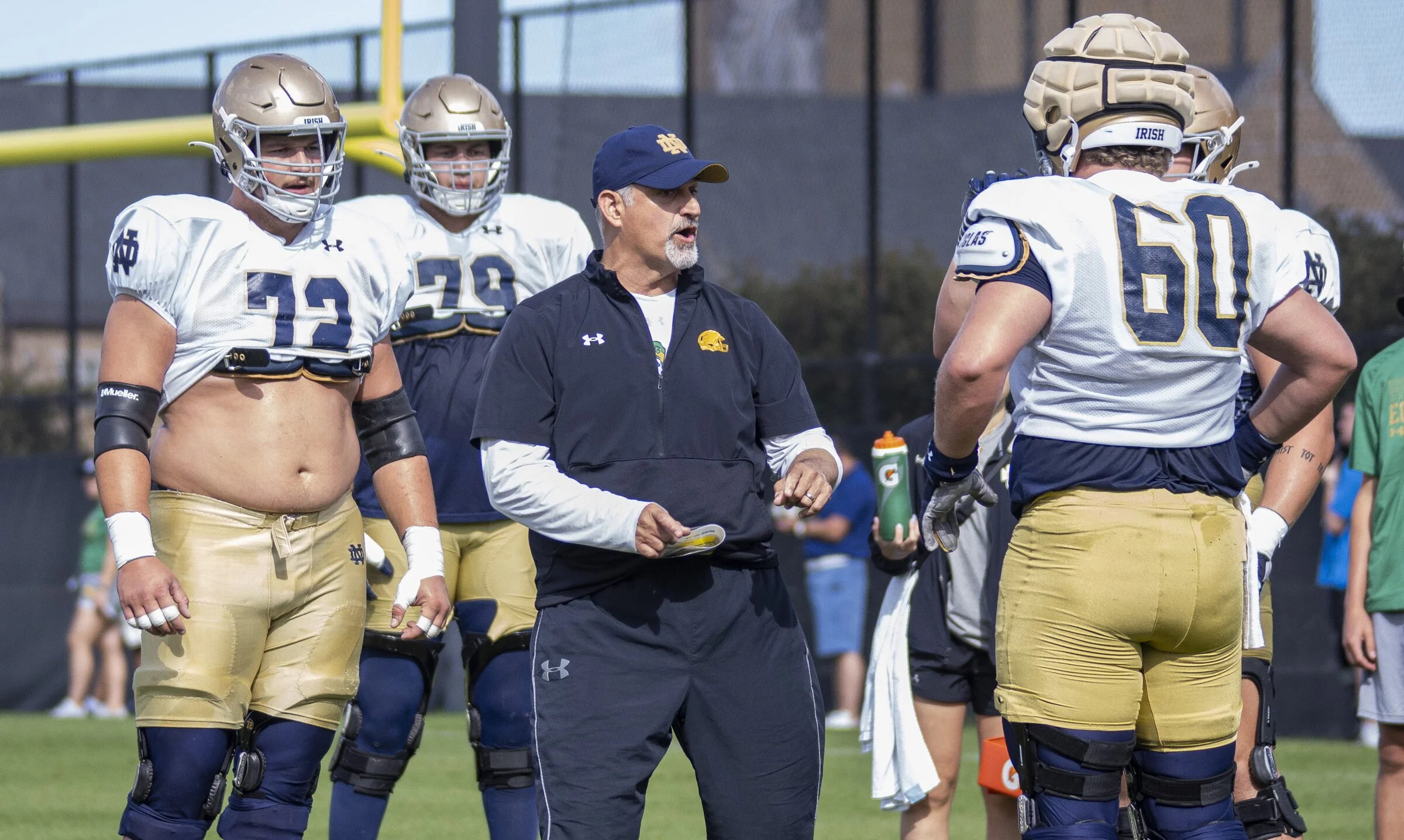
Anthonie Knapp returns with two years of starting experience, now settled into the left guard position where his power, anchor and starting-caliber development project most powerfully. Ashton Craig — healthy and back from the injury that kept him out of spring practice — anchors the unit at center, the position most responsible for the communication and cohesion that separates good offensive lines from great ones. Sullivan Absher brings redshirt junior experience and genuine competitive hunger to right guard, a player who has waited for exactly this starting opportunity and arrives with the kind of chip-on-the-shoulder energy that produces the best seasons of college careers.
The experienced interior trio of Knapp, Craig and Absher gives Notre Dame's offensive line a proven, battle-tested core that first-year starting tackles can build around rather than carry. That structural advantage is enormous — because it means Black and Lambert do not have to be immediately dominant in order for the unit to function at a high level. They need to develop, grow and improve as the season progresses while the interior handles the communication load and sets the physical tone that the entire unit runs through.
That is the exact formula that produces breakthrough offensive line seasons — proven interior stability giving young, high-ceiling tackles the space to develop without the unit's effectiveness depending entirely on their immediate mastery of the position.
starting LT Will Black
The most consequential individual decision in Notre Dame's 2026 offensive line construction is Will Black's installation as the starting left tackle — and everything about Black's physical profile suggests it is exactly the right decision at exactly the right time.
Black arrived at Notre Dame as a five-star recruit whose combination of length, athleticism and raw pass protection tools projected to the blindside tackle position from the moment he stepped on campus. The left tackle spot is where his ceiling is highest, where his physical tools are most naturally expressed and where his development under Rudolph's coaching has always been pointed. Putting him there in 2026 — committing to the position, committing to the growing pains that come with first-year starting experience and committing to the long-term development arc that makes the short-term challenges worthwhile — is the kind of coaching conviction that separates programs building for championships from programs managing for comfort.
The growing pains will come. First-year starting left tackles in the Power Four face a learning curve against elite edge rushers that even the most talented players cannot fully avoid. Black will have moments in 2026 where that curve is visible — moments where an elite pass rusher wins a rep, where a coverage sack happens because the protection broke down outside and where the raw tools have not yet been fully refined into finished technique.
But the ceiling at the end of that developmental process is what makes every one of those moments worth the investment. A Will Black who has navigated a full season of left tackle starting experience against Power Four competition — processing different pass rush moves, learning to handle speed-to-power combinations and building the confidence that only comes from sustained starting-level repetitions — is the kind of blindside tackle that makes Notre Dame's offensive line genuinely elite for two or three more years beyond 2026.
The investment begins now. The return on that investment will define what Notre Dame's offensive line becomes.
Starting Rt Guerby Lambert
If Black's story in 2026 is about a talented young player stepping into the most demanding position on the offensive line for the first time, Lambert's story is about a proven, elite-recruited player finally getting to play where his ceiling has always been highest.
Lambert is a five-star recruit who arrived at Notre Dame with the physical tools — the length, the athleticism, the power and the frame — of an elite college right tackle. The right tackle position is where Lambert's profile projects most naturally, and 2026 represents the first time in his Notre Dame career that he steps into that role as the full-time, unambiguous starting right tackle without positional questions complicating his preparation or his identity within the unit.
That clarity matters more than it might initially appear. A five-star tackle who knows exactly where he is playing, who his running mate is at right guard and what his specific assignments and responsibilities are within the unit's blocking scheme is a significantly more effective player than one navigating positional uncertainty on top of the normal competitive demands of Power Four starting experience. Lambert enters 2026 with that clarity for the first time — and the results of a full season at right tackle in his natural position could be exactly what his recruiting profile always suggested was coming.
Together, Black on the left and Lambert on the right give Notre Dame something the offensive line has not had since Joe Alt and Blake Fisher anchored the 2023 unit — a pair of bookend tackles whose individual ceilings, if realized, make the entire offensive line a different and more dangerous entity than the sum of its experienced interior parts.
Alt and Fisher are starting in the NFL right now. The standard has been set. Black and Lambert have the talent to approach it. Whether they do in 2026 is the central question of Joe Rudolph's defining season.
Fueling the Rush — Two Seasons of Production That Demand Protection
The case for Notre Dame's offensive line dominance in 2026 is not built on projection alone. It is built on a foundation of sustained rushing production over the past two seasons that reflects a ground game operating at a high level even when the offensive line's performance has been inconsistent — and that should produce even more explosive results when the line reaches the potential that the 2026 configuration makes possible.
Over the past two seasons, Notre Dame has established itself as one of the most consistent rushing offenses in the country, grounding its attack in a zone-blocking scheme that rewards intelligence, footwork and the ability to move defenders off the line of scrimmage. The production has been there even through the injury disruptions and positional uncertainty that have complicated Rudolph's previous two seasons — which means the floor of what this rushing attack can do is already established at a high level.
Now pair that established rushing foundation with the most positionally sound offensive line configuration Rudolph has built since 2023 — and add the most dynamic running back room Notre Dame has had in recent memory.
Aneyas Williams enters 2026 as the featured back in a backfield that has been reloaded with genuine talent after the departure of Jeremiyah Love to the NFL. Williams brings a quickness, burst and space-creation ability that makes him a natural fit for the zone-blocking concepts Notre Dame runs — a runner who understands how to set up blocks, identify cutback lanes and accelerate through holes before defenders can close them. His ability to threaten defenses horizontally as well as vertically gives the ground game a dimension that forces defensive coordinators to honor the perimeter before crashing the interior — creating the kind of pre-snap conflict that makes Notre Dame's inside zone and power concepts more effective than they would be against a purely downhill running threat.
The offensive line's job is to create the environment where Williams's natural abilities can be fully expressed. With Black and Lambert protecting the edges, Knapp and Absher controlling the interior gaps and Craig directing the unit's communication from the center position, the blocking structure that Williams runs behind in 2026 has the potential to be the most effective the Irish have fielded in years.
When an offensive line dominates up front and a dynamic back like Williams is running behind it, rushing attacks do not just produce yards — they produce explosive plays, favorable down-and-distance situations and the kind of physical momentum that changes the entire complexion of a football game. Notre Dame's rushing attack has the ingredients for exactly that kind of production in 2026.
Protecting CJ Carr — The Most Important Assignment on the Roster
As important as the ground game is to Notre Dame's offensive identity, the offensive line's most critical assignment in 2026 is the one that directly determines whether the Irish passing offense reaches its enormous potential — protecting CJ Carr.
Carr enters his second season as Notre Dame's starter with the full benefit of a year of starting experience behind him, a deepened understanding of the offense and the weapons around him upgraded on every level. The wide receiver room is better. The tight end group is more experienced. The running back room gives him a genuine dual-threat dimension to work with in the passing game. The continuity of returning offensive coordinator Mike Denbrock and the same system Carr operated in throughout 2025 gives him a pre-snap processing advantage that second-year starters with returning coordinators enjoy in ways that are difficult to quantify but impossible to miss in the way they play.
But none of those advantages mean anything if Carr is running for his life on every passing down. The difference between a good quarterback and a great quarterback — between a solid season and a Heisman Trophy season — is almost always a function of how much time the offensive line gives him to go through progressions, identify coverage rotations and deliver the football to the right place with the timing and accuracy that his skill set demands.
Clean pockets do not just protect quarterbacks. They elevate them. When a quarterback can step into his throws, trust that his blindside is protected and operate through his full progression without the pressure of an unblocked defender bearing down on him, the entire passing game functions at a higher level. Routes develop more fully. Timing throws hit their windows. Check-downs become available when the primary read is covered. The entire mental processing load that second-year quarterbacks are still refining becomes more manageable when the physical environment the offensive line creates allows that processing to happen without the distortion of pressure.
Black and Lambert protecting Carr's edges in 2026 — if they perform at the level their talent suggests they can — give Notre Dame's quarterback an environment where his Heisman candidacy can develop naturally and fully. That is the assignment. Everything else the offensive line accomplishes in 2026 runs through whether they can consistently give CJ Carr the clean pocket he needs to maximize the talent surrounding him.
Mike Denbrock's Blueprint — Why Second-Year Quarterbacks Thrive Under His System
The offensive line's assignment in 2026 does not exist in isolation — it exists within the context of an offensive system designed by coordinator Mike Denbrock whose track record with second-year starting quarterbacks is one of the most compelling and relevant data points in Notre Dame's 2026 offensive preview.
Denbrock's résumé with second-year quarterbacks traces directly to the most celebrated quarterback performance in recent college football history. At LSU in 2023, Denbrock was the offensive coordinator for Jayden Daniels's Heisman Trophy season — a campaign in which Daniels, operating in his second year within a system that had been built around his strengths, produced one of the most statistically dominant quarterback performances the sport has ever seen. Daniels threw for 3,812 yards and 40 touchdowns while rushing for 1,134 yards and 10 more scores — numbers that earned him the Heisman Trophy and announced him as the most complete offensive player in college football.
The pattern that produced Daniels's Heisman season is directly applicable to what Carr and Notre Dame are building toward in 2026. A quarterback who has a full season of starting experience in the system. An offensive coordinator who has had a full offseason to study that quarterback's strengths, identify the plays and concepts that maximize his skill set and build a game plan philosophy that puts him in positions to succeed. A supporting cast that is upgraded from the previous season. And an offensive line assignment that is clearer, more positionally sound and more capable of providing protection than the one that existed in the quarterback's first year as a starter.
Denbrock has done this before. He has taken a second-year starting quarterback, built a system around his specific strengths and produced the kind of Heisman-caliber performance that changes careers. The offensive line's role in that process — keeping Carr clean, controlling the line of scrimmage in the run game and giving Denbrock's system the physical foundation it needs to operate at its ceiling — is the most direct and consequential contribution the unit can make to Notre Dame's 2026 championship aspirations.
If the offensive line delivers, Denbrock has everything he needs. If Denbrock has everything he needs, Carr has everything he needs. And if Carr has everything he needs — with the receiver room, the running back room and the system surrounding him in 2026 — the ceiling of what Notre Dame's offense can produce is genuinely limitless.
The Best Offensive Line of the Rudolph Era?
Stack all of it together — the experienced interior anchored by Knapp, Craig and Absher, the bookend tackle upside of Black and Lambert, the rushing production foundation that the past two seasons have established, the dynamic running back room led by Williams and the Denbrock-Carr connection that mirrors the blueprint that produced a Heisman Trophy at LSU — and the case for Notre Dame's 2026 offensive line being the best unit Rudolph has assembled at Notre Dame becomes genuinely compelling.
The standard was set in 2023 when Alt and Fisher gave Notre Dame two future NFL starters at the bookend positions. That unit is the measuring stick. Whether the 2026 group can approach or exceed that standard depends on Black and Lambert fulfilling the expectations their talent demands and the experienced interior delivering the consistency and physicality that championship offensive lines produce week after week.
The ingredients are there. The configuration is right. The assignment is clear. The supporting cast surrounding the offensive line — from Carr to Williams to the upgraded receiver room — gives the unit's performance a direct and immediate impact on Notre Dame's national championship aspirations.
This is Joe Rudolph's defining season. And for the first time in his Notre Dame tenure, he has the right players in the right places to make the definition one that every Fighting Irish fan will be proud of when the 2026 season is complete.
Will Black and Guerby Lambert. Protect the edge. Control the line of scrimmage. Fulfill the potential. Give CJ Carr the time to be great.
Do those things — and this offensive line does not just have the chance to be the best unit of the Rudolph era at Notre Dame.
It has the chance to be something that Notre Dame fans remember for a very long time.
joe rudolph may have his best 5-man combo on the offensive line
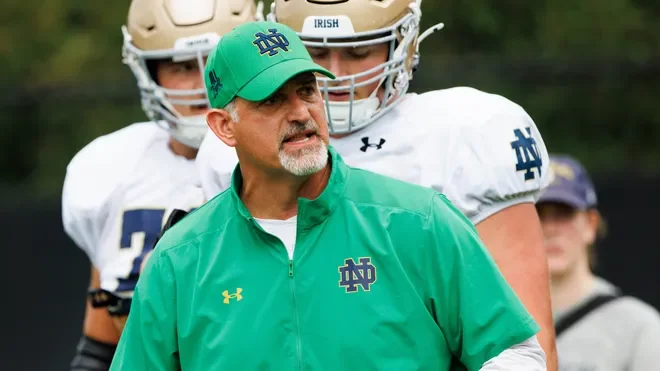
Joe Rudolph has done an amazing job recruiting size, length and talent to the Notre Dame offensive line room. His efforts may lead to the Joe Moore Award returning to South Bend next winter, if things go as planned. Entering spring practice, the first unit has been freshman left tackle Will Black, junior left guard Anthoine Knapp, junior center Joe Otting, junior right guard Sullivan Absher and Sophomore right tackle Guerby Lambert. Senior center Ashton Craig is expected to make a full recovery from the leg injury that ended his 2025 season prematurely, and junior guard Charles Jagusah is still dealing with complications from surgery to remedy his injured left arm due to a ATV accident last summer. Despite missing two highly talented linemen this spring, the early returns from coaches and players signal great things ahead for the group.
Rudolph spoke to the media on Wednesday and began with sharing how pleased he’s been with the right side of the first unit, which features Guerby Lambert being moved from right guard to right tackle, and Sullivan Absher replacing him at the right guard spot.
“Those two guys really kind of called each other out about guys that they are confident in, guys that they really look to for leadership, guys that they really trust. and that's always a unique situation when you can kind of create that or build that into your five-line. And then it would have been easy to leave Knapp outside and Guerby inside. What was just the basis of moving them around, too? Guerby has a real comfort on the right side of the line, which is cool.”
Knapp has always been a devastating run blocker and will serve as a more than comparable replacement for former left guard standout Billy Schrauth, who is preparing to be selected in the upcoming NFL Draft. Freshman Will Black came to South Bend with a lot of buzz as a 5-Star in the 2025 class, and head coach Marcus Freeman said there some early growing pains that he had to endure and overcome to begin reaching his full potential. He’s a natural tackle with great length and athleticism that should benefit from being next to a veteran like Knapp, who was ranked as top returning offensive tackle in college football before being moved inside,
With all of the movement this spring, Rudolph has been impressed with the performance of the Black-Knapp combo on the left side and the performance of the line as a whole.
“Knapper, we felt, has done a great job playing left. But we thought to get each guy in maybe the spot that would allow them to shine the most would be the chance to move Knapp in and create a good competition at the left, which Will's done a great job of, but there's still good competition there. And really what you don't know is how the guys will embrace it. And there's a lot of differences, right? It's like, I've been really good here, and now you want me to move here. And Anthony's just embraced it, and he wants to know the intricacies of the position and the differences. And that's really kind of created it. And then what you can't anticipate is how well they work together, the pre-snap communication, how they work in the meeting room, how they talk, their plan, their trust for one another. So I've been impressed by it.”
Another bright spot this spring has been the performance of freshman guard Matty Augustine, who can play both guard and tackle for coach Rudolph. The Irish have 4-5 experienced linemen that have the flexibility to play multiple positions and that should allow a group that has suffered from injuries over the last three seasons to maintain a dominant level of play throughout the 2026 season.