

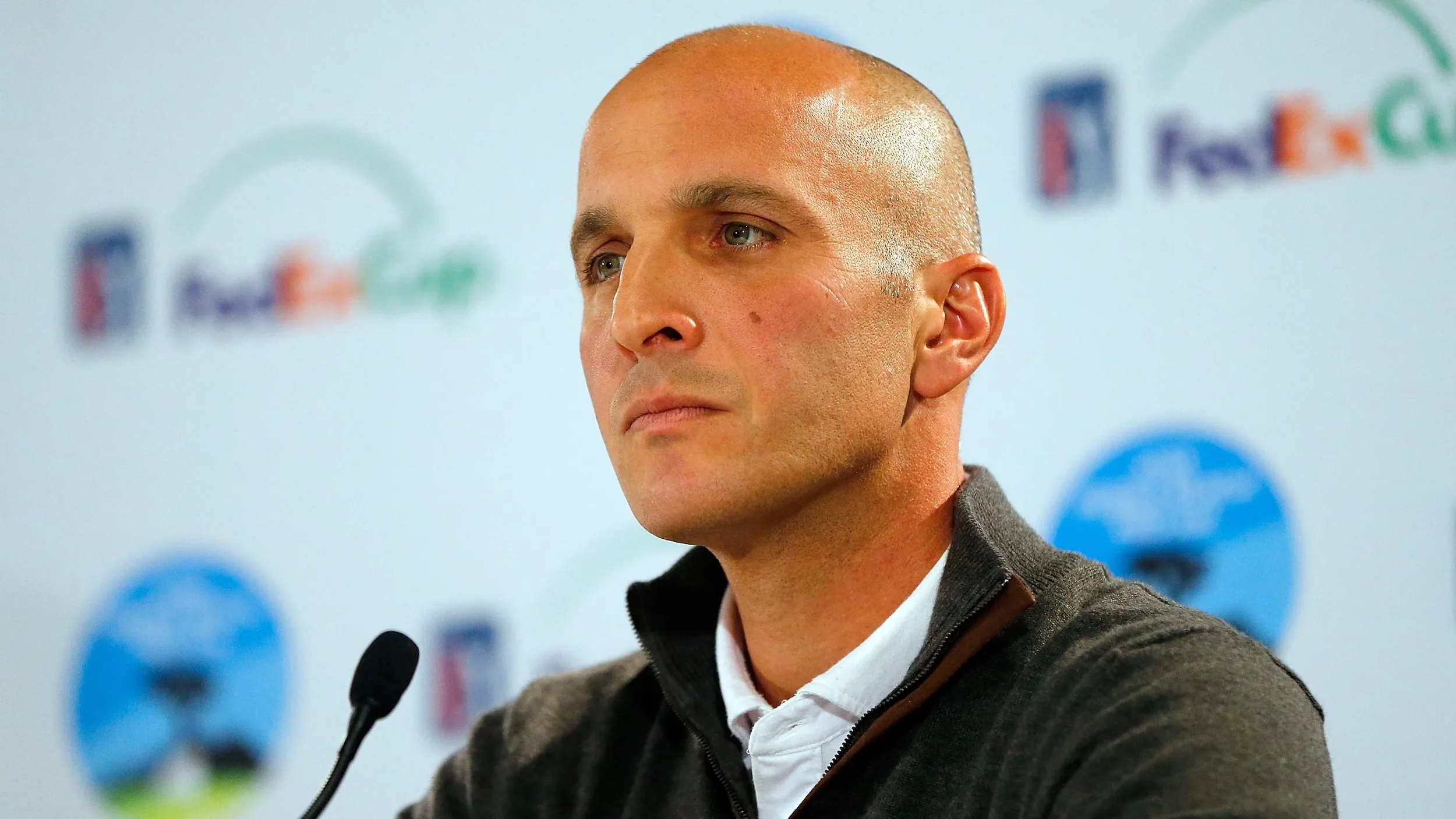
Notre Dame AD Pete Bevacqua stands with sec, big 10 for cfp expansion
The College Football Playoff expansion debate has reached a tipping point, and Notre Dame Athletic Director Pete Bevacqua has made clear exactly where the Fighting Irish stand. Bevacqua has aligned Notre Dame with the SEC, Big Ten and Big 12 in pushing for a 24-team playoff format — and in doing so, has positioned the Irish not just as a voice in the conversation, but as a program uniquely built to dominate regardless of how the playoff landscape ultimately unfolds.
Bevacqua Steps Into the Arena
The expansion conversation has been building for two offseasons now. Big Ten commissioner Tony Petitti lit the fuse last year with an aggressive push to double the current 12-team field. The Big 12 and ACC have since climbed on board, with commissioner Jim Phillips lending his voice to the chorus. Now Notre Dame has joined them, and Bevacqua's reasoning goes deeper than simply wanting more teams in the field.
"I think in this day and age with what universities are investing in football, it's a very expensive sport," Bevacqua said. "You need to give more teams hope. The way things are structured now, everything points to the CFP. It's a measure of success. It's important in the tenure of a coach. We've seen firings when teams aren't going to make it to the CFP."
Bevacqua's vision extends beyond the present moment. He's thinking about the long-term health of college football as a whole — and what happens to the sport if the financial burden of competing at the highest level becomes unsustainable for programs outside the traditional powerhouse tier.
"My concern is that if more teams aren't given hope, that universities over the course of the next five, ten years will say, 'Hey, is the investment worth it?'" Bevacqua continued. "I would hate to see a college football landscape where there's only a handful of teams that can really give it a legitimate go year after year after year."
That is the voice of a man who understands that a thriving college football ecosystem benefits Notre Dame just as much as anyone. A sport with thirty programs genuinely competing for a title is a healthier, more marketable, more financially robust product than one with eight. Bevacqua sees the big picture — and he's right to.
The Strategic Genius of Notre Dame's Position
What makes Notre Dame's embrace of the 24-team format particularly shrewd is that it comes from a position of strength, not desperation. The Fighting Irish don't need a bigger playoff to survive. They need it to thrive — and there is a significant difference.
Consider what Marcus Freeman has built in South Bend. Notre Dame is scheduling some of the most demanding non-conference slates in the country, with home-and-home series against Alabama, Texas, BYU, Florida and Auburn on the books in coming seasons. The Irish aren't soft-scheduling their way into playoff consideration — they are earning it the hard way, against the best competition available. Ohio State plays Texas out of conference. Clemson has gone back-to-back against Georgia and LSU. Notre Dame belongs in that same conversation about programs willing to put their records on the line before conference play even begins.
That scheduling philosophy means one thing clearly: Notre Dame is building a program that can compete with anybody, anywhere, at any time. In a 12-team playoff, that makes the Irish a dangerous contender. In a 24-team playoff, it makes them a program that would enter the field battle-tested and ready while other programs that padded their records against cupcakes scramble to compete with legitimate title contenders.
Notre Dame wins in either world — and Bevacqua knows it.
Aligning With Power to Shape the Future
By stepping forward alongside the SEC and Big Ten — the two most powerful conferences in college football — Bevacqua has ensured that Notre Dame has a seat at the table where the sport's future gets decided. That is not a small thing for an independent program without a conference megaphone behind it.
The SEC and Big Ten generate the lion's share of college football's revenue and carry the most weight in playoff format negotiations. Notre Dame aligning with those conferences on the 24-team push isn't just a philosophical stance — it's a political calculation that keeps the Irish relevant in conversations that will shape the sport for the next decade. An independent program that sits on the sidelines of that debate risks being shaped by decisions made without their interests in mind. Bevacqua made sure that doesn't happen.
The revenue implications are also impossible to ignore. A 24-team playoff means more games, more television inventory, more distribution money and a bigger financial pie for participating programs. Notre Dame, with its own NBC television deal and massive national brand, stands to be one of the biggest financial beneficiaries of an expanded field. More playoff games means more Notre Dame on national television — and that is always good for the bottom line in South Bend.
A Program Built to Prosper at Any Playoff Size
Perhaps the most important element of Notre Dame's position is that Freeman and Bevacqua have constructed a program that doesn't need the playoff format to change in order to compete. Under Freeman, Notre Dame has already demonstrated it can reach the College Football Playoff and make deep runs in the current 12-team format. The roster investment, the recruiting infrastructure, the coaching staff and the scheduling ambition are all pointed at one goal — winning a national championship.
If the playoff stays at 12 teams, Notre Dame's brutal non-conference schedule and elite recruiting class position them as perennial contenders for one of those coveted spots. If it expands to 24, the Irish would enter as one of the most battle-tested programs in the field — a team that has been preparing to play anyone, not just survive a soft schedule long enough to sneak into an expanded bracket.
Either way, the programs that should be concerned about the playoff format are the ones that need a bigger field just to get in. Notre Dame is not one of those programs. Bevacqua is advocating for expansion from the high ground — as the AD of a program that will be in the conversation whether the field is 12, 16 or 24 teams.
The Bottom Line
Pete Bevacqua has made a bold, calculated and strategically sound move by aligning Notre Dame with the forces pushing for a 24-team College Football Playoff. His argument for the long-term health of the sport is genuine and carries real merit. His understanding of what expansion means for Notre Dame's brand, revenue and competitive positioning shows a leader thinking well beyond the next season.
Most importantly, Marcus Freeman is building exactly the kind of program that makes this position credible. Notre Dame isn't lobbying for a bigger playoff because they need a lifeline. They're supporting expansion because they intend to be one of the programs that makes every round of a 24-team field worth watching — and they're scheduling, recruiting and competing like it every single day.
The playoff may be changing. Notre Dame is ready for all of it.
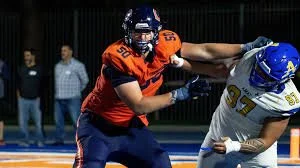
Joe Rudolph and Notre Dame Flip OT Jackson Hill From UCLA
Joe Rudolph didn't have to go after Jackson Hill. That is the first thing you need to understand about this commitment — and it is the most important context for everything that follows.
Notre Dame's offensive line coach already had three quality commitments locked in for the 2027 class. He has five-star target Albert Simien scheduled for an official visit on June 19th. He signed six offensive linemen just a year ago. By any conventional measure of roster construction, Rudolph had room to be patient, selective and conservative with the next offensive line commitment in this class.
Instead, he went to California, identified a 6-7, 300-pound three-star prospect playing at Chaminade Prep, made a conviction call that the recruiting services had this one wrong — and didn't stop until Jackson Hill flipped his commitment from UCLA and chose Notre Dame.
That decision tells you everything about how Joe Rudolph evaluates offensive linemen and why his track record of developing players that others overlooked is one of the most quietly elite résumés in college football coaching.
Rudolph Made a Conviction Call — Not a Desperation Move
The easiest way to misread this commitment is to assume Notre Dame added Hill because they needed bodies or because the elite targets weren't materializing. Neither is true, and Rudolph's own actions prove it.
Simien, one of the most coveted offensive line prospects in the entire 2027 class, is still very much in play for Notre Dame with a June official visit on the schedule. Rudolph is not closing the door on elite five-star additions to this class — he is pursuing them aggressively at the same time he committed Hill. That simultaneity is the key. This was not an either-or decision driven by scarcity. It was a both-and decision driven by genuine belief in what Jackson Hill can become.
When an offensive line coach of Rudolph's caliber pursues a prospect while elite alternatives are still available and actively being recruited, that pursuit is a statement. It means Rudolph watched the film, saw something real and decided that waiting on rankings to catch up to his evaluation was a luxury Notre Dame couldn't afford — because eventually someone else was going to see what he saw, and by then Hill would already be committed somewhere else.
Rudolph saw it first. He moved first. That is what separates elite evaluators from everyone else.
The Rudolph Track Record — Turning Upside Into Production
To fully appreciate why this commitment makes sense, you have to understand the history Joe Rudolph brings to offensive line evaluation — because his track record of identifying players whose rankings dramatically understated their actual ceiling is not a coincidence. It is a philosophy.
Throughout his coaching career at Wisconsin, Pittsburgh and now Notre Dame, Rudolph has consistently identified offensive linemen that recruiting services rated as good-not-great prospects and developed them into legitimate NFL-caliber players. The pattern is unmistakable to anyone who has followed his career closely. Rudolph does not simply recruit the rankings — he recruits the player, the frame, the athleticism and the coachability. He asks one central question when he evaluates an offensive line prospect: what does this player become when I get three years of elite coaching, elite strength training and elite competition into his body?
That question produces very different answers than a recruiting service snapshot of a 17-year-old's current production level. And time and again, Rudolph's answers have been proven right when the players he believed in reach their junior and senior seasons and the rest of the country finally sees what he saw years earlier.
Jackson Hill is the latest player to benefit from that evaluation process — and if Rudolph's track record means anything, Hill's three-star ranking will feel like a distant memory long before his Notre Dame career is finished.
What Rudolph Sees in Hill That the Rankings Don't Capture
So what exactly did Joe Rudolph see when he watched Jackson Hill that convinced him to go all-in on a three-star prospect while five-star targets remained on the board?
Start with the foundation that cannot be faked and cannot be coached — the physical profile. At 6-7 and 300 pounds, Hill already possesses the frame that NFL offensive line scouts put at the very top of their evaluation criteria. Length is the single most non-negotiable physical attribute for a developmental offensive tackle, and Hill has it in a way that only a handful of prospects in any given recruiting class possess. Those long arms allow him to strike pass rushers before they can get into his body, create natural leverage advantages in the run game and give coaches the raw material to build a finished product that can hold up against elite college pass rushers for four years.
But Rudolph didn't fall in love with Hill's size alone. What truly separated Hill in Rudolph's evaluation is the athleticism that lives inside that massive frame — and the proof of it comes from the most unexpected place imaginable.
Jackson Hill plays catcher in baseball. Let that sink in for a moment. A 6-7, 300-pound athlete who lines up behind home plate, receives pitches at full velocity, blocks balls in the dirt, controls a running game and makes throws to every base is not just big. He is a legitimate multi-sport athlete whose body moves with a coordination and quickness that his size has no business producing. The quick-twitch hand-eye coordination required to catch at a high level translates directly to an offensive lineman's most critical skill set — active, fast, coordinated hands that can punch, redirect and sustain blocks against elite competition.
That dual-sport athleticism tells Rudolph something the film alone might not fully communicate — that Hill's body is not done developing, his coordination is already advanced beyond what his football experience reflects and his ceiling as an offensive lineman has not yet come close to being reached.
Add to that a powerful run-blocking foundation already in place, the football IQ to potentially play both tackle and guard at the college level and the academic profile that attracted offers from Penn and Dartmouth alongside his Power Four football offers — and what Rudolph saw was not a three-star offensive tackle. He saw a Power Four starter hiding inside a recruiting ranking that hadn't caught up to reality yet.
The Positional Upside That Makes Hill Even More Valuable
One of the most underappreciated elements of Hill's commitment is what his positional flexibility means for Notre Dame's offensive line depth over the next four years.
His natural size and length make him an obvious developmental tackle — the kind of player you project to protect the blind side as he refines his technique and adds functional strength. But Rudolph has also identified a realistic path where Hill moves inside to guard, where his 6-7, 300-pound power frame would make him one of the most physically imposing interior blockers in the ACC. A guard with Hill's size and athletic profile is a mauler in the run game — the kind of interior presence that creates movement at the line of scrimmage and gives a rushing attack a completely different dimension.
That flexibility to develop Hill at multiple positions is a luxury for Rudolph as he constructs the offensive line room around the 2027 class. It means Hill isn't locked into a single role before he ever takes a college snap. It means Rudolph can put him where the offense needs him most as the depth chart evolves. And it means that even if the tackle spots ahead of him are filled with elite talent, Hill's value to the program doesn't diminish — it simply finds a different expression.
The Class Context — Building With Depth and Range
Understanding why Rudolph went after Hill also requires understanding the broader 2027 offensive line class Notre Dame is assembling — because this group is being built with a specific philosophy in mind.
Olu Olubobola is the crown jewel — an elite, nationally-ranked New Jersey tackle whose offer list reads like a who's who of college football royalty. James Halter brings physicality and toughness from Pennsylvania. Richie Flanigan adds size and length from Wisconsin. And now Hill contributes a high-ceiling developmental profile with rare physical tools from the West Coast.
Rudolph is not building a one-dimensional offensive line class of interchangeable prospects. He is building a room with range — elite recruits with proven rankings alongside high-upside players whose ceilings may ultimately be just as high, or higher, than the stars suggested. That is how championship offensive line rooms get built. Not by chasing the same profile over and over, but by identifying different kinds of value and trusting your evaluation process to sort out who becomes what.
With Simien's official visit still on the calendar, this class could add another elite headline name before the 2027 cycle is complete. But Rudolph's willingness to commit Hill now — before that visit, while Simien is still in play — tells you he sees Hill's value as independent of any other decision. Hill earned this commitment on his own merits, on his own timeline, through Rudolph's own evaluation process.
That is the highest compliment an offensive line coach can pay a prospect.
The Bottom Line
Joe Rudolph went after Jackson Hill because Joe Rudolph trusts his eyes over a ranking, his evaluation over a database and his understanding of what a 6-7, 300-pound multi-sport athlete can become over what he currently is on a recruiting service's board.
The three-star label on Hill's profile will not survive contact with Notre Dame's strength program, Rudolph's coaching and the kind of elite competition that accelerates development faster than any recruiting service can track. It never does when Rudolph makes a conviction call on a high-upside offensive lineman that others have undervalued.
Jackson Hill chose Notre Dame over UCLA because the pull of South Bend and the belief of one elite offensive line coach proved stronger than a prior commitment. Notre Dame went after Jackson Hill because Joe Rudolph saw a future starter that the rest of the country hasn't fully discovered yet.
History suggests Rudolph is right. It usually does.
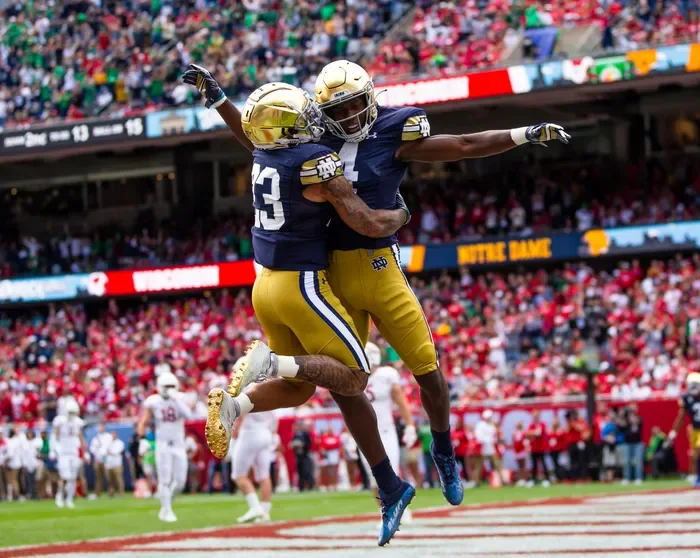
Notre dame faces wisconsin at lambeau field in shamrock series
Notre Dame Football’s 2026 Shamrock Series game presented by Credit Union 1 will now be played on Sunday, Sept. 6, 2026 vs. Wisconsin at Lambeau Field, home of the Green Bay Packers. The game was originally scheduled to be played in 2020 and was rescheduled due to the COVID-19 pandemic for Sept. 5, 2026. It has now been scheduled for a Sunday matchup. The game is the second installment of the two-game series with Wisconsin, the first of which was played at Soldier Field in 2021, with Notre Dame exploding for 31 unanswered fourth quarter points in a 41-13 victory. The highlight of the game was Chris Tyree’s 96-yard kickoff return that broke a 13-13 tie early in the 4th quarter.
Notre Dame will serve as the home team in this Shamrock Series game, the first game the Irish have played at Lambeau Field. The historic stadium has hosted just two college football games in history: St. Norbert vs. Fordham in 1983 and Wisconsin vs. LSU in 2016.
The Shamrock Series began in 2009 when Notre Dame started to ‘take a home game on the road’ in San Antonio. The Irish defeated Washington State, 40-14, in the Alamodome and have hosted 12 Shamrock Series games across the country, including Landover, Md; Chicago, Ill.; Arlington, Texas; Indianapolis, Ind., Las Vegas, Nev. and Bronx, N.Y..
The Shamrock Series has been an incredible resource in recruiting in these areas and the recent success in the Chicagoland area and Wisconsin will be bolstered by this matchup as the eyes of top high schoolers in he Midwest will be focused on two historical programs in one of the most historic venues in football.

Notre dame 2025 schedule highlighted by 3 primetime games
Notre Dame Football announced the game times and broadcast information for its 2025 home slate, including three primetime matchups against Texas A&M, USC and Navy. The Irish will host seven opponents in Notre Dame Stadium in 2025. Six of those contests will be broadcast on NBC (simulstreamed on Peacock), while the Oct. 11 game vs. NC State will be broadcast exclusively on Peacock. For the first time, Notre Dame will 2025 will host three night games since 2018.
Notre Dame’s home opener will bring Texas A&M to Notre Dame Stadium on Sept. 13, after opening the 2024 season in Kyle Field. The Fighting Irish defeated the Aggies’ 23-13 in that matchup with 10 unanswered points late in the fourth quarter to seal an impressive victory.
Notre Dame will remain at home the next week to face rival Purdue at 3:30 p.m. ET on NBC. The 2024 matchup saw an angry Fighting Irish team, on the heels of their only regular season loss to Northern Illinois, travel to West Lafayette and deliver a pummeling to the Boilermakers with a 66-7 Irish victory. They will face them in game 3 in consecutive years for the first time in the battle for the Shillelagh Trophy.
On Oct. 4, the Irish will return home for a three-game stint in South Bend, beginning with another first-time opponent, Boise State, who is coming off a CFP AQ bye and loss to the Penn State Nittany Lions. Kickoff is scheduled for 3:30 p.m. ET on NBC. The Irish will face NC State in Notre Dame Stadium on Oct. 11 at 3:30 p.m., broadcast exclusively on Peacock. It marks the fifth Notre Dame game that will be streamed exclusively on Peacock.
Notre Dame will then host USC in the annual Jeweled Shillelagh rivalry game, this season occurring on Oct. 18 at 7:30 p.m. ET on NBC. The 2024 matchup saw a weary Fighting Irish team hold off a valiant effort from the Trojans with two interceptions returned for touchdowns in the fourth quarter by Christian Gray and Xavier Watts to seal the victory and a berth in the CFP. The matchup will mark the 96th meeting between Notre Dame and USC. The Irish are 7-2 over the Trojans in the last nine meetings.
On Nov. 8, Notre Dame will come back home for the annual matchup with Navy. This installment of the famed rivalry will kick off at 7:30 p.m. ET on NBC. It will mark the first time Notre Dame and Navy have met in a night game at Notre Dame Stadium. The Midshipmen entered the 2024 matchup undefeated with a high flying offense, but struggled to hold on to the football against Notre Dame’s defense that collected 6 turnovers in a 51-14 victory
The 2025 Notre Dame home slate will conclude with a 3:30 p.m. matchup vs. Syracuse on Senior Day, broadcast on NBC.