
Notre Dame hits Wall Street: Freeman, Carr, Moore Kick Off NYC Media Blitz
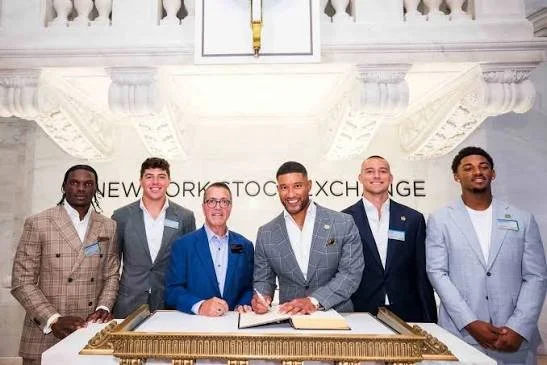
Notre Dame football's biggest names traded South Bend for the concrete canyons of Manhattan this week, launching a whirlwind New York media tour that opened in the most on-brand way possible for a program synonymous with tradition: ringing the bell at the New York Stock Exchange.
Head coach Marcus Freeman was joined on the trading floor by quarterback CJ Carr, cornerback Leonard Moore, linebacker Drayk Bowen and safety Adon Shuler for the closing bell ceremony, where the group used the moment to remind the Big Apple who was in town with a "Let's Go Irish" chant that got much of the floor chanting along, with a Notre Dame banner draped behind them as a backdrop. It capped a day that had already included stops on ESPN doing a variety of interviews before the group made its way to the Exchange.
The quartet's trip to New York was no accident. Notre Dame announced that quarterback CJ Carr, linebacker Drayk Bowen, safety Adon Shuler and cornerback Leonard Moore would represent the program on its annual media tour around the city's major outlets, with appearances lined up on shows like ESPN's SportsCenter and NFL Network's Good Morning Football. As one Notre Dame outlet noted, the group also doubles as a strong hint at this year's leadership structure — Bowen and Shuler return as captains from 2025, while Carr and Moore, both just second-year players last season, were too young to hold the title but easily could have.
Carr, the presumptive Heisman frontrunner, got the first big spotlight moment, sitting down with Rich Eisen to walk through his path to South Bend — including the story of his father initially hiding Michigan's offer letter from him, and how it was former offensive coordinator Tommy Rees who recruited him hardest and showed him the most love, a pull that, combined with Marcus Freeman's own recruiting effort, ultimately landed Carr with the Irish over his grandfather Lloyd Carr's alma mater. Carr also used the sit-down to frame the mindset for the upcoming season, discussing how Notre Dame plans to keep using the disappointing end to 2025 as motivation heading into 2026.
The tour continued into Friday morning, when Freeman and Moore stopped by the Today Show. Asked about the "Here Come the Irish" refrain that blares over the loudspeaker as Notre Dame takes the field — now also the title of the program's in-house Peacock series — Freeman kept it simple: "It was there before I got there. As you take the field, they play over the loudspeaker 'Here Come the Irish.' We take the field, so I think it's pretty simple to make that the title of the show."
Freeman was also asked what it's been like having a camera crew shadow the program for that same series, and admitted the adjustment took some time. "Yeah, it took some convincing to think about all the cameras, the mics and the distractions. We really started to implement it last spring. It was a good trial run and it became like they were a part of the team, you didn't notice they were there. They feel like they were part of the staff and I think everybody kind of dropped their guards and it just became natural," he said.
The New York swing comes on the heels of a spring in which Moore made headlines of his own, telling reporters in South Bend that Notre Dame was on something of a "revenge tour" after last year's College Football Playoff snub. Moore said the defensive backs took a lot of the blame following Notre Dame's loss to Miami, in which Hurricanes quarterback Carson Beck completed 20 of 30 passes for 205 yards and two touchdowns without an interception, and didn't sugarcoat how Freeman responded. "He told us we was weak, we was soft," Moore said, "all that type of stuff. It's serious to him, too. That's something he's not used to seeing from us."
Freeman, for his part, waved off any notion that revenge is the operative word internally, preaching focus on the present instead. "We spend too much time daydreaming about Miami, we're going to lose to Wisconsin," he said, referencing Notre Dame's Sept. 6 season opener. "You've got to focus on the task right at hand. That's no different than saying, can we go back to the national championship? If we want to focus on the national championship, we're going to lose the opportunity we have right here. It's my job to make sure I'm directing the focus where it needs to be."
With the bell-ringing and morning show circuit behind them, the group's New York run is expected to continue over the next several days, with more national appearances on tap as Notre Dame — with a Heisman-caliber quarterback, an All-American cornerback and a coach determined to keep the noise pointed forward rather than backward — begins building the case for a 2026 season with, in Freeman's words, no doubt left to leave.
Four-Star Chicago Linebacker Roman Igwebuike Commits to Notre Dame
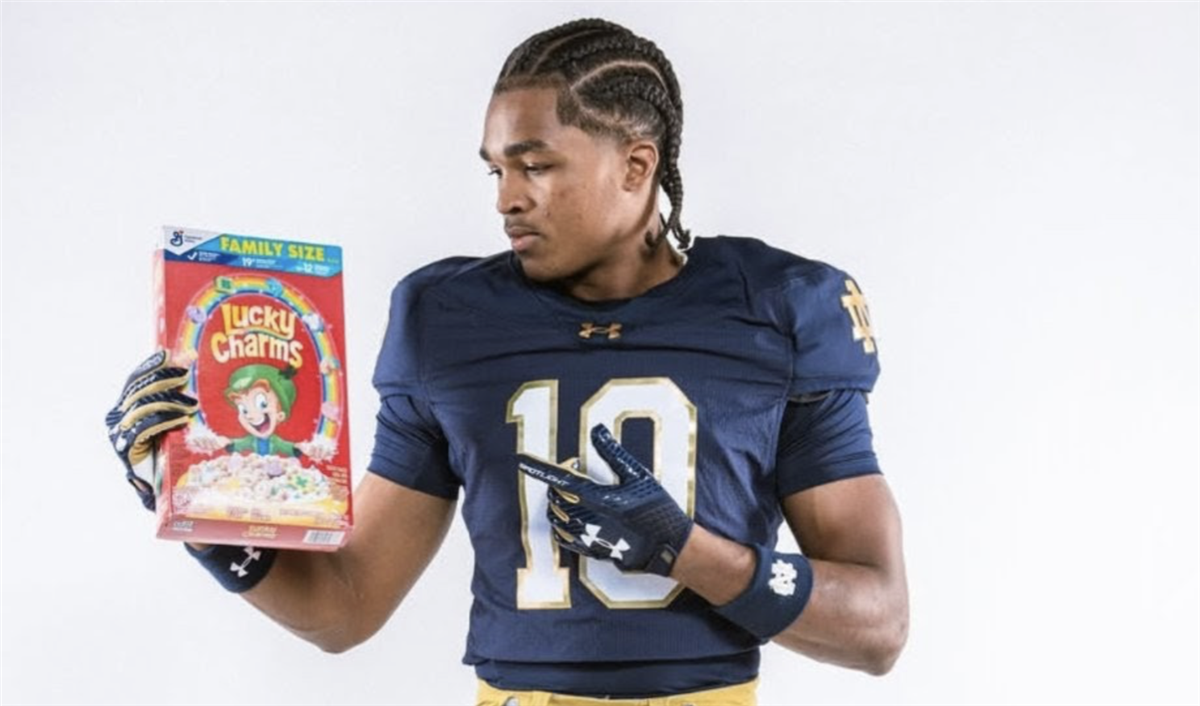
Notre Dame football landed one of its most important remaining targets in the 2027 recruiting class on Saturday when four-star linebacker Roman Igwebuike, a standout at Mount Carmel High School in Chicago, announced his commitment to the Fighting Irish on the CBS Sports College Football YouTube channel.
The 6-foot-3, 220-pound Igwebuike chose Marcus Freeman's program over a finalist group that included Clemson, Indiana, Missouri and Tennessee, capping a recruitment that also drew serious interest from Ohio State, Oregon, Michigan, Georgia and dozens of other blue bloods. He becomes Notre Dame's 22nd commitment in the 2027 cycle and the lone linebacker in a class already ranked No. 2 nationally.
Explaining his decision, Igwebuike pointed to the culture Freeman has built in South Bend as much as anything else. "Just the culture and the program!" Igwebuike said of his commitment to Notre Dame. "Also playing for a ex-linebacker as my head coach is a big deal to me. The community and off-the-field success told me it was right. The way they take care of their players and their networking is unmatched."
A recruitment that had to be rebuilt from scratch
Igwebuike's path to South Bend was anything but a straight line, and the shift didn't happen until relatively late in the process. Notre Dame's original offer came last October while he was on campus for the Boise State game, but the relationship never gained real traction under then-linebackers coach Max Bullough, who departed the program after the 2025 season and had made little meaningful push for the Chicago native during his tenure. For a prospect fielding calls from nearly every major program in the country, Notre Dame was, for a time, an afterthought rather than a priority.
That changed in January 2026, when the Irish hired Brian Jean-Mary — previously Michigan's linebackers coach — to run the position room. Jean-Mary made Igwebuike a target from his very first weeks on staff, and paired with Freeman's own credibility as a former college linebacker, Notre Dame walked back into the recruitment with a fundamentally different pitch than the one it had offered six months earlier.
Igwebuike took five official visits over a roughly six-week stretch: Indiana in May, Clemson at the end of May, Missouri in early June, Notre Dame on June 12, and Tennessee on June 19. The June 12 trip to South Bend proved to be the turning point. It was during that visit that Igwebuike and the new staff had the direct conversations needed to clear up exactly where he stood — addressing head-on the uneven communication of the previous regime and making clear that, under Jean-Mary and Freeman, he wasn't just a name on a board but the room's top target. Notre Dame had already hosted him once before, in April during jersey scrimmage weekend, but the official visit in June was where the Chicago native said he found clarity on where he wanted to play his college football.
The production behind the profile
Igwebuike's MaxPreps career profile tells the story of a player who has started for Mount Carmel every year of high school and grown into the role. He debuted as a freshman outside linebacker in 2023 at 6-foot-2, 215 pounds, helping the Caravan to a 13-1 record and a No. 2 state ranking. As a sophomore in 2024, still 6-foot-2 and 215 pounds, he moved into the middle linebacker spot and helped Mount Carmel to an 11-3 finish and a No. 3 state ranking.
The breakout came as a junior in 2025, when Igwebuike — now up to 6-foot-3 and 225 pounds — anchored the middle of a Mount Carmel defense that went a perfect 14-0 and won the Illinois Class 8A state championship. He finished the season with 115 tackles, 13.5 tackles for loss, seven sacks, 17 quarterback pressures, three forced fumbles, one fumble recovery, two interceptions and three pass breakups, production that earned him first-team all-conference honors in the Chicago Catholic League Blue and helped push him into four-star territory nationally.
What it means for the class
The commitment fills a real hole on Notre Dame's board — it's the program's first linebacker pledge in the 2027 cycle since previous commit Amarri Irvin flipped to Virginia Tech — and gives Jean-Mary his first signature win since taking over the room. It also carries symbolic weight for a staff intent on tightening its grip on Chicago recruiting: Igwebuike joins defensive lineman David Folorunsho as the second Illinois pledge in the class, keeping two of the Chicago Catholic League's best defenders committed close to home.
With Igwebuike now in the fold, Notre Dame will look to hold his commitment through a long runway to signing day — a stretch during which programs like Clemson and Tennessee, both of whom hosted him for official visits, are unlikely to fully step away. But after a recruitment that needed a full coaching change to get back on track, the Irish have their answer at linebacker, and a Chicago pipeline that's showing real signs of life.
Notre Dame's Greatest Games Since 2000
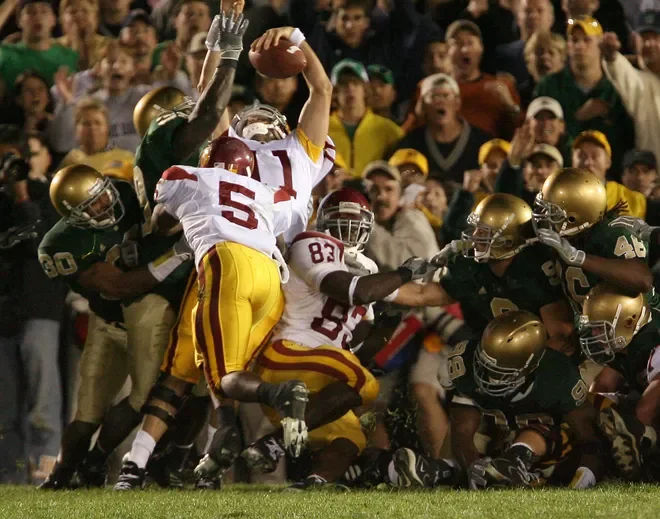
When Fox Sports' Joel Klatt ranked his top college football games since 2000, he put the 2005 Notre Dame–USC "Bush Push" game at No. 1 — and it's easy to see why the topic sparked a real "I remember watching it" reaction. That game alone is a masterclass in what makes a great football game: constant lead changes, a Heisman winner, a bitter rivalry, and an all-time controversial finish. But it's far from the only Notre Dame game from the last 25 years that belongs in the conversation. Here's a look at some of the games that define the Irish's modern era.
The Heartbreak: USC, 2005 — "The Bush Push"
This is the one that still stings, and the one that still gets brought up on podcasts two decades later. Unranked, four-and-one Notre Dame — in year one under Charlie Weis — hosted a USC team riding a 27-game win streak with two Heisman winners in the backfield. The lead changed hands throughout, with the Irish up 31-28 in the final minutes. USC drove into range, appeared to be stopped short of the goal line as time expired, and then Reggie Bush shoved quarterback Matt Leinart into the end zone on the game's final play — a shove that wasn't a penalty under the rules at the time. USC escaped 34-31. It remains one of the most replayed, most argued-about finishes in the sport's history, and it's the game most associated with Notre Dame in any "greatest games" conversation since 2000.
The Statement Win: Oklahoma, 2012
Notre Dame's 2012 season is remembered for the eventual national title game loss to Alabama, but the game that actually made that season feel real was a road win over Oklahoma. It was widely seen as the moment that vaulted the Irish from "surprising and undefeated" to legitimate national title contender — the win that made the rest of the country start taking Brian Kelly's team seriously. Notre Dame ran the table the rest of the regular season on the strength of that statement.
The Signature Upset: No. 1 Clemson, 2020
If Bush Push is Notre Dame's most famous loss of the era, the 2020 double-overtime win over top-ranked Clemson is arguably its most famous modern win. With Trevor Lawrence out due to COVID-19 and freshman D.J. Uiagalelei starting in his place, Notre Dame jumped out early, survived a furious Clemson rally that forced overtime, and then rode three touchdown runs from Kyren Williams — including the eventual game-winner — to a 47-40 victory. It ended Clemson's 36-game regular-season winning streak and gave Notre Dame its first win over an AP No. 1 team since 1993. Fans stormed the field in the middle of a pandemic; it was, by most accounts, the loudest Notre Dame Stadium had been in over a decade.
The Blowout Statement: USC, 2017
Not every great game has to come down to the final play. Notre Dame's 49-14 demolition of USC in 2017 stands out simply because of how rare it is for both programs to be ranked in the top 15 at the same time, as they were that October — the first time that had happened since the 2006 meeting. The Irish took control early and never let up, and it remains one of the most convincing wins of the rivalry's modern stretch.
The Road Classic: LSU, 2014 Music City Bowl
Notre Dame limped into this game on a four-game losing streak with Brian Kelly's job security being questioned nationally, a seven-point underdog against an LSU team with Leonard Fournette in the backfield. Instead, the Irish took the opening drive down the field for a touchdown and held on for a 31-28 win that's remembered less for the stakes and more for simply being an excellent, hard-fought football game at a moment the program badly needed one.
The Defensive Grind: Stanford, 2012
Before the Oklahoma win vaulted Notre Dame into title contention, the Irish had to get through Stanford — and they did it in overtime, 20-13, with a goal-line stand that's become one of the most replayed defensive sequences of the Kelly era. It wasn't flashy. It was Notre Dame playing exactly the kind of physical, run-the-ball, control-the-clock football that had, for years, been Stanford's own signature — and beating the Cardinal at their own game.
Why These Games Still Matter
What ties all of these together isn't just the final score — it's that each one reflects something bigger about where the program stood at that moment. Bush Push was Notre Dame announcing it was ready to compete with the sport's best again under a new coach. Oklahoma and Stanford in 2012 were the turning point that took the Irish to a national title game. LSU in 2014 was survival. Clemson in 2020 was proof the program could still win the biggest possible regular-season game against a genuine blueblood.
Twenty-five years in, it says something about Notre Dame's place in the sport that a Fox Sports analyst's list of the best games since 2000 — a list covering hundreds of games across every conference — still runs straight through South Bend.
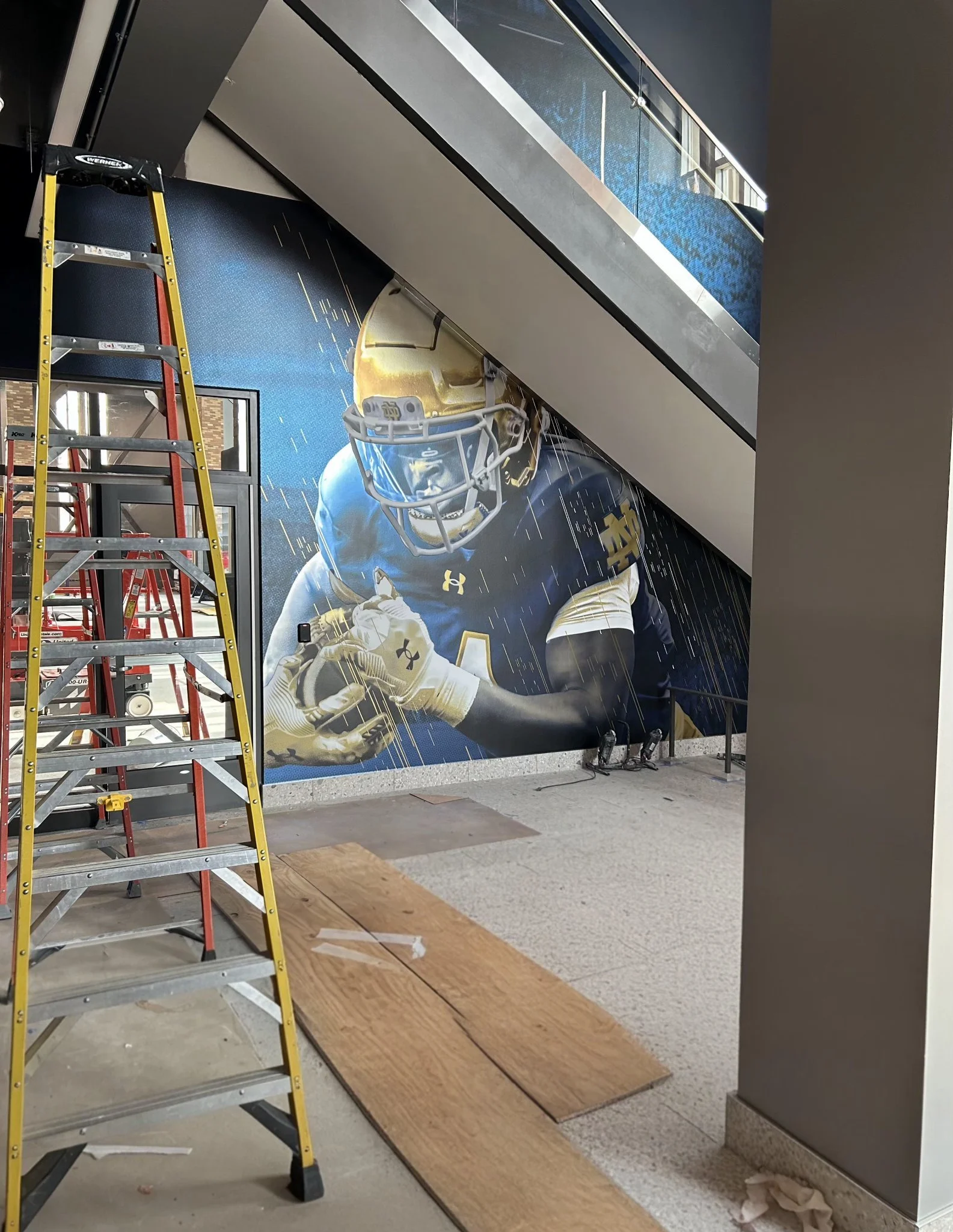
Shields Family Hall: How Notre Dame's New Football Home Reshapes the Program — On the Field and Off
When Notre Dame broke ground on the Jack and Kathy Shields Family Hall in the spring of 2024, it wasn't just another shovel-in-the-dirt photo op. It was a statement. Set to open this fall on Courtney Lane, the 150,000-square-foot facility represents a nearly 50% increase in football-dedicated space over the current Guglielmino Athletics Complex — and it arrives at a moment when facilities have become one of the clearest battlegrounds in college football's arms race.
What's Actually Inside
Shields Hall isn't just bigger locker rooms and shinier weight equipment. According to the university, the building will house advanced training and sports medicine facilities, an equipment room built around body-scanning and fabrication technology, and — maybe most notably — an on-site player nutrition area designed to let the program prepare meals directly rather than trucking them in from elsewhere on campus, as has been the case for years.
That last piece matters more than it might sound. Notre Dame athletic officials have talked about wanting the nutrition space to "foster community between teams and model healthy eating," which points to a broader philosophy: this building isn't just about building bigger, faster players. It's about building an environment players actually want to spend time in.
The project is being funded by a group of former Irish players led by ex-linebacker Jack Shields, along with fellow former players Pat Eilers and Dave Butler. That detail carries its own weight — it's not corporate money or a naming-rights deal with an outside company. It's alumni who played the game reinvesting in the infrastructure of the program that shaped them.
The On-Field Case: Closing the Facilities Gap
For years, Notre Dame's brass — including former AD Jack Swarbrick and head coach Marcus Freeman — have insisted facilities weren't the reason the program hadn't broken through to a national title. But "not the reason we're losing" and "not worth fixing" are two different things, and the athletic department has clearly decided this is a lever worth pulling.
Consider the timeline: the $400 million Crossroads renovation of Notre Dame Stadium in 2018, the Irish Athletics Center indoor practice facility in 2020, and now Shields Hall. That's a decade-plus of continuous, deliberate investment. Athletic director Pete Bevacqua has framed it directly — the goal is putting Notre Dame's infrastructure "on par with the big-hitting programs across the country, and then some."
Notably, Notre Dame officials reportedly toured Clemson's football facility before playing the Tigers, a small but telling detail — measuring yourself against the programs you're trying to beat, then building past them.
The Recruiting Angle
This is where a building starts to translate into actual roster talent. All-American cornerback Ben Morrison put it plainly at the groundbreaking ceremony: recruits notice. He spoke about how the Irish Athletics Center influenced his own decision to come to Notre Dame, closing his remarks with a simple line — facilities do matter.
That's not just a player being polite for the cameras. In modern recruiting, five-star prospects and their families are touring multiple campuses, often within days of each other, and physical impressions matter — the weight room, the nutrition setup, the sense that a program is investing in you specifically for the next four or five years. A tired, cramped, hand-me-down facility sends one message. A brand-new, purpose-built space with body-scanning tech and an in-house culinary operation sends another. Shields Hall gives Notre Dame's coaching staff a tangible, walkable answer to the "why here" question that comes up on every visit.
The Part Worth Watching: Notre Dame's Unusual Campus Culture
Here's where Notre Dame's situation is genuinely different from most of its Power Four peers, and it's worth sitting with for a second.
At a lot of major programs, football players increasingly operate in something close to a separate ecosystem — their own dorms, their own dining, their own daily orbit that barely intersects with the broader student body. Notre Dame has historically resisted that model. Its student-athletes live in the dorm system, eat in the dining halls, sit in the same classrooms, and are woven into campus life in a way that's become something of a point of pride for the university — part of the broader "student-athlete" identity Notre Dame likes to sell as central to its brand.
Shields Hall, by design, pulls more of a player's day-to-day life — training, meals, recovery, treatment — onto a self-contained football campus. That's the right move competitively. It's also a structural shift away from the integration that's long made Notre Dame's culture distinct.
None of this means Notre Dame is abandoning that identity overnight. But it's a dynamic worth monitoring as the building comes online this fall: as football life becomes more self-contained and professionalized, does the historic closeness between athletes and the broader student body hold, or does it quietly start to erode? Programs that have gone further down this road elsewhere have sometimes found that the more insulated an athletic operation becomes, the harder it gets to maintain that everyday connection to campus life — even when no one intends for that to happen.
For a program that has long branded itself as different from the professionalized model of college football, that tension between building a championship-level operation and preserving what makes Notre Dame Notre Dame is one of the more interesting subplots to watch once the doors open.
Bottom Line
Shields Hall is a clear, tangible investment in on-field performance and a legitimate recruiting weapon — the kind of facility that shows up in a highlight reel during an official visit and closes the gap with programs Notre Dame is chasing. But its bigger, quieter story might be about the second-order effects: what happens to Notre Dame's uniquely integrated culture as the football program becomes more self-contained. Worth watching once the building opens its doors this fall.
ESPN's College Football Future Power Rankings Have Notre Dame at the Top
When ESPN set out to rank all 68 Power Four programs in their future power rankings — evaluating quarterback situations, trench outlooks, roster management, star power and coaching staff quality with the kind of comprehensive rigor that separates serious analytical work from preseason speculation — the Fighting Irish came out on top.
Not second. Not in a group of three or four teams separated by fractions of evaluation points. First. Unambiguously, convincingly and with justification that holds up to scrutiny from every angle the evaluation touched.
This is not a sentimental ranking built on Notre Dame's brand, its history or the weight of its tradition. ESPN looked at what is actually on the field, what is being built in the recruiting pipeline, how the roster is being managed and who is coaching the program — and concluded that no program in the country is better positioned for sustained elite performance than Marcus Freeman's Notre Dame Fighting Irish.
The case begins with a quarterback whose growth and efficiency have already made him one of the most decorated signal callers in Notre Dame history. It runs through an offensive line that is finally deploying its elite talent in the right positions. It extends through a running back room with genuine dimension and a wide receiver group upgraded on every level. And it culminates in a defense that returns significant proven production while adding transfer portal talent to a revamped defensive staff that made the transition look seamless during spring practice.
Stack all of it together and the No. 1 ranking does not just make sense. It is the only honest conclusion.
CJ Carr — Growth, Efficiency and the Foundation of Everything
Every conversation about Notre Dame's 2026 ceiling begins in the same place — under center, with a redshirt sophomore quarterback whose growth from his first start to where he stands today represents one of the most impressive individual development arcs in college football.
CJ Carr did not arrive at Notre Dame's starting position through the transfer portal or through the kind of five-star recruiting coronation that precedes some quarterbacks before they ever take a college snap. He developed — through the program's system, under the coaching staff's instruction and through the accumulated experience of an entire season of starting at Notre Dame — into exactly what ESPN's Adam Rittenberg described as a national awards contender.
The statistical foundation that justifies that description is historically significant. Carr's 168.06 passer rating from the 2025 season was a Notre Dame program record — surpassing the previous mark held by Jimmy Clausen, a quarterback whose 2009 season is still discussed as one of the most polished individual performances in Notre Dame's quarterback history. Breaking a program record in your first year as a starter is not a product of circumstance. It is a product of genuine excellence sustained over the course of a full season against Power Four competition.
The efficiency numbers amplify the record even further. Carr completed 66.6 percent of his passes — fourth best single-season mark in Notre Dame program history across every era of Fighting Irish football. He threw 24 touchdowns against just six interceptions — and four of those six interceptions came in his first two starts, the natural adjustment period of a first-year starter navigating varsity speed for the first time. In his final ten starts of the season, Carr threw four interceptions across ten games — a turnover rate that matches the best decision-making quarterbacks in the country regardless of experience level.
The deep ball numbers are equally impressive and perhaps more revealing about what kind of quarterback Carr truly is. Eight touchdowns and zero interceptions on passes of 20 yards or more — a statistical combination that reflects both the arm talent to challenge defenses vertically and the decision-making discipline to never force throws in the most high-risk areas of the field. Zero interceptions on deep passes across an entire season is the kind of number that NFL scouts and Heisman voters notice immediately because it is so rare and so meaningful as a predictor of elite quarterback performance.
His yards-per-attempt average of 9.4 ranked second among all returning quarterbacks in the entire country — not second in the ACC, not second among independent programs, but second nationally among every returning signal caller in college football. That number reflects efficient, high-value passing that consistently moves the chains, creates explosive plays and maximizes the production value of every throw rather than accumulating yards through volume and check-downs.
The November elevation that Sporting News specifically cited in their No. 3 national quarterback ranking — a passer rating of 170.2 in the final month of the regular season — confirms what the full-season numbers suggest and then exceeds it. Carr was better in November than he was in September. He was better when the schedule was harder, the stakes were higher and the defensive preparation against him was most sophisticated. That late-season elevation is the single most reliable indicator that a quarterback's development is genuine, sustainable and pointed toward something significantly better in year two.
The growth from his first start against Miami in 2025 — when the country got its initial look at a talented but unproven first-year starter navigating an elite opponent in a high-pressure environment — to the polished, confident and statistically dominant quarterback who closed that season and walked into spring 2026 as the program's unquestioned leader is as dramatic an individual development arc as any quarterback in the country produced over the same period.
Entering 2026 with that foundation behind him — the record passer rating, the elite completion percentage, the zero deep-ball interceptions, the November elevation and a full offseason of development with Mike Denbrock building a system specifically around his strengths — Carr is not just one of the five best returning quarterbacks in the country. He is making a genuine and credible case to be the best. And the structure surrounding him in 2026 gives that case more supporting evidence than any other quarterback in college football can claim.
The Offensive Line — Elite Talent Finally in the Right Places
The offensive line evaluation is where ESPN's future power ranking for Notre Dame gets most specific and most optimistic — and for good reason. The unit that Joe Rudolph is sending onto the field in 2026 is the most thoughtfully constructed and positionally appropriate starting five he has assembled since his arrival in 2023, when Joe Alt and Blake Fisher gave Notre Dame a bookend tackle pair that now starts in the NFL.
The interior of this offensive line returns experienced, battle-tested starters whose collective knowledge of Notre Dame's blocking schemes and protection concepts gives the unit a communication and cohesion that young tackle prospects need around them to develop effectively. Ashton Craig returns at center as a legitimate Rimington Trophy contender — a distinction that reflects both the quality of Craig's individual performance and the critical importance of his role as the unit's communicator and pre-snap processor. Craig's ability to identify defensive alignments, make protection calls and ensure that every blocker on the unit is operating from the same information on every snap is the infrastructure that makes everything else on the offensive line function.
Anthonie Knapp returns at left guard — now settled into the position where Rudolph and the staff believe his ceiling is highest after two years of starting at left tackle. The move inside is not a demotion but a correction — putting a talented, experienced blocker in the alignment where his power at the point of attack, his ability to anchor against interior rushers and his two years of starting-caliber experience are most powerfully expressed. Knapp at left guard entering 2026 is a significantly more dangerous player than Knapp at left tackle — and the unit benefits immediately from having his experience and physicality deployed in the right place.
Sullivan Absher completes the interior at right guard with the competitive hunger of a redshirt junior who has waited for exactly this starting opportunity. Players who earn starting roles through development and patience rather than through recruiting star ratings tend to play with a chip-on-the-shoulder energy that makes them among the most consistently effective contributors on any offensive line — and Absher enters 2026 with every motivation to prove that the wait was worth it for both himself and the program.
The bookend tackles are where this offensive line's ceiling lives and where the most exciting development stories of the 2026 season will unfold. Will Black — a five-star recruit whose length, athleticism and pass protection tools have always projected to the blindside tackle position — takes over at left tackle for what should be a transformative first full season protecting Carr's blind side. The growing pains of a first-year starting left tackle against Power Four edge rushers are a normal and expected part of the development process — but the ceiling that Black is building toward as those growing pains accumulate into experience and confidence is the kind that changes what a program's offensive line can be for multiple seasons.
Guerby Lambert at right tackle is the complementary story — a five-star recruit from the 2024 class finally operating at the position where his physical profile projects most naturally for a full season as the unambiguous starting right tackle. Lambert's combination of size, length and athleticism gives Notre Dame a potential true bookend pair with Black on the left side — the first time since Alt and Fisher that Rudolph has had that configuration available — and the results of a full season with both tackles in their natural positions could finally deliver the dominant unit that the talent in this room has always suggested was possible.
The potential return of Charles Jagusah — a five-star recruit whose development has been delayed — adds yet another elite-recruited option to a depth chart that is already one of the deepest Rudolph has had since his arrival. The depth and quality of this offensive line room entering 2026 is genuinely exceptional — and the configuration finally matches the talent with the positional assignments that maximize every player's individual ceiling.
The Running Back Room — Dynamic Talent Ready to Carry the Load
The departure of Jeremiyah Love — the No. 3 overall pick in the NFL Draft — is the most significant personnel loss Notre Dame faces on offense heading into 2026. Love was one of the most dynamic running backs in college football, a unanimous All-American whose big-play capability and consistency defined Notre Dame's ground attack across two seasons and made him one of the most celebrated players in the program's recent history.
But the Irish are not rebuilding the backfield. They are reloading it — with a group of talented, complementary backs whose collective skill set gives Mike Denbrock's offense a multi-dimensional ground game that can attack defenses in ways that a single-back approach never allows.
Aneyas Williams steps into the featured role with the physical tools, competitive instincts and playmaking ability to make the transition from Love to the next era of Notre Dame running back excellence as smooth as the talent in the room allows. Williams's combination of acceleration, vision and contact balance gives the Irish a back who can operate effectively in Notre Dame's zone-blocking scheme — identifying cutback lanes, setting up blocks and accelerating through holes before defenders can close them with the quickness that makes him a natural fit for the concepts Denbrock calls most frequently.
Williams's versatility as a receiver out of the backfield adds a dimension to Notre Dame's passing game that forces defensive coordinators to honor the check-down and screen game on every snap — pulling linebackers and safeties into coverage assignments that open the intermediate passing windows where Carr's accuracy and anticipation are most devastating. A running back who can genuinely threaten defenses both between the tackles and in the passing game is one of the most valuable offensive assets any coordinator can have — and Williams brings both dimensions to Notre Dame's 2026 backfield.
The depth behind Williams gives Denbrock genuine flexibility in how he deploys the ground game. Multiple capable backs with different physical profiles and running styles creates the kind of schematic variety that keeps defensive coordinators from settling into comfortable run defense adjustments — because the same blocking scheme produces different looks when different runners are operating behind it.
The collective expectation for Notre Dame's 2026 running back room is not to replace what Love provided individually but to provide what the room as a whole can produce collectively — and the talent assembled gives the Irish offense every reason to believe that collective production will be more than sufficient to keep the ground game a genuine threat that defenses must account for on every single snap.
The Wide Receiver Room — More Weapons Than CJ Carr Has Ever Had
If the offensive line case for Notre Dame's No. 1 ranking is built on positional construction and the running back case is built on dynamic talent filling a significant departure, the wide receiver case is the most straightforwardly exciting component of the entire offensive evaluation — because the group Carr is throwing to in 2026 is simply better than any receiver room he has had available in his Notre Dame career.
Jordan Faison returns as the established and proven No. 1 option after leading Notre Dame with 40 receptions, 640 yards and four touchdowns in 2025 — the team's leading receiver, produced while sharing a room with Malachi Fields and Jaden Greathouse. Faison's decision to give up lacrosse and commit entirely to football this offseason is the kind of singular focus investment that produces significant statistical leaps — and the Carr-Faison connection that produced 40 catches in a season where Fields was the projected No. 1 option is primed to become something even more dominant when Faison enters 2026 as the unambiguous first read with an undivided preparation investment behind him.
Jaden Greathouse brings the explosive playmaking dimension that makes Notre Dame's receiver room genuinely dangerous rather than simply functional. Greathouse's combination of separation quickness, yards-after-catch capability and big-play instincts — demonstrated emphatically in Notre Dame's 2024 postseason run — gives Carr a receiver who can take a short completion and turn it into a long gain, a slant route and turn it into a crossing score and a go ball and create the kind of contested-catch opportunity that changes field position in an instant. Pair Greathouse's explosion with Faison's reliable production and Notre Dame presents opposing secondaries with a No. 1 and No. 2 receiver combination that is as difficult to defend as any in the country.
The transfer portal additions elevate the room from very good to genuinely elite. Mylan Graham arrives from Ohio State with Big Ten starting experience, proven production at one of the most demanding programs in college football and the physical tools that made him a highly coveted recruit before his time at Ohio State. Graham does not need to be the No. 1 receiver or carry the production load to be enormously valuable — he needs to be a legitimate third option who punishes defensive coordinators for the coverage attention they devote to Faison and Greathouse. With the coverage bracket that those two demand, Graham will see single coverage against the best corner available on a given defense — and his Ohio State-tested talent gives him every tool to make opposing teams pay for that coverage decision.
Quincy Porter provides additional receiving depth from the same Ohio State program — another experienced, proven pass catcher who brings Big Ten competition reps to a Notre Dame receiver room that needed exactly this kind of experienced depth to complement its returning talent.
Three legitimate receiving threats with different physical profiles, different route-running styles and different strengths within the passing game — backed by experienced portal additions who contribute immediately and meaningfully to the room's depth and versatility. The receiver room Carr inherits in 2026 is the best he has ever had and one of the most complete groups in college football heading into the season.
The Defense — Proven Production Returns, Elite Additions Bolster the Front
While the offensive case for Notre Dame's No. 1 ranking builds from quarterback to skill positions to the line, the defensive case begins and ends with a simple and powerful truth — the production that made Notre Dame's defense one of the best units in the country late in the 2025 season is returning at a remarkably high rate, and the additions made through the transfer portal have addressed the few areas where reinforcement was genuinely needed.
Leonard Moore is the centerpiece of everything Notre Dame does defensively in 2026 and the most important returning player on the entire roster. The best cornerback in college football — PFF's No. 1 ranked returning cornerback for the second consecutive season — enters 2026 as the consensus Thorpe Award favorite after earning first-team unanimous All-America honors in 2025. Moore's 91.4 coverage grade and 90.9 overall defensive grade led all Power Four starting cornerbacks. He led Notre Dame with five interceptions while being targeted on only 11.5 percent of his coverage snaps — the ultimate testament to a cornerback so dominant that the entire country's offenses chose to scheme away from him rather than challenge him.
With Moore locking down one side of the field, the rest of Notre Dame's secondary carries a freedom and flexibility that makes the entire defensive system more dangerous. Christian Gray returns as a proven secondary contributor whose versatility allows defensive coordinator Chris Ash to present multiple coverage looks without sacrificing quality at any individual position. The addition of DJ McKinney from Colorado via the transfer portal gives the secondary a third proven option — a player with starting experience against Power Four competition who slides into a complementary role alongside Moore and Gray and completes what ESPN identified as potentially the biggest strength on Notre Dame's entire 2026 roster.
Adon Shuler returns at safety with the kind of range, instincts and ball-hawking ability that make him one of the most exciting developmental stories in Notre Dame's defensive backfield. His presence in the deep middle — rotating into coverage, supporting the run and creating the kind of turnover opportunities that change field position and momentum — gives Ash's secondary a complete, complementary set of pieces that no passing game can attack with a single schematic approach.
The linebacker corps is anchored by Drayk Bowen — one of the most complete linebackers in college football and the defensive engine that makes Notre Dame's second level function at its highest capacity. Bowen's combination of run-stopping physicality, coverage range and pre-snap processing intelligence gives the entire defense a communicator and lead tackler who elevates every player around him. His return alongside the developing linebacker talent around him gives Brian Jean-Mary — veteran defensive assistant now overseeing the linebacker group — proven production to build around from day one.
The Defensive Line — Transfer Additions Transform an Already Talented Front
The most dramatic and consequential roster construction development on Notre Dame's defensive side heading into 2026 is the transformation of the defensive line through a combination of proven returning contributors and high-impact transfer additions that address the program's most critical pass rush needs.
Boubacar Traore returns as Notre Dame's most dangerous and most disruptive pass rush weapon — a junior edge whose combination of first-step quickness, motor and technical pass rush arsenal makes him a consistent threat to influence every passing down. Traore's presence gives Ash's defensive front a proven, established disruptive force that new additions can complement rather than replace — the difference between addition by addition and addition by multiplication when it comes to what a defensive line can become collectively.
Bryce Young returns as a versatile and experienced contributor whose ability to line up in multiple positions along the defensive front gives Ash the flexibility to create different alignments and present different problems to opposing offenses without sacrificing individual quality at any spot. Young's experience and positional versatility are the kind of foundational traits that make an entire defensive line unit more difficult to prepare for — because the combinations he enables on the front are more numerous and more creative than a less flexible roster allows.
Jason Onye provides senior-level experience and established production at the defensive tackle position — a player whose understanding of what Notre Dame's defensive system demands and what elite college football competition requires gives the younger contributors on the defensive line a standard to measure themselves against and a guide to follow in the most demanding preparation moments of the week.
The transfer additions are where the defensive line story becomes genuinely transformative. Francis Brewu arrives from Pittsburgh with a national reputation as one of the most physically dominant interior defensive linemen in the transfer portal — a player whose combination of power, leverage and relentless effort at the point of attack gives Notre Dame's front an interior disruptive presence that immediately elevates the entire unit's run-stopping and pass-rushing capability. Brewu's Pittsburgh experience against ACC competition means his transition to Notre Dame's defensive system is not a leap into the unknown but a progression within a competitive environment he already understands.
Keon Keeley arrives from Alabama with the pedigree and physical tools that made him one of the most coveted defensive line recruits in his class — and the development infrastructure of Alabama's program having already invested significant time and resources into maximizing his potential. Keeley gives Notre Dame an edge presence whose ceiling, if fully realized under Ash's system and Partridge's coaching, could be the most disruptive individual defensive line performance the Irish have produced in years.
Tionne Gray from Oregon rounds out the transfer additions with starting experience and proven production from a Pac-12-level program — a player whose senior eligibility makes him the most immediately impactful of the three portal additions in terms of on-field availability and competitive readiness.
A New Defensive Staff That Hit the Ground Running
The most compelling subplot of Notre Dame's defensive preparation heading into 2026 is the transition to a reshaped defensive staff — and how smoothly that transition appears to have gone during spring practice despite the significant personnel changes that coordinator Chris Ash made to his unit this offseason.
Aaron Henry joins the staff to coach defensive backs, reuniting with Ash in a configuration that the coordinator knows and trusts from previous stops in his coaching career. The comfort and communication between Henry and Ash — built on an existing professional relationship — eliminates the adjustment period that typically accompanies new staff additions and allows the defensive back group to benefit from coaching cohesion from the very first practice of the spring.
Charlie Partridge takes over the defensive line — a coach whose recruiting track record and development philosophy give Notre Dame's front seven a proven leader whose ability to maximize pass rush talent and interior disruption is already on display in the 2027 recruiting class, where he landed the No. 2 defensive tackle in the country in David Folorunsho during his first recruiting cycle.
Brian Jean-Mary's oversight of the linebackers completes a defensive staff whose collective experience and internal cohesion make the transition from the previous staff configuration feel less like a rebuild and more like a refinement.
The spring practice reports that emerged from the new defensive staff's first extended look at the roster were encouraging across the board — a unit that absorbed significant coaching change, integrated transfer additions and developed communication between new coaches and returning players with a smoothness that reflects both the quality of the coaches Ash brought in and the leadership of the veteran players already in the building.
A defensive staff transition that goes well in the spring is not a guarantee of autumn dominance — but a transition that goes poorly in the spring is almost always visible in September. Notre Dame's spring went well. The foundation for what this defense can become in 2026 under its new coaching configuration is as solid as any rebuilt staff could reasonably hope to establish in a single spring session.
The Bottom Line — No. 1 is Not a Gift. It Is a Grade.
ESPN evaluated 68 Power Four programs. They looked at quarterback situations, trench outlooks, roster management philosophies, collections of star power and coaching staff quality. They graded every program with the analytical rigor that separates meaningful future power rankings from preseason popularity contests.
Notre Dame came out No. 1.
Not because of history. Not because of brand. Not because of 11 national championships and one of the most famous stadiums in American sports. Because of CJ Carr's historically efficient first year and the second-year leap that every indicator supports. Because of an offensive line finally deploying its elite bookend talent in its natural positions. Because of a dynamic, versatile running back room. Because of a receiver group more talented and more experienced than any Carr has had available. Because of Leonard Moore being the best cornerback in America and Drayk Bowen being one of the best linebackers. Because of Brewu, Keeley and Gray transforming a defensive line that was already talented. Because of a new defensive staff that transitioned smoothly and a head coach who turned down the NFL to keep building something in South Bend.
Phil Steele has Notre Dame No. 1 in his preseason rankings. ESPN has Notre Dame No. 1 in their future power rankings.
The program that Marcus Freeman has built did not get to the top of those lists by accident.
It earned every spot.
Charlie Partridge looking to turn up the pressure
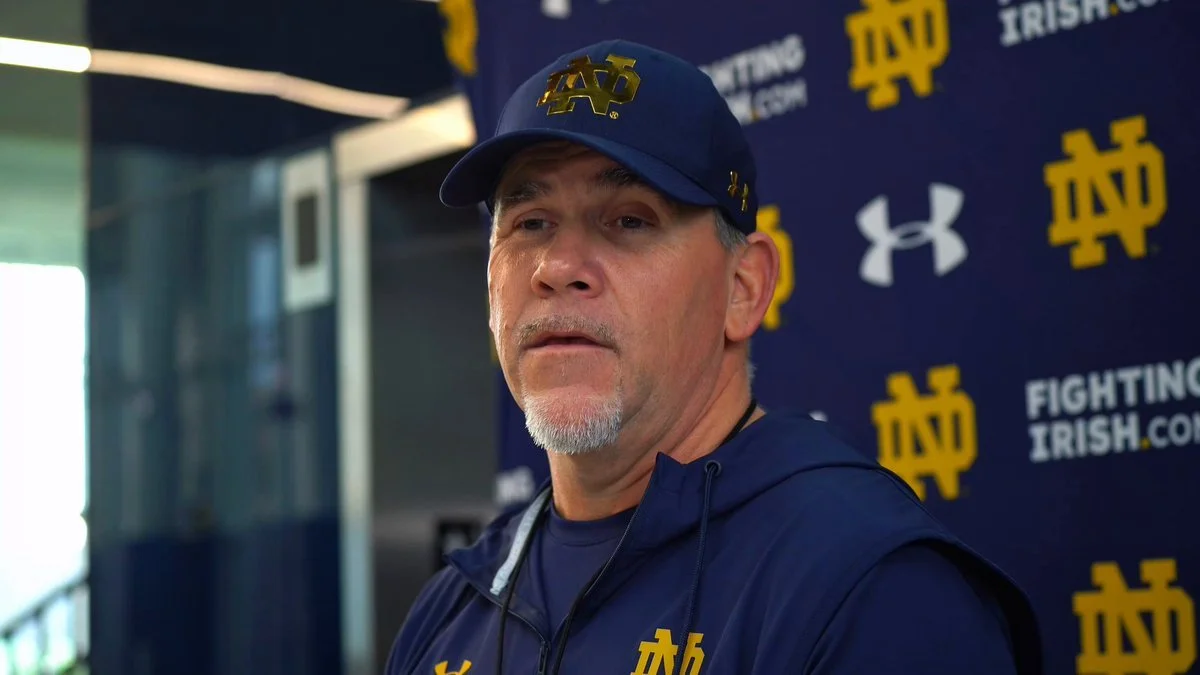
The impact of new defensive line coach Charlie Partridge was on display as several Irish defensive linemen met with the assembled media after their seventh practice. Before they walked to the podium, their new leader shared his thoughts on how he’s re-shaping how the front four has been challenged to focus on consistently pass rushing collectively. .
Last season, the Irish sacked opposing quarterbacks 43 times and hurried them 210 times, but they were key moments in games where they allowed open lanes for players like Texas A&M quarterback Marcel Reed to scramble for first downs. Partridge has set the tone for his position room by setting a focus for each day.
“We're leaning in on pass rush lanes. I know Coach Freeman talked about that the other day with the media group.”
“That's something we've put a big emphasis on while still pass rushing aggressively, pass rushing together as a unit. Because so many times, if you don't pay attention to that, you may have somebody have a great rush and win on one side, but if you're not in good lanes on the other, it was for naught. So we put a big focus on that, and today's focus, like I said, was aggressively attacking our keys in the run.”
As he learns his athletes, Partridge has been able to lean on the familiarity he has with defensive coordinator Chris Ash to help with his transition. The relationship is built on mutual respect with an understanding that disagreement is not about personal feelings. They haven’t worked together since 2013, when they were both on the Arkansas Razorback staff. However, they’ve always been in contact with one another, including last season when he was a defensive line coach in the NFL for the Indianapolis Colts.
“It's kind of what I said when I got here, guys. I mean, me and Chris, our background goes so much. We've been through so much together in the football world that we can argue or discuss things that maybe we don't see the same way, and there's no feelings. You don't have to worry about hurting each other's feelings. Even if we get to a point where we're maybe arguing about something, it's all about getting together and getting on the same page, and then it's very, very healthy. He hasn't let me down one bit.”
“It's been a while since we've worked together. Last time we were together was Arkansas in 2013. Yeah, it was 2013, so it's been a while, but we talk all the time, and he's exactly what I knew he would be.”
With returning edge rushers like Boubacar Traore and Bryce Young, and the additions of defensive tackle transfers Francis Brewu and Tionne Gray. the Fighting Irish are working hard during spring practices to have four pass rushing threats that should lead to a more disciplined and consistent rush for opposing offenses. The linebacking corp added 13.5 sacks last season, but that number could decrease if the plans being laid by Partridge and his players continue to manifest through the rest of spring and fall camps into the regular season.