
4-star DT Brayden parks chooses notre dame over oregon
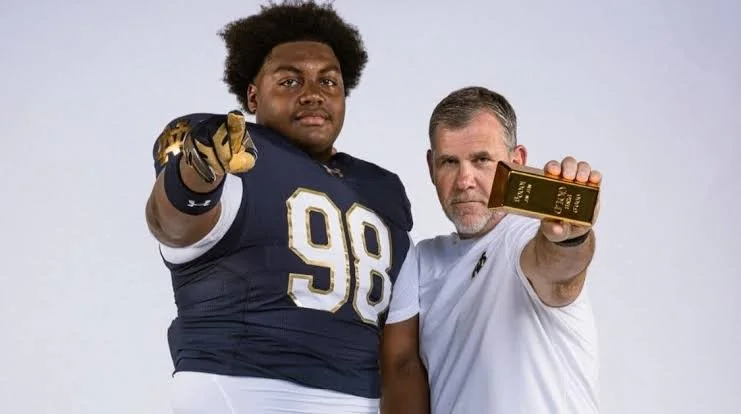
For nearly three years, Brayden Parks was one of the most coveted names on Notre Dame's board. On Thursday, that pursuit finally came to an end when the four-star Brother Rice defensive tackle put pen to paper — or, in this case, made his announcement on a CBS Sports special — and chose the Fighting Irish over Oregon in one of the more drawn-out recruitments of the 2027 cycle.
Speaking with Irish Breakdown afterward, Parks summed up just how long the process had felt: "Everything feels like a relief, honestly. I've been going through this recruiting process since my freshman year — coaches reaching out, trying to contact my family, all that. But now that it's over, I feel relieved. From that camp last year until now, man, it feels like it's finally come true."
But to understand why this commitment means so much to Notre Dame's program, you have to go back to where it started: a performance at Irish Invasion that first turned heads in South Bend, and a coaching relationship that very nearly didn't survive to see the finish line.
Long before Parks became a household name in recruiting circles, Notre Dame's staff had circled him as a priority target. That belief was reinforced during his showing at Irish Invasion in the summer of 2025, Notre Dame's marquee on-campus recruiting camp. Evaluators who watched him that day came away convinced that his twitch and explosiveness at his size — he was already pushing 305 pounds — put him in a different tier than most interior linemen his age. It's the kind of performance that gets internally referenced for years afterward whenever a staff needs a reminder of why a prospect was worth fighting for.
That early standout showing set the tone for what would become one of the more significant recruiting battles of the cycle, and it cemented a truth that would hold for the better part of two years: Notre Dame was not going to let Brayden Parks leave the board without a fight.
The Washington-Sebastian Connection
At the heart of Notre Dame's pursuit was the relationship Parks built with then-defensive line coach Al Washington and defensive line assistant Nick Sebastian. Washington, who joined Marcus Freeman's original 2022 staff after previously coaching linebackers at Ohio State and Michigan, built a reputation as one of the more respected recruiters in the country — he was later recognized as a top-10 recruiter nationally for his work on the 2026 class. Sebastian, who followed Washington to South Bend from Columbus that same year, became just as central to the Chicagoland pipeline, playing a lead role in landing five-star edge Rodney Dunham for the 2026 class.
For a Chicago prospect like Parks, that combination mattered. Washington and Sebastian weren't just recruiting him from a distance — they were regulars in the building at Brother Rice, familiar faces who built the kind of trust that's hard to replicate overnight. It's the kind of groundwork that had Notre Dame firmly entrenched as the perceived frontrunner for much of Parks' recruitment, well before his final decision ever became a two-team race.
Parks himself made that clear speaking with Irish Breakdown after his announcement, describing just how far back the relationship went: "I've been talking to Coach Washington since my freshman year, the first time I went out there. He's been there since I started this whole thing." When Washington's move to the NFL came up, Parks didn't hesitate to speak well of it: "I'm happy for him. It's a huge step up in his career. I'm grateful for what he did, and Coach P picked up right where he left off."
A Crack in the Foundation
Then came January.
In the span of about a week, Notre Dame's defensive staff was gutted by the NFL. Secondary coach Mike Mickens left for the Baltimore Ravens on January 25. Days later, Washington — who had just been shifted from defensive line coach to linebackers coach following Max Bullough's departure — announced he was leaving to coach linebackers for the Miami Dolphins under new head coach Jeff Hafley. It marked the third defensive assistant Notre Dame lost to the NFL in a matter of weeks, and it meant the Irish would be replacing position coaches at every level of the defense heading into 2026.
Freeman moved quickly to stabilize the room, hiring veteran defensive line coach Charlie Partridge to take over up front. But for a recruitment as relationship-driven as Parks', Washington's exit still mattered. It didn't sever the pipeline — Sebastian stayed on and remained a constant presence — but it did open a window that programs like Oregon were happy to climb through. Over the following months, the Ducks built real momentum, and at various points the industry buzz around Parks trended firmly in Oregon's direction. Ohio State and Michigan also lingered in the periphery of the process without ever fully displacing the top two.
What had once looked like it might be a formality turned into a genuine dogfight. The last several months of Parks' recruitment played out like an endurance test rather than a sprint — visits, momentum swings, and a decision date that kept extending as both Notre Dame and Oregon dug in for the long haul.
Closing the Gap
When Washington left, he didn't just leave behind a coaching vacancy — he left behind a standard. Sources close to the program had made clear that Washington and Notre Dame were prepared to do whatever it took to land Parks, and it fell on Charlie Partridge to carry that same energy into the final stretch without missing a beat.
Partridge didn't waste time trying to build something from scratch. But it wasn't a one-way effort. Rather than treating the coaching change as something that put the burden of relationship-building entirely on the new guy, Parks did his own homework on Partridge before they'd even met in person — digging into his background, his coaching stops, his track record in the NFL. It's a small detail, but it says a lot: Parks wasn't just being recruited by Notre Dame at that point, he was actively buying in. That kind of initiative from a prospect is often as telling as anything a coaching staff can do, and it's part of why the Irish never fully lost their footing even after Washington's departure.
That effort paid off in a memory Parks says he'll carry for a while. Recalling the first time the two actually met in person, he told Irish Breakdown: "The first time I actually met him, we were in my head coach's office taking a picture, and he tried to demonstrate a double-team drill — next thing you know, he slipped and busted his head open on the TV. That's one of those long-lasting memories me and Coach P will have forever."
Partridge and Sebastian didn't let the momentum stay with Oregon for long. Notre Dame hosted Parks for a pivotal official visit in June, part of a loaded weekend built around several of the program's top remaining defensive line targets for the cycle. By July, Parks had trimmed his list to two: Notre Dame and Oregon.
He set his commitment date for Thursday, July 23, and after weeks of speculation that could have gone either way, he chose the Irish.
By the Numbers
Recruiting services have tracked Parks closely throughout his high school career, and while individual grades have varied slightly by outlet, the four-star consensus has been consistent for over a year:
247Sports: Ranked him among the top defensive linemen in the 2027 class and the No. 7 prospect in Illinois, with 247Sports' individual metric rating him even higher than the industry composite.
Rivals: Slotted him as the No. 185 overall prospect, the No. 22 defensive lineman, and the No. 7 player in the state of Illinois in its industry ranking.
ESPN: Included Parks in its national recruiting rankings as one of the top interior defensive line prospects in the cycle, maintaining a recruiting profile that tracked his offer list as it grew to more than 40 schools.
On the field, MaxPreps logged Parks with 44 total tackles, six tackles for loss and two sacks as a junior in 2025 across 13 games, helping anchor a Brother Rice defense that won the CCL/ESCC Blue title and an IHSA 7A state championship. He was named the conference's Defensive Player of the Year for his efforts — a testament to an interior presence that scouts describe as disruptive against both the run and the pass, with an advanced hand-usage package for a player his age.
The Scene at Brother Rice
The energy inside the athletic building on commitment day was hard to miss. The school's top-ranked baseball team was in the middle of a summer league game outside, and the football team had just wrapped its final practice of the summer session before the state-mandated dead period ahead of fall camp. Walking past the locker room, players were still peeling off practice gear, showering, and changing into shirts and ties for the ceremony — more than a few of them trading excited chatter about Notre Dame and Marcus Freeman as they made their way toward the school's forum.
Throughout the process, Marcus Freeman was a steadying influence for Parks, and it went beyond what the program could offer on the field. Parks pointed to what Notre Dame provides outside of football as a major factor in his decision, and Freeman stood out among the other head coaches recruiting him for the way he showed genuine care for him as a person, not just as a football player. "Coach Freeman is a great person in general. He's a player's coach — he cares more about the person than the football player. That's one of the reasons I wanted to play for a guy like that. He cares about you and your family, not just when things are good, but whatever you're going through."
By the time the forum filled with teammates, coaches, administrators and family, the moment carried a weight that went beyond recruiting. The Brother Rice community is still grieving the loss of 2026 graduate and former football player Patrick Noonan, who died in a car accident on July 18 — just days before Parks' announcement. It was the kind of backdrop that made clear this was about more than one player's decision; it was a program and a school leaning on each other.
Parks took the moment in stride, thanking God, his parents, his sister, extended family, coaches, teachers and teammates before revealing the news — unzipping his jacket to show the Notre Dame logo underneath, officially closing the book on one of the more hard-fought recruitments in recent Chicago history. Asked what Fighting Irish fans should expect from their newest commit, Parks kept it simple: "They're getting a smart, disciplined, dominant defensive lineman."
What It Means Going Forward
Parks becomes the latest piece in what's shaping up as one of the more talented defensive line hauls of the Freeman era. He also arrives with family ties to the program, adding another layer to a recruitment that, in the end, came full circle back to where it started — with the relationships Notre Dame built long before the rest of the country came calling.
Parks' commitment also puts into focus just how much ground Notre Dame has made up in Chicago under Freeman. He joins St. Patrick's David Folorunsho and Mount Carmel's Roman Igwebuike as three of the best defensive prospects to come out of the city in this cycle — all of them products of programs that compete within the same Chicago Catholic League football alignment. Landing all three gives the Irish a defensive haul that's arguably the best in the entire 2027 class, and it's the kind of local sweep Notre Dame hasn't been able to pull off in years.
That matters because Notre Dame needed exactly this kind of moment. For a stretch under Freeman, the program had drifted to the outside looking in on some of Chicago's premier talent, watching top-tier recruits build relationships elsewhere before the Irish ever got a real shot. Parks' commitment — paired with Folorunsho and Igwebuike — signals that the hard work Freeman and his staff have put in has shifted the calculus. Notre Dame is no longer playing catch-up in its own backyard; it's back to being the offer Chicago kids grow up dreaming about.
The early returns for 2028 back that up. Notre Dame is already involved with several of the top uncommitted prospects in the Chicagoland area, and the brand is shining brightest with two names that happen to be Parks' own teammates at Brother Rice: five-star edge Kameron McGee and four-star tight end Jack McNamara. Both have been building relationships with the Irish staff, and having their own guy already in South Bend only strengthens Notre Dame's hand.
And Parks doesn't plan on sitting back and watching it happen from a distance. He made clear after his announcement that he considers this a homecoming, and that recruiting his own teammates to join him at Notre Dame is very much part of the plan.
But this moment wasn't just significant for Notre Dame. It carried just as much weight back home at Brother Rice.
For years, the standard in the Chicago Catholic League has been Mt. Carmel, the program Casey Quedenfeld and the Crusaders have been chasing since he took over. Brother Rice's rise — capped by last fall's IHSA 7A state championship — has started to close that gap, and Parks has become the face of that ascension. A recruit of his caliber, drawing this level of national attention, is a signal that Brother Rice can now stand toe to toe with the league's traditional powerhouse rather than living in its shadow.
Parks is also, by a wide margin, the highest-rated recruit to come through the program in recent memory, and the reaction inside the forum made clear how much that means to the people around him. When he pulled back his jacket to reveal the Notre Dame logo, the room didn't just applaud politely — it erupted, teammates and classmates included, a reflection of just how beloved he is inside that building and how much his teammates had been waiting for this moment right alongside him.
It wasn't a clean, wire-to-wire recruitment. Washington's departure tested it, Oregon pushed it to the brink, and the final months demanded patience from a coaching staff that refused to let go. But for Notre Dame — and for Brother Rice — Brayden Parks was always worth the fight.
chicago’s elite Defensive Tackle David Folorunsho Brings Top-10 Talent to Notre Dame
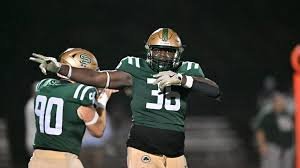
Notre Dame has landed one of the most uniquely gifted defensive tackles in the 2027 recruiting class, securing a commitment from Chicago's David Folorunsho — a St. Patrick standout whose combination of explosive speed, raw power and positional versatility makes him precisely the kind of defensive lineman that transforms how a coordinator can build and deploy a front. And in a story woven together by deep Notre Dame relationships at every level of his development, Folorunsho's path to South Bend feels less like a recruiting victory and more like an inevitable homecoming.
Folorunsho chose Notre Dame over Miami, Georgia, Michigan and Texas Tech, handing first-year defensive line coach Charlie Partridge one of the most significant early recruiting wins of his tenure and giving the Fighting Irish a cornerstone piece for a defensive front that is being built to play multiple looks, confuse offensive lines and dominate from the inside out.
A Swiss Army Knife on the Defensive Front
The first thing that jumps off the film when you watch David Folorunsho is that he doesn't fit neatly into a single box — and that is exactly what makes him so dangerous, and so valuable to Notre Dame's defensive system.
At 6-3 and 285 pounds, Folorunsho has the size, anchor and power to line up as a true nose tackle and own the interior against the run. But what separates him from a conventional space-eater is the explosion and lateral athleticism that allow him to slide outside, line up over a tackle and win in ways that interior linemen simply aren't supposed to win. He can two-gap, he can shoot gaps, he can be a three-technique on one snap and a nose on the next. That ability to play multiple alignments without losing effectiveness is rare at any level of football — at the high school level, it is almost unheard of.
For Notre Dame's defensive staff, this versatility is not a bonus — it is the foundation of why they wanted Folorunsho so badly in the first place. The ability to present different fronts, shift alignments pre-snap and keep offensive lines off balance requires players who can execute in multiple roles without hesitation. Folorunsho is exactly that player. He gives defensive coordinators a true chess piece — someone who can be the answer to multiple problems on any given game plan.
Explosive Speed That Redefines What an Interior Lineman Can Do
What truly elevates Folorunsho into the conversation as a national top-10 prospect is a first step that simply does not belong on a 285-pound defensive tackle — and yet there it is, every single snap, blowing up offensive linemen before they can establish their sets.
His get-off is elite. The moment the ball moves, Folorunsho is already in the backfield mentally and closing on the quarterback or ball carrier physically. That kind of explosion draws immediate comparisons to former Notre Dame defensive line standouts Sheldon Day and Rylie Mills — players who combined interior size with an athletic profile that made them impossible to account for on a one-on-one basis. Folorunsho is cut from that same cloth.
That speed off the line translates directly into production. In his dominant junior season at St. Patrick, Folorunsho posted 55 tackles, 18 tackles for loss and five sacks — numbers that reflect a player who is not waiting for plays to come to him but actively hunting them down with first-step quickness that offensive linemen at the high school level simply cannot match. As he continues to develop that explosion under Notre Dame's elite strength and conditioning program, the production that made the entire country take notice will only grow.
His hands are equally impressive — fast, strong and violent at the point of contact. He doesn't just use his speed to get into the backfield; he uses his hands to win the leverage battle and finish plays with authority. The combination of an elite first step with fast, powerful hands is what allows Folorunsho to rack up tackles for loss against double teams, against chip blocks, against every scheme an offensive coordinator has thrown at him. He finds a way to win.
Power That Anchors the Run Defense
Speed and versatility tell only part of the Folorunsho story. The other half is the kind of raw, physical power that allows Notre Dame to line him up in the middle of the field and simply dare opposing offenses to run at him.
Folorunsho's ability to anchor against double teams, absorb contact without losing ground and still make plays at the point of attack gives Notre Dame's defensive front a true run-stuffing anchor when the game plan calls for it. He is not a finesse player who disappears when the line of scrimmage becomes a phone booth — he thrives in that environment just as much as he does in open-field pursuit.
That balance of speed and power is what gives Notre Dame's defensive staff the freedom to be genuinely creative with their front structures. They can ask Folorunsho to be a disruptive, gap-shooting interior pass rusher on one series and a two-gap run-stopper on the next. Offensive coordinators cannot simply account for one dimension of his game — they have to prepare for all of them, and that is an enormous advantage for a Notre Dame defense that wants to make life as complicated as possible for opposing offenses.
The Notre Dame Brotherhood That Brought Him Home
David Folorunsho's commitment to Notre Dame is not simply the result of a great recruiting pitch. It is the product of relationships built over years by people who love Notre Dame deeply and poured that love into a young man who was watching and absorbing all of it.
The head coach at St. Patrick is Tom Zbikowski — a name that needs no introduction in South Bend. Zbikowski was one of the most celebrated safeties in Notre Dame history, a hard-hitting, instinct-driven defender whose toughness and competitive fire defined his Irish career. As the head coach guiding Folorunsho's development at St. Patrick, Zbikowski brought Notre Dame's standard of toughness, discipline and preparation to the program every single day. Folorunsho didn't just hear about what it means to be a Notre Dame football player — he was coached by one, shaped by one and held to that standard throughout his high school career.
The Notre Dame thread runs even deeper at St. Patrick. School president Dan Santucci is himself a former Notre Dame starter and a teammate of Zbikowski's with the Fighting Irish. The culture inside St. Patrick's walls — the standard of excellence, the pride in academics, the understanding of what Notre Dame football demands — is not incidental. It is baked into the institution by men who lived it. Folorunsho has been immersed in that environment from the moment he arrived at St. Patrick, long before Notre Dame's coaching staff ever made a formal offer.
And then there is Kerry Neal of WIN Performance, Folorunsho's trainer — a man whose fingerprints are all over the physical transformation and athletic development that turned a three-star prospect into a consensus Top-10 national recruit almost overnight. Neal's work with Folorunsho refined the explosiveness, built the functional strength and honed the technical skills that made the entire country take notice after his junior season. The elite first step, the violent hands, the ability to play with leverage and power at 285 pounds — Neal had a major hand in building all of it. Notre Dame isn't just getting a great player; they're getting a great player who has been developed by an elite trainer who understood exactly how to maximize his gifts.
Together, Zbikowski, Santucci and Neal form a triangle of trusted, Notre Dame-connected mentors who shaped David Folorunsho at every level — on the field, in the weight room and within the walls of his school. When Notre Dame came calling, Folorunsho wasn't hearing about the program for the first time. He already knew what it stood for. He had been living it.
Charlie Partridge Wins Big in Year One
The significance of this commitment for first-year defensive line coach Charlie Partridge cannot be overstated. Landing the No. 2 defensive tackle in the country — the No. 9 overall prospect nationally according to Rivals and On3 — against Georgia, Michigan, Miami and Texas Tech in his very first recruiting cycle at Notre Dame is a statement that echoes across the entire college football landscape. Partridge didn't need a grace period. He identified the right player, built the right relationships and delivered one of the biggest defensive line commitments Notre Dame has seen in years.
A Class That Keeps Getting Better
Folorunsho becomes the 17th commitment in Notre Dame's 2027 recruiting class, joining a group that already features quarterback Champ Monds, running backs Lathan Whisenton and Isaiah Rogers, wide receiver Jackson Coleman, tight end Titus Hawk, offensive linemen Olu Olubobola, Jackson Hill, James Halter and Richie Flanigan, defensive end Aidan O'Neil, linebacker Amarri Irvin, cornerbacks Xavier Hasan and Ace Alston, safety Zayden Gamble, nickel John Gay III and long snapper Sean Kraft.
Adding a consensus Top-10 national prospect with Folorunsho's unique skill set doesn't just deepen the class — it changes the ceiling of what this Notre Dame defense can become.
The Bottom Line
David Folorunsho is the rare defensive tackle who can do everything — stop the run with power, rush the passer with elite speed and line up in multiple alignments without losing a step. He is a versatile, explosive, physically dominant interior defender who gives Notre Dame's defensive staff the freedom to be as creative and multiple as any front in college football.
He is also a Chicago kid who was raised in a Notre Dame household by a Notre Dame coaching legend, developed by an elite trainer in Kerry Neal, and supported by a school president who wore the same Notre Dame uniform. When David Folorunsho commits to the Fighting Irish, it isn't just a recruiting win. It is a family reunion — and Notre Dame's defensive front of the future is better for it.