
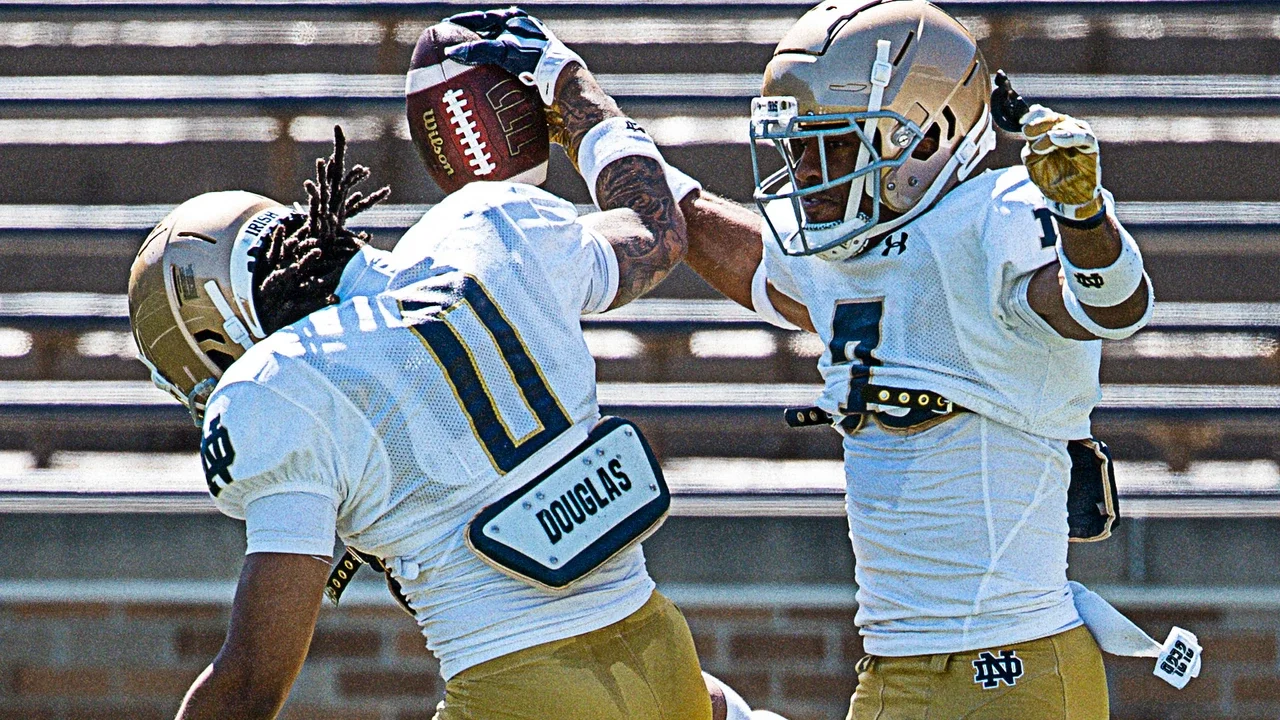
fall camp Position Battles on offense
Notre Dame is 42 days from kicking off its 2026 season against Wisconsin at Lambeau Field, and for the first time in Marcus Freeman's tenure, fall camp won't be defined by a quarterback competition. CJ Carr locked down the job a year ago and started all 12 games as a true freshman. But the absence of drama at quarterback doesn't mean fall camp will be quiet. Several other spots on this offense are wide open, and the players fighting for them have already left a data trail this spring worth digging into.
Running Back
Junior Aneyas Williams enters fall camp as the presumptive lead back, and the numbers back up why. Over two seasons behind Jeremiyah Love and Jadarian Price, Williams has piled up 58 carries for 443 yards, 20 catches for 212 yards and seven total touchdowns, a career average north of 7.5 yards per carry. His 2025 season alone saw him rush for 224 yards and five touchdowns on 24 carries, a 9.3 yards-per-carry average, to go with two catches for 40 yards. He backed that up this spring: despite being limited for most of camp by an elbow injury, Williams led the team in rushing at the Blue-Gold Game and found the end zone, then followed it up with 38 yards on 10 carries, a touchdown and three catches out of the backfield in the spring finale.
The real intrigue is what happens behind him. Redshirt sophomore Kedren Young was a top-100 recruit out of Lufkin, Texas, and looked like a potential difference-maker as a true freshman before a torn ACL wiped out his entire 2025 season. As of late March, Young was seven months into recovery, had just begun running again and was targeting a return to game shape by summer workouts. Position coach Ja'Juan Seider has been careful with his timeline, but the belief inside the building is that a healthy Young could push Williams for the top job rather than settle for a complementary role. Some evaluators see his combination of size, power and explosiveness as the element capable of pushing this running back room from good to excellent if he's fully healthy.
Behind those two, the picture is murkier. In that same Blue-Gold Game, true freshman Jonaz Walton emerged as a legitimate factor, rushing for 33 yards on 11 carries with a touchdown of his own, with Williams and Walton combining for the bulk of the workload. Redshirt freshman Nolan James Jr. and newcomer Javian Osborne round out a room that is as deep as it is unsettled, meaning fall camp reps could carry real consequences for who's active on gamedays.
Boundary Receiver
With Malachi Fields gone, Notre Dame is turning to a boundary receiver competition built almost entirely around transfer talent and physical upside. Ohio State transfer Quincy Porter arrives as a former five-star recruit who was rated the No. 13 overall player nationally and the No. 2 receiver in the 2025 class, and at 6-foot-4 with a rare wingspan, he profiles exactly like the boundary target Notre Dame's staff covets. His production at Ohio State was limited by the depth chart, not lack of talent: he played roughly 57 offensive snaps as a freshman behind Jeremiah Smith, Carnell Tate and Brandon Inniss, one of the most talented receiver rooms in the country, finishing with four catches for 59 yards. Notably, Smith himself, one of the best receivers in college football, called Porter the "next one" at Ohio State before Porter ever left Columbus.
Redshirt sophomores Micah Gilbert and Cam Williams round out the competition, and while their spring production hasn't generated the same buzz, both have the size and physical tools the staff wants at the position. Given the uncertainty, offensive coordinator Mike Denbrock may lean toward a rotation rather than naming a clear-cut starter, which would make fall camp less about crowning a No. 1 and more about establishing snap share.
Slot Receiver
Few storylines are as tied to injury history as the slot receiver competition between Jaden Greathouse and Ohio State transfer Mylan Graham. Greathouse was electric during Notre Dame's 2024 College Football Playoff run, but 2025 was almost entirely lost to a hamstring injury: he played in only a handful of games and finished with just four receptions for 73 yards on the year, a steep drop from his 2024 season total of 43 catches for 576 yards and three touchdowns.
That opening is exactly what Graham capitalized on. A former five-star recruit who saw limited playing time in two years at Ohio State, Graham arrived at Notre Dame and, due to Greathouse's lingering hamstring issue, became the No. 1 slot receiver throughout spring practice, quickly turning into a go-to target for CJ Carr. Scouting notes from the spring were also quick to push back on a perceived weakness from his Ohio State tape: the drop issues some had flagged around Graham simply didn't show up this spring, as he looked like a sure-handed receiver throughout camp. That performance has fueled real hype that Graham could emerge as Notre Dame's top overall receiver in 2026, not just its top slot option.
Greathouse, for his part, is healthy again and has taken on more of a leadership role in the receiver room this offseason. But until he proves he can stay on the field for a full season, an uncomfortable question hangs over the position: is this actually a two-man competition, or is it Graham's job to lose?
Tight End
Redshirt junior Cooper Flanagan looks like the only true lock at any offensive skill position outside quarterback and running back. Flanagan missed almost all of 2025 recovering from an Achilles injury, but before that, he was already establishing himself as one of Notre Dame's best run-blocking tight ends, having played 262 snaps across 13 games in 2024, mostly as a blocker, and graded out by Pro Football Focus as one of the team's highest-rated run blockers over Notre Dame's final four games of that season.
With Eli Raridon off to the NFL, the receiving production at tight end is now up for grabs, and recent Notre Dame history suggests it's realistic for someone in this room to break out. Analysts have pointed to a clear pattern: Notre Dame tight ends have historically taken a modest role in year one before erupting the following season, as Raridon himself went from 11 catches for 90 yards and two touchdowns in 2024 to 32 receptions for 482 yards in 2025. Flanagan is the most likely candidate to follow that path in the run game, but the pass-catching questions are wide open behind him. Redshirt freshman James Flanigan flashed as a blocker last season but has yet to record his first collegiate catch, Arkansas transfer Ty Washington profiles as more of a steady depth option, and true freshman Ian Premer and Jack Larsen give the staff even more bodies to evaluate. Fall camp will likely determine less "who starts" and more "who earns the No. 2 tight end reps behind Flanagan.
Backup Quarterback
There's no competition atop the quarterback depth chart, marking the first time in Freeman's tenure Notre Dame enters a season with an established returning starter. But the No. 2 job is a legitimate three-way battle between redshirt freshman Blake Hebert and true freshmen Noah Grubbs and Teddy Jarrard, none of whom has thrown a competitive pass in college. Hebert did get spring game reps, connecting on an 8-yard touchdown pass during the Blue-Gold Game, giving him a small but real head start over the two true freshmen heading into camp. But Grubbs made his own case this spring, flashing some genuinely impressive throws mixed in with the expected freshman miscues. That combination of upside and inconsistency is exactly what you'd expect from a true freshman, but it's also enough to suggest he'll have a real shot at pushing Hebert for the No. 2 job once fall camp begins. It's an unusual dynamic: the most consequential backup quarterback battle of Freeman's tenure so far, decided entirely without a single game snap to lean on for any of the three competitors.
The Bottom Line
Without a quarterback competition to dominate headlines, this year's fall camp battles are more spread out, but arguably carry just as much weight for how Notre Dame's offense will look in September. The running back room has its floor set with Williams but a real ceiling if Young returns to form. The receiver competitions are shaped almost entirely by two Ohio State transfers who are already outproducing expectations. And the tight end room has its anchor in Flanagan, but no clarity behind him. All of it will get sorted out over the next six weeks, and how it shakes out will go a long way toward determining whether Notre Dame's offense takes a step forward or take a step back from a 2025 team that fell just short of the Playoff.
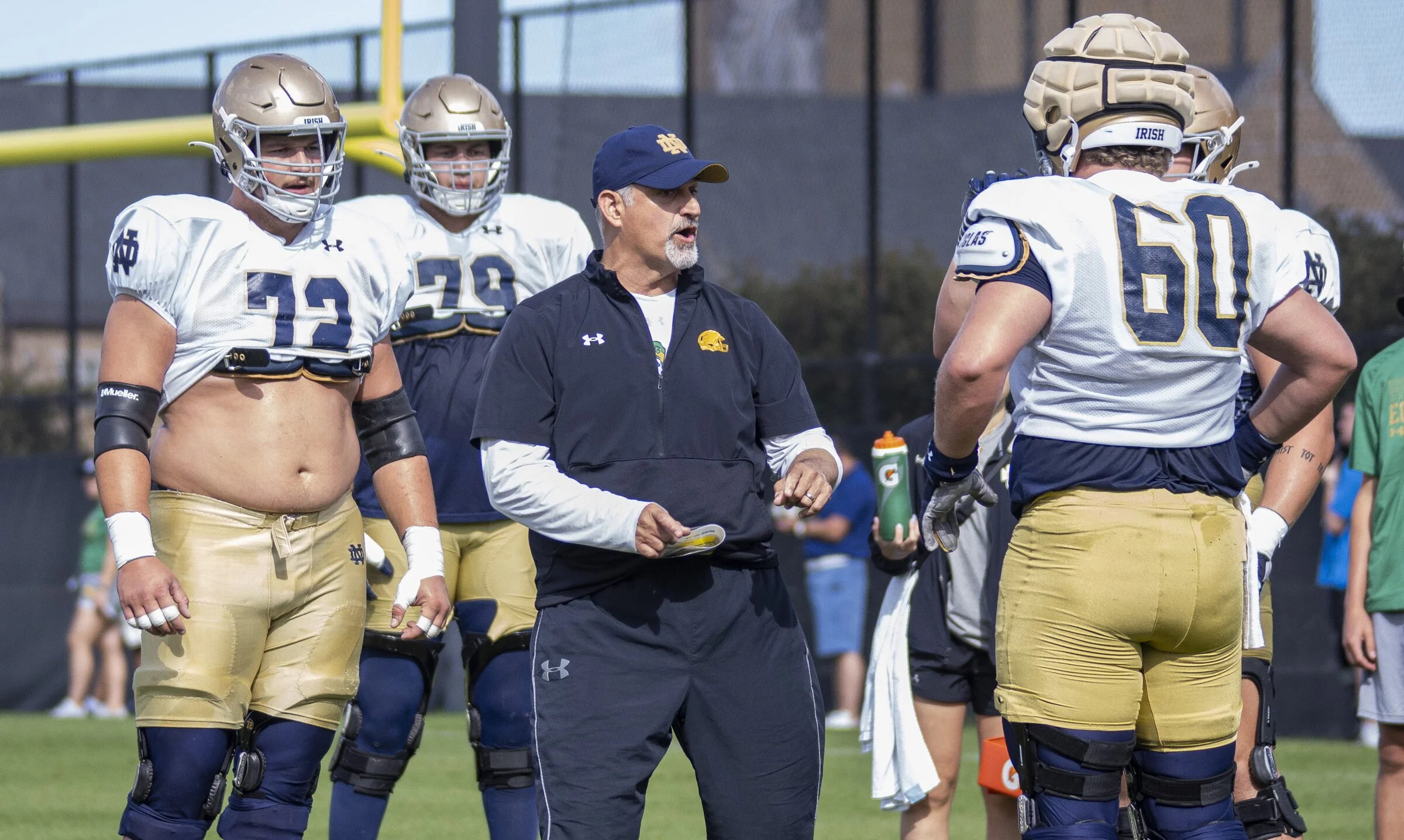
Notre Dame's 2026 Offensive Line Has the Makings of Joe Rudolph's Best Unit Yet
Marcus Freeman's vision for Notre Dame football has always started in the same place. Before the skill positions, before the quarterback, before the coordinators and the scheme and the recruiting rankings — it starts in the trenches. It starts with the offensive line setting a physical tone that makes everything else the Fighting Irish want to do on offense not just possible but inevitable.
That vision has been building toward something in South Bend. The recruiting has been elite. The talent in the room has been undeniable. And now, entering 2026, the pieces are finally aligned in a way that makes the question not whether Notre Dame's offensive line can be great — but whether this specific group, with this specific configuration, in this specific season, can be the best offensive line Joe Rudolph has assembled since arriving at Notre Dame in 2023.
The answer depends significantly on two players — Will Black and Guerby Lambert, a pair of bookend tackles with tremendous upside whose development in 2026 could define not just this season but the entire trajectory of Rudolph's Notre Dame tenure. If Black and Lambert fulfill the expectations that their physical profiles and recruiting pedigrees have always suggested were coming, this offensive line has the talent, the experience and the positional construction to be a genuinely dominant unit — the kind that powers a rushing attack, protects an elite quarterback and gives an offensive coordinator with Mike Denbrock's résumé everything he needs to operate at the highest level.
Everything starts up front. In 2026, Notre Dame's offensive line has the chance to prove that the vision and the reality are finally the same thing.
Experience
The foundation of Notre Dame's 2026 offensive line case is a combination that championship units are built on — experienced interior players providing stability and continuity alongside new starting tackles with the kind of upside that changes what a unit can become at its ceiling.
Anthonie Knapp returns with two years of starting experience, now settled into the left guard position where his power, anchor and starting-caliber development project most powerfully. Ashton Craig — healthy and back from the injury that kept him out of spring practice — anchors the unit at center, the position most responsible for the communication and cohesion that separates good offensive lines from great ones. Sullivan Absher brings redshirt junior experience and genuine competitive hunger to right guard, a player who has waited for exactly this starting opportunity and arrives with the kind of chip-on-the-shoulder energy that produces the best seasons of college careers.
The experienced interior trio of Knapp, Craig and Absher gives Notre Dame's offensive line a proven, battle-tested core that first-year starting tackles can build around rather than carry. That structural advantage is enormous — because it means Black and Lambert do not have to be immediately dominant in order for the unit to function at a high level. They need to develop, grow and improve as the season progresses while the interior handles the communication load and sets the physical tone that the entire unit runs through.
That is the exact formula that produces breakthrough offensive line seasons — proven interior stability giving young, high-ceiling tackles the space to develop without the unit's effectiveness depending entirely on their immediate mastery of the position.
starting LT Will Black
The most consequential individual decision in Notre Dame's 2026 offensive line construction is Will Black's installation as the starting left tackle — and everything about Black's physical profile suggests it is exactly the right decision at exactly the right time.
Black arrived at Notre Dame as a five-star recruit whose combination of length, athleticism and raw pass protection tools projected to the blindside tackle position from the moment he stepped on campus. The left tackle spot is where his ceiling is highest, where his physical tools are most naturally expressed and where his development under Rudolph's coaching has always been pointed. Putting him there in 2026 — committing to the position, committing to the growing pains that come with first-year starting experience and committing to the long-term development arc that makes the short-term challenges worthwhile — is the kind of coaching conviction that separates programs building for championships from programs managing for comfort.
The growing pains will come. First-year starting left tackles in the Power Four face a learning curve against elite edge rushers that even the most talented players cannot fully avoid. Black will have moments in 2026 where that curve is visible — moments where an elite pass rusher wins a rep, where a coverage sack happens because the protection broke down outside and where the raw tools have not yet been fully refined into finished technique.
But the ceiling at the end of that developmental process is what makes every one of those moments worth the investment. A Will Black who has navigated a full season of left tackle starting experience against Power Four competition — processing different pass rush moves, learning to handle speed-to-power combinations and building the confidence that only comes from sustained starting-level repetitions — is the kind of blindside tackle that makes Notre Dame's offensive line genuinely elite for two or three more years beyond 2026.
The investment begins now. The return on that investment will define what Notre Dame's offensive line becomes.
Starting Rt Guerby Lambert
If Black's story in 2026 is about a talented young player stepping into the most demanding position on the offensive line for the first time, Lambert's story is about a proven, elite-recruited player finally getting to play where his ceiling has always been highest.
Lambert is a five-star recruit who arrived at Notre Dame with the physical tools — the length, the athleticism, the power and the frame — of an elite college right tackle. The right tackle position is where Lambert's profile projects most naturally, and 2026 represents the first time in his Notre Dame career that he steps into that role as the full-time, unambiguous starting right tackle without positional questions complicating his preparation or his identity within the unit.
That clarity matters more than it might initially appear. A five-star tackle who knows exactly where he is playing, who his running mate is at right guard and what his specific assignments and responsibilities are within the unit's blocking scheme is a significantly more effective player than one navigating positional uncertainty on top of the normal competitive demands of Power Four starting experience. Lambert enters 2026 with that clarity for the first time — and the results of a full season at right tackle in his natural position could be exactly what his recruiting profile always suggested was coming.
Together, Black on the left and Lambert on the right give Notre Dame something the offensive line has not had since Joe Alt and Blake Fisher anchored the 2023 unit — a pair of bookend tackles whose individual ceilings, if realized, make the entire offensive line a different and more dangerous entity than the sum of its experienced interior parts.
Alt and Fisher are starting in the NFL right now. The standard has been set. Black and Lambert have the talent to approach it. Whether they do in 2026 is the central question of Joe Rudolph's defining season.
Fueling the Rush — Two Seasons of Production That Demand Protection
The case for Notre Dame's offensive line dominance in 2026 is not built on projection alone. It is built on a foundation of sustained rushing production over the past two seasons that reflects a ground game operating at a high level even when the offensive line's performance has been inconsistent — and that should produce even more explosive results when the line reaches the potential that the 2026 configuration makes possible.
Over the past two seasons, Notre Dame has established itself as one of the most consistent rushing offenses in the country, grounding its attack in a zone-blocking scheme that rewards intelligence, footwork and the ability to move defenders off the line of scrimmage. The production has been there even through the injury disruptions and positional uncertainty that have complicated Rudolph's previous two seasons — which means the floor of what this rushing attack can do is already established at a high level.
Now pair that established rushing foundation with the most positionally sound offensive line configuration Rudolph has built since 2023 — and add the most dynamic running back room Notre Dame has had in recent memory.
Aneyas Williams enters 2026 as the featured back in a backfield that has been reloaded with genuine talent after the departure of Jeremiyah Love to the NFL. Williams brings a quickness, burst and space-creation ability that makes him a natural fit for the zone-blocking concepts Notre Dame runs — a runner who understands how to set up blocks, identify cutback lanes and accelerate through holes before defenders can close them. His ability to threaten defenses horizontally as well as vertically gives the ground game a dimension that forces defensive coordinators to honor the perimeter before crashing the interior — creating the kind of pre-snap conflict that makes Notre Dame's inside zone and power concepts more effective than they would be against a purely downhill running threat.
The offensive line's job is to create the environment where Williams's natural abilities can be fully expressed. With Black and Lambert protecting the edges, Knapp and Absher controlling the interior gaps and Craig directing the unit's communication from the center position, the blocking structure that Williams runs behind in 2026 has the potential to be the most effective the Irish have fielded in years.
When an offensive line dominates up front and a dynamic back like Williams is running behind it, rushing attacks do not just produce yards — they produce explosive plays, favorable down-and-distance situations and the kind of physical momentum that changes the entire complexion of a football game. Notre Dame's rushing attack has the ingredients for exactly that kind of production in 2026.
Protecting CJ Carr — The Most Important Assignment on the Roster
As important as the ground game is to Notre Dame's offensive identity, the offensive line's most critical assignment in 2026 is the one that directly determines whether the Irish passing offense reaches its enormous potential — protecting CJ Carr.
Carr enters his second season as Notre Dame's starter with the full benefit of a year of starting experience behind him, a deepened understanding of the offense and the weapons around him upgraded on every level. The wide receiver room is better. The tight end group is more experienced. The running back room gives him a genuine dual-threat dimension to work with in the passing game. The continuity of returning offensive coordinator Mike Denbrock and the same system Carr operated in throughout 2025 gives him a pre-snap processing advantage that second-year starters with returning coordinators enjoy in ways that are difficult to quantify but impossible to miss in the way they play.
But none of those advantages mean anything if Carr is running for his life on every passing down. The difference between a good quarterback and a great quarterback — between a solid season and a Heisman Trophy season — is almost always a function of how much time the offensive line gives him to go through progressions, identify coverage rotations and deliver the football to the right place with the timing and accuracy that his skill set demands.
Clean pockets do not just protect quarterbacks. They elevate them. When a quarterback can step into his throws, trust that his blindside is protected and operate through his full progression without the pressure of an unblocked defender bearing down on him, the entire passing game functions at a higher level. Routes develop more fully. Timing throws hit their windows. Check-downs become available when the primary read is covered. The entire mental processing load that second-year quarterbacks are still refining becomes more manageable when the physical environment the offensive line creates allows that processing to happen without the distortion of pressure.
Black and Lambert protecting Carr's edges in 2026 — if they perform at the level their talent suggests they can — give Notre Dame's quarterback an environment where his Heisman candidacy can develop naturally and fully. That is the assignment. Everything else the offensive line accomplishes in 2026 runs through whether they can consistently give CJ Carr the clean pocket he needs to maximize the talent surrounding him.
Mike Denbrock's Blueprint — Why Second-Year Quarterbacks Thrive Under His System
The offensive line's assignment in 2026 does not exist in isolation — it exists within the context of an offensive system designed by coordinator Mike Denbrock whose track record with second-year starting quarterbacks is one of the most compelling and relevant data points in Notre Dame's 2026 offensive preview.
Denbrock's résumé with second-year quarterbacks traces directly to the most celebrated quarterback performance in recent college football history. At LSU in 2023, Denbrock was the offensive coordinator for Jayden Daniels's Heisman Trophy season — a campaign in which Daniels, operating in his second year within a system that had been built around his strengths, produced one of the most statistically dominant quarterback performances the sport has ever seen. Daniels threw for 3,812 yards and 40 touchdowns while rushing for 1,134 yards and 10 more scores — numbers that earned him the Heisman Trophy and announced him as the most complete offensive player in college football.
The pattern that produced Daniels's Heisman season is directly applicable to what Carr and Notre Dame are building toward in 2026. A quarterback who has a full season of starting experience in the system. An offensive coordinator who has had a full offseason to study that quarterback's strengths, identify the plays and concepts that maximize his skill set and build a game plan philosophy that puts him in positions to succeed. A supporting cast that is upgraded from the previous season. And an offensive line assignment that is clearer, more positionally sound and more capable of providing protection than the one that existed in the quarterback's first year as a starter.
Denbrock has done this before. He has taken a second-year starting quarterback, built a system around his specific strengths and produced the kind of Heisman-caliber performance that changes careers. The offensive line's role in that process — keeping Carr clean, controlling the line of scrimmage in the run game and giving Denbrock's system the physical foundation it needs to operate at its ceiling — is the most direct and consequential contribution the unit can make to Notre Dame's 2026 championship aspirations.
If the offensive line delivers, Denbrock has everything he needs. If Denbrock has everything he needs, Carr has everything he needs. And if Carr has everything he needs — with the receiver room, the running back room and the system surrounding him in 2026 — the ceiling of what Notre Dame's offense can produce is genuinely limitless.
The Best Offensive Line of the Rudolph Era?
Stack all of it together — the experienced interior anchored by Knapp, Craig and Absher, the bookend tackle upside of Black and Lambert, the rushing production foundation that the past two seasons have established, the dynamic running back room led by Williams and the Denbrock-Carr connection that mirrors the blueprint that produced a Heisman Trophy at LSU — and the case for Notre Dame's 2026 offensive line being the best unit Rudolph has assembled at Notre Dame becomes genuinely compelling.
The standard was set in 2023 when Alt and Fisher gave Notre Dame two future NFL starters at the bookend positions. That unit is the measuring stick. Whether the 2026 group can approach or exceed that standard depends on Black and Lambert fulfilling the expectations their talent demands and the experienced interior delivering the consistency and physicality that championship offensive lines produce week after week.
The ingredients are there. The configuration is right. The assignment is clear. The supporting cast surrounding the offensive line — from Carr to Williams to the upgraded receiver room — gives the unit's performance a direct and immediate impact on Notre Dame's national championship aspirations.
This is Joe Rudolph's defining season. And for the first time in his Notre Dame tenure, he has the right players in the right places to make the definition one that every Fighting Irish fan will be proud of when the 2026 season is complete.
Will Black and Guerby Lambert. Protect the edge. Control the line of scrimmage. Fulfill the potential. Give CJ Carr the time to be great.
Do those things — and this offensive line does not just have the chance to be the best unit of the Rudolph era at Notre Dame.
It has the chance to be something that Notre Dame fans remember for a very long time.
ESPN's College Football Future Power Rankings Have Notre Dame at the Top
When ESPN set out to rank all 68 Power Four programs in their future power rankings — evaluating quarterback situations, trench outlooks, roster management, star power and coaching staff quality with the kind of comprehensive rigor that separates serious analytical work from preseason speculation — the Fighting Irish came out on top.
Not second. Not in a group of three or four teams separated by fractions of evaluation points. First. Unambiguously, convincingly and with justification that holds up to scrutiny from every angle the evaluation touched.
This is not a sentimental ranking built on Notre Dame's brand, its history or the weight of its tradition. ESPN looked at what is actually on the field, what is being built in the recruiting pipeline, how the roster is being managed and who is coaching the program — and concluded that no program in the country is better positioned for sustained elite performance than Marcus Freeman's Notre Dame Fighting Irish.
The case begins with a quarterback whose growth and efficiency have already made him one of the most decorated signal callers in Notre Dame history. It runs through an offensive line that is finally deploying its elite talent in the right positions. It extends through a running back room with genuine dimension and a wide receiver group upgraded on every level. And it culminates in a defense that returns significant proven production while adding transfer portal talent to a revamped defensive staff that made the transition look seamless during spring practice.
Stack all of it together and the No. 1 ranking does not just make sense. It is the only honest conclusion.
CJ Carr — Growth, Efficiency and the Foundation of Everything
Every conversation about Notre Dame's 2026 ceiling begins in the same place — under center, with a redshirt sophomore quarterback whose growth from his first start to where he stands today represents one of the most impressive individual development arcs in college football.
CJ Carr did not arrive at Notre Dame's starting position through the transfer portal or through the kind of five-star recruiting coronation that precedes some quarterbacks before they ever take a college snap. He developed — through the program's system, under the coaching staff's instruction and through the accumulated experience of an entire season of starting at Notre Dame — into exactly what ESPN's Adam Rittenberg described as a national awards contender.
The statistical foundation that justifies that description is historically significant. Carr's 168.06 passer rating from the 2025 season was a Notre Dame program record — surpassing the previous mark held by Jimmy Clausen, a quarterback whose 2009 season is still discussed as one of the most polished individual performances in Notre Dame's quarterback history. Breaking a program record in your first year as a starter is not a product of circumstance. It is a product of genuine excellence sustained over the course of a full season against Power Four competition.
The efficiency numbers amplify the record even further. Carr completed 66.6 percent of his passes — fourth best single-season mark in Notre Dame program history across every era of Fighting Irish football. He threw 24 touchdowns against just six interceptions — and four of those six interceptions came in his first two starts, the natural adjustment period of a first-year starter navigating varsity speed for the first time. In his final ten starts of the season, Carr threw four interceptions across ten games — a turnover rate that matches the best decision-making quarterbacks in the country regardless of experience level.
The deep ball numbers are equally impressive and perhaps more revealing about what kind of quarterback Carr truly is. Eight touchdowns and zero interceptions on passes of 20 yards or more — a statistical combination that reflects both the arm talent to challenge defenses vertically and the decision-making discipline to never force throws in the most high-risk areas of the field. Zero interceptions on deep passes across an entire season is the kind of number that NFL scouts and Heisman voters notice immediately because it is so rare and so meaningful as a predictor of elite quarterback performance.
His yards-per-attempt average of 9.4 ranked second among all returning quarterbacks in the entire country — not second in the ACC, not second among independent programs, but second nationally among every returning signal caller in college football. That number reflects efficient, high-value passing that consistently moves the chains, creates explosive plays and maximizes the production value of every throw rather than accumulating yards through volume and check-downs.
The November elevation that Sporting News specifically cited in their No. 3 national quarterback ranking — a passer rating of 170.2 in the final month of the regular season — confirms what the full-season numbers suggest and then exceeds it. Carr was better in November than he was in September. He was better when the schedule was harder, the stakes were higher and the defensive preparation against him was most sophisticated. That late-season elevation is the single most reliable indicator that a quarterback's development is genuine, sustainable and pointed toward something significantly better in year two.
The growth from his first start against Miami in 2025 — when the country got its initial look at a talented but unproven first-year starter navigating an elite opponent in a high-pressure environment — to the polished, confident and statistically dominant quarterback who closed that season and walked into spring 2026 as the program's unquestioned leader is as dramatic an individual development arc as any quarterback in the country produced over the same period.
Entering 2026 with that foundation behind him — the record passer rating, the elite completion percentage, the zero deep-ball interceptions, the November elevation and a full offseason of development with Mike Denbrock building a system specifically around his strengths — Carr is not just one of the five best returning quarterbacks in the country. He is making a genuine and credible case to be the best. And the structure surrounding him in 2026 gives that case more supporting evidence than any other quarterback in college football can claim.
The Offensive Line — Elite Talent Finally in the Right Places
The offensive line evaluation is where ESPN's future power ranking for Notre Dame gets most specific and most optimistic — and for good reason. The unit that Joe Rudolph is sending onto the field in 2026 is the most thoughtfully constructed and positionally appropriate starting five he has assembled since his arrival in 2023, when Joe Alt and Blake Fisher gave Notre Dame a bookend tackle pair that now starts in the NFL.
The interior of this offensive line returns experienced, battle-tested starters whose collective knowledge of Notre Dame's blocking schemes and protection concepts gives the unit a communication and cohesion that young tackle prospects need around them to develop effectively. Ashton Craig returns at center as a legitimate Rimington Trophy contender — a distinction that reflects both the quality of Craig's individual performance and the critical importance of his role as the unit's communicator and pre-snap processor. Craig's ability to identify defensive alignments, make protection calls and ensure that every blocker on the unit is operating from the same information on every snap is the infrastructure that makes everything else on the offensive line function.
Anthonie Knapp returns at left guard — now settled into the position where Rudolph and the staff believe his ceiling is highest after two years of starting at left tackle. The move inside is not a demotion but a correction — putting a talented, experienced blocker in the alignment where his power at the point of attack, his ability to anchor against interior rushers and his two years of starting-caliber experience are most powerfully expressed. Knapp at left guard entering 2026 is a significantly more dangerous player than Knapp at left tackle — and the unit benefits immediately from having his experience and physicality deployed in the right place.
Sullivan Absher completes the interior at right guard with the competitive hunger of a redshirt junior who has waited for exactly this starting opportunity. Players who earn starting roles through development and patience rather than through recruiting star ratings tend to play with a chip-on-the-shoulder energy that makes them among the most consistently effective contributors on any offensive line — and Absher enters 2026 with every motivation to prove that the wait was worth it for both himself and the program.
The bookend tackles are where this offensive line's ceiling lives and where the most exciting development stories of the 2026 season will unfold. Will Black — a five-star recruit whose length, athleticism and pass protection tools have always projected to the blindside tackle position — takes over at left tackle for what should be a transformative first full season protecting Carr's blind side. The growing pains of a first-year starting left tackle against Power Four edge rushers are a normal and expected part of the development process — but the ceiling that Black is building toward as those growing pains accumulate into experience and confidence is the kind that changes what a program's offensive line can be for multiple seasons.
Guerby Lambert at right tackle is the complementary story — a five-star recruit from the 2024 class finally operating at the position where his physical profile projects most naturally for a full season as the unambiguous starting right tackle. Lambert's combination of size, length and athleticism gives Notre Dame a potential true bookend pair with Black on the left side — the first time since Alt and Fisher that Rudolph has had that configuration available — and the results of a full season with both tackles in their natural positions could finally deliver the dominant unit that the talent in this room has always suggested was possible.
The potential return of Charles Jagusah — a five-star recruit whose development has been delayed — adds yet another elite-recruited option to a depth chart that is already one of the deepest Rudolph has had since his arrival. The depth and quality of this offensive line room entering 2026 is genuinely exceptional — and the configuration finally matches the talent with the positional assignments that maximize every player's individual ceiling.
The Running Back Room — Dynamic Talent Ready to Carry the Load
The departure of Jeremiyah Love — the No. 3 overall pick in the NFL Draft — is the most significant personnel loss Notre Dame faces on offense heading into 2026. Love was one of the most dynamic running backs in college football, a unanimous All-American whose big-play capability and consistency defined Notre Dame's ground attack across two seasons and made him one of the most celebrated players in the program's recent history.
But the Irish are not rebuilding the backfield. They are reloading it — with a group of talented, complementary backs whose collective skill set gives Mike Denbrock's offense a multi-dimensional ground game that can attack defenses in ways that a single-back approach never allows.
Aneyas Williams steps into the featured role with the physical tools, competitive instincts and playmaking ability to make the transition from Love to the next era of Notre Dame running back excellence as smooth as the talent in the room allows. Williams's combination of acceleration, vision and contact balance gives the Irish a back who can operate effectively in Notre Dame's zone-blocking scheme — identifying cutback lanes, setting up blocks and accelerating through holes before defenders can close them with the quickness that makes him a natural fit for the concepts Denbrock calls most frequently.
Williams's versatility as a receiver out of the backfield adds a dimension to Notre Dame's passing game that forces defensive coordinators to honor the check-down and screen game on every snap — pulling linebackers and safeties into coverage assignments that open the intermediate passing windows where Carr's accuracy and anticipation are most devastating. A running back who can genuinely threaten defenses both between the tackles and in the passing game is one of the most valuable offensive assets any coordinator can have — and Williams brings both dimensions to Notre Dame's 2026 backfield.
The depth behind Williams gives Denbrock genuine flexibility in how he deploys the ground game. Multiple capable backs with different physical profiles and running styles creates the kind of schematic variety that keeps defensive coordinators from settling into comfortable run defense adjustments — because the same blocking scheme produces different looks when different runners are operating behind it.
The collective expectation for Notre Dame's 2026 running back room is not to replace what Love provided individually but to provide what the room as a whole can produce collectively — and the talent assembled gives the Irish offense every reason to believe that collective production will be more than sufficient to keep the ground game a genuine threat that defenses must account for on every single snap.
The Wide Receiver Room — More Weapons Than CJ Carr Has Ever Had
If the offensive line case for Notre Dame's No. 1 ranking is built on positional construction and the running back case is built on dynamic talent filling a significant departure, the wide receiver case is the most straightforwardly exciting component of the entire offensive evaluation — because the group Carr is throwing to in 2026 is simply better than any receiver room he has had available in his Notre Dame career.
Jordan Faison returns as the established and proven No. 1 option after leading Notre Dame with 40 receptions, 640 yards and four touchdowns in 2025 — the team's leading receiver, produced while sharing a room with Malachi Fields and Jaden Greathouse. Faison's decision to give up lacrosse and commit entirely to football this offseason is the kind of singular focus investment that produces significant statistical leaps — and the Carr-Faison connection that produced 40 catches in a season where Fields was the projected No. 1 option is primed to become something even more dominant when Faison enters 2026 as the unambiguous first read with an undivided preparation investment behind him.
Jaden Greathouse brings the explosive playmaking dimension that makes Notre Dame's receiver room genuinely dangerous rather than simply functional. Greathouse's combination of separation quickness, yards-after-catch capability and big-play instincts — demonstrated emphatically in Notre Dame's 2024 postseason run — gives Carr a receiver who can take a short completion and turn it into a long gain, a slant route and turn it into a crossing score and a go ball and create the kind of contested-catch opportunity that changes field position in an instant. Pair Greathouse's explosion with Faison's reliable production and Notre Dame presents opposing secondaries with a No. 1 and No. 2 receiver combination that is as difficult to defend as any in the country.
The transfer portal additions elevate the room from very good to genuinely elite. Mylan Graham arrives from Ohio State with Big Ten starting experience, proven production at one of the most demanding programs in college football and the physical tools that made him a highly coveted recruit before his time at Ohio State. Graham does not need to be the No. 1 receiver or carry the production load to be enormously valuable — he needs to be a legitimate third option who punishes defensive coordinators for the coverage attention they devote to Faison and Greathouse. With the coverage bracket that those two demand, Graham will see single coverage against the best corner available on a given defense — and his Ohio State-tested talent gives him every tool to make opposing teams pay for that coverage decision.
Quincy Porter provides additional receiving depth from the same Ohio State program — another experienced, proven pass catcher who brings Big Ten competition reps to a Notre Dame receiver room that needed exactly this kind of experienced depth to complement its returning talent.
Three legitimate receiving threats with different physical profiles, different route-running styles and different strengths within the passing game — backed by experienced portal additions who contribute immediately and meaningfully to the room's depth and versatility. The receiver room Carr inherits in 2026 is the best he has ever had and one of the most complete groups in college football heading into the season.
The Defense — Proven Production Returns, Elite Additions Bolster the Front
While the offensive case for Notre Dame's No. 1 ranking builds from quarterback to skill positions to the line, the defensive case begins and ends with a simple and powerful truth — the production that made Notre Dame's defense one of the best units in the country late in the 2025 season is returning at a remarkably high rate, and the additions made through the transfer portal have addressed the few areas where reinforcement was genuinely needed.
Leonard Moore is the centerpiece of everything Notre Dame does defensively in 2026 and the most important returning player on the entire roster. The best cornerback in college football — PFF's No. 1 ranked returning cornerback for the second consecutive season — enters 2026 as the consensus Thorpe Award favorite after earning first-team unanimous All-America honors in 2025. Moore's 91.4 coverage grade and 90.9 overall defensive grade led all Power Four starting cornerbacks. He led Notre Dame with five interceptions while being targeted on only 11.5 percent of his coverage snaps — the ultimate testament to a cornerback so dominant that the entire country's offenses chose to scheme away from him rather than challenge him.
With Moore locking down one side of the field, the rest of Notre Dame's secondary carries a freedom and flexibility that makes the entire defensive system more dangerous. Christian Gray returns as a proven secondary contributor whose versatility allows defensive coordinator Chris Ash to present multiple coverage looks without sacrificing quality at any individual position. The addition of DJ McKinney from Colorado via the transfer portal gives the secondary a third proven option — a player with starting experience against Power Four competition who slides into a complementary role alongside Moore and Gray and completes what ESPN identified as potentially the biggest strength on Notre Dame's entire 2026 roster.
Adon Shuler returns at safety with the kind of range, instincts and ball-hawking ability that make him one of the most exciting developmental stories in Notre Dame's defensive backfield. His presence in the deep middle — rotating into coverage, supporting the run and creating the kind of turnover opportunities that change field position and momentum — gives Ash's secondary a complete, complementary set of pieces that no passing game can attack with a single schematic approach.
The linebacker corps is anchored by Drayk Bowen — one of the most complete linebackers in college football and the defensive engine that makes Notre Dame's second level function at its highest capacity. Bowen's combination of run-stopping physicality, coverage range and pre-snap processing intelligence gives the entire defense a communicator and lead tackler who elevates every player around him. His return alongside the developing linebacker talent around him gives Brian Jean-Mary — veteran defensive assistant now overseeing the linebacker group — proven production to build around from day one.
The Defensive Line — Transfer Additions Transform an Already Talented Front
The most dramatic and consequential roster construction development on Notre Dame's defensive side heading into 2026 is the transformation of the defensive line through a combination of proven returning contributors and high-impact transfer additions that address the program's most critical pass rush needs.
Boubacar Traore returns as Notre Dame's most dangerous and most disruptive pass rush weapon — a junior edge whose combination of first-step quickness, motor and technical pass rush arsenal makes him a consistent threat to influence every passing down. Traore's presence gives Ash's defensive front a proven, established disruptive force that new additions can complement rather than replace — the difference between addition by addition and addition by multiplication when it comes to what a defensive line can become collectively.
Bryce Young returns as a versatile and experienced contributor whose ability to line up in multiple positions along the defensive front gives Ash the flexibility to create different alignments and present different problems to opposing offenses without sacrificing individual quality at any spot. Young's experience and positional versatility are the kind of foundational traits that make an entire defensive line unit more difficult to prepare for — because the combinations he enables on the front are more numerous and more creative than a less flexible roster allows.
Jason Onye provides senior-level experience and established production at the defensive tackle position — a player whose understanding of what Notre Dame's defensive system demands and what elite college football competition requires gives the younger contributors on the defensive line a standard to measure themselves against and a guide to follow in the most demanding preparation moments of the week.
The transfer additions are where the defensive line story becomes genuinely transformative. Francis Brewu arrives from Pittsburgh with a national reputation as one of the most physically dominant interior defensive linemen in the transfer portal — a player whose combination of power, leverage and relentless effort at the point of attack gives Notre Dame's front an interior disruptive presence that immediately elevates the entire unit's run-stopping and pass-rushing capability. Brewu's Pittsburgh experience against ACC competition means his transition to Notre Dame's defensive system is not a leap into the unknown but a progression within a competitive environment he already understands.
Keon Keeley arrives from Alabama with the pedigree and physical tools that made him one of the most coveted defensive line recruits in his class — and the development infrastructure of Alabama's program having already invested significant time and resources into maximizing his potential. Keeley gives Notre Dame an edge presence whose ceiling, if fully realized under Ash's system and Partridge's coaching, could be the most disruptive individual defensive line performance the Irish have produced in years.
Tionne Gray from Oregon rounds out the transfer additions with starting experience and proven production from a Pac-12-level program — a player whose senior eligibility makes him the most immediately impactful of the three portal additions in terms of on-field availability and competitive readiness.
A New Defensive Staff That Hit the Ground Running
The most compelling subplot of Notre Dame's defensive preparation heading into 2026 is the transition to a reshaped defensive staff — and how smoothly that transition appears to have gone during spring practice despite the significant personnel changes that coordinator Chris Ash made to his unit this offseason.
Aaron Henry joins the staff to coach defensive backs, reuniting with Ash in a configuration that the coordinator knows and trusts from previous stops in his coaching career. The comfort and communication between Henry and Ash — built on an existing professional relationship — eliminates the adjustment period that typically accompanies new staff additions and allows the defensive back group to benefit from coaching cohesion from the very first practice of the spring.
Charlie Partridge takes over the defensive line — a coach whose recruiting track record and development philosophy give Notre Dame's front seven a proven leader whose ability to maximize pass rush talent and interior disruption is already on display in the 2027 recruiting class, where he landed the No. 2 defensive tackle in the country in David Folorunsho during his first recruiting cycle.
Brian Jean-Mary's oversight of the linebackers completes a defensive staff whose collective experience and internal cohesion make the transition from the previous staff configuration feel less like a rebuild and more like a refinement.
The spring practice reports that emerged from the new defensive staff's first extended look at the roster were encouraging across the board — a unit that absorbed significant coaching change, integrated transfer additions and developed communication between new coaches and returning players with a smoothness that reflects both the quality of the coaches Ash brought in and the leadership of the veteran players already in the building.
A defensive staff transition that goes well in the spring is not a guarantee of autumn dominance — but a transition that goes poorly in the spring is almost always visible in September. Notre Dame's spring went well. The foundation for what this defense can become in 2026 under its new coaching configuration is as solid as any rebuilt staff could reasonably hope to establish in a single spring session.
The Bottom Line — No. 1 is Not a Gift. It Is a Grade.
ESPN evaluated 68 Power Four programs. They looked at quarterback situations, trench outlooks, roster management philosophies, collections of star power and coaching staff quality. They graded every program with the analytical rigor that separates meaningful future power rankings from preseason popularity contests.
Notre Dame came out No. 1.
Not because of history. Not because of brand. Not because of 11 national championships and one of the most famous stadiums in American sports. Because of CJ Carr's historically efficient first year and the second-year leap that every indicator supports. Because of an offensive line finally deploying its elite bookend talent in its natural positions. Because of a dynamic, versatile running back room. Because of a receiver group more talented and more experienced than any Carr has had available. Because of Leonard Moore being the best cornerback in America and Drayk Bowen being one of the best linebackers. Because of Brewu, Keeley and Gray transforming a defensive line that was already talented. Because of a new defensive staff that transitioned smoothly and a head coach who turned down the NFL to keep building something in South Bend.
Phil Steele has Notre Dame No. 1 in his preseason rankings. ESPN has Notre Dame No. 1 in their future power rankings.
The program that Marcus Freeman has built did not get to the top of those lists by accident.
It earned every spot.
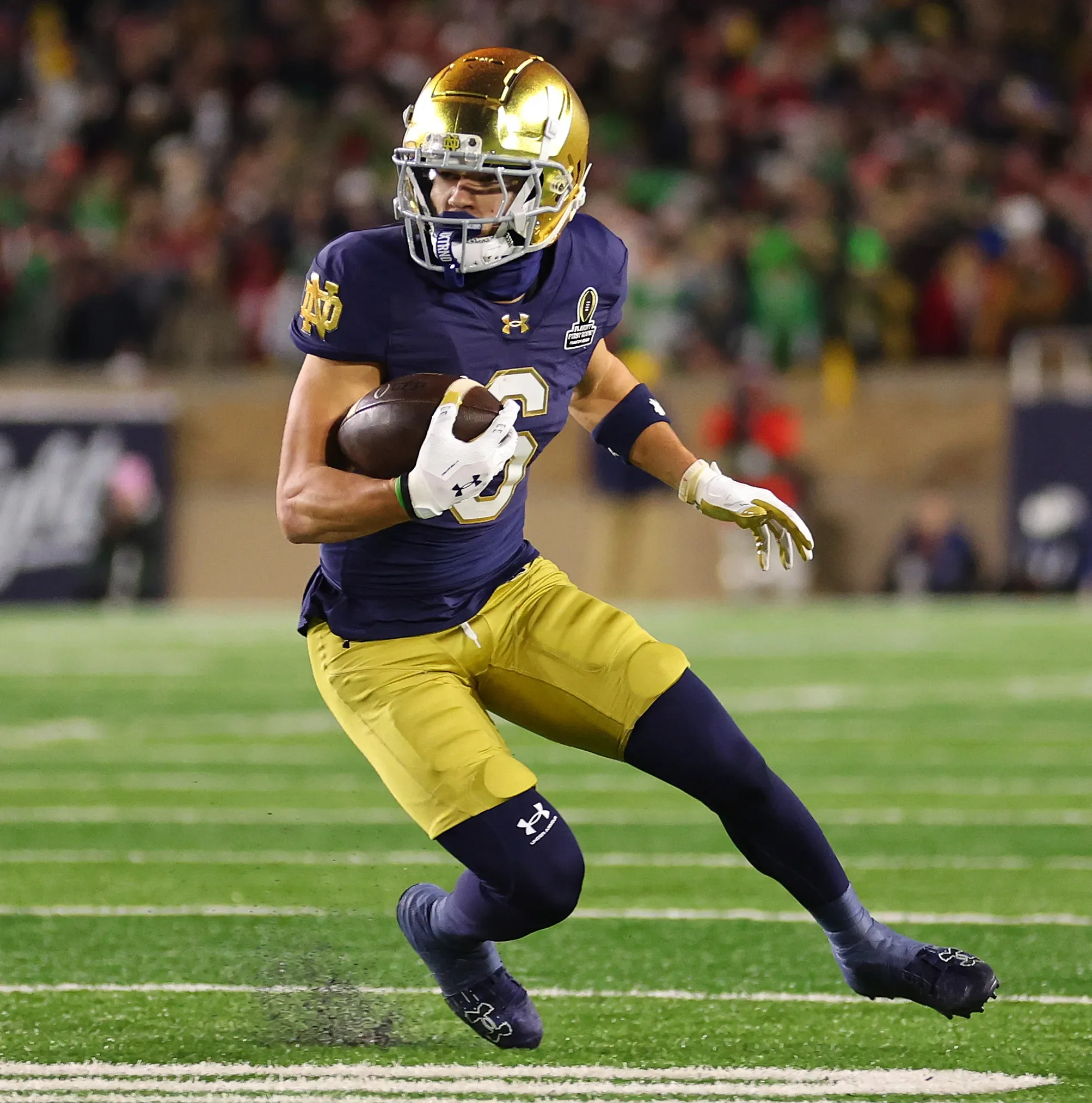
Jordan Faison's Growth Sets the Stage for a 2026 Breakout at Notre Dame
Breakout seasons don't materialize from thin air. They are built — rep by rep, season by season, through a progression of growth that is visible in the numbers if you know where to look and patient enough to watch the arc develop over time rather than demanding immediate results.
Jordan Faison's arc at Notre Dame is one of the most clearly defined and statistically compelling progression stories in college football heading into 2026. Look at the numbers across each season he has played and the trajectory is unmistakable — a receiver who has gotten measurably, undeniably better every single time he has stepped on a college football field, against better competition, in bigger moments, with higher stakes surrounding every performance.
Now, entering 2026 as Notre Dame's established No. 1 wide receiver and quarterback CJ Carr's most trusted target, everything Faison has built across three seasons of steady statistical growth is pointed directly at one destination — a breakout season that the numbers have been predicting for anyone paying close enough attention.
The progression is real. The breakout is coming. And the story of how Jordan Faison got here is worth telling in full.
Where It Started — A Walk-On With Zero Catches and One Moment
The baseline of Faison's progression at Notre Dame is important context for everything that follows — because where he started makes where he is going that much more remarkable.
Faison arrived at Notre Dame as a walk-on. Not a three-star recruit who needed development time. Not a portal addition brought in for a specific role. A walk-on — a player who had to earn everything from scratch against a roster filled with recruited talent that arrived with built-in advantages in opportunity and visibility.
Through the first several weeks of his freshman season in 2023, Faison had zero catches. Not a breakout waiting to happen, not a player on the verge — zero production, zero statistical footprint, zero reason for the outside world to pay attention.
Then came Louisville. Two catches, 48 yards, one touchdown — and a trajectory that changed permanently from that moment forward. In the final six games of that regular season, Faison went from invisible to indispensable, finishing with 17 catches for 274 yards and three touchdowns once he got going. His freshman year closed with a five-catch, 115-yard, one-touchdown performance against a ranked Oregon State team in the Sun Bowl — a statement game that planted the flag for everything that was coming.
The foundation had been laid. The progression was about to begin in earnest.
2024 — The Injury-Interrupted Proof of Concept
The 2024 season was supposed to be the year Faison announced himself to the wider college football world on a full-season scale. Injuries had other plans — limiting his overall regular season production and forcing a level of patience and resilience that tested his commitment to the process.
But here is what the 2024 numbers reveal when you look at them honestly — even in an injury-hampered season, Faison produced when he was healthy, and when the playoffs arrived and his health returned, he delivered the kind of performances that proved the Sun Bowl was not a one-game sample of his ceiling.
Against Indiana and Georgia in back-to-back playoff games, Faison recorded 11 catches for 135 yards — producing at exactly the moment Notre Dame needed its receivers most, on the biggest stage the college football regular season offers, against playoff-caliber defenses that had spent weeks preparing specifically for Notre Dame's offense.
The 2024 season's most important contribution to Faison's progression was not statistical. It was the proof that he could be relied upon in high-stakes moments, that the Louisville and Sun Bowl performances were character revelations rather than flukes and that when his body allowed him to play at full capacity, the production followed immediately and emphatically.
That proof set the stage for what 2025 was about to become.
2025 — The Statistical Leap That Changed the Conversation
If 2023 planted the seed and 2024 proved the concept despite limited opportunity, then 2025 was the season Jordan Faison's progression announced itself to the entire country with a clarity that could not be dismissed, debated or explained away.
Forty receptions. 640 receiving yards. Four touchdowns. Notre Dame's leading receiver — not a portal addition, not a five-star recruit, not the player anyone had projected to lead this offense statistically when the season began.
The numbers represent a genuine statistical leap that reflects every element of Faison's growth as a receiver. More receptions than any season before. More yards than any season before. More touchdowns in a single full campaign than his career suggested was coming. And all of it produced while sharing a receiver room with Malachi Fields — a four-year Virginia transfer who arrived specifically to be the go-to target — and Jaden Greathouse, who had been one of the most talked-about receivers in the program entering the season.
Faison outproduced them both. Not because the opportunity fell to him by default but because he earned it, week after week, with performances that proved he was the most reliable and productive weapon in Carr's passing arsenal.
The weekly production in 2025 told the story of a receiver operating with a consistency and confidence that only comes from genuine development. Five receptions for 33 yards and a touchdown against Miami in the season opener — no easing into the season, no waiting for momentum to build. Five catches for 105 yards and a touchdown against Purdue two weeks later — back-to-back productive performances that established a standard rather than teasing one. Seven catches for 89 yards against Arkansas on the road — producing in an environment where receivers are routinely neutralized by crowd noise, hostile atmospheres and game-plan-specific coverage. Six catches for 83 yards against Boise State — maintaining production against a defense built specifically to take away big plays in the passing game.
Then the regular season finale — three catches for 68 yards and a touchdown against Stanford on the road — a closing performance that mirrored the Sun Bowl statement from his freshman year and confirmed that Faison's best games consistently come when the moment is largest.
The Carr-Faison Connection — Chemistry Built Over Time
Numbers tell one part of the Faison story in 2025. The other part is the relationship that developed between him and quarterback CJ Carr throughout the season — a connection that grew more precise, more instinctive and more productive as the weeks accumulated and the two players built the kind of shared football language that only develops through sustained repetition and genuine trust.
Carr arrived in 2025 as a first-year starter navigating all the challenges that come with that transition — learning to manage game speed, make pre-snap reads under pressure and build the kind of confidence in his receivers that allows a quarterback to throw with conviction into tight windows against elite coverage. Faison became his anchor in that process.
The Carr-Faison connection worked because Faison gave his quarterback something every first-year starter desperately needs — a receiver who ran precise routes, found soft spots in zone coverage with intelligence rather than just athleticism, presented a reliable and consistently available target and made the right play after the catch to maximize every opportunity. Carr learned he could trust Faison in any situation, against any coverage and in any field position — and that trust, built game by game throughout 2025, is now entering 2026 as one of Notre Dame's most valuable offensive assets.
A quarterback and his No. 1 receiver entering their second full season together with an established connection and a full year of shared starting experience is a luxury Marcus Freeman has never had in his tenure at Notre Dame. Carr and Faison have it now — and what that chemistry can produce with a full offseason of work behind it is one of the most exciting questions surrounding Notre Dame's 2026 offense.
The Decision That Unlocks the Next Level
Before the statistical case for a 2026 breakout can be fully made, the offseason decision that makes it possible deserves its own recognition — because Jordan Faison made a choice this spring that speaks directly to how seriously he is approaching this opportunity.
Faison gave up lacrosse. Completely. Fully committed to football as the singular focus of his athletic life going forward.
For a multi-sport athlete, that decision carries real weight. It means every offseason hour that was previously divided between two sports is now directed entirely toward football. Every training session, every film session, every route-running repetition, every moment spent deepening his understanding of the offense and strengthening his connection with Carr — all of it now happens in the undivided context of a player who has chosen football as his complete identity.
The technical refinements that decision enables — sharper route running, more refined release packages against press coverage, deeper route tree development and the kind of receiver-quarterback timing work that only accumulates through concentrated repetition — are exactly what separate a very good college receiver from a great one. Faison has invested in all of it this offseason, and reports from South Bend suggest it is already showing up in the way he is operating within Notre Dame's offensive system.
The player who led Notre Dame in receiving in 2025 while still splitting his attention between two sports is now a full-time football player preparing for what could be his final season in South Bend. That combination of established production and elevated preparation is a genuinely dangerous thing for opposing defenses.
Reading the Progression — What the Numbers Say About 2026
Pull back and look at Jordan Faison's statistical arc across his Notre Dame career and the trajectory draws itself.
A walk-on with zero catches who finished his freshman year with 17 receptions, 274 yards and three touchdowns in six games once he got going — including a 115-yard Sun Bowl performance against a ranked opponent. An injury-hampered sophomore season that still produced 11 catches for 135 yards in two playoff games when his health returned. A junior season that produced 40 receptions, 640 yards and four touchdowns as the team's leading receiver — with consistent weekly production against a diverse slate of competition that included road games, playoff-caliber defenses and opponents that specifically schemed to take him away.
Each season has been better than the one before it. Each opportunity has been maximized more completely than the previous one. Each stage of the progression has revealed a receiver who is not just adding statistical volume but genuinely improving as a route runner, a contested-catch threat, a yards-after-catch contributor and a football intelligence that allows him to manipulate coverage in ways that create opportunities for himself and for the receivers around him.
The natural extension of that arc — a returning No. 1 receiver, a full offseason dedicated entirely to football, a second season of genuine chemistry with his starting quarterback and a role in the offense that is now unambiguously his — points toward one thing.
A breakout season. The kind that turns a compelling progression story into a national conversation about one of the best receivers in college football.
The Stage Is Set
Marcus Freeman has never entered a season with a returning No. 1 wide receiver. He has never had all three coordinators return simultaneously. He has never had a returning starting quarterback with a full season of starting experience already behind him. In 2026, he has all three — and Jordan Faison is the player who ties them together most directly.
Carr knows where Faison will be. Faison knows what Carr needs. The offense knows how to use them together. And Faison has spent an offseason investing everything he has into becoming the best version of himself as a receiver before what could be his final opportunity to make a definitive statement in South Bend.
The progression from walk-on afterthought to Notre Dame's leading receiver to preseason No. 1 target entering 2026 is one of the best individual development stories in Marcus Freeman's tenure. The numbers back every word of it.
Now comes the breakout. The progression has been building toward it for three years.
In 2026, Jordan Faison is ready to arrive — completely, definitively and on the biggest stage Notre Dame has to offer.
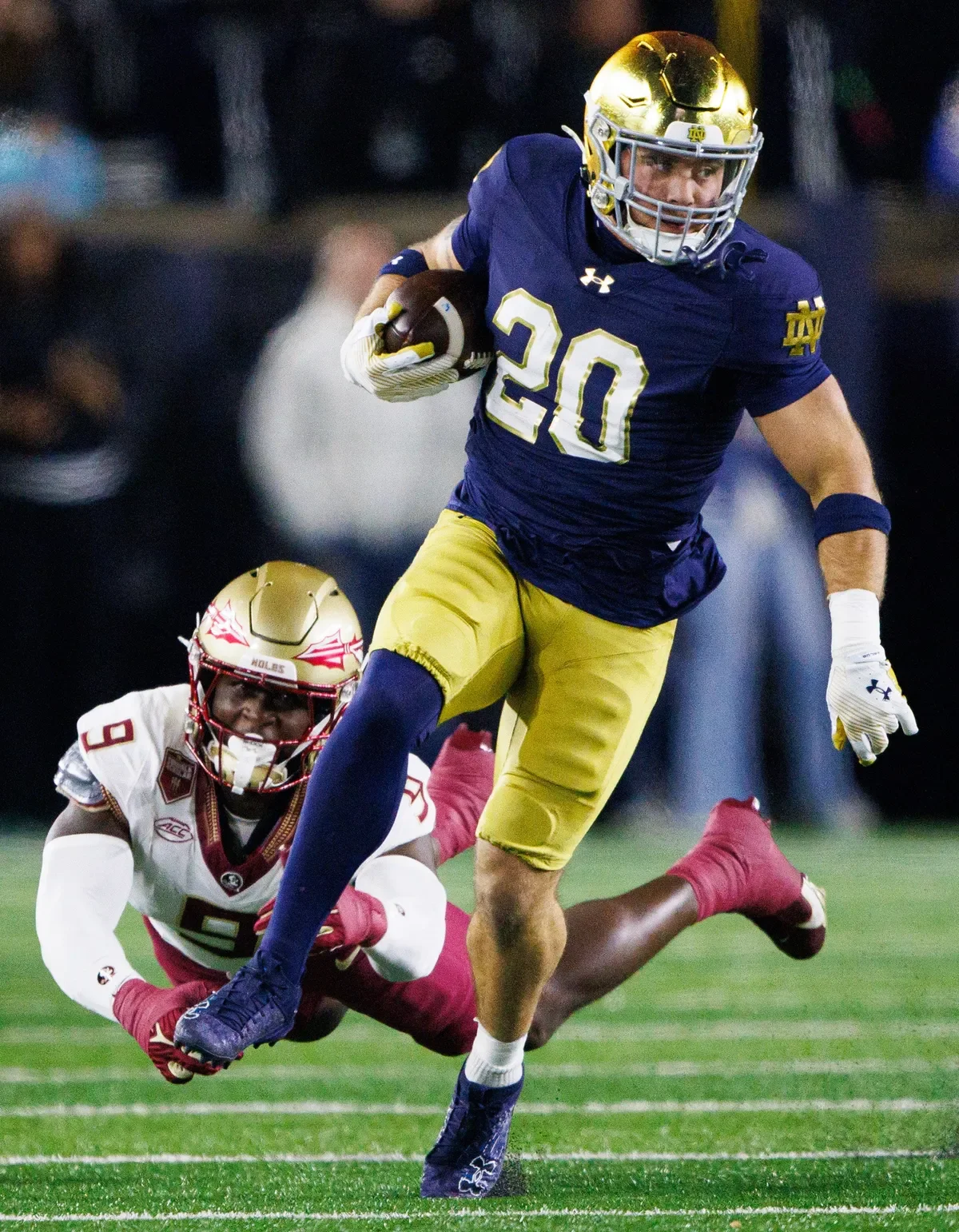
usa today ranks notre dame 2nd in post spring poll
USA Today has spoken — and the verdict on Notre Dame heading into the 2026 season is about as emphatic as a preseason ranking can be. Analysts Erick Schmidt and Paul Myerberg have tabbed the Fighting Irish as the No. 2 overall team in the country in their Post-Spring Top 25, trailing only Ohio State and ranking ahead of Texas, Georgia and Indiana in a list that reflects a program operating at the absolute peak of its modern era.
The ranking is not a gift or a projection built on hope. It is a recognition of something concrete — a Notre Dame roster that returns an experienced starting quarterback, a proven offensive supporting cast, a defense that kept its best players and a coaching staff with all three coordinators back for the first time in Marcus Freeman's tenure. When you stack those ingredients together and evaluate them honestly against every other program in the country, No. 2 is not a stretch. It might even be conservative.
Here is the full case for why Notre Dame belongs exactly where USA Today put them — and why 2026 could be the year everything comes together.
CJ Carr — The Heisman Front-Runner Nobody Should Be Sleeping On
Every conversation about Notre Dame's 2026 ceiling begins and ends with CJ Carr — and every conversation about the 2026 Heisman Trophy race should begin and end there too.
Carr enters his second season as Notre Dame's starting quarterback with something that no other signal caller in the country can claim in quite the same way — a full season of starting experience at Notre Dame, in a system he now owns completely, with the weapons around him upgraded and the continuity of returning coordinators giving him the most stable offensive environment of his college career. That combination of experience, continuity and talent elevation is precisely the formula that produces Heisman Trophy-caliber seasons.
In his first full season as a starter in 2025, Carr demonstrated command, poise and playmaking ability that immediately announced him as one of the premier quarterbacks in college football. He managed Notre Dame's offense with the kind of veteran intelligence that first-year starters rarely possess — reading defenses pre-snap, going through progressions efficiently and delivering the football with accuracy and timing in the most critical moments of the most critical games. The Carr-Faison connection that developed throughout 2025 became one of the most reliable quarterback-receiver partnerships in the sport, and that chemistry only deepens entering 2026 with a full offseason of concentrated work behind it.
What elevates Carr's Heisman candidacy beyond simply returning a quality starter is the trajectory. The jump from a first-year starter finding his footing to a second-year starter who knows every concept, trusts every receiver and operates from a position of complete offensive authority is one of the most dramatic developmental leaps in college football. Carr has already shown he can win games and manage a complex offense. In 2026, with the supporting cast around him upgraded on every level, the expectation is that he takes the next step — from excellent game manager to dominant offensive force — and the tools surrounding him make that leap entirely realistic.
The Heisman Trophy watch list will have many names on it when the 2026 season begins. CJ Carr should be at or near the top of every legitimate conversation about who wins it.
A Backfield Built to Replace Elite Production
The departure of Jeremiyah Love — selected No. 3 overall by the Arizona Cardinals in the NFL Draft — leaves the most significant void Notre Dame needs to fill on offense heading into 2026. Love was one of the most dynamic running backs in college football, a unanimous All-American whose production and big-play capability defined Notre Dame's ground attack for two seasons.
But the Irish are not rebuilding the backfield from scratch. They are reloading it with proven talent that has been waiting for exactly this opportunity — and the players stepping into expanded roles bring legitimate credentials of their own.
Nolan James Jr. returns as the most experienced back in Notre Dame's room, a proven contributor who has demonstrated the vision, patience and contact balance to be a productive starter at the Power Four level. His ability to operate within Notre Dame's zone-blocking scheme, find cutback lanes and move the chains in critical short-yardage situations gives the Irish a reliable foundation in the backfield that Carr can lean on in the most important moments of games.
Aneyas Williams brings a complementary dimension to the backfield that gives offensive coordinator Tim Rees genuine flexibility in how he deploys the ground game. Williams's quickness, acceleration and ability to create in space provide a contrast to James's between-the-tackles style — giving Notre Dame a two-back approach that can attack defenses horizontally as effectively as it attacks them vertically. The combination of James's power and patience with Williams's quickness and space creation gives Notre Dame's ground game the kind of range that makes it genuinely difficult to defend with a single schematic approach.
Together, James and Williams represent a backfield that does not replace Love's individual brilliance but provides Notre Dame's offense with enough combined production, versatility and proven capability to keep the ground game a legitimate threat on every snap. That is all Carr and the passing game need — a running back room that keeps defenses honest and prevents them from loading the box against Notre Dame's receivers.
A Wide Receiver Room Transformed by Experience and Elite Portal Additions
Jordan Faison returns as Notre Dame's established No. 1 wide receiver — the team's leading receiver in 2025 with 40 receptions, 640 yards and four touchdowns — and does so as a completely different player than the one who led the team statistically last season. His offseason decision to give up lacrosse and commit entirely to football signals a level of investment and focus that should translate directly into elevated production in 2026. Faison gives Carr exactly what a second-year starter needs more than anything — a proven, trusted target who knows the offense, runs precise routes and makes the right play after the catch every single time.
Jaden Greathouse returns alongside Faison after a 2025 season that saw him emerge as one of Notre Dame's most explosive playmakers in the postseason. Greathouse's combination of separation quickness, yards-after-catch ability and big-play capability gives the Irish a legitimate second receiving threat that defenses cannot bracket without leaving Faison in one-on-one coverage outside. Two proven, experienced receivers at the top of the depth chart entering the season is a luxury Notre Dame has not had in recent memory.
The addition of Mylan Graham from Ohio State via the transfer portal elevates what was already a strong receiver room into one of the most complete groups in the country. Graham arrives with Big Ten experience, proven production at an elite program and the kind of physical tools that made him a highly recruited prospect out of high school. His ability to contribute immediately in a complementary role — taking advantage of the attention that Faison and Greathouse command from opposing secondaries — gives Carr a third legitimate receiving option that stretches defenses in ways that create opportunities for everyone on the field.
The combination of Faison's established No. 1 production, Greathouse's explosive playmaking and Graham's experienced portal addition gives Notre Dame's receiver room a depth and versatility that rivals any group in college football heading into 2026.
A Defense That Returns Its Best Players — And Added Elite Talent
If the offensive case for Notre Dame's No. 2 ranking is compelling, the defensive case is even stronger — because what Marcus Freeman's defense is returning in 2026 is not simply a group of experienced players. It is a collection of proven, dominant performers at every level of the field, supplemented by transfer additions that address the few areas where reinforcement was needed.
Leonard Moore — The Best Cornerback in America
The foundation of Notre Dame's defensive identity in 2026 is a player who has already been discussed at length in every preseason publication that covers college football seriously — and for good reason. Leonard Moore is the best cornerback in the country. Full stop.
Moore returns after a 2025 season in which he ranked first among all starting Power Four cornerbacks in both coverage grade at 91.4 and overall defensive grade at 90.9 according to PFF. He led Notre Dame with five interceptions — tied for sixth most in the entire country — while adding 31 tackles, seven pass breakups and a forced fumble across 10 starts. Opposing quarterbacks targeted him on only 11.5 percent of his coverage snaps — a testament to the reputation he built as a cornerback that the entire country's offenses chose to scheme away from rather than challenge.
PFF has ranked Moore the No. 1 returning cornerback in the country for the second consecutive season. ESPN has named him the lead candidate for the Jim Thorpe Award. He is a legitimate front-runner for the Bronko Nagurski Trophy and the Chuck Bednarik Award. In a defense returning significant production across all three levels, Moore is the crown jewel — the player that every offensive coordinator game plans around specifically and still cannot consistently solve.
Drayk Bowen — The Defensive Engine
While Moore commands the attention of opposing passing games on the outside, Drayk Bowen commands the interior of Notre Dame's defense with the kind of instinctive, physical presence that makes the entire system function at its highest level. Bowen is one of the most complete linebackers in college football — a player who processes information quickly, fills gaps with authority, covers enough ground to be a factor in pass defense and brings a physicality to the run game that sets the tone for how Notre Dame's defense operates on any given Saturday.
His return for 2026 gives Notre Dame's linebacker corps a proven leader and production anchor that younger players in the group can develop around. Bowen's ability to quarterback the defense from the second level — making pre-snap adjustments, communicating coverage calls and reacting to offensive formation changes with veteran intelligence — is as valuable as his individual statistical contribution and perhaps more so in a defense that returns significant personnel but needs someone to tie all the pieces together.
Adon Shuler — A Safety Making His Move
Adon Shuler enters 2026 as one of the most intriguing players on Notre Dame's entire roster — a safety whose athletic profile and instinctive play have been building toward a breakout season that the 2026 campaign is set up to deliver. Shuler's combination of range, closing speed and ball-hawking instincts in the deep middle of the field gives Notre Dame's secondary a versatile, playmaking presence that complements Moore's dominance on the outside in a way that makes the entire pass defense more difficult to attack from any angle.
His ability to rotate into coverage, support the run from the second level and create turnovers in the deep part of the field gives Notre Dame's defensive staff the flexibility to disguise coverage looks and present offenses with pre-snap pictures that become something entirely different after the snap. That kind of safety versatility is invaluable in a modern college football landscape where offenses are increasingly sophisticated in their ability to identify and attack predictable coverage structures.
Boubacar Traore — Pressuring the Quarterback
Boubacar Traore returns as one of Notre Dame's most important pass rush weapons — a player whose combination of athleticism, first-step quickness and relentless motor makes him a consistent threat to disrupt opposing quarterbacks on every passing down. In a 2026 defensive front that has added significant reinforcement through the transfer portal, Traore's returning production and established role give the Irish a proven disruptive presence that new additions can build around rather than having to establish from scratch.
His ability to win one-on-one matchups against offensive tackles, create pressure from multiple alignments and finish plays in the backfield gives Notre Dame's defensive line a dynamic, production-proven element that elevates the entire group's ceiling. Opposing offensive coordinators cannot simply account for the new additions on Notre Dame's defensive front without also accounting for Traore — and that collective burden on an offensive line makes everyone on the Irish front more dangerous.
Bryce Young and the Transfer Portal Additions Transform the Front Seven
Notre Dame's returning defensive core is impressive enough on its own. Add the transfer portal additions and the front seven becomes one of the most formidable groups in the country.
Bryce Young arrives as the leader of a defensive line that also added Francis Brewu from Pittsburgh and Keon Keeley from Alabama — two transfers whose production and credentials at elite programs give Notre Dame's defensive front an immediate infusion of experienced, proven talent that addresses the depth and pass rush concerns that any program faces when losing contributors to graduation or the NFL.
Brewu brings interior disruption capability from a Pittsburgh program that regularly produces NFL-caliber defensive linemen. Keeley arrives from Alabama with the pedigree and physical tools that made him one of the most coveted defensive line recruits in his class — and Notre Dame gets the benefit of Alabama's development infrastructure having already invested significant time and resources into maximizing his potential.
Together with Traore and the returning pieces up front, Young, Brewu and Keeley give Notre Dame a defensive line rotation that can go deep into games without losing effectiveness — matching the physical demands of a Power Four schedule snap for snap, series for series, against the best offensive lines the sport produces.
Christian Gray and DJ McKinney Complete an Elite Secondary
Behind Moore, Notre Dame's secondary is anchored by Christian Gray — a versatile, proven defender whose ability to play multiple positions in the back end gives defensive coordinator Al Golden the flexibility to present different looks without sacrificing production at any individual spot.
The addition of DJ McKinney from Colorado via the transfer portal completes what USA Today identified as potentially the biggest strength on Notre Dame's entire roster. McKinney arrives with starting experience, proven production against Power Four competition and the physical and athletic profile to step in immediately and contribute at a high level alongside Moore and Gray. A secondary that starts Moore, Gray and McKinney — with Shuler patrolling the deep middle — is as complete and as dangerous a group of defensive backs as any program in the country can put on the field in 2026.
The Continuity Factor — Why This Year Is Different
Every element of Notre Dame's 2026 roster case is amplified by something that has never existed before in Marcus Freeman's tenure — complete continuity at the coordinator level. All three coordinators return for the first time under Freeman, bringing with them the accumulated institutional knowledge, player relationships and schematic sophistication that only develops when a coaching staff stays together long enough to truly master their system.
Carr does not have to learn a new offensive system. Moore does not have to rebuild trust with a new defensive coordinator. The entire roster — from the most experienced starters to the youngest contributors — enters 2026 operating within a framework they already know, already trust and already know how to maximize. That continuity is worth several wins over the course of a season, and in a college football landscape where coordinator turnover is constant and relentless, Notre Dame's stability entering 2026 is a genuine competitive advantage.
The Bottom Line
USA Today ranked Notre Dame No. 2 in the country after spring practice — and the case for that ranking is as strong as any program in America can make. A returning Heisman-caliber quarterback in CJ Carr. A backfield reloaded with Nolan James Jr. and Aneyas Williams. A receiver room elevated by Jordan Faison's leadership, Jaden Greathouse's explosion and Mylan Graham's portal addition. A defense returning Leonard Moore, Drayk Bowen, Adon Shuler and Boubacar Traore while adding Bryce Young, Francis Brewu, Keon Keeley and DJ McKinney to an already elite group.
Stack all of it together under three returning coordinators with a head coach entering his fifth season and the program's deepest, most talented roster to date — and No. 2 in the country is not just defensible.
It might be the most honest thing USA Today has published all offseason.
joe rudolph may have his best 5-man combo on the offensive line
Joe Rudolph has done an amazing job recruiting size, length and talent to the Notre Dame offensive line room. His efforts may lead to the Joe Moore Award returning to South Bend next winter, if things go as planned. Entering spring practice, the first unit has been freshman left tackle Will Black, junior left guard Anthoine Knapp, junior center Joe Otting, junior right guard Sullivan Absher and Sophomore right tackle Guerby Lambert. Senior center Ashton Craig is expected to make a full recovery from the leg injury that ended his 2025 season prematurely, and junior guard Charles Jagusah is still dealing with complications from surgery to remedy his injured left arm due to a ATV accident last summer. Despite missing two highly talented linemen this spring, the early returns from coaches and players signal great things ahead for the group.
Rudolph spoke to the media on Wednesday and began with sharing how pleased he’s been with the right side of the first unit, which features Guerby Lambert being moved from right guard to right tackle, and Sullivan Absher replacing him at the right guard spot.
“Those two guys really kind of called each other out about guys that they are confident in, guys that they really look to for leadership, guys that they really trust. and that's always a unique situation when you can kind of create that or build that into your five-line. And then it would have been easy to leave Knapp outside and Guerby inside. What was just the basis of moving them around, too? Guerby has a real comfort on the right side of the line, which is cool.”
Knapp has always been a devastating run blocker and will serve as a more than comparable replacement for former left guard standout Billy Schrauth, who is preparing to be selected in the upcoming NFL Draft. Freshman Will Black came to South Bend with a lot of buzz as a 5-Star in the 2025 class, and head coach Marcus Freeman said there some early growing pains that he had to endure and overcome to begin reaching his full potential. He’s a natural tackle with great length and athleticism that should benefit from being next to a veteran like Knapp, who was ranked as top returning offensive tackle in college football before being moved inside,
With all of the movement this spring, Rudolph has been impressed with the performance of the Black-Knapp combo on the left side and the performance of the line as a whole.
“Knapper, we felt, has done a great job playing left. But we thought to get each guy in maybe the spot that would allow them to shine the most would be the chance to move Knapp in and create a good competition at the left, which Will's done a great job of, but there's still good competition there. And really what you don't know is how the guys will embrace it. And there's a lot of differences, right? It's like, I've been really good here, and now you want me to move here. And Anthony's just embraced it, and he wants to know the intricacies of the position and the differences. And that's really kind of created it. And then what you can't anticipate is how well they work together, the pre-snap communication, how they work in the meeting room, how they talk, their plan, their trust for one another. So I've been impressed by it.”
Another bright spot this spring has been the performance of freshman guard Matty Augustine, who can play both guard and tackle for coach Rudolph. The Irish have 4-5 experienced linemen that have the flexibility to play multiple positions and that should allow a group that has suffered from injuries over the last three seasons to maintain a dominant level of play throughout the 2026 season.
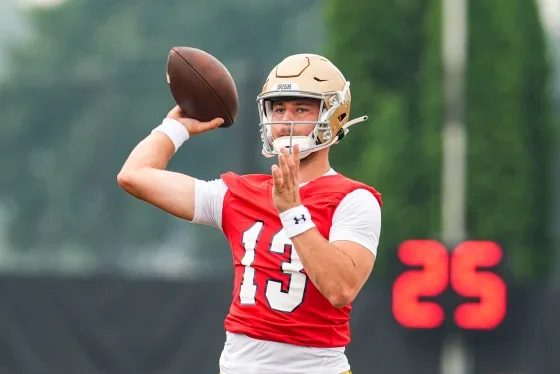
returning qb and coordinators give marcus freeman a better feeling this spring
For the first time since 2020, Notre Dame will have a returning starter under center. as quarterback CJ Carr returns to become the face of the Irish offense heading into a very important spring practice schedule. Carr had an impressive start to his 2025 season, but leveled off towards the end of the season. Despite disappointing late season performances, he threw for 2,741 yards and completed over 66 percent of his passes with 24 touchdowns, and seven interception. Head coach Marcus Freeman recently sat down with On3's JD Pickell and talked about his confidence in what he’s seen from his second year signal-caller.
"It's exciting," Freeman stated. "It's my first time having a returning starting quarterback along with all three coordinators returning as well. There's a level of comfort knowing who they are as people, knowing that they know the schemes, knowing who CJ Carr is and the work ethic that he puts in as well as the work our coaches put in. There's a level of confidence we have but we still have to continue to do the work."
According to FanDuel, Carr is currently the favorite to win the Heisman and widely considered one of the best returning quarterbacks according to several outlets. Multiple outlets project Carr to be the number one quarterback in college football with a chance of being a top 10 pick in the 2027 NFL Draft. The off-season buzz matches the buzz generated by his arrival during bowl practices for the 2023 Tony The Tiger Sun Bowl. Since then, the sound coming from his talent and preparation have been unavoidable.
"He's prepared," Freeman answered when asked about Carr. "From the moment he stepped on campus, he's prepared to be the starter. It's just a reflection of the way he was raised, being obviously a coach's kid and a coach's grandson. He prepares tremendously. That's the one thing you appreciate about CJ Carr is there is no finish line for him and that's what I'm excited for."
Now, the pressure ratchets up for Carr and offensive coordinator Mike Denbrock, who will also have the same conductor for his offense returning for the first time since returning prior to the 2024 season. Both Freeman and Denbrock have high expectations for their quarterback, and his maturity is greatly needed as the offense loses almost 73 percent of it’s production with players like Jeremiyah Love, Jadarian Price, Eli Raridon, and others leaving for the NFL. The passing game must take a step forward with Carr becoming the focal point of the offense.
"The thing that you're seeing him do now is him truly let his leadership shine," Freeman explained. "He's making the guys around him better. You see him getting the wide outs, tight ends and the running backs together saying, 'Okay, we're going to throw on Saturdays at this time and you have to be there. Then they're going to watch film at this time and they have to be there. He is always looking for ways to improve."
Defensive coordinator Chris Ash has continuity in the coaching staff with the hiring of Charlie Partridge, Aaron Henry and Brian Jean-Mary. All three coaches had existing relationships with Ash and understand how he wants things communicated to the players. That may have been difficult with the previous staff that had coached under former defensive coordinator Al Golden. Going into his second year, Ash has a better feel for what the players can do and the defense should benefit from it.”
"Every year before this, I was spending time with a certain side of the ball trying to make sure we understand what the new scheme was," Freeman stated. "You're trying to figure out how we're going to script practice to get enough reps for this quarterback competition. Every year is different, but this one's different. I don't need to go spend a whole bunch of time figuring out what we're doing on offense, defense and special teams because the coordinators are back."
Marcus Freeman has an early season hurdle to get over in the form of his team getting off to slow starts, and the continuity flowing from his quarterback and coordinators has him extremely confident about the Fighting Irish being able to fulfill his mantra for the season. “Leave No Doubt”.
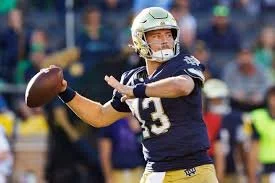
cj carr ranked as top returning qb in college football
Fighting Irish starting quarterback, CJ Carr, is the betting favorite to win the Heisman trophy according to FanDuel, and was recently picked by ESPN analyst Bill Connelly as the top ranked returning quarterback in the country.
The ESPN ranking is based on "stats, trends and recent performances." That equation led to Connelly placing Carr as the nation's top quarterback, ahead of Ohio State sophomore Julian Sayin. Carr will be Marcus Freeman’s first returning starter at the position and the success of the Fighting Irish rest on what many expect to be an impressive season.
Connelly’s Take:
"He sort of looked like a redshirt freshman against Miami in Week 1 of last season, but that was about it. He fell just short of leading a comeback win against the Hurricanes, then pretty much torched all other opposition. Sure, he had a spectacular run game at his disposal -- Jeremiyah Love and Jadarian Price combined for 2,046 yards and 29 touchdowns (and are both gone now) -- but Notre Dame ranked first nationally in third-and-long success rate (7 or more yards to go). When Carr had to make a throw, he did so.
"Carr isn't exactly your modern dual-threat guy; he doesn't scramble much, and he's not a threat to punish defenses for turning their backs on the QB in man coverage. But he also doesn't take sacks, both because of quick decision-making and the fact that he might have the best offensive line in the country protecting him. He's accurate, he has a big arm, and by the end of 2025 he was one of the most reliable passers in the sport.
"While three of last year's four main wideouts are gone, the return of Jordan Faison, plus 2024 playoff hero Jaden Greathouse (back from an injury redshirt) will help, as will the addition of two recent blue-chippers from Ohio State (Mylan Graham, Quincy Porter). Carr should have most of what he needs, and even if the run game regresses a bit, there's no reason to think he won't continue to come through on third down." - Connelly
Carr earned second team Freshman All-American honors last season after passing for 2,741 yards and 24 touchdowns while completing just under 67-percent of his passes. He ranked second in all of college football with a 9.4 yards per attempt average and ranked fifth with a passer rating of 168.06, and his passer rating set a new Notre Dame record, shattering the mark that was previously tied by Jimmy Clausen in 2009. Carr also ranked 4th in the country with a 14.1 per completion average.
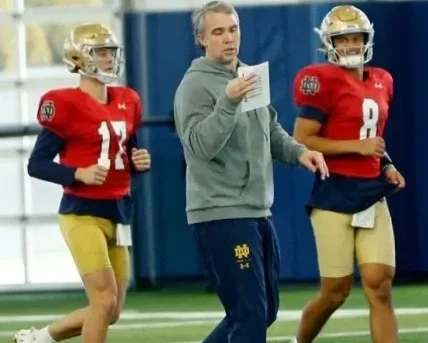
Nd set to begin fall camp: carr, minchey look to set the tone
Notre Dame begins fall camp on Thursday and there are several position battles that add intrigue to an already highly anticipated camp, because of the pending quarterback battle between CJ Carr and Kenny Minchey. Both quarterbacks have garnered confidence from the staff during the spring that they’re ready to assume the responsibility of being the leader of Notre Dame’s evolving offense under 2nd year offensive coordinator Mike Denbrock.
1) Who can be the most consistent performer? That is job number one for the quarterbacks, perform on a consistent level. It's not so much about completion percentage as it is moving the offense. Who can lead the offense to points on a more consistent basis. Who can make the best decisions on the most consistent basis, which gets the ball to the playmakers.
CJ Carr showed the ability to do this at a higher level in the Blue & Gold game with Minchey missing a few easy opportunities.
2) Who can command the offense at the highest level? Commanding the offense refers to leadership and also who can handle the system the best. Who commands the most confidence and trust from the rest of the offense? Who can show the best grasp of the offense, which allows the quarterback to get the unit into good looks and out of bad ones? Leadership comes from setting a good example, but it also comes from earning the trust of your teammates that you can set them up for success.
Both quarterbacks have been in Mike Denbrock’s offense for two years and have a good handle of things. Consistency and decision making will be vitally important during fall camp. The spring saw both have moments of greatness, so the more consistent QB will have an advantage.
3) Who can limit the big mistakes? Turnovers are going to happen for all quarterbacks, and that's especially true for first-time starters. Both Minchey and Carr will turn the ball over in fall camp and the winner of the starting job will turn the ball over during the season. The two keys are keeping them to a level you can live with as an offense and also avoiding the really bad turnovers. The bad turnovers are the ones that come from panic, the ones that kill potential scoring drives, the ones that set up the opposition for easier scores and the ones that crush momentum in the biggest moments of the game. Big mistakes aren't just about turnovers, avoiding big mistakes also means not missing out on the opportunities to make big plays and clutch plays when they happen.
No one expects either quarterback to be perfect, and mistakes will be made. The response to those mistakes will be a bigger focus throughout camp.
There should be a natural order at the quarterback position in any program, and the same holds true with this situation. Kenny Minchey has been around and should be viewed as the lead guy in the race with the snaps shared evenly. Ultimately, this is going to come down to how Mike Denbrock views the offense evolving in the hands of both quarterbacks, and if one can show that they possess the skills to speed up that evolution, then they will separate themselves. This battle will set the tone for everything Mike Denbrock is looking to establish heading into the season.
Malik Zaire

talented 2027 qb teddy jarrard gets nd offer
Offensive coordinator Mike Denbrock and quarterbacks coach Gino Guidugli went through an exhaustive evaluation process with the 2027 quarterbacks and 6-3 190-pound four-star signal caller Teddy Jarrard of Kennesaw (Ga.) North Cobb seems to have stood out as he received an offer from Notre Dame on Friday.
“It feels great,” Jarrard sai. “It’s an honor to be one of the two quarterback offers from Notre Dame. It’s a great school with
great tradition and I couldn’t be more excited.”
Jarrard took his first visit to South Bend with family on June 5 th and spent the day touring the campus and meeting the staff, which included a meeting with coach (Marcus) Freeman for about an hour. There was also an opportunity to impress Gino Guidugli during a workout and throwing session followed by conversations that strengthened their relationship throughout the day.
“I enjoyed my visit,” Houston said. “They told me that they liked me and would continue looking at guys before making offers. From that point, coach Gino started talking more.”
That relationship with coach Gino Guidugli can only be described as a forthcoming one that has budded quickly over the last month or so, and the North Cobb offensive player of the year wasn’t surprised when the Notre Dame staff FaceTimed him on Friday.
“I wasn’t surprised” Jarrard shared. “I knew the offer was coming. Coach Gino and I talked about my chances of getting it a week before, but it didn’t change how special the moment was.
“They called me with the staff on the phone,” Jarrard continued. “They gave me the offer, and I spoke to coach (Mike) Denbrock about everything as well.”
Even after receiving the offer, Jarrard remembers the conversation with head coach Marcus Freeman during his June visit and how it gave him insight into what the culture of Notre Dame was all about. He also has his eyes on the recent recruiting success for the Fighting Irish.
“The culture stands out for me,” Jarrard shared. “You can see what coach (Marcus) Freeman is building and how they’re winning right now. You see what they’re doing in the 2026 class, and you know that they’re moving in the right direction.”
Jarrard will now turn to leading his Warriors’ teammates to a deeper runin the Georgia state playoffs after a hot 11-0 start ended with disappointment. They began practicing early in the summer, but the excitement is at fever pitch with the squad going “full pads” starting next week.
“We’re going to be good,” Jarrard declared. “Health is going to be the key. If we can stay healthy, we’re going to be really good. We’ve been practicing, but we’re getting ready to go full pads.
“I’m working hard to get better,” Jarrard continued. “The strength of my game is making quick decisions and getting the ball out quickly. The most important thing is winning football games. I do want to increase my touch, limit interceptions and increase my completion percentage.” As far as a timetable for a decision is concerned, Jarrard can see two paths to an eventual decision.
“No set timetable,” Jarrard explained. “It depends if I really feel good about a school. If that happens, it will be after the summer. But, if I don’t feel good about a school and I’m not sure, it will be after the season. As a sophomore, Jarrard threw for 2783 yards, 34 touchdowns, 72 completion percentage and a QB rating of 128.2. He currently ranks 217th nationally according to 247 Sports composite and hold offers from schools like Georgia, Michigan, Miami, Ohio State, and Alabama to name a few.
Shaun M. Davis

2027 4-star qb peyton houston lands nd offer
As the annual “Pot Of Gold” offers were dispersed for the 2027
recruiting class, there was an omission that created a bunch of
questions amongst Notre Dame fans. Where were the offers for
quarterbacks? Offensive coordinator Mike Denbrock and quarterbacks
coach Gino Guidugli took a brave new approach in evaluating signal-
callers as they operated from a position of strength with promising
talents like CJ Carr, Kenny Minchey, Blake Herbert and Noah
Grubbs on the roster or committed to the program. They were afforded
the opportunity to methodically search for the young men that best fit
their plans for the evolution of the offense.
Their search led the Fighting Irish to 5-11 200-pound four-star
quarterback Peyton Houston of Shreveport (La.) Evangel Christian
and plans were immediately made for Houston to visit South Bend to
see the campus, meet coaches and observe practice.
“It was a really good visit,” Houston told Irish Breakdown. “They practice
really fast and all of the quarterbacks looked good. I got a chance to talk
to coach Gino (Guidugli) and coach (Mike) Denbrock and they told me
how they would handle the process with offers.
“They liked my film,” Houston continued. “They’re going to come and
watch me throw at my school in May. I’m excited for the opportunity and
to have a school like Notre Dame interested in me.”
The first day of May found coach Gino Guidugli travelling to Evangel
Christian to watch an Eagles’ practice in the Louisiana heat, but he
ended watching the talented passer pivot in more ways than one.
“We were scheduled for spring practice,” Houston said. “But, we had to
cancel it due to a mandatory school event, and I had track regionals. So,
I organized a session after school with my guys that were left.
“The throwing session went great with Coach Gino (Guidugli),” Houston
continued. “We worked on our day one install and did routes on air. The
total count was about 50-60 throws. Unfortunately, Coach Gino couldn’t
stay until the end because he had to fly out. He probably saw 25-30
throws, but he missed some of the deep throws. It seemed like he really
liked what he saw.”
After the throwing session, the three-sport athlete zeroed in on track
season as he waited for feedback from the Fighting Irish, and he didn’t
have to wait long.
“Coach (Marcus) Freeman reached out to my dad afterwards,” Houston
said. “My dad is our (Evangel Christian) quarterbacks coach, and he told
him that Coach Gino was extremely impressed with me.
It seems the Fighting Irish are still impressed and view him as a priority
quarterback recruit, when they extended an offer on Friday.
“It’s a huge blessing to get the Notre Dame offer,” Houston shared.
“Everyone knows how valuable that is and what it means to be a
Fighting Irish quarterback. I’m definitely grateful for the coaches having
trust in me to feel comfortable enough to extend the opportunity.
“I got the offer yesterday,” Houston continued. “Coach Gino asked me to
call him and put it on FaceTime. I spoke with him and coach Denbrock,
and they extended the offer. It was a really cool moment that I won’t
forget.”
As a sophomore, Houston threw for 4480 yards and 38 touchdowns with
70 percent completions. He ran for 690 yards and 7 touchdowns as well.
He currently ranks 85th nationally according to 247 sports composite
and holds offers from programs like Clemson, Ole Miss, LSU,
Michigan, Penn State, Texas, Texas A&M, and SMU to name a few.
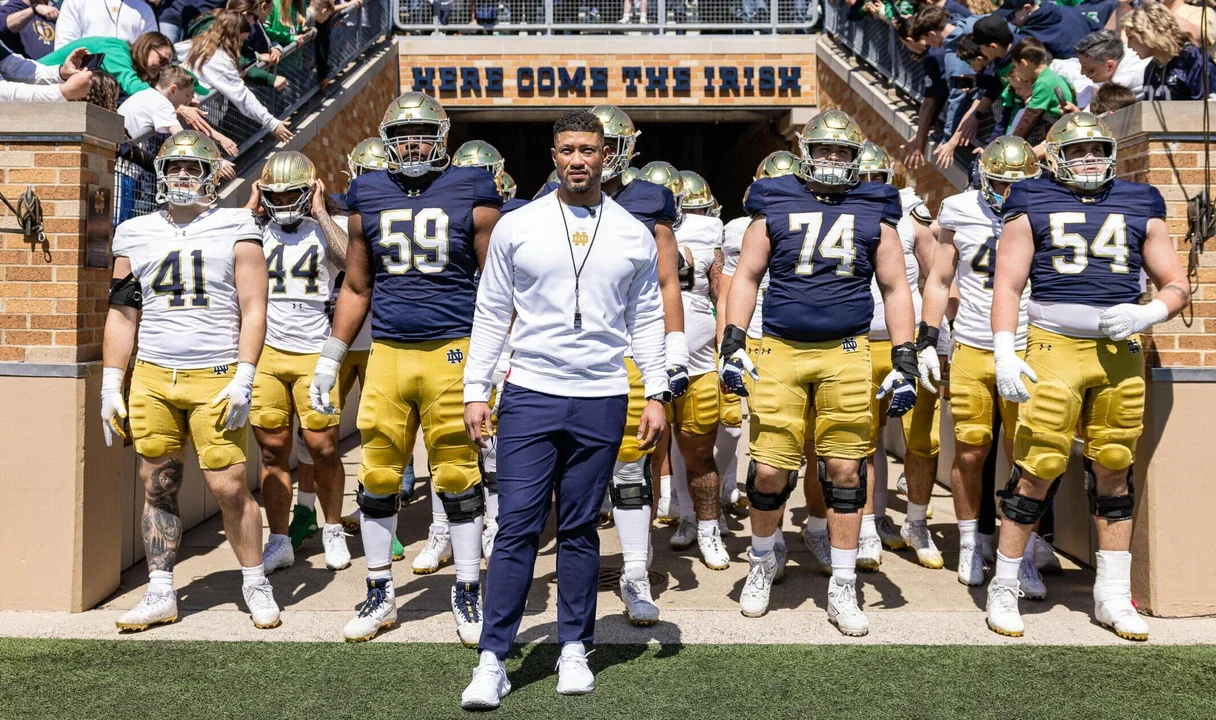
blue and gold game sheds light on qb competition
Marcus Freeman has spent the spring overseeing a new defensive coordinator in Chris Ash put his fingerprints on a talented defense along with a quarterback battle between Steve Angeli, CJ Carr and Kenny Minchey. Last Saturday, he got an opportunity to watch the fruit of months of observations and evaluations during the annual Blue and Gold game at Notre Dame stadium.
The Blue team defeated the Gold team 76-31 in a spring game that looked much different than in years past.The Fighting Irish were without several players who were rehabbing from injury or resting from an extended run in the college football playoff.
That encouraged some changes to the format and scoring to the game. Instead of four quarters, the game consisted of three periods with four drives consisting of a minimum of six plays. For each of these drives, the ball was placed at various spots to create different game-like situations.
The biggest storyline during the spring has been the quarterback battle between Steve Angeli, CJ Carr and Kenny Minchey. All three QBs had an equal opportunity to shine, and each led the Irish offense on at least one touchdown-scoring drive. But many Irish fans are saying Carr looked the most impressive during Saturday’s game.
Carr finished 14 of 19 for 170 yards and two touchdowns, including a 27-yard touchdown pass to sophomore wide receiver Xavier Southall and a two-yard score to freshman wide receiver Elijah Burress. However, he did throw the game’s only interception on his second-to-last drive under center.
After a slow start, Angeli seemed to settle in and capped his day with a 16-yard touchdown pass to freshman wide receiver Scrap Richardson. He finished 8 of 11 for 108 yards and the aforementioned touchdown.
Minchey ed a three-play, 45-yard drive where he scored on a four-yard run and celebrated his touchdown by doing a backflip in the end zone. He finished 6 of 14 through the air for 106 yards and ran for 12 yards on six carries.
After the game, Freeman said he saw a lot of good from all three quarterbacks and said they could all lead Notre Dame to wins.
“It’s crazy to think this, but you’ve got three guys that all could lead your program to a victory and be your starting quarterback,” Freeman said. “You would like to go into fall with a two-quarterback battle. It’s really hard truly having a three-quarterback battle.”
On the defensive side of the ball, Luke Talich led the way with nine tackles while Bryce Young and Preston Zinter were credited with sacks. Ben Minich intercepted Carr for the game’s only turnover.
But perhaps the biggest defensive plays of the afternoon came on a goal line stand in the seventh series of the scrimmage, where Talich helped the Gold team make back-to-back stops at the goal line on third and fourth down to prevent a Blue touchdown.
Jadarian Price led the team in rushing with 46 yards on six carries while freshman running back Nolan James Jr. led the team in receiving with 60 yards on three catches. For a full look at the final stats from the 2025 Blue-Gold Game,
The Irish will now wait for fall camp to begin preparation for their season opener versus the Miami Hurricanes on August 31st.