
Notre Dame hits Wall Street: Freeman, Carr, Moore Kick Off NYC Media Blitz
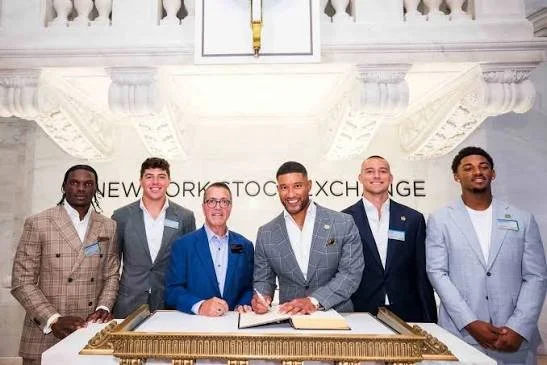
Notre Dame football's biggest names traded South Bend for the concrete canyons of Manhattan this week, launching a whirlwind New York media tour that opened in the most on-brand way possible for a program synonymous with tradition: ringing the bell at the New York Stock Exchange.
Head coach Marcus Freeman was joined on the trading floor by quarterback CJ Carr, cornerback Leonard Moore, linebacker Drayk Bowen and safety Adon Shuler for the closing bell ceremony, where the group used the moment to remind the Big Apple who was in town with a "Let's Go Irish" chant that got much of the floor chanting along, with a Notre Dame banner draped behind them as a backdrop. It capped a day that had already included stops on ESPN doing a variety of interviews before the group made its way to the Exchange.
The quartet's trip to New York was no accident. Notre Dame announced that quarterback CJ Carr, linebacker Drayk Bowen, safety Adon Shuler and cornerback Leonard Moore would represent the program on its annual media tour around the city's major outlets, with appearances lined up on shows like ESPN's SportsCenter and NFL Network's Good Morning Football. As one Notre Dame outlet noted, the group also doubles as a strong hint at this year's leadership structure — Bowen and Shuler return as captains from 2025, while Carr and Moore, both just second-year players last season, were too young to hold the title but easily could have.
Carr, the presumptive Heisman frontrunner, got the first big spotlight moment, sitting down with Rich Eisen to walk through his path to South Bend — including the story of his father initially hiding Michigan's offer letter from him, and how it was former offensive coordinator Tommy Rees who recruited him hardest and showed him the most love, a pull that, combined with Marcus Freeman's own recruiting effort, ultimately landed Carr with the Irish over his grandfather Lloyd Carr's alma mater. Carr also used the sit-down to frame the mindset for the upcoming season, discussing how Notre Dame plans to keep using the disappointing end to 2025 as motivation heading into 2026.
The tour continued into Friday morning, when Freeman and Moore stopped by the Today Show. Asked about the "Here Come the Irish" refrain that blares over the loudspeaker as Notre Dame takes the field — now also the title of the program's in-house Peacock series — Freeman kept it simple: "It was there before I got there. As you take the field, they play over the loudspeaker 'Here Come the Irish.' We take the field, so I think it's pretty simple to make that the title of the show."
Freeman was also asked what it's been like having a camera crew shadow the program for that same series, and admitted the adjustment took some time. "Yeah, it took some convincing to think about all the cameras, the mics and the distractions. We really started to implement it last spring. It was a good trial run and it became like they were a part of the team, you didn't notice they were there. They feel like they were part of the staff and I think everybody kind of dropped their guards and it just became natural," he said.
The New York swing comes on the heels of a spring in which Moore made headlines of his own, telling reporters in South Bend that Notre Dame was on something of a "revenge tour" after last year's College Football Playoff snub. Moore said the defensive backs took a lot of the blame following Notre Dame's loss to Miami, in which Hurricanes quarterback Carson Beck completed 20 of 30 passes for 205 yards and two touchdowns without an interception, and didn't sugarcoat how Freeman responded. "He told us we was weak, we was soft," Moore said, "all that type of stuff. It's serious to him, too. That's something he's not used to seeing from us."
Freeman, for his part, waved off any notion that revenge is the operative word internally, preaching focus on the present instead. "We spend too much time daydreaming about Miami, we're going to lose to Wisconsin," he said, referencing Notre Dame's Sept. 6 season opener. "You've got to focus on the task right at hand. That's no different than saying, can we go back to the national championship? If we want to focus on the national championship, we're going to lose the opportunity we have right here. It's my job to make sure I'm directing the focus where it needs to be."
With the bell-ringing and morning show circuit behind them, the group's New York run is expected to continue over the next several days, with more national appearances on tap as Notre Dame — with a Heisman-caliber quarterback, an All-American cornerback and a coach determined to keep the noise pointed forward rather than backward — begins building the case for a 2026 season with, in Freeman's words, no doubt left to leave.
usa today ranks notre dame 2nd in post spring poll
USA Today has spoken — and the verdict on Notre Dame heading into the 2026 season is about as emphatic as a preseason ranking can be. Analysts Erick Schmidt and Paul Myerberg have tabbed the Fighting Irish as the No. 2 overall team in the country in their Post-Spring Top 25, trailing only Ohio State and ranking ahead of Texas, Georgia and Indiana in a list that reflects a program operating at the absolute peak of its modern era.
The ranking is not a gift or a projection built on hope. It is a recognition of something concrete — a Notre Dame roster that returns an experienced starting quarterback, a proven offensive supporting cast, a defense that kept its best players and a coaching staff with all three coordinators back for the first time in Marcus Freeman's tenure. When you stack those ingredients together and evaluate them honestly against every other program in the country, No. 2 is not a stretch. It might even be conservative.
Here is the full case for why Notre Dame belongs exactly where USA Today put them — and why 2026 could be the year everything comes together.
CJ Carr — The Heisman Front-Runner Nobody Should Be Sleeping On
Every conversation about Notre Dame's 2026 ceiling begins and ends with CJ Carr — and every conversation about the 2026 Heisman Trophy race should begin and end there too.
Carr enters his second season as Notre Dame's starting quarterback with something that no other signal caller in the country can claim in quite the same way — a full season of starting experience at Notre Dame, in a system he now owns completely, with the weapons around him upgraded and the continuity of returning coordinators giving him the most stable offensive environment of his college career. That combination of experience, continuity and talent elevation is precisely the formula that produces Heisman Trophy-caliber seasons.
In his first full season as a starter in 2025, Carr demonstrated command, poise and playmaking ability that immediately announced him as one of the premier quarterbacks in college football. He managed Notre Dame's offense with the kind of veteran intelligence that first-year starters rarely possess — reading defenses pre-snap, going through progressions efficiently and delivering the football with accuracy and timing in the most critical moments of the most critical games. The Carr-Faison connection that developed throughout 2025 became one of the most reliable quarterback-receiver partnerships in the sport, and that chemistry only deepens entering 2026 with a full offseason of concentrated work behind it.
What elevates Carr's Heisman candidacy beyond simply returning a quality starter is the trajectory. The jump from a first-year starter finding his footing to a second-year starter who knows every concept, trusts every receiver and operates from a position of complete offensive authority is one of the most dramatic developmental leaps in college football. Carr has already shown he can win games and manage a complex offense. In 2026, with the supporting cast around him upgraded on every level, the expectation is that he takes the next step — from excellent game manager to dominant offensive force — and the tools surrounding him make that leap entirely realistic.
The Heisman Trophy watch list will have many names on it when the 2026 season begins. CJ Carr should be at or near the top of every legitimate conversation about who wins it.
A Backfield Built to Replace Elite Production
The departure of Jeremiyah Love — selected No. 3 overall by the Arizona Cardinals in the NFL Draft — leaves the most significant void Notre Dame needs to fill on offense heading into 2026. Love was one of the most dynamic running backs in college football, a unanimous All-American whose production and big-play capability defined Notre Dame's ground attack for two seasons.
But the Irish are not rebuilding the backfield from scratch. They are reloading it with proven talent that has been waiting for exactly this opportunity — and the players stepping into expanded roles bring legitimate credentials of their own.
Nolan James Jr. returns as the most experienced back in Notre Dame's room, a proven contributor who has demonstrated the vision, patience and contact balance to be a productive starter at the Power Four level. His ability to operate within Notre Dame's zone-blocking scheme, find cutback lanes and move the chains in critical short-yardage situations gives the Irish a reliable foundation in the backfield that Carr can lean on in the most important moments of games.
Aneyas Williams brings a complementary dimension to the backfield that gives offensive coordinator Tim Rees genuine flexibility in how he deploys the ground game. Williams's quickness, acceleration and ability to create in space provide a contrast to James's between-the-tackles style — giving Notre Dame a two-back approach that can attack defenses horizontally as effectively as it attacks them vertically. The combination of James's power and patience with Williams's quickness and space creation gives Notre Dame's ground game the kind of range that makes it genuinely difficult to defend with a single schematic approach.
Together, James and Williams represent a backfield that does not replace Love's individual brilliance but provides Notre Dame's offense with enough combined production, versatility and proven capability to keep the ground game a legitimate threat on every snap. That is all Carr and the passing game need — a running back room that keeps defenses honest and prevents them from loading the box against Notre Dame's receivers.
A Wide Receiver Room Transformed by Experience and Elite Portal Additions
Jordan Faison returns as Notre Dame's established No. 1 wide receiver — the team's leading receiver in 2025 with 40 receptions, 640 yards and four touchdowns — and does so as a completely different player than the one who led the team statistically last season. His offseason decision to give up lacrosse and commit entirely to football signals a level of investment and focus that should translate directly into elevated production in 2026. Faison gives Carr exactly what a second-year starter needs more than anything — a proven, trusted target who knows the offense, runs precise routes and makes the right play after the catch every single time.
Jaden Greathouse returns alongside Faison after a 2025 season that saw him emerge as one of Notre Dame's most explosive playmakers in the postseason. Greathouse's combination of separation quickness, yards-after-catch ability and big-play capability gives the Irish a legitimate second receiving threat that defenses cannot bracket without leaving Faison in one-on-one coverage outside. Two proven, experienced receivers at the top of the depth chart entering the season is a luxury Notre Dame has not had in recent memory.
The addition of Mylan Graham from Ohio State via the transfer portal elevates what was already a strong receiver room into one of the most complete groups in the country. Graham arrives with Big Ten experience, proven production at an elite program and the kind of physical tools that made him a highly recruited prospect out of high school. His ability to contribute immediately in a complementary role — taking advantage of the attention that Faison and Greathouse command from opposing secondaries — gives Carr a third legitimate receiving option that stretches defenses in ways that create opportunities for everyone on the field.
The combination of Faison's established No. 1 production, Greathouse's explosive playmaking and Graham's experienced portal addition gives Notre Dame's receiver room a depth and versatility that rivals any group in college football heading into 2026.
A Defense That Returns Its Best Players — And Added Elite Talent
If the offensive case for Notre Dame's No. 2 ranking is compelling, the defensive case is even stronger — because what Marcus Freeman's defense is returning in 2026 is not simply a group of experienced players. It is a collection of proven, dominant performers at every level of the field, supplemented by transfer additions that address the few areas where reinforcement was needed.
Leonard Moore — The Best Cornerback in America
The foundation of Notre Dame's defensive identity in 2026 is a player who has already been discussed at length in every preseason publication that covers college football seriously — and for good reason. Leonard Moore is the best cornerback in the country. Full stop.
Moore returns after a 2025 season in which he ranked first among all starting Power Four cornerbacks in both coverage grade at 91.4 and overall defensive grade at 90.9 according to PFF. He led Notre Dame with five interceptions — tied for sixth most in the entire country — while adding 31 tackles, seven pass breakups and a forced fumble across 10 starts. Opposing quarterbacks targeted him on only 11.5 percent of his coverage snaps — a testament to the reputation he built as a cornerback that the entire country's offenses chose to scheme away from rather than challenge.
PFF has ranked Moore the No. 1 returning cornerback in the country for the second consecutive season. ESPN has named him the lead candidate for the Jim Thorpe Award. He is a legitimate front-runner for the Bronko Nagurski Trophy and the Chuck Bednarik Award. In a defense returning significant production across all three levels, Moore is the crown jewel — the player that every offensive coordinator game plans around specifically and still cannot consistently solve.
Drayk Bowen — The Defensive Engine
While Moore commands the attention of opposing passing games on the outside, Drayk Bowen commands the interior of Notre Dame's defense with the kind of instinctive, physical presence that makes the entire system function at its highest level. Bowen is one of the most complete linebackers in college football — a player who processes information quickly, fills gaps with authority, covers enough ground to be a factor in pass defense and brings a physicality to the run game that sets the tone for how Notre Dame's defense operates on any given Saturday.
His return for 2026 gives Notre Dame's linebacker corps a proven leader and production anchor that younger players in the group can develop around. Bowen's ability to quarterback the defense from the second level — making pre-snap adjustments, communicating coverage calls and reacting to offensive formation changes with veteran intelligence — is as valuable as his individual statistical contribution and perhaps more so in a defense that returns significant personnel but needs someone to tie all the pieces together.
Adon Shuler — A Safety Making His Move
Adon Shuler enters 2026 as one of the most intriguing players on Notre Dame's entire roster — a safety whose athletic profile and instinctive play have been building toward a breakout season that the 2026 campaign is set up to deliver. Shuler's combination of range, closing speed and ball-hawking instincts in the deep middle of the field gives Notre Dame's secondary a versatile, playmaking presence that complements Moore's dominance on the outside in a way that makes the entire pass defense more difficult to attack from any angle.
His ability to rotate into coverage, support the run from the second level and create turnovers in the deep part of the field gives Notre Dame's defensive staff the flexibility to disguise coverage looks and present offenses with pre-snap pictures that become something entirely different after the snap. That kind of safety versatility is invaluable in a modern college football landscape where offenses are increasingly sophisticated in their ability to identify and attack predictable coverage structures.
Boubacar Traore — Pressuring the Quarterback
Boubacar Traore returns as one of Notre Dame's most important pass rush weapons — a player whose combination of athleticism, first-step quickness and relentless motor makes him a consistent threat to disrupt opposing quarterbacks on every passing down. In a 2026 defensive front that has added significant reinforcement through the transfer portal, Traore's returning production and established role give the Irish a proven disruptive presence that new additions can build around rather than having to establish from scratch.
His ability to win one-on-one matchups against offensive tackles, create pressure from multiple alignments and finish plays in the backfield gives Notre Dame's defensive line a dynamic, production-proven element that elevates the entire group's ceiling. Opposing offensive coordinators cannot simply account for the new additions on Notre Dame's defensive front without also accounting for Traore — and that collective burden on an offensive line makes everyone on the Irish front more dangerous.
Bryce Young and the Transfer Portal Additions Transform the Front Seven
Notre Dame's returning defensive core is impressive enough on its own. Add the transfer portal additions and the front seven becomes one of the most formidable groups in the country.
Bryce Young arrives as the leader of a defensive line that also added Francis Brewu from Pittsburgh and Keon Keeley from Alabama — two transfers whose production and credentials at elite programs give Notre Dame's defensive front an immediate infusion of experienced, proven talent that addresses the depth and pass rush concerns that any program faces when losing contributors to graduation or the NFL.
Brewu brings interior disruption capability from a Pittsburgh program that regularly produces NFL-caliber defensive linemen. Keeley arrives from Alabama with the pedigree and physical tools that made him one of the most coveted defensive line recruits in his class — and Notre Dame gets the benefit of Alabama's development infrastructure having already invested significant time and resources into maximizing his potential.
Together with Traore and the returning pieces up front, Young, Brewu and Keeley give Notre Dame a defensive line rotation that can go deep into games without losing effectiveness — matching the physical demands of a Power Four schedule snap for snap, series for series, against the best offensive lines the sport produces.
Christian Gray and DJ McKinney Complete an Elite Secondary
Behind Moore, Notre Dame's secondary is anchored by Christian Gray — a versatile, proven defender whose ability to play multiple positions in the back end gives defensive coordinator Al Golden the flexibility to present different looks without sacrificing production at any individual spot.
The addition of DJ McKinney from Colorado via the transfer portal completes what USA Today identified as potentially the biggest strength on Notre Dame's entire roster. McKinney arrives with starting experience, proven production against Power Four competition and the physical and athletic profile to step in immediately and contribute at a high level alongside Moore and Gray. A secondary that starts Moore, Gray and McKinney — with Shuler patrolling the deep middle — is as complete and as dangerous a group of defensive backs as any program in the country can put on the field in 2026.
The Continuity Factor — Why This Year Is Different
Every element of Notre Dame's 2026 roster case is amplified by something that has never existed before in Marcus Freeman's tenure — complete continuity at the coordinator level. All three coordinators return for the first time under Freeman, bringing with them the accumulated institutional knowledge, player relationships and schematic sophistication that only develops when a coaching staff stays together long enough to truly master their system.
Carr does not have to learn a new offensive system. Moore does not have to rebuild trust with a new defensive coordinator. The entire roster — from the most experienced starters to the youngest contributors — enters 2026 operating within a framework they already know, already trust and already know how to maximize. That continuity is worth several wins over the course of a season, and in a college football landscape where coordinator turnover is constant and relentless, Notre Dame's stability entering 2026 is a genuine competitive advantage.
The Bottom Line
USA Today ranked Notre Dame No. 2 in the country after spring practice — and the case for that ranking is as strong as any program in America can make. A returning Heisman-caliber quarterback in CJ Carr. A backfield reloaded with Nolan James Jr. and Aneyas Williams. A receiver room elevated by Jordan Faison's leadership, Jaden Greathouse's explosion and Mylan Graham's portal addition. A defense returning Leonard Moore, Drayk Bowen, Adon Shuler and Boubacar Traore while adding Bryce Young, Francis Brewu, Keon Keeley and DJ McKinney to an already elite group.
Stack all of it together under three returning coordinators with a head coach entering his fifth season and the program's deepest, most talented roster to date — and No. 2 in the country is not just defensible.
It might be the most honest thing USA Today has published all offseason.

drayk bowen, leonard moore on nagurski watchlist
Notre Dame defenders continue to receive admiration and buzz from the success of the Fighting Irish defense over the past three seasons. The latest recognition is courtesy of the Bronko Nagurski Award, which has linebacker Drayk Bowen and cornerback Leonard Moore on its preseason Watch List.
The Nagurski Trophy goes to the nation’s top all-around defensive player, and the award found it’s way to South Bend in 2023 when it went to Notre Dame star safety Xavier Watts. Bowen and Moore are the two returners getting the most preseason recognition as the Irish look to have another star win that honor.
Bowen excelled as a first-year starter in 2024 and he took control on the Mike linebacker position under now ex-defensive coordinator Al Golden, and became a vocal leader for the defense. He finished third on the Irish defense with 78 tackles while ranking 7th on the defense in snaps. By the end of the season Bowen was a clear leader of the Irish defense. He played his best football of the season during the final stretch, racking up 22 tackles in the final three playoff games, including 8 in both the Orange Bowl win over Penn State and 8 in the title game loss to Ohio State.
Bowen was listed as a preseason All-American by Phil Steele.
Moore is widely considered the best returning cornerback in college football and projects as a future first-round NFL draft pick. He was a star as a freshman earning Defensive Freshman of the Year honors from the Football Writers Association of America. He tallied 48 tackles, picked off two passes and broke up 11 more during his dynamic rookie season. Heading into his sophomore season, Moore is expected to be one of the top defenders in the nation, regardless of position.
Five Notre Dame opponents also made the Nagurski Trophy Watch List. Miami (Fla.) defensive end Rueben Bain Jr., Texas A&M cornerback Will Lee, Pittsburgh linebacker Kyle Louis, Navy defensive tackle Landon Robinson and Boise State defensive Jayden Virgin-Morgan all made the list.
Shaun M. Davis