
Notre Dame's 2026 Offensive Line Has the Makings of Joe Rudolph's Best Unit Yet
Marcus Freeman's vision for Notre Dame football has always started in the same place. Before the skill positions, before the quarterback, before the coordinators and the scheme and the recruiting rankings — it starts in the trenches. It starts with the offensive line setting a physical tone that makes everything else the Fighting Irish want to do on offense not just possible but inevitable.
That vision has been building toward something in South Bend. The recruiting has been elite. The talent in the room has been undeniable. And now, entering 2026, the pieces are finally aligned in a way that makes the question not whether Notre Dame's offensive line can be great — but whether this specific group, with this specific configuration, in this specific season, can be the best offensive line Joe Rudolph has assembled since arriving at Notre Dame in 2023.
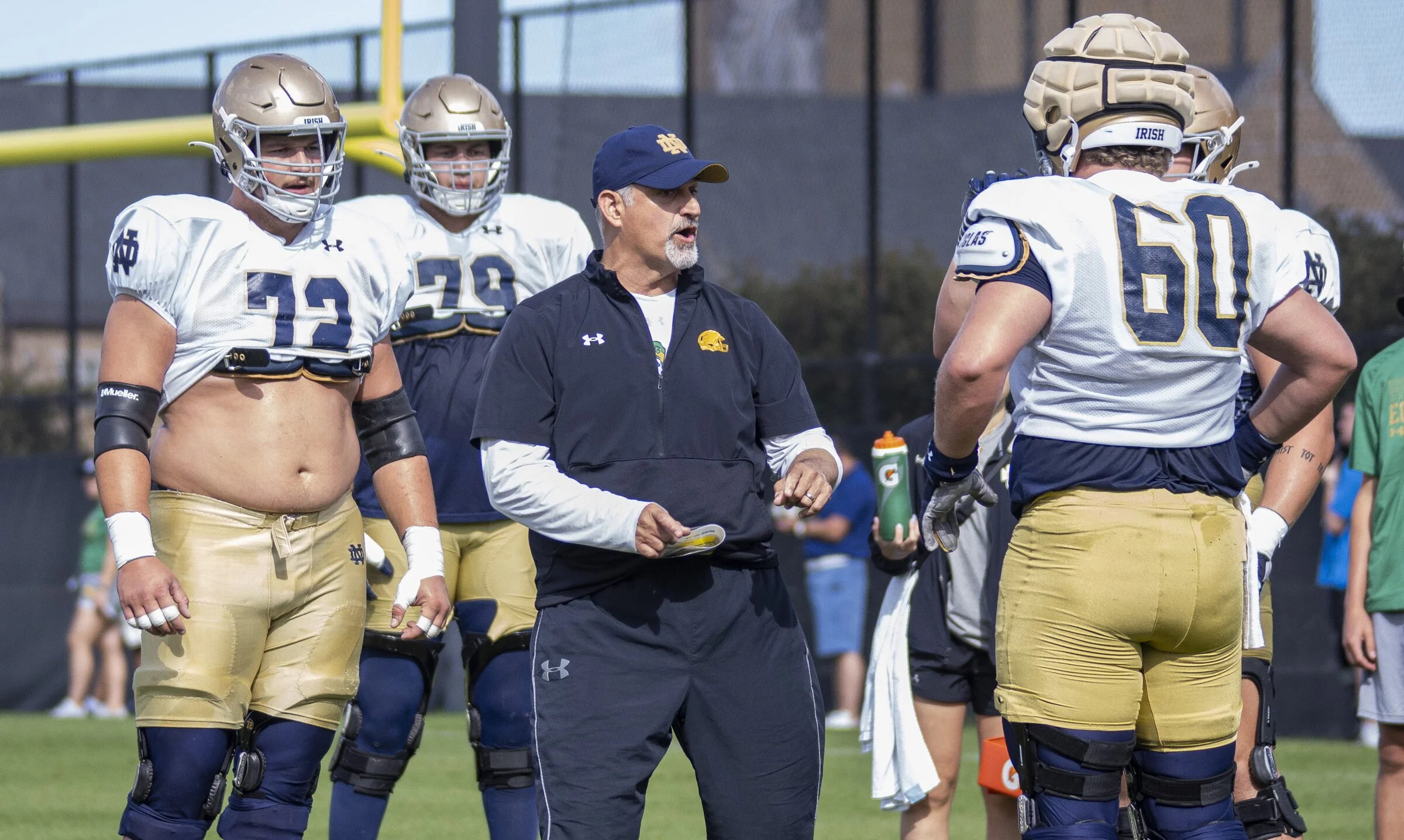
The answer depends significantly on two players — Will Black and Guerby Lambert, a pair of bookend tackles with tremendous upside whose development in 2026 could define not just this season but the entire trajectory of Rudolph's Notre Dame tenure. If Black and Lambert fulfill the expectations that their physical profiles and recruiting pedigrees have always suggested were coming, this offensive line has the talent, the experience and the positional construction to be a genuinely dominant unit — the kind that powers a rushing attack, protects an elite quarterback and gives an offensive coordinator with Mike Denbrock's résumé everything he needs to operate at the highest level.
Everything starts up front. In 2026, Notre Dame's offensive line has the chance to prove that the vision and the reality are finally the same thing.
Experience
The foundation of Notre Dame's 2026 offensive line case is a combination that championship units are built on — experienced interior players providing stability and continuity alongside new starting tackles with the kind of upside that changes what a unit can become at its ceiling.
Anthonie Knapp returns with two years of starting experience, now settled into the left guard position where his power, anchor and starting-caliber development project most powerfully. Ashton Craig — healthy and back from the injury that kept him out of spring practice — anchors the unit at center, the position most responsible for the communication and cohesion that separates good offensive lines from great ones. Sullivan Absher brings redshirt junior experience and genuine competitive hunger to right guard, a player who has waited for exactly this starting opportunity and arrives with the kind of chip-on-the-shoulder energy that produces the best seasons of college careers.
The experienced interior trio of Knapp, Craig and Absher gives Notre Dame's offensive line a proven, battle-tested core that first-year starting tackles can build around rather than carry. That structural advantage is enormous — because it means Black and Lambert do not have to be immediately dominant in order for the unit to function at a high level. They need to develop, grow and improve as the season progresses while the interior handles the communication load and sets the physical tone that the entire unit runs through.
That is the exact formula that produces breakthrough offensive line seasons — proven interior stability giving young, high-ceiling tackles the space to develop without the unit's effectiveness depending entirely on their immediate mastery of the position.
starting LT Will Black
The most consequential individual decision in Notre Dame's 2026 offensive line construction is Will Black's installation as the starting left tackle — and everything about Black's physical profile suggests it is exactly the right decision at exactly the right time.
Black arrived at Notre Dame as a five-star recruit whose combination of length, athleticism and raw pass protection tools projected to the blindside tackle position from the moment he stepped on campus. The left tackle spot is where his ceiling is highest, where his physical tools are most naturally expressed and where his development under Rudolph's coaching has always been pointed. Putting him there in 2026 — committing to the position, committing to the growing pains that come with first-year starting experience and committing to the long-term development arc that makes the short-term challenges worthwhile — is the kind of coaching conviction that separates programs building for championships from programs managing for comfort.
The growing pains will come. First-year starting left tackles in the Power Four face a learning curve against elite edge rushers that even the most talented players cannot fully avoid. Black will have moments in 2026 where that curve is visible — moments where an elite pass rusher wins a rep, where a coverage sack happens because the protection broke down outside and where the raw tools have not yet been fully refined into finished technique.
But the ceiling at the end of that developmental process is what makes every one of those moments worth the investment. A Will Black who has navigated a full season of left tackle starting experience against Power Four competition — processing different pass rush moves, learning to handle speed-to-power combinations and building the confidence that only comes from sustained starting-level repetitions — is the kind of blindside tackle that makes Notre Dame's offensive line genuinely elite for two or three more years beyond 2026.
The investment begins now. The return on that investment will define what Notre Dame's offensive line becomes.
Starting Rt Guerby Lambert
If Black's story in 2026 is about a talented young player stepping into the most demanding position on the offensive line for the first time, Lambert's story is about a proven, elite-recruited player finally getting to play where his ceiling has always been highest.
Lambert is a five-star recruit who arrived at Notre Dame with the physical tools — the length, the athleticism, the power and the frame — of an elite college right tackle. The right tackle position is where Lambert's profile projects most naturally, and 2026 represents the first time in his Notre Dame career that he steps into that role as the full-time, unambiguous starting right tackle without positional questions complicating his preparation or his identity within the unit.
That clarity matters more than it might initially appear. A five-star tackle who knows exactly where he is playing, who his running mate is at right guard and what his specific assignments and responsibilities are within the unit's blocking scheme is a significantly more effective player than one navigating positional uncertainty on top of the normal competitive demands of Power Four starting experience. Lambert enters 2026 with that clarity for the first time — and the results of a full season at right tackle in his natural position could be exactly what his recruiting profile always suggested was coming.
Together, Black on the left and Lambert on the right give Notre Dame something the offensive line has not had since Joe Alt and Blake Fisher anchored the 2023 unit — a pair of bookend tackles whose individual ceilings, if realized, make the entire offensive line a different and more dangerous entity than the sum of its experienced interior parts.
Alt and Fisher are starting in the NFL right now. The standard has been set. Black and Lambert have the talent to approach it. Whether they do in 2026 is the central question of Joe Rudolph's defining season.
Fueling the Rush — Two Seasons of Production That Demand Protection
The case for Notre Dame's offensive line dominance in 2026 is not built on projection alone. It is built on a foundation of sustained rushing production over the past two seasons that reflects a ground game operating at a high level even when the offensive line's performance has been inconsistent — and that should produce even more explosive results when the line reaches the potential that the 2026 configuration makes possible.
Over the past two seasons, Notre Dame has established itself as one of the most consistent rushing offenses in the country, grounding its attack in a zone-blocking scheme that rewards intelligence, footwork and the ability to move defenders off the line of scrimmage. The production has been there even through the injury disruptions and positional uncertainty that have complicated Rudolph's previous two seasons — which means the floor of what this rushing attack can do is already established at a high level.
Now pair that established rushing foundation with the most positionally sound offensive line configuration Rudolph has built since 2023 — and add the most dynamic running back room Notre Dame has had in recent memory.
Aneyas Williams enters 2026 as the featured back in a backfield that has been reloaded with genuine talent after the departure of Jeremiyah Love to the NFL. Williams brings a quickness, burst and space-creation ability that makes him a natural fit for the zone-blocking concepts Notre Dame runs — a runner who understands how to set up blocks, identify cutback lanes and accelerate through holes before defenders can close them. His ability to threaten defenses horizontally as well as vertically gives the ground game a dimension that forces defensive coordinators to honor the perimeter before crashing the interior — creating the kind of pre-snap conflict that makes Notre Dame's inside zone and power concepts more effective than they would be against a purely downhill running threat.
The offensive line's job is to create the environment where Williams's natural abilities can be fully expressed. With Black and Lambert protecting the edges, Knapp and Absher controlling the interior gaps and Craig directing the unit's communication from the center position, the blocking structure that Williams runs behind in 2026 has the potential to be the most effective the Irish have fielded in years.
When an offensive line dominates up front and a dynamic back like Williams is running behind it, rushing attacks do not just produce yards — they produce explosive plays, favorable down-and-distance situations and the kind of physical momentum that changes the entire complexion of a football game. Notre Dame's rushing attack has the ingredients for exactly that kind of production in 2026.
Protecting CJ Carr — The Most Important Assignment on the Roster
As important as the ground game is to Notre Dame's offensive identity, the offensive line's most critical assignment in 2026 is the one that directly determines whether the Irish passing offense reaches its enormous potential — protecting CJ Carr.
Carr enters his second season as Notre Dame's starter with the full benefit of a year of starting experience behind him, a deepened understanding of the offense and the weapons around him upgraded on every level. The wide receiver room is better. The tight end group is more experienced. The running back room gives him a genuine dual-threat dimension to work with in the passing game. The continuity of returning offensive coordinator Mike Denbrock and the same system Carr operated in throughout 2025 gives him a pre-snap processing advantage that second-year starters with returning coordinators enjoy in ways that are difficult to quantify but impossible to miss in the way they play.
But none of those advantages mean anything if Carr is running for his life on every passing down. The difference between a good quarterback and a great quarterback — between a solid season and a Heisman Trophy season — is almost always a function of how much time the offensive line gives him to go through progressions, identify coverage rotations and deliver the football to the right place with the timing and accuracy that his skill set demands.
Clean pockets do not just protect quarterbacks. They elevate them. When a quarterback can step into his throws, trust that his blindside is protected and operate through his full progression without the pressure of an unblocked defender bearing down on him, the entire passing game functions at a higher level. Routes develop more fully. Timing throws hit their windows. Check-downs become available when the primary read is covered. The entire mental processing load that second-year quarterbacks are still refining becomes more manageable when the physical environment the offensive line creates allows that processing to happen without the distortion of pressure.
Black and Lambert protecting Carr's edges in 2026 — if they perform at the level their talent suggests they can — give Notre Dame's quarterback an environment where his Heisman candidacy can develop naturally and fully. That is the assignment. Everything else the offensive line accomplishes in 2026 runs through whether they can consistently give CJ Carr the clean pocket he needs to maximize the talent surrounding him.
Mike Denbrock's Blueprint — Why Second-Year Quarterbacks Thrive Under His System
The offensive line's assignment in 2026 does not exist in isolation — it exists within the context of an offensive system designed by coordinator Mike Denbrock whose track record with second-year starting quarterbacks is one of the most compelling and relevant data points in Notre Dame's 2026 offensive preview.
Denbrock's résumé with second-year quarterbacks traces directly to the most celebrated quarterback performance in recent college football history. At LSU in 2023, Denbrock was the offensive coordinator for Jayden Daniels's Heisman Trophy season — a campaign in which Daniels, operating in his second year within a system that had been built around his strengths, produced one of the most statistically dominant quarterback performances the sport has ever seen. Daniels threw for 3,812 yards and 40 touchdowns while rushing for 1,134 yards and 10 more scores — numbers that earned him the Heisman Trophy and announced him as the most complete offensive player in college football.
The pattern that produced Daniels's Heisman season is directly applicable to what Carr and Notre Dame are building toward in 2026. A quarterback who has a full season of starting experience in the system. An offensive coordinator who has had a full offseason to study that quarterback's strengths, identify the plays and concepts that maximize his skill set and build a game plan philosophy that puts him in positions to succeed. A supporting cast that is upgraded from the previous season. And an offensive line assignment that is clearer, more positionally sound and more capable of providing protection than the one that existed in the quarterback's first year as a starter.
Denbrock has done this before. He has taken a second-year starting quarterback, built a system around his specific strengths and produced the kind of Heisman-caliber performance that changes careers. The offensive line's role in that process — keeping Carr clean, controlling the line of scrimmage in the run game and giving Denbrock's system the physical foundation it needs to operate at its ceiling — is the most direct and consequential contribution the unit can make to Notre Dame's 2026 championship aspirations.
If the offensive line delivers, Denbrock has everything he needs. If Denbrock has everything he needs, Carr has everything he needs. And if Carr has everything he needs — with the receiver room, the running back room and the system surrounding him in 2026 — the ceiling of what Notre Dame's offense can produce is genuinely limitless.
The Best Offensive Line of the Rudolph Era?
Stack all of it together — the experienced interior anchored by Knapp, Craig and Absher, the bookend tackle upside of Black and Lambert, the rushing production foundation that the past two seasons have established, the dynamic running back room led by Williams and the Denbrock-Carr connection that mirrors the blueprint that produced a Heisman Trophy at LSU — and the case for Notre Dame's 2026 offensive line being the best unit Rudolph has assembled at Notre Dame becomes genuinely compelling.
The standard was set in 2023 when Alt and Fisher gave Notre Dame two future NFL starters at the bookend positions. That unit is the measuring stick. Whether the 2026 group can approach or exceed that standard depends on Black and Lambert fulfilling the expectations their talent demands and the experienced interior delivering the consistency and physicality that championship offensive lines produce week after week.
The ingredients are there. The configuration is right. The assignment is clear. The supporting cast surrounding the offensive line — from Carr to Williams to the upgraded receiver room — gives the unit's performance a direct and immediate impact on Notre Dame's national championship aspirations.
This is Joe Rudolph's defining season. And for the first time in his Notre Dame tenure, he has the right players in the right places to make the definition one that every Fighting Irish fan will be proud of when the 2026 season is complete.
Will Black and Guerby Lambert. Protect the edge. Control the line of scrimmage. Fulfill the potential. Give CJ Carr the time to be great.
Do those things — and this offensive line does not just have the chance to be the best unit of the Rudolph era at Notre Dame.
It has the chance to be something that Notre Dame fans remember for a very long time.
Joe Rudolph and Notre Dame Flip OT Jackson Hill From UCLA
Joe Rudolph didn't have to go after Jackson Hill. That is the first thing you need to understand about this commitment — and it is the most important context for everything that follows.
Notre Dame's offensive line coach already had three quality commitments locked in for the 2027 class. He has five-star target Albert Simien scheduled for an official visit on June 19th. He signed six offensive linemen just a year ago. By any conventional measure of roster construction, Rudolph had room to be patient, selective and conservative with the next offensive line commitment in this class.
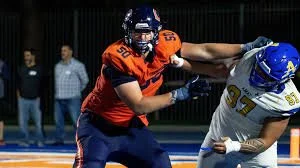
Instead, he went to California, identified a 6-7, 300-pound three-star prospect playing at Chaminade Prep, made a conviction call that the recruiting services had this one wrong — and didn't stop until Jackson Hill flipped his commitment from UCLA and chose Notre Dame.
That decision tells you everything about how Joe Rudolph evaluates offensive linemen and why his track record of developing players that others overlooked is one of the most quietly elite résumés in college football coaching.
Rudolph Made a Conviction Call — Not a Desperation Move
The easiest way to misread this commitment is to assume Notre Dame added Hill because they needed bodies or because the elite targets weren't materializing. Neither is true, and Rudolph's own actions prove it.
Simien, one of the most coveted offensive line prospects in the entire 2027 class, is still very much in play for Notre Dame with a June official visit on the schedule. Rudolph is not closing the door on elite five-star additions to this class — he is pursuing them aggressively at the same time he committed Hill. That simultaneity is the key. This was not an either-or decision driven by scarcity. It was a both-and decision driven by genuine belief in what Jackson Hill can become.
When an offensive line coach of Rudolph's caliber pursues a prospect while elite alternatives are still available and actively being recruited, that pursuit is a statement. It means Rudolph watched the film, saw something real and decided that waiting on rankings to catch up to his evaluation was a luxury Notre Dame couldn't afford — because eventually someone else was going to see what he saw, and by then Hill would already be committed somewhere else.
Rudolph saw it first. He moved first. That is what separates elite evaluators from everyone else.
The Rudolph Track Record — Turning Upside Into Production
To fully appreciate why this commitment makes sense, you have to understand the history Joe Rudolph brings to offensive line evaluation — because his track record of identifying players whose rankings dramatically understated their actual ceiling is not a coincidence. It is a philosophy.
Throughout his coaching career at Wisconsin, Pittsburgh and now Notre Dame, Rudolph has consistently identified offensive linemen that recruiting services rated as good-not-great prospects and developed them into legitimate NFL-caliber players. The pattern is unmistakable to anyone who has followed his career closely. Rudolph does not simply recruit the rankings — he recruits the player, the frame, the athleticism and the coachability. He asks one central question when he evaluates an offensive line prospect: what does this player become when I get three years of elite coaching, elite strength training and elite competition into his body?
That question produces very different answers than a recruiting service snapshot of a 17-year-old's current production level. And time and again, Rudolph's answers have been proven right when the players he believed in reach their junior and senior seasons and the rest of the country finally sees what he saw years earlier.
Jackson Hill is the latest player to benefit from that evaluation process — and if Rudolph's track record means anything, Hill's three-star ranking will feel like a distant memory long before his Notre Dame career is finished.
What Rudolph Sees in Hill That the Rankings Don't Capture
So what exactly did Joe Rudolph see when he watched Jackson Hill that convinced him to go all-in on a three-star prospect while five-star targets remained on the board?
Start with the foundation that cannot be faked and cannot be coached — the physical profile. At 6-7 and 300 pounds, Hill already possesses the frame that NFL offensive line scouts put at the very top of their evaluation criteria. Length is the single most non-negotiable physical attribute for a developmental offensive tackle, and Hill has it in a way that only a handful of prospects in any given recruiting class possess. Those long arms allow him to strike pass rushers before they can get into his body, create natural leverage advantages in the run game and give coaches the raw material to build a finished product that can hold up against elite college pass rushers for four years.
But Rudolph didn't fall in love with Hill's size alone. What truly separated Hill in Rudolph's evaluation is the athleticism that lives inside that massive frame — and the proof of it comes from the most unexpected place imaginable.
Jackson Hill plays catcher in baseball. Let that sink in for a moment. A 6-7, 300-pound athlete who lines up behind home plate, receives pitches at full velocity, blocks balls in the dirt, controls a running game and makes throws to every base is not just big. He is a legitimate multi-sport athlete whose body moves with a coordination and quickness that his size has no business producing. The quick-twitch hand-eye coordination required to catch at a high level translates directly to an offensive lineman's most critical skill set — active, fast, coordinated hands that can punch, redirect and sustain blocks against elite competition.
That dual-sport athleticism tells Rudolph something the film alone might not fully communicate — that Hill's body is not done developing, his coordination is already advanced beyond what his football experience reflects and his ceiling as an offensive lineman has not yet come close to being reached.
Add to that a powerful run-blocking foundation already in place, the football IQ to potentially play both tackle and guard at the college level and the academic profile that attracted offers from Penn and Dartmouth alongside his Power Four football offers — and what Rudolph saw was not a three-star offensive tackle. He saw a Power Four starter hiding inside a recruiting ranking that hadn't caught up to reality yet.
The Positional Upside That Makes Hill Even More Valuable
One of the most underappreciated elements of Hill's commitment is what his positional flexibility means for Notre Dame's offensive line depth over the next four years.
His natural size and length make him an obvious developmental tackle — the kind of player you project to protect the blind side as he refines his technique and adds functional strength. But Rudolph has also identified a realistic path where Hill moves inside to guard, where his 6-7, 300-pound power frame would make him one of the most physically imposing interior blockers in the ACC. A guard with Hill's size and athletic profile is a mauler in the run game — the kind of interior presence that creates movement at the line of scrimmage and gives a rushing attack a completely different dimension.
That flexibility to develop Hill at multiple positions is a luxury for Rudolph as he constructs the offensive line room around the 2027 class. It means Hill isn't locked into a single role before he ever takes a college snap. It means Rudolph can put him where the offense needs him most as the depth chart evolves. And it means that even if the tackle spots ahead of him are filled with elite talent, Hill's value to the program doesn't diminish — it simply finds a different expression.
The Class Context — Building With Depth and Range
Understanding why Rudolph went after Hill also requires understanding the broader 2027 offensive line class Notre Dame is assembling — because this group is being built with a specific philosophy in mind.
Olu Olubobola is the crown jewel — an elite, nationally-ranked New Jersey tackle whose offer list reads like a who's who of college football royalty. James Halter brings physicality and toughness from Pennsylvania. Richie Flanigan adds size and length from Wisconsin. And now Hill contributes a high-ceiling developmental profile with rare physical tools from the West Coast.
Rudolph is not building a one-dimensional offensive line class of interchangeable prospects. He is building a room with range — elite recruits with proven rankings alongside high-upside players whose ceilings may ultimately be just as high, or higher, than the stars suggested. That is how championship offensive line rooms get built. Not by chasing the same profile over and over, but by identifying different kinds of value and trusting your evaluation process to sort out who becomes what.
With Simien's official visit still on the calendar, this class could add another elite headline name before the 2027 cycle is complete. But Rudolph's willingness to commit Hill now — before that visit, while Simien is still in play — tells you he sees Hill's value as independent of any other decision. Hill earned this commitment on his own merits, on his own timeline, through Rudolph's own evaluation process.
That is the highest compliment an offensive line coach can pay a prospect.
The Bottom Line
Joe Rudolph went after Jackson Hill because Joe Rudolph trusts his eyes over a ranking, his evaluation over a database and his understanding of what a 6-7, 300-pound multi-sport athlete can become over what he currently is on a recruiting service's board.
The three-star label on Hill's profile will not survive contact with Notre Dame's strength program, Rudolph's coaching and the kind of elite competition that accelerates development faster than any recruiting service can track. It never does when Rudolph makes a conviction call on a high-upside offensive lineman that others have undervalued.
Jackson Hill chose Notre Dame over UCLA because the pull of South Bend and the belief of one elite offensive line coach proved stronger than a prior commitment. Notre Dame went after Jackson Hill because Joe Rudolph saw a future starter that the rest of the country hasn't fully discovered yet.
History suggests Rudolph is right. It usually does.
Notre Dame Built an Instant Connection With Elite Tackle Olu Olubobola and Won Big Recruiting battle
Some recruiting victories are built over years of relationship-building, endless in-home visits and a slow, methodical courtship that eventually tips in one program's favor. And then there are moments like this one — where Notre Dame identified one of the most athletically gifted offensive tackle prospects in the entire country, extended an offer, built a genuine and deep connection in a matter of weeks and walked away with a commitment that programs like Ohio State, Texas, LSU, Michigan and Florida State were pursuing for far longer.
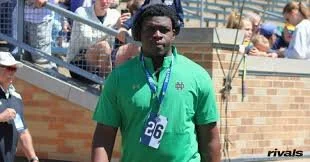
Jersey City, N.J./St. Peter's Prep standout Oluwasemilore Olubobola has committed to Notre Dame, choosing the Fighting Irish over Miami and Texas A&M — and the story of how this recruitment unfolded is as impressive as the prospect himself. Notre Dame didn't just land a five-star offensive tackle. They did it faster, more decisively and more convincingly than anyone thought possible when the offer was first extended in late March.
This is what elite program building looks like at its very best.
Six Weeks, One Visit, One Decision
The numbers that frame this recruitment are almost hard to believe when you lay them out in sequence. Notre Dame didn't offer Olubobola until March 19th — at which point programs like Ohio State, Texas, LSU, Oregon, Florida, Michigan, Florida State, Penn State, Tennessee, Auburn and dozens of other elite programs had already been recruiting him for months. The Irish entered the race behind nearly everyone.
From that March offer, Notre Dame had exactly one opportunity to get in front of Olubobola in person — a visit for the Blue-Gold Game on April 25th. One visit. Not a home visit followed by an official visit followed by multiple campus trips over the course of a year. One single opportunity to show Olubobola what Notre Dame's offensive line program looks like up close, what the campus feels like on a football weekend and what Joe Rudolph's development pipeline has produced for the elite tackle prospects who came before him.
Notre Dame made that one visit count in a way that changed everything. Coming out of the Blue-Gold weekend, the Irish still appeared to have ground to make up. But something had clearly shifted inside the relationship — something genuine and real that the Notre Dame staff recognized and immediately accelerated. By early May, Notre Dame had gone from late entry to the clear frontrunner. Shortly after, Olubobola made it official.
Six weeks from offer to commitment. One campus visit. A decision that beat out programs that had been recruiting him for a year or more.
That is not a coincidence. That is connection.
What Notre Dame Did Right — Building Real Relationship at Warp Speed
The most important question surrounding this commitment isn't what Olubobola brings to Notre Dame — it's how Notre Dame built a bond strong enough in six weeks to beat programs with far longer head starts.
The answer lies in what the Irish staff prioritized from the moment the offer went out. Notre Dame didn't just sell Olubobola on rankings, facilities or conference affiliations. They sold him on something more personal and more powerful — a genuine belief in who he is as a player, a student and a person, communicated with an authenticity and urgency that prospects at this level immediately recognize as real.
Joe Rudolph and the Notre Dame staff made Olubobola feel like he wasn't just a recruiting target — he was exactly who Notre Dame needed, specifically and uniquely, in this class. That distinction matters enormously to elite prospects who have every program in America telling them how great they are. When a coach can articulate precisely why you fit, what you will become under their development system and what your specific role in the program's future looks like, it cuts through the noise in ways that months of generic recruiting communication never can.
The Blue-Gold Game visit did the rest. There is simply no substitute for standing on Notre Dame's campus, feeling the weight of the tradition, watching the program operate at close range and imagining yourself inside it. Olubobola took that visit and came away with something that six weeks of phone calls and text messages couldn't fully deliver — a visceral, personal understanding of what Notre Dame means. That understanding accelerated everything.
The Athletic Profile That Made Every Program in America Take Notice
To fully appreciate the magnitude of what Notre Dame has secured, you have to understand exactly what kind of athlete Oluwasemilore Olubobola is — because his physical and athletic profile is the kind that offensive line coaches spend entire careers searching for and rarely find at this stage of development.
Start with the frame. At 6-6 and 295 pounds, Olubobola is already built like a finished college offensive tackle before he has taken a single college snap. That size and weight at his age, combined with the room his frame still has to develop, gives Notre Dame's strength and conditioning staff an extraordinary foundation to work with. But size alone is common enough among highly recruited offensive tackle prospects. What makes Olubobola genuinely special — what makes him a top-20 national prospect and the No. 1 player in the state of New Jersey — is what that 6-6, 295-pound body can actually do.
Olubobola moves with an athletic fluidity that has no business existing in a player his size. His feet are nimble and quick, processing lateral movement with an ease and natural rhythm that you typically find in skill position players, not massive offensive tackles. That footwork is not the product of years of technique work — it is native athleticism, the kind that shows up on film immediately and makes experienced evaluators lean forward in their chairs. Light feet at 295 pounds is a gift. Olubobola has it in abundance.
His length is equally elite, and what separates Olubobola from other long-armed tackle prospects is that he already knows how to use it as an active weapon. He strikes pass rushers before they can get into his frame, extending with timing and coordination that creates a natural barrier most defenders at the high school level simply cannot overcome. That early hand usage, combined with elite length and nimble footwork, gives Notre Dame a left tackle prospect who already has the foundational athletic tools to compete at the highest level of college football.
In the run game, Olubobola's explosiveness off the line is immediately evident. He doesn't ease into contact — he attacks it, driving his legs through the point of contact with powerful lower body mechanics and finishing blocks with the kind of physicality that moves defenders off the ball. His burst off the snap combined with his power through contact makes him a legitimate force in the ground game right now, with a ceiling that has barely been touched.
His change of direction skills round out an athletic package that is genuinely rare at his position. Olubobola doesn't lumber from one assignment to the next — he redirects, adjusts and moves in space with a smoothness that tells you his athleticism extends well beyond the straight-line power game. In pass protection, that lateral agility is everything when an edge rusher tries to counter inside or set up a speed-to-power conversion. Olubobola already has the natural movement skills to handle both.
The technical refinements — particularly in the finer points of pass protection hand placement and anchor depth — will come with Rudolph's coaching. But here is the essential truth about developing elite offensive tackles: you can coach technique, you can refine hand usage, you can install protection schemes. You cannot manufacture the athletic foundation that Olubobola already has. That foundation is what makes everything else teachable — and what makes his ceiling as a college offensive tackle genuinely limitless.
Five Years Running — A Standard That Doesn't Slip
Olubobola's commitment extends Notre Dame's remarkable streak of landing a five-star offensive tackle in five consecutive recruiting classes — a run of elite tackle recruiting that stands as one of the most impressive position-specific streaks in college football.
That streak doesn't happen by accident, and it doesn't happen because Notre Dame is simply throwing more resources at offensive tackle recruiting than everyone else. It happens because Joe Rudolph has built a reputation, a development track record and a relationship style that elite offensive tackle prospects trust — and because Notre Dame as an institution offers something that no purely football-based pitch can replicate. The combination of elite football development, genuine academic prestige and a program culture built on brotherhood creates a package that keeps landing at the top of the list when elite offensive tackle prospects make their final decisions.
Olubobola becomes the latest in that line — and if the development trajectory of the five-star tackles before him is any indication, he will not be the last.
A 2027 Offensive Line Room Built for Dominance
With Olubobola committed, Notre Dame's 2027 offensive line class now has three pieces that fit together with genuine intentionality. Olubobola anchors the left side with elite athleticism and a top-20 national profile. Pennsylvania standout James Halter brings physical toughness and right tackle upside from Pittsburgh Central Catholic. Wisconsin lineman Richie Flanigan projects inside with the size and temperament to develop into a power interior blocker.
Three different players. Three different profiles. Three different roles. One cohesive vision from Joe Rudolph about what this offensive line room needs — and the recruiting execution to go get it in a single class.
The New Jersey thread adds another dimension worth celebrating. With defensive end Aidan O'Neil already committed, Notre Dame now holds commitments from both the No. 1 and No. 3 players in the state of New Jersey in the 2027 class. Locking up the top talent from one of the most talent-rich states in the country on both sides of the ball reflects a regional recruiting dominance that has real long-term implications for the program.
Olubobola becomes the 15th overall commitment in Notre Dame's 2027 class, joining a group that already features quarterback Champ Monds, running backs Lathan Whisenton and Isaiah Rogers, wide receiver Jackson Coleman, tight end Titus Hawk, defensive end Aidan O'Neil, linebacker Amarri Irvin, cornerbacks Xavier Hasan and Ace Alston, safety Zayden Gamble, nickel John Gay III and long snapper Sean Kraft.
The Bottom Line
Notre Dame identified one of the most athletically gifted offensive tackle prospects in the 2027 class late, moved with precision and purpose, built a genuine connection in a matter of weeks and walked away with a commitment over programs that had been recruiting Oluwasemilore Olubobola for far longer.
The athletic package Olubobola brings to South Bend — the elite length, the nimble feet, the explosive power, the natural change of direction at 295 pounds — is exactly the kind of foundation that Joe Rudolph's development system turns into NFL-caliber offensive tackles. Notre Dame has done it five years in a row now.
The connection was instant. The talent is elite. The fit is perfect.
And once again, Notre Dame found a way to win.
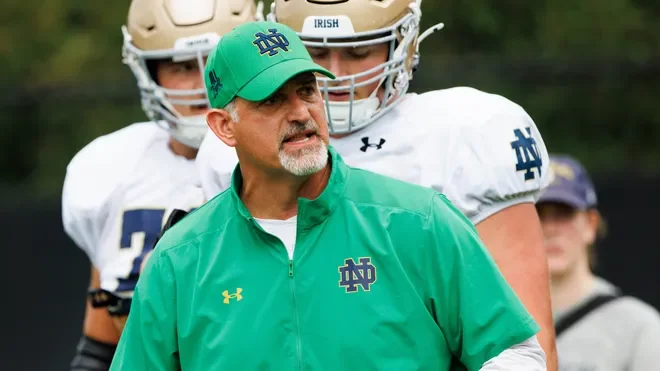
joe rudolph may have his best 5-man combo on the offensive line
Joe Rudolph has done an amazing job recruiting size, length and talent to the Notre Dame offensive line room. His efforts may lead to the Joe Moore Award returning to South Bend next winter, if things go as planned. Entering spring practice, the first unit has been freshman left tackle Will Black, junior left guard Anthoine Knapp, junior center Joe Otting, junior right guard Sullivan Absher and Sophomore right tackle Guerby Lambert. Senior center Ashton Craig is expected to make a full recovery from the leg injury that ended his 2025 season prematurely, and junior guard Charles Jagusah is still dealing with complications from surgery to remedy his injured left arm due to a ATV accident last summer. Despite missing two highly talented linemen this spring, the early returns from coaches and players signal great things ahead for the group.
Rudolph spoke to the media on Wednesday and began with sharing how pleased he’s been with the right side of the first unit, which features Guerby Lambert being moved from right guard to right tackle, and Sullivan Absher replacing him at the right guard spot.
“Those two guys really kind of called each other out about guys that they are confident in, guys that they really look to for leadership, guys that they really trust. and that's always a unique situation when you can kind of create that or build that into your five-line. And then it would have been easy to leave Knapp outside and Guerby inside. What was just the basis of moving them around, too? Guerby has a real comfort on the right side of the line, which is cool.”
Knapp has always been a devastating run blocker and will serve as a more than comparable replacement for former left guard standout Billy Schrauth, who is preparing to be selected in the upcoming NFL Draft. Freshman Will Black came to South Bend with a lot of buzz as a 5-Star in the 2025 class, and head coach Marcus Freeman said there some early growing pains that he had to endure and overcome to begin reaching his full potential. He’s a natural tackle with great length and athleticism that should benefit from being next to a veteran like Knapp, who was ranked as top returning offensive tackle in college football before being moved inside,
With all of the movement this spring, Rudolph has been impressed with the performance of the Black-Knapp combo on the left side and the performance of the line as a whole.
“Knapper, we felt, has done a great job playing left. But we thought to get each guy in maybe the spot that would allow them to shine the most would be the chance to move Knapp in and create a good competition at the left, which Will's done a great job of, but there's still good competition there. And really what you don't know is how the guys will embrace it. And there's a lot of differences, right? It's like, I've been really good here, and now you want me to move here. And Anthony's just embraced it, and he wants to know the intricacies of the position and the differences. And that's really kind of created it. And then what you can't anticipate is how well they work together, the pre-snap communication, how they work in the meeting room, how they talk, their plan, their trust for one another. So I've been impressed by it.”
Another bright spot this spring has been the performance of freshman guard Matty Augustine, who can play both guard and tackle for coach Rudolph. The Irish have 4-5 experienced linemen that have the flexibility to play multiple positions and that should allow a group that has suffered from injuries over the last three seasons to maintain a dominant level of play throughout the 2026 season.
cj carr ranked as top returning qb in college football
Fighting Irish starting quarterback, CJ Carr, is the betting favorite to win the Heisman trophy according to FanDuel, and was recently picked by ESPN analyst Bill Connelly as the top ranked returning quarterback in the country.
The ESPN ranking is based on "stats, trends and recent performances." That equation led to Connelly placing Carr as the nation's top quarterback, ahead of Ohio State sophomore Julian Sayin. Carr will be Marcus Freeman’s first returning starter at the position and the success of the Fighting Irish rest on what many expect to be an impressive season.
Connelly’s Take:
"He sort of looked like a redshirt freshman against Miami in Week 1 of last season, but that was about it. He fell just short of leading a comeback win against the Hurricanes, then pretty much torched all other opposition. Sure, he had a spectacular run game at his disposal -- Jeremiyah Love and Jadarian Price combined for 2,046 yards and 29 touchdowns (and are both gone now) -- but Notre Dame ranked first nationally in third-and-long success rate (7 or more yards to go). When Carr had to make a throw, he did so.
"Carr isn't exactly your modern dual-threat guy; he doesn't scramble much, and he's not a threat to punish defenses for turning their backs on the QB in man coverage. But he also doesn't take sacks, both because of quick decision-making and the fact that he might have the best offensive line in the country protecting him. He's accurate, he has a big arm, and by the end of 2025 he was one of the most reliable passers in the sport.
"While three of last year's four main wideouts are gone, the return of Jordan Faison, plus 2024 playoff hero Jaden Greathouse (back from an injury redshirt) will help, as will the addition of two recent blue-chippers from Ohio State (Mylan Graham, Quincy Porter). Carr should have most of what he needs, and even if the run game regresses a bit, there's no reason to think he won't continue to come through on third down." - Connelly
Carr earned second team Freshman All-American honors last season after passing for 2,741 yards and 24 touchdowns while completing just under 67-percent of his passes. He ranked second in all of college football with a 9.4 yards per attempt average and ranked fifth with a passer rating of 168.06, and his passer rating set a new Notre Dame record, shattering the mark that was previously tied by Jimmy Clausen in 2009. Carr also ranked 4th in the country with a 14.1 per completion average.

Schrauth, Wagner ON Outland Trophy Watch List
Junior offensive linemen Billy Schrauth and Aamil Wagner have been selected to the 2025 Outland Trophy Watch List, which recognizes commitment to community service and leadership off the field.
The two Irish players are part of a group of 50 linemen on the watch list. Notre Dame has had three past winners of the Outland Trophy: OT George Connor (1946), OG Bill Fischer (1948) and DE Ross Browner (1976). THe Irish have had four additional finalists: Aaron Taylor (1993), Quenton Nelson (2017), Liam Eichenberg (2020) and Joe Alt (2023) according to the Notre Dame Athletic Department.
The Outland Trophy, which recognizes standout interior linemen, is celebrating its 80th season and this year's preseason list includes 16 offensive tackles, 15 guards, nine centers and 10 defensive tackles. It’s an impressive list of the best lineman in college football, and quite the honor to be included for the two Notre Dame stars.
ND's offensive line is expected to be one of the best units in the country after a bit of an inconsistent 2024 campaign due to injury and the need to play freshman at important positions along the line. The Fighting Irish are poised to make another deep run in the College Football Playoff and that could transition both players into finalists for the award. If Schrauth and Wagner play up to the Outland standard, they’ll both be in the mix to win the award.
Shaun M. Davis
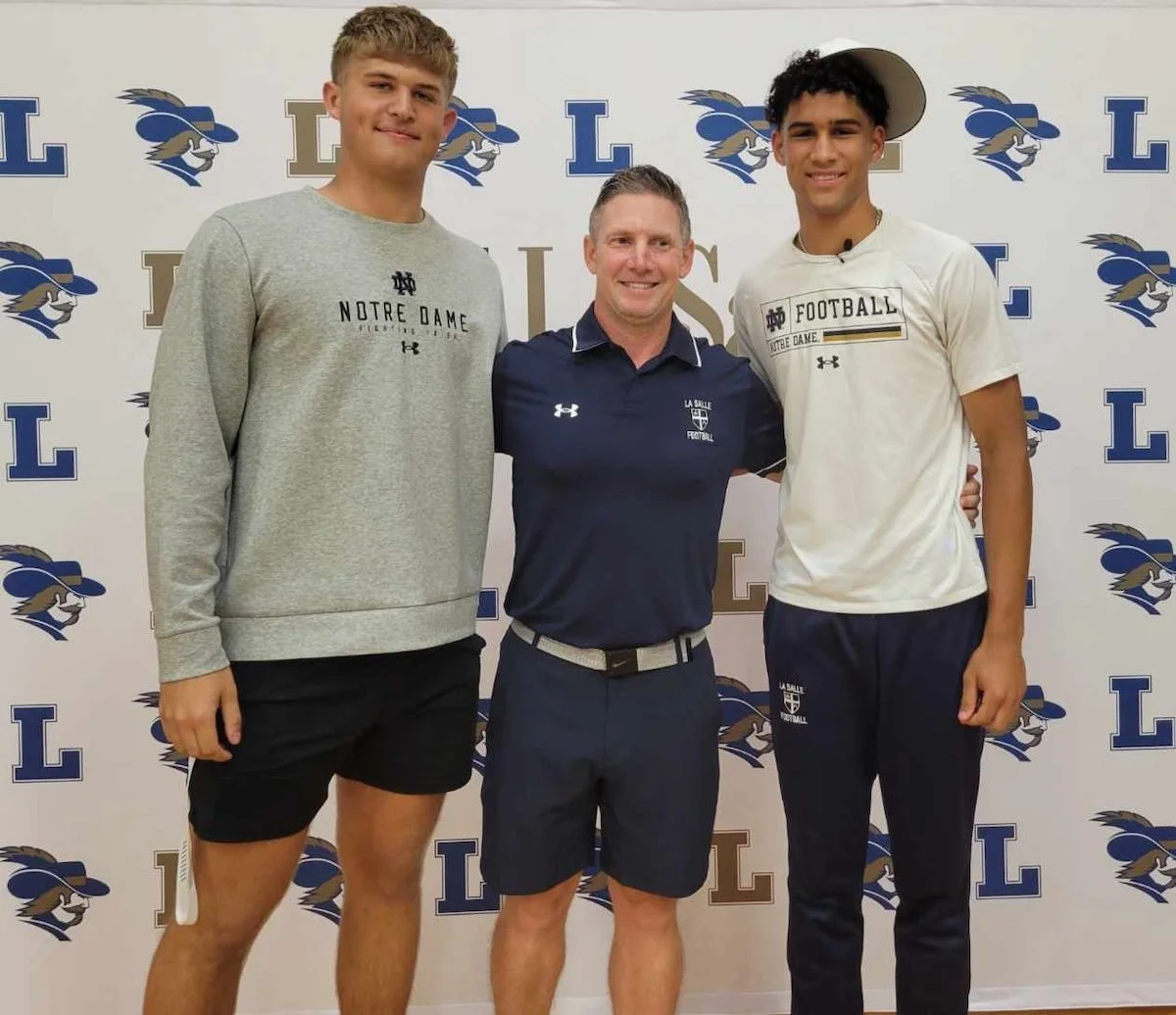
teammates Joey o’brien and grayson mckeough took different paths to nd
The roller coaster recruitment for 6-4 195-pound five-star defensive back Joey O’Brien of Glenside (Pa.) LaSalle College Prep reached a conclusion when he picked Notre Dame on June 20th over finalists Oregon, Penn State, and Clemson. At one point, all four programs were perceived as possible leaders for O’Brien. His teammate, 6-7 285-pound pass blocker Grayson McKeough, who chose the Fighting Irish over Penn State, had a totally different path to his commitment to Notre Dame and their head coach,Brett Gordon, witnessed both journeys as a confidant and advisor.
“All four schools did a great job recruiting Joey,” Gordon said. “The coaches did a great job of showing him how they would develop and use him. Joey really liked all the schools, coaches and players, but it came down to what school felt like home for him.”
Originally, the Pennsylvania Player of the Year was scheduled to take his official visit to South Bend on June 20th but decided to switch to the weekend of June 13th, which happened to be the same as his teammate four-star offensive lineman Grayson McKeough, who also eventually committed to the Fighting Irish. At the same time, he announced that his decision would now take place on June 20th , leaving the fanbases of the finalists pondering about where their teams stood in the recruitment.
“I don’t think he was leaning anywhere going into the Notre Dame visit,” Gordon said. “I told him that he was being recruited by the blue bloods with tradition, and great coaching. So, whatever school felt like the place he wanted to spend the next four years of his life would be the determining factor.
“The date change was to help make things easier,” Gordon continued. He wanted to take all five official visits, but I thought that was too much. Joey and his family were thorough in the five unofficials, and taking five officials was too much, so the Tennessee one was dropped and that’s why the Notre Dame visit was moved.”
The Fighting Irish seemed to take over in his recruitment as his June 13th official visit approached. His teammate, 5-star defensive back Joey O’Brien would be visiting on the same weekend after a late change to his schedule. Although they would travel different paths to South Bend on that weekend, they would leave with similar feelings about the visit that led both to commit to the program on June 18th and June 20th respectively.
“Grayson’s path was different from Joey’s,” Gordon explained. “Two different scenarios. Everyone was in the mix with Joey going into the official visits. Grayson was probably leaning Notre Dame going into the visit. The visit helped him make his decision. Joey had already set his decision date for June 20th, two weeks before the visit. Grayson didn’t have a set date, but he was ready to make his decision once he got back.
“It was a great visit,” Gordon continued. “Being around the other recruits and current players was big for him. He spoke about brotherhood and how comfortable he felt. Him and Joey kept using the word “family” when they talked about the visit.”
Landing the talented teammates shows great cohesiveness in the Notre Dame recruiting operation right now, and the success of the June 13th recruiting weekend could lead to more additions to an already impressive top 5 class.
Shaun M. Davis