

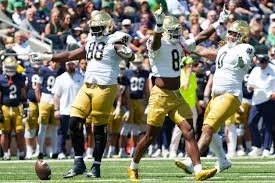
ESPN's College Football Future Power Rankings Have Notre Dame at the Top
When ESPN set out to rank all 68 Power Four programs in their future power rankings — evaluating quarterback situations, trench outlooks, roster management, star power and coaching staff quality with the kind of comprehensive rigor that separates serious analytical work from preseason speculation — the Fighting Irish came out on top.
Not second. Not in a group of three or four teams separated by fractions of evaluation points. First. Unambiguously, convincingly and with justification that holds up to scrutiny from every angle the evaluation touched.
This is not a sentimental ranking built on Notre Dame's brand, its history or the weight of its tradition. ESPN looked at what is actually on the field, what is being built in the recruiting pipeline, how the roster is being managed and who is coaching the program — and concluded that no program in the country is better positioned for sustained elite performance than Marcus Freeman's Notre Dame Fighting Irish.
The case begins with a quarterback whose growth and efficiency have already made him one of the most decorated signal callers in Notre Dame history. It runs through an offensive line that is finally deploying its elite talent in the right positions. It extends through a running back room with genuine dimension and a wide receiver group upgraded on every level. And it culminates in a defense that returns significant proven production while adding transfer portal talent to a revamped defensive staff that made the transition look seamless during spring practice.
Stack all of it together and the No. 1 ranking does not just make sense. It is the only honest conclusion.
CJ Carr — Growth, Efficiency and the Foundation of Everything
Every conversation about Notre Dame's 2026 ceiling begins in the same place — under center, with a redshirt sophomore quarterback whose growth from his first start to where he stands today represents one of the most impressive individual development arcs in college football.
CJ Carr did not arrive at Notre Dame's starting position through the transfer portal or through the kind of five-star recruiting coronation that precedes some quarterbacks before they ever take a college snap. He developed — through the program's system, under the coaching staff's instruction and through the accumulated experience of an entire season of starting at Notre Dame — into exactly what ESPN's Adam Rittenberg described as a national awards contender.
The statistical foundation that justifies that description is historically significant. Carr's 168.06 passer rating from the 2025 season was a Notre Dame program record — surpassing the previous mark held by Jimmy Clausen, a quarterback whose 2009 season is still discussed as one of the most polished individual performances in Notre Dame's quarterback history. Breaking a program record in your first year as a starter is not a product of circumstance. It is a product of genuine excellence sustained over the course of a full season against Power Four competition.
The efficiency numbers amplify the record even further. Carr completed 66.6 percent of his passes — fourth best single-season mark in Notre Dame program history across every era of Fighting Irish football. He threw 24 touchdowns against just six interceptions — and four of those six interceptions came in his first two starts, the natural adjustment period of a first-year starter navigating varsity speed for the first time. In his final ten starts of the season, Carr threw four interceptions across ten games — a turnover rate that matches the best decision-making quarterbacks in the country regardless of experience level.
The deep ball numbers are equally impressive and perhaps more revealing about what kind of quarterback Carr truly is. Eight touchdowns and zero interceptions on passes of 20 yards or more — a statistical combination that reflects both the arm talent to challenge defenses vertically and the decision-making discipline to never force throws in the most high-risk areas of the field. Zero interceptions on deep passes across an entire season is the kind of number that NFL scouts and Heisman voters notice immediately because it is so rare and so meaningful as a predictor of elite quarterback performance.
His yards-per-attempt average of 9.4 ranked second among all returning quarterbacks in the entire country — not second in the ACC, not second among independent programs, but second nationally among every returning signal caller in college football. That number reflects efficient, high-value passing that consistently moves the chains, creates explosive plays and maximizes the production value of every throw rather than accumulating yards through volume and check-downs.
The November elevation that Sporting News specifically cited in their No. 3 national quarterback ranking — a passer rating of 170.2 in the final month of the regular season — confirms what the full-season numbers suggest and then exceeds it. Carr was better in November than he was in September. He was better when the schedule was harder, the stakes were higher and the defensive preparation against him was most sophisticated. That late-season elevation is the single most reliable indicator that a quarterback's development is genuine, sustainable and pointed toward something significantly better in year two.
The growth from his first start against Miami in 2025 — when the country got its initial look at a talented but unproven first-year starter navigating an elite opponent in a high-pressure environment — to the polished, confident and statistically dominant quarterback who closed that season and walked into spring 2026 as the program's unquestioned leader is as dramatic an individual development arc as any quarterback in the country produced over the same period.
Entering 2026 with that foundation behind him — the record passer rating, the elite completion percentage, the zero deep-ball interceptions, the November elevation and a full offseason of development with Mike Denbrock building a system specifically around his strengths — Carr is not just one of the five best returning quarterbacks in the country. He is making a genuine and credible case to be the best. And the structure surrounding him in 2026 gives that case more supporting evidence than any other quarterback in college football can claim.
The Offensive Line — Elite Talent Finally in the Right Places
The offensive line evaluation is where ESPN's future power ranking for Notre Dame gets most specific and most optimistic — and for good reason. The unit that Joe Rudolph is sending onto the field in 2026 is the most thoughtfully constructed and positionally appropriate starting five he has assembled since his arrival in 2023, when Joe Alt and Blake Fisher gave Notre Dame a bookend tackle pair that now starts in the NFL.
The interior of this offensive line returns experienced, battle-tested starters whose collective knowledge of Notre Dame's blocking schemes and protection concepts gives the unit a communication and cohesion that young tackle prospects need around them to develop effectively. Ashton Craig returns at center as a legitimate Rimington Trophy contender — a distinction that reflects both the quality of Craig's individual performance and the critical importance of his role as the unit's communicator and pre-snap processor. Craig's ability to identify defensive alignments, make protection calls and ensure that every blocker on the unit is operating from the same information on every snap is the infrastructure that makes everything else on the offensive line function.
Anthonie Knapp returns at left guard — now settled into the position where Rudolph and the staff believe his ceiling is highest after two years of starting at left tackle. The move inside is not a demotion but a correction — putting a talented, experienced blocker in the alignment where his power at the point of attack, his ability to anchor against interior rushers and his two years of starting-caliber experience are most powerfully expressed. Knapp at left guard entering 2026 is a significantly more dangerous player than Knapp at left tackle — and the unit benefits immediately from having his experience and physicality deployed in the right place.
Sullivan Absher completes the interior at right guard with the competitive hunger of a redshirt junior who has waited for exactly this starting opportunity. Players who earn starting roles through development and patience rather than through recruiting star ratings tend to play with a chip-on-the-shoulder energy that makes them among the most consistently effective contributors on any offensive line — and Absher enters 2026 with every motivation to prove that the wait was worth it for both himself and the program.
The bookend tackles are where this offensive line's ceiling lives and where the most exciting development stories of the 2026 season will unfold. Will Black — a five-star recruit whose length, athleticism and pass protection tools have always projected to the blindside tackle position — takes over at left tackle for what should be a transformative first full season protecting Carr's blind side. The growing pains of a first-year starting left tackle against Power Four edge rushers are a normal and expected part of the development process — but the ceiling that Black is building toward as those growing pains accumulate into experience and confidence is the kind that changes what a program's offensive line can be for multiple seasons.
Guerby Lambert at right tackle is the complementary story — a five-star recruit from the 2024 class finally operating at the position where his physical profile projects most naturally for a full season as the unambiguous starting right tackle. Lambert's combination of size, length and athleticism gives Notre Dame a potential true bookend pair with Black on the left side — the first time since Alt and Fisher that Rudolph has had that configuration available — and the results of a full season with both tackles in their natural positions could finally deliver the dominant unit that the talent in this room has always suggested was possible.
The potential return of Charles Jagusah — a five-star recruit whose development has been delayed — adds yet another elite-recruited option to a depth chart that is already one of the deepest Rudolph has had since his arrival. The depth and quality of this offensive line room entering 2026 is genuinely exceptional — and the configuration finally matches the talent with the positional assignments that maximize every player's individual ceiling.
The Running Back Room — Dynamic Talent Ready to Carry the Load
The departure of Jeremiyah Love — the No. 3 overall pick in the NFL Draft — is the most significant personnel loss Notre Dame faces on offense heading into 2026. Love was one of the most dynamic running backs in college football, a unanimous All-American whose big-play capability and consistency defined Notre Dame's ground attack across two seasons and made him one of the most celebrated players in the program's recent history.
But the Irish are not rebuilding the backfield. They are reloading it — with a group of talented, complementary backs whose collective skill set gives Mike Denbrock's offense a multi-dimensional ground game that can attack defenses in ways that a single-back approach never allows.
Aneyas Williams steps into the featured role with the physical tools, competitive instincts and playmaking ability to make the transition from Love to the next era of Notre Dame running back excellence as smooth as the talent in the room allows. Williams's combination of acceleration, vision and contact balance gives the Irish a back who can operate effectively in Notre Dame's zone-blocking scheme — identifying cutback lanes, setting up blocks and accelerating through holes before defenders can close them with the quickness that makes him a natural fit for the concepts Denbrock calls most frequently.
Williams's versatility as a receiver out of the backfield adds a dimension to Notre Dame's passing game that forces defensive coordinators to honor the check-down and screen game on every snap — pulling linebackers and safeties into coverage assignments that open the intermediate passing windows where Carr's accuracy and anticipation are most devastating. A running back who can genuinely threaten defenses both between the tackles and in the passing game is one of the most valuable offensive assets any coordinator can have — and Williams brings both dimensions to Notre Dame's 2026 backfield.
The depth behind Williams gives Denbrock genuine flexibility in how he deploys the ground game. Multiple capable backs with different physical profiles and running styles creates the kind of schematic variety that keeps defensive coordinators from settling into comfortable run defense adjustments — because the same blocking scheme produces different looks when different runners are operating behind it.
The collective expectation for Notre Dame's 2026 running back room is not to replace what Love provided individually but to provide what the room as a whole can produce collectively — and the talent assembled gives the Irish offense every reason to believe that collective production will be more than sufficient to keep the ground game a genuine threat that defenses must account for on every single snap.
The Wide Receiver Room — More Weapons Than CJ Carr Has Ever Had
If the offensive line case for Notre Dame's No. 1 ranking is built on positional construction and the running back case is built on dynamic talent filling a significant departure, the wide receiver case is the most straightforwardly exciting component of the entire offensive evaluation — because the group Carr is throwing to in 2026 is simply better than any receiver room he has had available in his Notre Dame career.
Jordan Faison returns as the established and proven No. 1 option after leading Notre Dame with 40 receptions, 640 yards and four touchdowns in 2025 — the team's leading receiver, produced while sharing a room with Malachi Fields and Jaden Greathouse. Faison's decision to give up lacrosse and commit entirely to football this offseason is the kind of singular focus investment that produces significant statistical leaps — and the Carr-Faison connection that produced 40 catches in a season where Fields was the projected No. 1 option is primed to become something even more dominant when Faison enters 2026 as the unambiguous first read with an undivided preparation investment behind him.
Jaden Greathouse brings the explosive playmaking dimension that makes Notre Dame's receiver room genuinely dangerous rather than simply functional. Greathouse's combination of separation quickness, yards-after-catch capability and big-play instincts — demonstrated emphatically in Notre Dame's 2024 postseason run — gives Carr a receiver who can take a short completion and turn it into a long gain, a slant route and turn it into a crossing score and a go ball and create the kind of contested-catch opportunity that changes field position in an instant. Pair Greathouse's explosion with Faison's reliable production and Notre Dame presents opposing secondaries with a No. 1 and No. 2 receiver combination that is as difficult to defend as any in the country.
The transfer portal additions elevate the room from very good to genuinely elite. Mylan Graham arrives from Ohio State with Big Ten starting experience, proven production at one of the most demanding programs in college football and the physical tools that made him a highly coveted recruit before his time at Ohio State. Graham does not need to be the No. 1 receiver or carry the production load to be enormously valuable — he needs to be a legitimate third option who punishes defensive coordinators for the coverage attention they devote to Faison and Greathouse. With the coverage bracket that those two demand, Graham will see single coverage against the best corner available on a given defense — and his Ohio State-tested talent gives him every tool to make opposing teams pay for that coverage decision.
Quincy Porter provides additional receiving depth from the same Ohio State program — another experienced, proven pass catcher who brings Big Ten competition reps to a Notre Dame receiver room that needed exactly this kind of experienced depth to complement its returning talent.
Three legitimate receiving threats with different physical profiles, different route-running styles and different strengths within the passing game — backed by experienced portal additions who contribute immediately and meaningfully to the room's depth and versatility. The receiver room Carr inherits in 2026 is the best he has ever had and one of the most complete groups in college football heading into the season.
The Defense — Proven Production Returns, Elite Additions Bolster the Front
While the offensive case for Notre Dame's No. 1 ranking builds from quarterback to skill positions to the line, the defensive case begins and ends with a simple and powerful truth — the production that made Notre Dame's defense one of the best units in the country late in the 2025 season is returning at a remarkably high rate, and the additions made through the transfer portal have addressed the few areas where reinforcement was genuinely needed.
Leonard Moore is the centerpiece of everything Notre Dame does defensively in 2026 and the most important returning player on the entire roster. The best cornerback in college football — PFF's No. 1 ranked returning cornerback for the second consecutive season — enters 2026 as the consensus Thorpe Award favorite after earning first-team unanimous All-America honors in 2025. Moore's 91.4 coverage grade and 90.9 overall defensive grade led all Power Four starting cornerbacks. He led Notre Dame with five interceptions while being targeted on only 11.5 percent of his coverage snaps — the ultimate testament to a cornerback so dominant that the entire country's offenses chose to scheme away from him rather than challenge him.
With Moore locking down one side of the field, the rest of Notre Dame's secondary carries a freedom and flexibility that makes the entire defensive system more dangerous. Christian Gray returns as a proven secondary contributor whose versatility allows defensive coordinator Chris Ash to present multiple coverage looks without sacrificing quality at any individual position. The addition of DJ McKinney from Colorado via the transfer portal gives the secondary a third proven option — a player with starting experience against Power Four competition who slides into a complementary role alongside Moore and Gray and completes what ESPN identified as potentially the biggest strength on Notre Dame's entire 2026 roster.
Adon Shuler returns at safety with the kind of range, instincts and ball-hawking ability that make him one of the most exciting developmental stories in Notre Dame's defensive backfield. His presence in the deep middle — rotating into coverage, supporting the run and creating the kind of turnover opportunities that change field position and momentum — gives Ash's secondary a complete, complementary set of pieces that no passing game can attack with a single schematic approach.
The linebacker corps is anchored by Drayk Bowen — one of the most complete linebackers in college football and the defensive engine that makes Notre Dame's second level function at its highest capacity. Bowen's combination of run-stopping physicality, coverage range and pre-snap processing intelligence gives the entire defense a communicator and lead tackler who elevates every player around him. His return alongside the developing linebacker talent around him gives Brian Jean-Mary — veteran defensive assistant now overseeing the linebacker group — proven production to build around from day one.
The Defensive Line — Transfer Additions Transform an Already Talented Front
The most dramatic and consequential roster construction development on Notre Dame's defensive side heading into 2026 is the transformation of the defensive line through a combination of proven returning contributors and high-impact transfer additions that address the program's most critical pass rush needs.
Boubacar Traore returns as Notre Dame's most dangerous and most disruptive pass rush weapon — a junior edge whose combination of first-step quickness, motor and technical pass rush arsenal makes him a consistent threat to influence every passing down. Traore's presence gives Ash's defensive front a proven, established disruptive force that new additions can complement rather than replace — the difference between addition by addition and addition by multiplication when it comes to what a defensive line can become collectively.
Bryce Young returns as a versatile and experienced contributor whose ability to line up in multiple positions along the defensive front gives Ash the flexibility to create different alignments and present different problems to opposing offenses without sacrificing individual quality at any spot. Young's experience and positional versatility are the kind of foundational traits that make an entire defensive line unit more difficult to prepare for — because the combinations he enables on the front are more numerous and more creative than a less flexible roster allows.
Jason Onye provides senior-level experience and established production at the defensive tackle position — a player whose understanding of what Notre Dame's defensive system demands and what elite college football competition requires gives the younger contributors on the defensive line a standard to measure themselves against and a guide to follow in the most demanding preparation moments of the week.
The transfer additions are where the defensive line story becomes genuinely transformative. Francis Brewu arrives from Pittsburgh with a national reputation as one of the most physically dominant interior defensive linemen in the transfer portal — a player whose combination of power, leverage and relentless effort at the point of attack gives Notre Dame's front an interior disruptive presence that immediately elevates the entire unit's run-stopping and pass-rushing capability. Brewu's Pittsburgh experience against ACC competition means his transition to Notre Dame's defensive system is not a leap into the unknown but a progression within a competitive environment he already understands.
Keon Keeley arrives from Alabama with the pedigree and physical tools that made him one of the most coveted defensive line recruits in his class — and the development infrastructure of Alabama's program having already invested significant time and resources into maximizing his potential. Keeley gives Notre Dame an edge presence whose ceiling, if fully realized under Ash's system and Partridge's coaching, could be the most disruptive individual defensive line performance the Irish have produced in years.
Tionne Gray from Oregon rounds out the transfer additions with starting experience and proven production from a Pac-12-level program — a player whose senior eligibility makes him the most immediately impactful of the three portal additions in terms of on-field availability and competitive readiness.
A New Defensive Staff That Hit the Ground Running
The most compelling subplot of Notre Dame's defensive preparation heading into 2026 is the transition to a reshaped defensive staff — and how smoothly that transition appears to have gone during spring practice despite the significant personnel changes that coordinator Chris Ash made to his unit this offseason.
Aaron Henry joins the staff to coach defensive backs, reuniting with Ash in a configuration that the coordinator knows and trusts from previous stops in his coaching career. The comfort and communication between Henry and Ash — built on an existing professional relationship — eliminates the adjustment period that typically accompanies new staff additions and allows the defensive back group to benefit from coaching cohesion from the very first practice of the spring.
Charlie Partridge takes over the defensive line — a coach whose recruiting track record and development philosophy give Notre Dame's front seven a proven leader whose ability to maximize pass rush talent and interior disruption is already on display in the 2027 recruiting class, where he landed the No. 2 defensive tackle in the country in David Folorunsho during his first recruiting cycle.
Brian Jean-Mary's oversight of the linebackers completes a defensive staff whose collective experience and internal cohesion make the transition from the previous staff configuration feel less like a rebuild and more like a refinement.
The spring practice reports that emerged from the new defensive staff's first extended look at the roster were encouraging across the board — a unit that absorbed significant coaching change, integrated transfer additions and developed communication between new coaches and returning players with a smoothness that reflects both the quality of the coaches Ash brought in and the leadership of the veteran players already in the building.
A defensive staff transition that goes well in the spring is not a guarantee of autumn dominance — but a transition that goes poorly in the spring is almost always visible in September. Notre Dame's spring went well. The foundation for what this defense can become in 2026 under its new coaching configuration is as solid as any rebuilt staff could reasonably hope to establish in a single spring session.
The Bottom Line — No. 1 is Not a Gift. It Is a Grade.
ESPN evaluated 68 Power Four programs. They looked at quarterback situations, trench outlooks, roster management philosophies, collections of star power and coaching staff quality. They graded every program with the analytical rigor that separates meaningful future power rankings from preseason popularity contests.
Notre Dame came out No. 1.
Not because of history. Not because of brand. Not because of 11 national championships and one of the most famous stadiums in American sports. Because of CJ Carr's historically efficient first year and the second-year leap that every indicator supports. Because of an offensive line finally deploying its elite bookend talent in its natural positions. Because of a dynamic, versatile running back room. Because of a receiver group more talented and more experienced than any Carr has had available. Because of Leonard Moore being the best cornerback in America and Drayk Bowen being one of the best linebackers. Because of Brewu, Keeley and Gray transforming a defensive line that was already talented. Because of a new defensive staff that transitioned smoothly and a head coach who turned down the NFL to keep building something in South Bend.
Phil Steele has Notre Dame No. 1 in his preseason rankings. ESPN has Notre Dame No. 1 in their future power rankings.
The program that Marcus Freeman has built did not get to the top of those lists by accident.
It earned every spot.
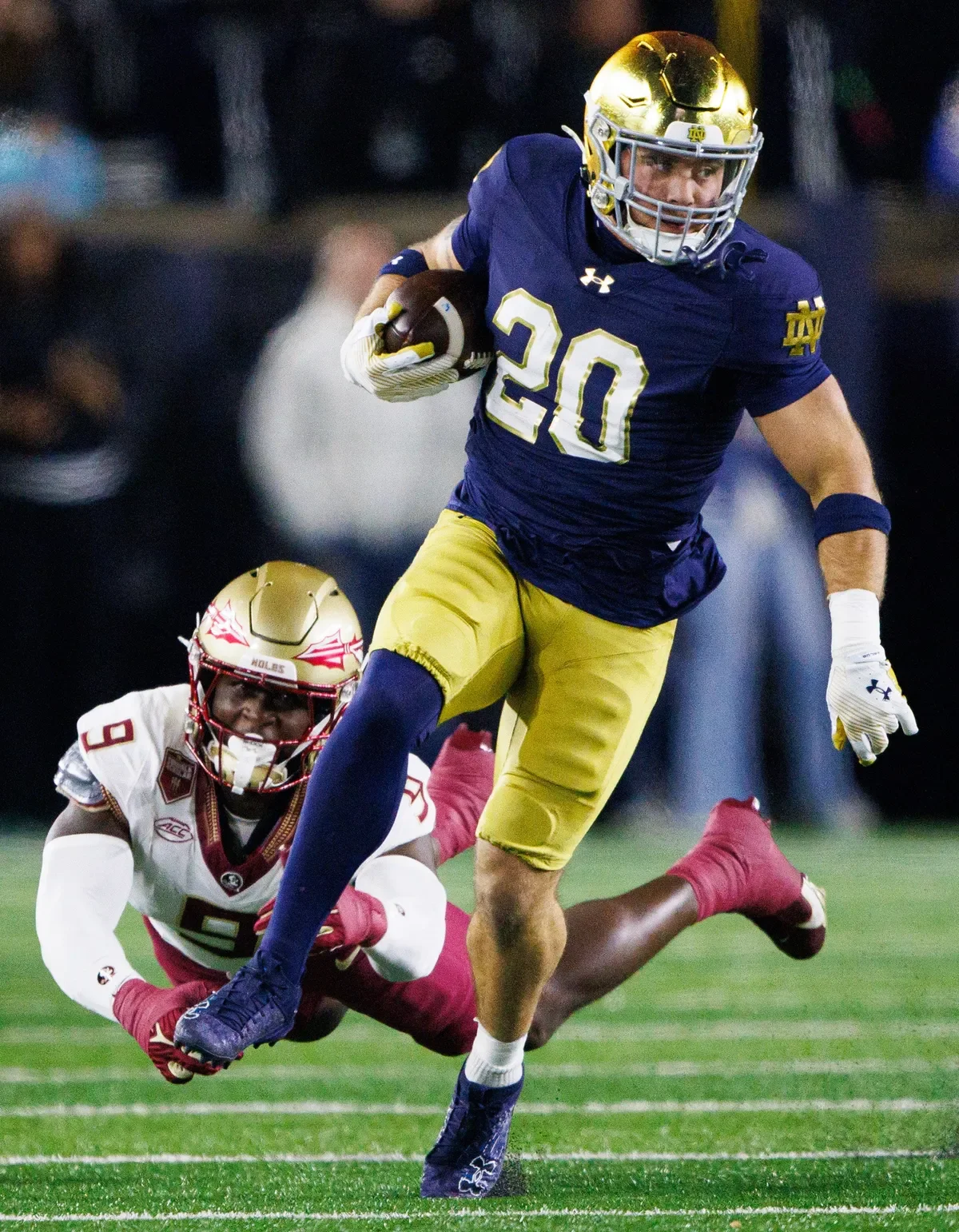
usa today ranks notre dame 2nd in post spring poll
USA Today has spoken — and the verdict on Notre Dame heading into the 2026 season is about as emphatic as a preseason ranking can be. Analysts Erick Schmidt and Paul Myerberg have tabbed the Fighting Irish as the No. 2 overall team in the country in their Post-Spring Top 25, trailing only Ohio State and ranking ahead of Texas, Georgia and Indiana in a list that reflects a program operating at the absolute peak of its modern era.
The ranking is not a gift or a projection built on hope. It is a recognition of something concrete — a Notre Dame roster that returns an experienced starting quarterback, a proven offensive supporting cast, a defense that kept its best players and a coaching staff with all three coordinators back for the first time in Marcus Freeman's tenure. When you stack those ingredients together and evaluate them honestly against every other program in the country, No. 2 is not a stretch. It might even be conservative.
Here is the full case for why Notre Dame belongs exactly where USA Today put them — and why 2026 could be the year everything comes together.
CJ Carr — The Heisman Front-Runner Nobody Should Be Sleeping On
Every conversation about Notre Dame's 2026 ceiling begins and ends with CJ Carr — and every conversation about the 2026 Heisman Trophy race should begin and end there too.
Carr enters his second season as Notre Dame's starting quarterback with something that no other signal caller in the country can claim in quite the same way — a full season of starting experience at Notre Dame, in a system he now owns completely, with the weapons around him upgraded and the continuity of returning coordinators giving him the most stable offensive environment of his college career. That combination of experience, continuity and talent elevation is precisely the formula that produces Heisman Trophy-caliber seasons.
In his first full season as a starter in 2025, Carr demonstrated command, poise and playmaking ability that immediately announced him as one of the premier quarterbacks in college football. He managed Notre Dame's offense with the kind of veteran intelligence that first-year starters rarely possess — reading defenses pre-snap, going through progressions efficiently and delivering the football with accuracy and timing in the most critical moments of the most critical games. The Carr-Faison connection that developed throughout 2025 became one of the most reliable quarterback-receiver partnerships in the sport, and that chemistry only deepens entering 2026 with a full offseason of concentrated work behind it.
What elevates Carr's Heisman candidacy beyond simply returning a quality starter is the trajectory. The jump from a first-year starter finding his footing to a second-year starter who knows every concept, trusts every receiver and operates from a position of complete offensive authority is one of the most dramatic developmental leaps in college football. Carr has already shown he can win games and manage a complex offense. In 2026, with the supporting cast around him upgraded on every level, the expectation is that he takes the next step — from excellent game manager to dominant offensive force — and the tools surrounding him make that leap entirely realistic.
The Heisman Trophy watch list will have many names on it when the 2026 season begins. CJ Carr should be at or near the top of every legitimate conversation about who wins it.
A Backfield Built to Replace Elite Production
The departure of Jeremiyah Love — selected No. 3 overall by the Arizona Cardinals in the NFL Draft — leaves the most significant void Notre Dame needs to fill on offense heading into 2026. Love was one of the most dynamic running backs in college football, a unanimous All-American whose production and big-play capability defined Notre Dame's ground attack for two seasons.
But the Irish are not rebuilding the backfield from scratch. They are reloading it with proven talent that has been waiting for exactly this opportunity — and the players stepping into expanded roles bring legitimate credentials of their own.
Nolan James Jr. returns as the most experienced back in Notre Dame's room, a proven contributor who has demonstrated the vision, patience and contact balance to be a productive starter at the Power Four level. His ability to operate within Notre Dame's zone-blocking scheme, find cutback lanes and move the chains in critical short-yardage situations gives the Irish a reliable foundation in the backfield that Carr can lean on in the most important moments of games.
Aneyas Williams brings a complementary dimension to the backfield that gives offensive coordinator Tim Rees genuine flexibility in how he deploys the ground game. Williams's quickness, acceleration and ability to create in space provide a contrast to James's between-the-tackles style — giving Notre Dame a two-back approach that can attack defenses horizontally as effectively as it attacks them vertically. The combination of James's power and patience with Williams's quickness and space creation gives Notre Dame's ground game the kind of range that makes it genuinely difficult to defend with a single schematic approach.
Together, James and Williams represent a backfield that does not replace Love's individual brilliance but provides Notre Dame's offense with enough combined production, versatility and proven capability to keep the ground game a legitimate threat on every snap. That is all Carr and the passing game need — a running back room that keeps defenses honest and prevents them from loading the box against Notre Dame's receivers.
A Wide Receiver Room Transformed by Experience and Elite Portal Additions
Jordan Faison returns as Notre Dame's established No. 1 wide receiver — the team's leading receiver in 2025 with 40 receptions, 640 yards and four touchdowns — and does so as a completely different player than the one who led the team statistically last season. His offseason decision to give up lacrosse and commit entirely to football signals a level of investment and focus that should translate directly into elevated production in 2026. Faison gives Carr exactly what a second-year starter needs more than anything — a proven, trusted target who knows the offense, runs precise routes and makes the right play after the catch every single time.
Jaden Greathouse returns alongside Faison after a 2025 season that saw him emerge as one of Notre Dame's most explosive playmakers in the postseason. Greathouse's combination of separation quickness, yards-after-catch ability and big-play capability gives the Irish a legitimate second receiving threat that defenses cannot bracket without leaving Faison in one-on-one coverage outside. Two proven, experienced receivers at the top of the depth chart entering the season is a luxury Notre Dame has not had in recent memory.
The addition of Mylan Graham from Ohio State via the transfer portal elevates what was already a strong receiver room into one of the most complete groups in the country. Graham arrives with Big Ten experience, proven production at an elite program and the kind of physical tools that made him a highly recruited prospect out of high school. His ability to contribute immediately in a complementary role — taking advantage of the attention that Faison and Greathouse command from opposing secondaries — gives Carr a third legitimate receiving option that stretches defenses in ways that create opportunities for everyone on the field.
The combination of Faison's established No. 1 production, Greathouse's explosive playmaking and Graham's experienced portal addition gives Notre Dame's receiver room a depth and versatility that rivals any group in college football heading into 2026.
A Defense That Returns Its Best Players — And Added Elite Talent
If the offensive case for Notre Dame's No. 2 ranking is compelling, the defensive case is even stronger — because what Marcus Freeman's defense is returning in 2026 is not simply a group of experienced players. It is a collection of proven, dominant performers at every level of the field, supplemented by transfer additions that address the few areas where reinforcement was needed.
Leonard Moore — The Best Cornerback in America
The foundation of Notre Dame's defensive identity in 2026 is a player who has already been discussed at length in every preseason publication that covers college football seriously — and for good reason. Leonard Moore is the best cornerback in the country. Full stop.
Moore returns after a 2025 season in which he ranked first among all starting Power Four cornerbacks in both coverage grade at 91.4 and overall defensive grade at 90.9 according to PFF. He led Notre Dame with five interceptions — tied for sixth most in the entire country — while adding 31 tackles, seven pass breakups and a forced fumble across 10 starts. Opposing quarterbacks targeted him on only 11.5 percent of his coverage snaps — a testament to the reputation he built as a cornerback that the entire country's offenses chose to scheme away from rather than challenge.
PFF has ranked Moore the No. 1 returning cornerback in the country for the second consecutive season. ESPN has named him the lead candidate for the Jim Thorpe Award. He is a legitimate front-runner for the Bronko Nagurski Trophy and the Chuck Bednarik Award. In a defense returning significant production across all three levels, Moore is the crown jewel — the player that every offensive coordinator game plans around specifically and still cannot consistently solve.
Drayk Bowen — The Defensive Engine
While Moore commands the attention of opposing passing games on the outside, Drayk Bowen commands the interior of Notre Dame's defense with the kind of instinctive, physical presence that makes the entire system function at its highest level. Bowen is one of the most complete linebackers in college football — a player who processes information quickly, fills gaps with authority, covers enough ground to be a factor in pass defense and brings a physicality to the run game that sets the tone for how Notre Dame's defense operates on any given Saturday.
His return for 2026 gives Notre Dame's linebacker corps a proven leader and production anchor that younger players in the group can develop around. Bowen's ability to quarterback the defense from the second level — making pre-snap adjustments, communicating coverage calls and reacting to offensive formation changes with veteran intelligence — is as valuable as his individual statistical contribution and perhaps more so in a defense that returns significant personnel but needs someone to tie all the pieces together.
Adon Shuler — A Safety Making His Move
Adon Shuler enters 2026 as one of the most intriguing players on Notre Dame's entire roster — a safety whose athletic profile and instinctive play have been building toward a breakout season that the 2026 campaign is set up to deliver. Shuler's combination of range, closing speed and ball-hawking instincts in the deep middle of the field gives Notre Dame's secondary a versatile, playmaking presence that complements Moore's dominance on the outside in a way that makes the entire pass defense more difficult to attack from any angle.
His ability to rotate into coverage, support the run from the second level and create turnovers in the deep part of the field gives Notre Dame's defensive staff the flexibility to disguise coverage looks and present offenses with pre-snap pictures that become something entirely different after the snap. That kind of safety versatility is invaluable in a modern college football landscape where offenses are increasingly sophisticated in their ability to identify and attack predictable coverage structures.
Boubacar Traore — Pressuring the Quarterback
Boubacar Traore returns as one of Notre Dame's most important pass rush weapons — a player whose combination of athleticism, first-step quickness and relentless motor makes him a consistent threat to disrupt opposing quarterbacks on every passing down. In a 2026 defensive front that has added significant reinforcement through the transfer portal, Traore's returning production and established role give the Irish a proven disruptive presence that new additions can build around rather than having to establish from scratch.
His ability to win one-on-one matchups against offensive tackles, create pressure from multiple alignments and finish plays in the backfield gives Notre Dame's defensive line a dynamic, production-proven element that elevates the entire group's ceiling. Opposing offensive coordinators cannot simply account for the new additions on Notre Dame's defensive front without also accounting for Traore — and that collective burden on an offensive line makes everyone on the Irish front more dangerous.
Bryce Young and the Transfer Portal Additions Transform the Front Seven
Notre Dame's returning defensive core is impressive enough on its own. Add the transfer portal additions and the front seven becomes one of the most formidable groups in the country.
Bryce Young arrives as the leader of a defensive line that also added Francis Brewu from Pittsburgh and Keon Keeley from Alabama — two transfers whose production and credentials at elite programs give Notre Dame's defensive front an immediate infusion of experienced, proven talent that addresses the depth and pass rush concerns that any program faces when losing contributors to graduation or the NFL.
Brewu brings interior disruption capability from a Pittsburgh program that regularly produces NFL-caliber defensive linemen. Keeley arrives from Alabama with the pedigree and physical tools that made him one of the most coveted defensive line recruits in his class — and Notre Dame gets the benefit of Alabama's development infrastructure having already invested significant time and resources into maximizing his potential.
Together with Traore and the returning pieces up front, Young, Brewu and Keeley give Notre Dame a defensive line rotation that can go deep into games without losing effectiveness — matching the physical demands of a Power Four schedule snap for snap, series for series, against the best offensive lines the sport produces.
Christian Gray and DJ McKinney Complete an Elite Secondary
Behind Moore, Notre Dame's secondary is anchored by Christian Gray — a versatile, proven defender whose ability to play multiple positions in the back end gives defensive coordinator Al Golden the flexibility to present different looks without sacrificing production at any individual spot.
The addition of DJ McKinney from Colorado via the transfer portal completes what USA Today identified as potentially the biggest strength on Notre Dame's entire roster. McKinney arrives with starting experience, proven production against Power Four competition and the physical and athletic profile to step in immediately and contribute at a high level alongside Moore and Gray. A secondary that starts Moore, Gray and McKinney — with Shuler patrolling the deep middle — is as complete and as dangerous a group of defensive backs as any program in the country can put on the field in 2026.
The Continuity Factor — Why This Year Is Different
Every element of Notre Dame's 2026 roster case is amplified by something that has never existed before in Marcus Freeman's tenure — complete continuity at the coordinator level. All three coordinators return for the first time under Freeman, bringing with them the accumulated institutional knowledge, player relationships and schematic sophistication that only develops when a coaching staff stays together long enough to truly master their system.
Carr does not have to learn a new offensive system. Moore does not have to rebuild trust with a new defensive coordinator. The entire roster — from the most experienced starters to the youngest contributors — enters 2026 operating within a framework they already know, already trust and already know how to maximize. That continuity is worth several wins over the course of a season, and in a college football landscape where coordinator turnover is constant and relentless, Notre Dame's stability entering 2026 is a genuine competitive advantage.
The Bottom Line
USA Today ranked Notre Dame No. 2 in the country after spring practice — and the case for that ranking is as strong as any program in America can make. A returning Heisman-caliber quarterback in CJ Carr. A backfield reloaded with Nolan James Jr. and Aneyas Williams. A receiver room elevated by Jordan Faison's leadership, Jaden Greathouse's explosion and Mylan Graham's portal addition. A defense returning Leonard Moore, Drayk Bowen, Adon Shuler and Boubacar Traore while adding Bryce Young, Francis Brewu, Keon Keeley and DJ McKinney to an already elite group.
Stack all of it together under three returning coordinators with a head coach entering his fifth season and the program's deepest, most talented roster to date — and No. 2 in the country is not just defensible.
It might be the most honest thing USA Today has published all offseason.
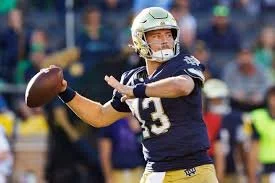
cj carr ranked as top returning qb in college football
Fighting Irish starting quarterback, CJ Carr, is the betting favorite to win the Heisman trophy according to FanDuel, and was recently picked by ESPN analyst Bill Connelly as the top ranked returning quarterback in the country.
The ESPN ranking is based on "stats, trends and recent performances." That equation led to Connelly placing Carr as the nation's top quarterback, ahead of Ohio State sophomore Julian Sayin. Carr will be Marcus Freeman’s first returning starter at the position and the success of the Fighting Irish rest on what many expect to be an impressive season.
Connelly’s Take:
"He sort of looked like a redshirt freshman against Miami in Week 1 of last season, but that was about it. He fell just short of leading a comeback win against the Hurricanes, then pretty much torched all other opposition. Sure, he had a spectacular run game at his disposal -- Jeremiyah Love and Jadarian Price combined for 2,046 yards and 29 touchdowns (and are both gone now) -- but Notre Dame ranked first nationally in third-and-long success rate (7 or more yards to go). When Carr had to make a throw, he did so.
"Carr isn't exactly your modern dual-threat guy; he doesn't scramble much, and he's not a threat to punish defenses for turning their backs on the QB in man coverage. But he also doesn't take sacks, both because of quick decision-making and the fact that he might have the best offensive line in the country protecting him. He's accurate, he has a big arm, and by the end of 2025 he was one of the most reliable passers in the sport.
"While three of last year's four main wideouts are gone, the return of Jordan Faison, plus 2024 playoff hero Jaden Greathouse (back from an injury redshirt) will help, as will the addition of two recent blue-chippers from Ohio State (Mylan Graham, Quincy Porter). Carr should have most of what he needs, and even if the run game regresses a bit, there's no reason to think he won't continue to come through on third down." - Connelly
Carr earned second team Freshman All-American honors last season after passing for 2,741 yards and 24 touchdowns while completing just under 67-percent of his passes. He ranked second in all of college football with a 9.4 yards per attempt average and ranked fifth with a passer rating of 168.06, and his passer rating set a new Notre Dame record, shattering the mark that was previously tied by Jimmy Clausen in 2009. Carr also ranked 4th in the country with a 14.1 per completion average.