

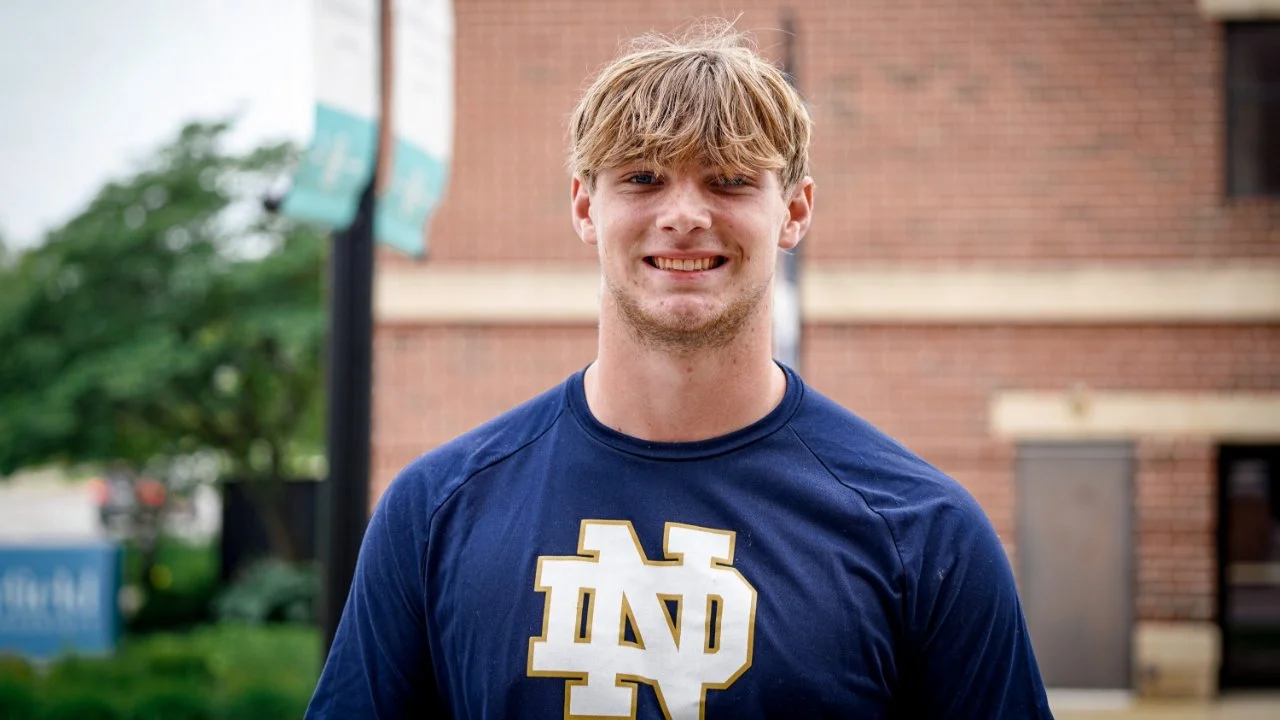
notre dame offers 2028 rb xander edwards
Notre Dame has officially extended an offer to 2028 running back Xander Edwards, with Marcus Freeman and his staff picking up the legacy recruit over the weekend. The offer continues a trend that has defined the Freeman era — Notre Dame football has continuously prioritized both Fighting Irish legacies and NFL sons, with players like Bryce Young, Devin Fitzgerald, Kaydon Finley, James Flanigan, Jerome Bettis Jr. and Elijah Burress all landing with the Irish as recruits in recent years. Betting on genetics has been a constant under this staff.
But this offer is about much more than bloodlines. Xander Edwards is the seventh-rated running back in the 2028 cycle according to the 247Sports composite ratings, and Notre Dame is undeniably a top destination for running backs right now. With Notre Dame running backs coach Je'Juan Seider being notably patient and selective with his offers in this cycle, the decision to extend one to Edwards says everything about how highly the staff views his fit in South Bend's backfield of the future.
The Legacy Connection
Edwards is the son of former Notre Dame great Marc Edwards, who rushed for 1,591 yards and 27 touchdowns in four seasons from 1993 to 1996. The elder Edwards also played nine seasons in the NFL, including for the 2001 Super Bowl champion New England Patriots. Inheriting his father's elite size and physical mentality, Xander has spent his early high school career carving out his own legacy in the talent-rich state of Florida.
The Production Backs Up Every Bit of the Hype
Edwards was already a notable performer for the Bolles School as just a freshman two years ago — in 12 games, he rushed for 558 yards and eight touchdowns, an average of 7.2 yards per carry, while adding 46 receiving yards on four catches.
It was his sophomore season that turned him into a national name. As the featured back for Bolles School in 2025, Edwards exploded for 2,629 yards and 44 touchdowns on just 265 carries — an average of just under 10 yards per carry — while also hauling in 17 receptions for 211 yards through the air. That includes a game against Baldwin where he scored his eighth rushing touchdown of the night, a feat that, per NFHS record books, would make him the first Florida high school football player ever to accomplish.
Per MaxPreps, Edwards has piled up 3,187 career rushing yards on a 9.3 yards-per-carry average, ranking him among the national stat leaders at the position.
The Size-Speed Profile Notre Dame Covets
At a listed 6-2, 220 pounds, Edwards carries the kind of frame that immediately stands out at the high school level — and the testing numbers back up that he's not just a big back, but an explosive one. Edwards has been clocked with a 4.80 in the 40-yard dash, a 4.65 shuttle and a 28.5-inch vertical — numbers that reflect legitimate speed and explosiveness for a back already pushing 220 pounds as a sophomore.
That combination of breakaway speed and bruising, between-the-tackles size is exactly what makes Edwards such an intriguing complement to the other running backs already on Notre Dame's 2028 board. Acely Brown and Zaiden Jernigan each bring their own distinct skill sets to the position, and Edwards' size-speed profile would round out a backfield class with real positional diversity — a power-and-burst combination back who can both punish defenses inside and outrun them to the second level, pairing alongside backs with different stylistic strengths to give Notre Dame's offensive staff multiple ways to attack a defense out of the same personnel grouping.
A Crowded, High-Profile Recruitment
More than 35 teams have offered Edwards, including Florida, Florida State, Georgia, Indiana, Miami, Michigan, North Carolina, Ohio State, Penn State, Vanderbilt, Virginia Tech, West Virginia and Wisconsin, among many others. Miami has reportedly been at the top of his recruitment following a Legends Camp experience, and On3's industry prediction data currently shows Florida and USF among the schools drawing the most buzz, with Notre Dame now squarely entering that conversation following the offer.
The Rankings Across the Industry
Edwards' rapid rise on the recruiting trail is reflected across every major service. On the 247Sports Composite, Edwards is rated a four-star prospect — the No. 117 overall player in the country, the No. 7 running back nationally, and the No. 17 player in the state of Florida for the 2028 class. He is rated a four-star and top-150 overall prospect by every major recruiting platform. On3 has him as the No. 141 player nationally and the No. 8 running back in the class, with a composite-style rating of .9532 placing him at No. 117 nationally and No. 7 at his position — essentially mirroring the 247Sports numbers. ESPN's recruiting database lists Edwards similarly among the class's premier running back talents.
The Bottom Line
It's by no means a guarantee that Notre Dame ends up landing Edwards after this offer, but the fit is hard to ignore. Notre Dame isn't perfect when it comes to recruiting sons of former Fighting Irish players, but it lands those commitments a lot more often than it misses.
With Je'Juan Seider's patient approach finally yielding an offer to one of the most explosive backs in the 2028 class, and with Edwards' size-speed combination offering a natural complement to fellow 2028 targets Acely Brown and Zaiden Jernigan, Notre Dame's running back room of the future is starting to take shape — and a legacy name with elite production and a frame built for the position is now squarely in the mix to be a part of it.
Notre Dame's Most Painful and Embarrassing Losses-fan’s perspective
From gut-punch defeats to head-scratching upsets, these are the losses Irish fans can never forget
Every Notre Dame fan carries a mental list. The losses that still sting when you think about them too long, the ones that changed the trajectory of a season — or a program — and the ones so unexpected they still feel like a fever dream years later. The Lucky Lefty Podcast recently opened that wound for their audience, and the responses painted a vivid picture of decades of Irish heartbreak.
The conversation surfaced losses across multiple eras, each carrying its own specific flavor of pain.
The Embarrassments
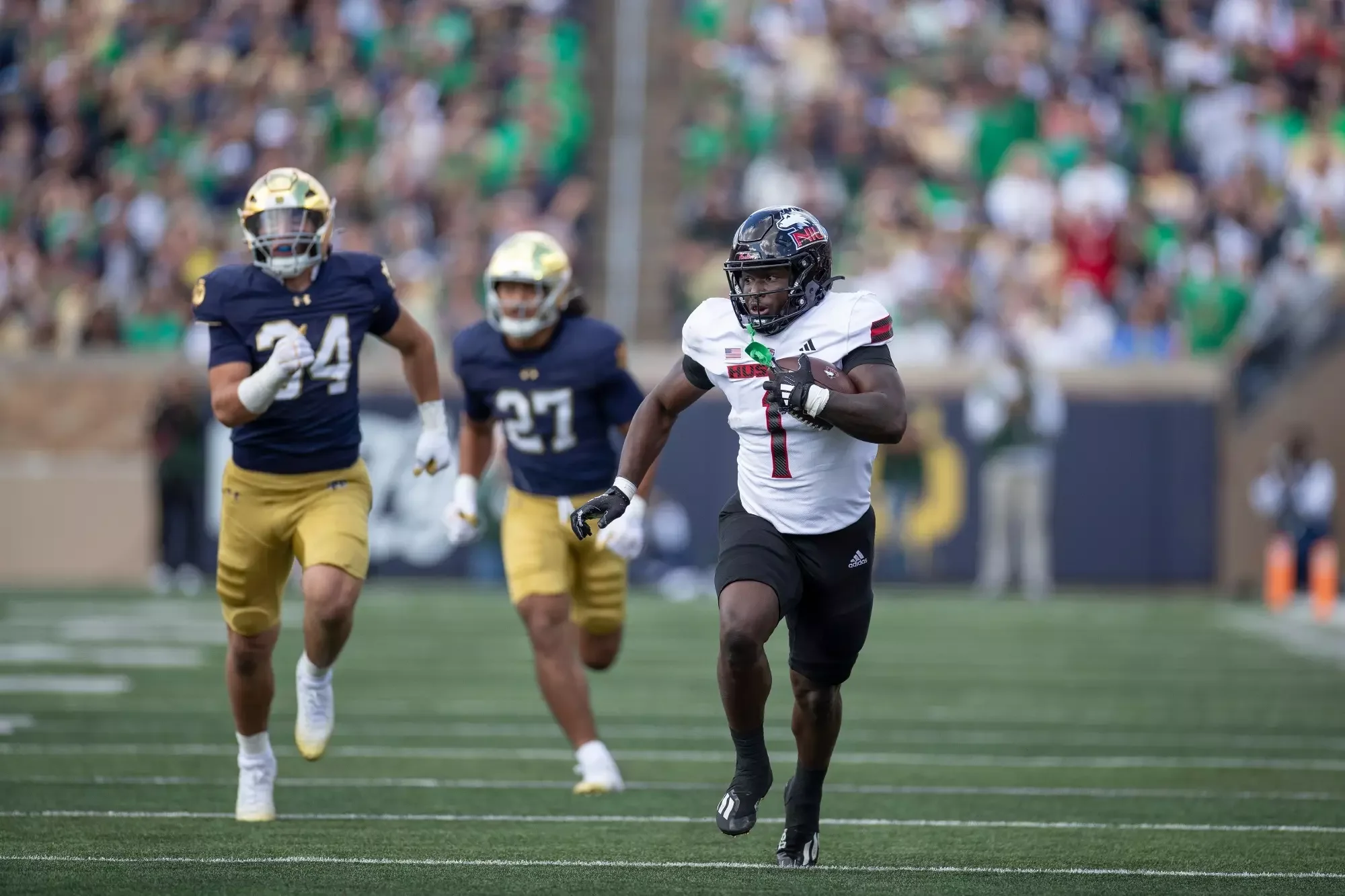
Northern Illinois in 2012 sits near the top of almost every fan's embarrassment list — and for good reason. Notre Dame was riding the wave of an undefeated run toward a national championship appearance, and the NIU loss came at the worst possible time for the program's credibility. As one listener put it, every squirrel gets a nut eventually, but this particular nut cost the Irish dearly in terms of national perception.
The Stanford loss under Marcus Freeman's early tenure carries a different kind of embarrassment — not just because of the defeat itself but because of the way it ended. David Shaw, coaching what turned out to be one of his final games, walked off the field with a smirk that said everything. A program that had been terrible that year had just handed Freeman one of the most stinging early losses of his tenure, and Shaw departed without so much as a handshake — walking slowly off the field as if he wanted every Notre Dame fan to absorb the moment fully. You can't fight the bully when he moves to another city. That slow walk became the enduring image of that afternoon.
The Michigan State fake field goal belongs in its own category entirely. Notre Dame's defense had every reason to expect it — the Spartans' kicker had missed two attempts from distance on the night, and the situation screamed fake. And yet when Michigan State ran it, the Irish fell for it completely. The image of Notre Dame defenders' faces in that moment — the sudden realization of what had just happened — captured something painfully familiar about Irish football in certain eras.
The Painful Ones
The 2014 Florida State game occupies a special place of pain for Notre Dame fans because of what it represented beyond the loss itself. The Seminoles were coming off a national championship, riding an unbeaten streak, and playing at home with full momentum. Notre Dame had the talent and the moment to make a genuine statement — and a controversial pass interference call late in the game swung the outcome. The what-if of that game lingers because the trajectory of Brian Kelly's program could have bent permanently in Notre Dame's favor with a victory. Instead, a fork in the road sent the program in a different direction.
The 2023 Ohio State loss — with ten men on the field — makes the embarrassing list for reasons that need no elaboration. Execution errors at the most basic level, on the biggest stage, against the most visible opponent. That one hurt in a way that felt institutional rather than situational.
The Northwestern Problem
Perhaps the most revealing discussion centered on a Northwestern loss that podcast co-host Malik Zaire experienced firsthand as a Notre Dame player. The pain wasn't simply that Notre Dame lost — it was how Northwestern played in that game. The Wildcats were dropping touchdowns, making plays that had no business happening against a Notre Dame roster with significantly superior talent. Trevor Siemian was throwing bombs. The Irish were getting beaten by a team that, as Zaire noted, probably could have won by more if they had simply caught every ball thrown their way. Losing to a team that wasn't at full capacity is its own particular brand of humiliating.
The Consistent Thread
What connects every loss on this list is not talent disparity — it is execution, circumstance and the painful randomness of college football applied to a program that carries enormous expectations into every single game it plays. Notre Dame fans don't just want wins. They want wins that match the standard the program sets for itself, and every loss on this list fell short of that standard in its own specific and memorable way.
The good news, as one podcast host noted, is that genuinely embarrassing losses — the kind where Notre Dame had no business competing — have been remarkably rare over the past 15 years. The 2012 Alabama national championship game is the only contest in that span where the outcome felt completely inevitable from the opening drive. Everything else has been competitive, consequential and winnable.
That is the standard Marcus Freeman is now carrying forward — and the 2026 season represents his best opportunity yet to ensure the painful losses remain in the past where they belong.