
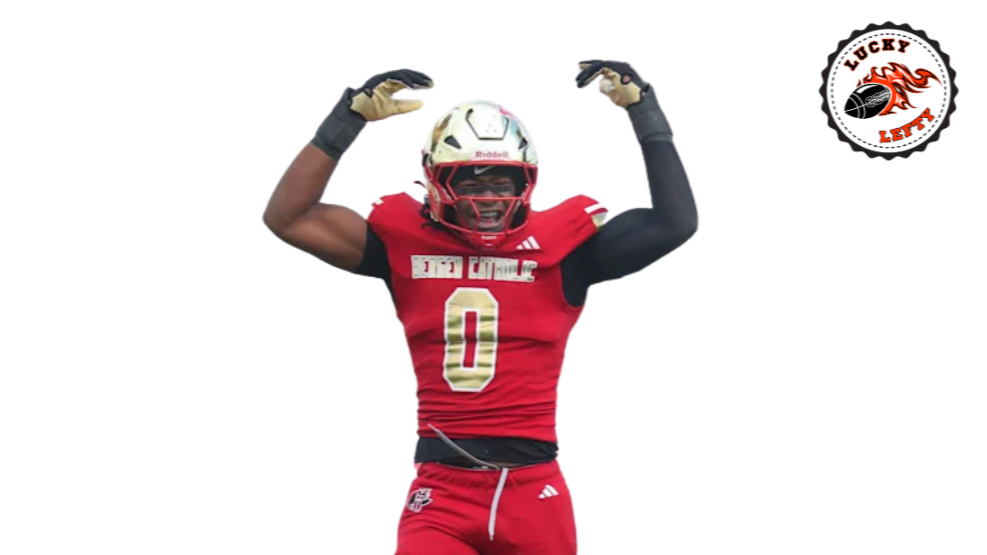
Elite 2027 edge Jackson Vaughn Brings Dominant pass rush to Notre Dame
Notre Dame has secured one of the most electrifying pass rushers in the 2027 recruiting class, landing standout defensive end Jackson Vaughn in what could prove to be a program-defining addition to the Fighting Irish defensive front. The 6-4, 220-pound edge destroyer out of Oradell, N.J./Bergen Catholic chose Notre Dame over a heavyweight field that included Miami, LSU, Auburn and South Carolina — a testament to just how coveted this talent is.
Make no mistake — Jackson Vaughn is not just another recruiting win. He is a generational edge talent who has been wrecking offensive lines in one of the most competitive high school football leagues in the nation since the moment he stepped on the field.
A Dominant Force From Day One
Vaughn's dominance isn't a recent development — it's been his calling card since he first put on a helmet at Bergen Catholic. As a true freshman, he posted a jaw-dropping 11 tackles for loss and eight sacks, immediately announcing himself as a force that no offensive lineman in his conference could handle. He matched that production as a sophomore, proving it was no fluke.
This past season, Vaughn elevated his game to an entirely new level. The Bergen Catholic standout was an absolute terror off the edge, racking up 40 tackles, 12 tackles for loss and eight sacks — numbers that would make any Power Four defensive coordinator salivate. When Vaughn lines up across from you, bad things happen to your quarterback.
His production is no accident. Vaughn is a technically refined pass rusher with an elite feel for winning on the edge that most defenders don't develop until years of college coaching. His hand usage is exceptional — he doesn't just rely on raw athleticism to beat blockers, he dissects them, reads their technique and exploits every weakness. That combination of football IQ and physical dominance is precisely what separates elite edge talents from the rest.
Explosive Speed That Changes Games
What makes Vaughn truly special — and what Notre Dame is getting that money can't buy — is his explosive, game-breaking speed off the line of scrimmage. He doesn't just rush the passer, he hunts quarterbacks with a relentless, lightning-fast motor that offensive tackles simply cannot account for.
Vaughn's first step is a weapon in itself. He explodes off the edge with elite burst, making even the best-prepared blockers look a step slow. His smooth athleticism enhances a devastating double-move repertoire and elite change of direction that allows him to beat blockers multiple ways on any given snap. He doesn't telegraph his rush — he sets up, accelerates, and is in the backfield before you realize it's happening.
His length, at 6-4 with a strong athletic frame, only amplifies that speed. Long arms combined with elite get-off make him nearly impossible to cut off on a speed rush, and his natural pop at the point of attack makes bull-rushing a very real secondary threat. Offensive coordinators will be drawing up extra protection schemes specifically because of Vaughn long before he ever takes a snap in Notre Dame blue and gold.
The Total Package
Vaughn is a dominant pass rusher today, but the scariest part for future Notre Dame opponents is that there is still room to grow. As he continues to add strength to his already impressive frame, he projects to become an equally disruptive run defender — a true every-down edge player at the highest level of college football. His athleticism and versatility in space also give Notre Dame's defensive staff the flexibility to deploy him in creative ways, much like the Irish have maximized their elite linebackers in years past.
It's worth noting that Vaughn was originally ranked as a Top 50 caliber prospect in the 2028 class before reclassifying to 2027 — meaning Notre Dame is getting this elite talent a full year early. He carries a 5.0-star upside grade and a Top 50 ranking on the Irish Breakdown board, and those numbers will only climb as the national recruiting services catch up to what anyone who has watched him play already knows.
Those who have seen Vaughn up close need no convincing. At last year's Irish Invasion camp — one of the premier recruiting showcases in the country — Vaughn was the single most dominant lineman on the field, outperforming every other prospect in attendance. That camp included his future Notre Dame teammate David Folorunsho, which speaks to just how loaded that event was. Vaughn still stood above them all.
Notre Dame DL Just Got Elite
With this commitment, Notre Dame now boasts two exceptionally talented edge players in the 2027 class, with Vaughn joining fellow Bergen Catholic-league standout Aidan O'Neil. The Irish aren't just building depth at the position — they are assembling a dominant, program-defining edge rotation.
Vaughn becomes the 18th commitment in Notre Dame's 2027 class, joining an already impressive group that includes quarterback Champ Monds, running backs Lathan Whisenton and Isaiah Rogers, wide receiver Jackson Coleman, tight end Titus Hawk, multiple offensive linemen, and a deep defensive haul featuring cornerbacks, safeties and linebackers from across the country.
But in a class full of talent, Jackson Vaughn stands out. Notre Dame has landed a heat-seeking, quarterback-destroying edge rusher with the speed, technique and instincts to be one of the most feared pass rushers in college football. The Fighting Irish just got significantly more dangerous — and opposing offenses should be very, very concerned.
Notre Dame Extends Stanford Rivalry and Adds Kent State, Filling Out Dominant 2027 and 2028 Schedules
Notre Dame is putting the finishing touches on two of the most anticipated schedules in recent program history, announcing a pair of additions that bring both the 2027 and 2028 seasons into clear focus. The Fighting Irish have added Stanford to both schedules while also slotting in Kent State for 2027 — and for a program that has absolutely owned the Stanford rivalry under head coach Marcus Freeman, the extension of that matchup is very good news for Notre Dame fans.
The Stanford Rivalry — A Series Notre Dame Has Made Its Own
The headline move is the extension of Notre Dame's storied rivalry with Stanford, a series that was previously scheduled to conclude after the 2026 season. Instead, the Irish and Cardinal will keep meeting, with Notre Dame traveling to Stanford to close out the 2027 season before hosting Stanford in South Bend on October 14th, 2028.
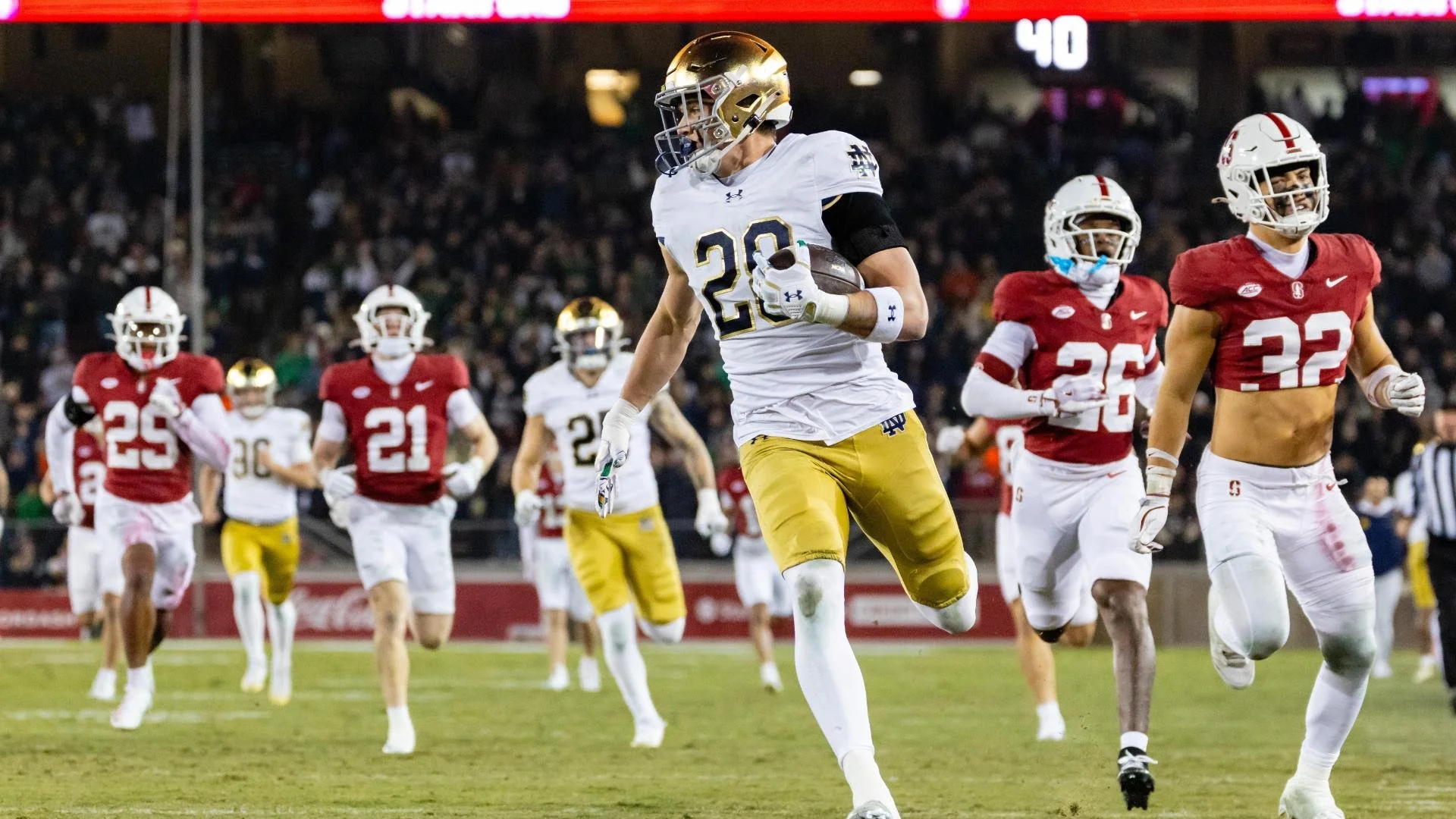
Notre Dame holds a commanding 25-14 all-time record in the series, but what makes this extension particularly exciting is what Marcus Freeman's era has looked like against the Cardinal. Under Freeman, Notre Dame has turned this rivalry into something resembling a mismatch — the Irish have won the last three meetings by an average score of 51.3 to 16.7, a level of dominance that is as emphatic as it sounds.
The most recent chapter was written in 2025, when Notre Dame traveled to Stanford's home field and left with a resounding 49-20 victory. That kind of road performance against a program with Stanford's tradition and facilities sends a message — and Notre Dame delivered it with authority.
The one blemish in Freeman's record against Stanford came in 2022, when the Cardinal handed the Irish an early-tenure loss that served as a humbling moment for a program still finding its footing under its new head coach. Freeman and his staff took that lesson to heart. What followed was a string of increasingly dominant performances that erased any doubt about who owned this rivalry. The 2022 result now looks less like a sign of things to come and more like the last gasp of a series that Notre Dame has since locked firmly in its grip.
Extending the rivalry means Notre Dame fans get more of what has become one of the most lopsided — and satisfying — matchups on the Irish schedule. If the trend under Freeman continues, Stanford is going to have a very difficult time in both 2027 and 2028.
A Loaded 2027 Schedule Taking Shape
With Stanford now locked in, Notre Dame will face five ACC opponents during the 2027 season — a reflection of the Irish's unique scheduling arrangement with the conference. That slate includes the beginning of Notre Dame's highly anticipated 10-year series against Clemson, which kicks off October 7th inside Notre Dame Stadium. Add in matchups against a pair of Big Ten programs in Purdue and Michigan State, an SEC showdown with Auburn, BYU out of the Big 12, and the annual rivalry with Navy, and the 2027 schedule is shaping up to be one of the most diverse and challenging in college football.
The Kent State addition rounds out the home schedule in a way that carries a personal storyline. Notre Dame will host the Golden Flashes on October 2nd in what will be the first-ever meeting between the two programs. The connection, of course, is that Marcus Freeman spent two seasons coaching at Kent State early in his career — 2011 and 2012 — helping lay the foundation for what has become one of the most celebrated coaching rises in recent college football history. Freeman returning to South Bend to face his old stomping grounds, now as the head coach of Notre Dame, adds a layer of meaning to what might otherwise be a straightforward home game.
2027 Schedule
Sep. 4 — Purdue
Sep. 18 — at Michigan State
Sep. 25 — Auburn
Oct. 2 — Kent State
Oct. 9 — vs. Wake Forest (Bank of America Stadium, Charlotte, NC)
Oct. 30 — at Clemson
Nov. 6 — Virginia Tech
Nov. 20 — Navy
Nov. 27 — at Stanford
TBD — Georgia Tech
TBD — BYU
2028 Shaping Up as an SEC-Heavy Challenge
The 2028 schedule is building toward something formidable as well. Notre Dame will now face six ACC opponents that year with both Stanford and Clemson on the books, while also navigating a brutal three-game SEC stretch that includes Texas, Auburn and Arkansas. Purdue returns to the schedule along with the perennial Navy rivalry game, while Boston College, Miami and Pittsburgh still need dates assigned.
2028 Schedule
Sep. 9 — Texas
Sep. 16 — Arkansas
Sep. 23 — at Purdue
Oct. 7 — Clemson
Oct. 14 — Stanford
Oct. 28 — at Auburn
Nov. 4 — at Virginia Tech
Nov. 18 — at Navy
TBD — Boston College
TBD — Miami (Fla.)
TBD — Pittsburgh
The Bottom Line
Notre Dame now has 11 games scheduled for each of the next two seasons, and the picture being painted is one of a program that isn't afraid to schedule anybody. The Stanford extension is the cherry on top — a rivalry that Marcus Freeman has turned into a showcase of Irish dominance, with one early stumble in 2022 long since buried under a avalanche of blowout victories. Notre Dame fans should be circling both Stanford dates on the calendar with confidence. If Freeman's track record against the Cardinal tells us anything, the Irish will be ready.
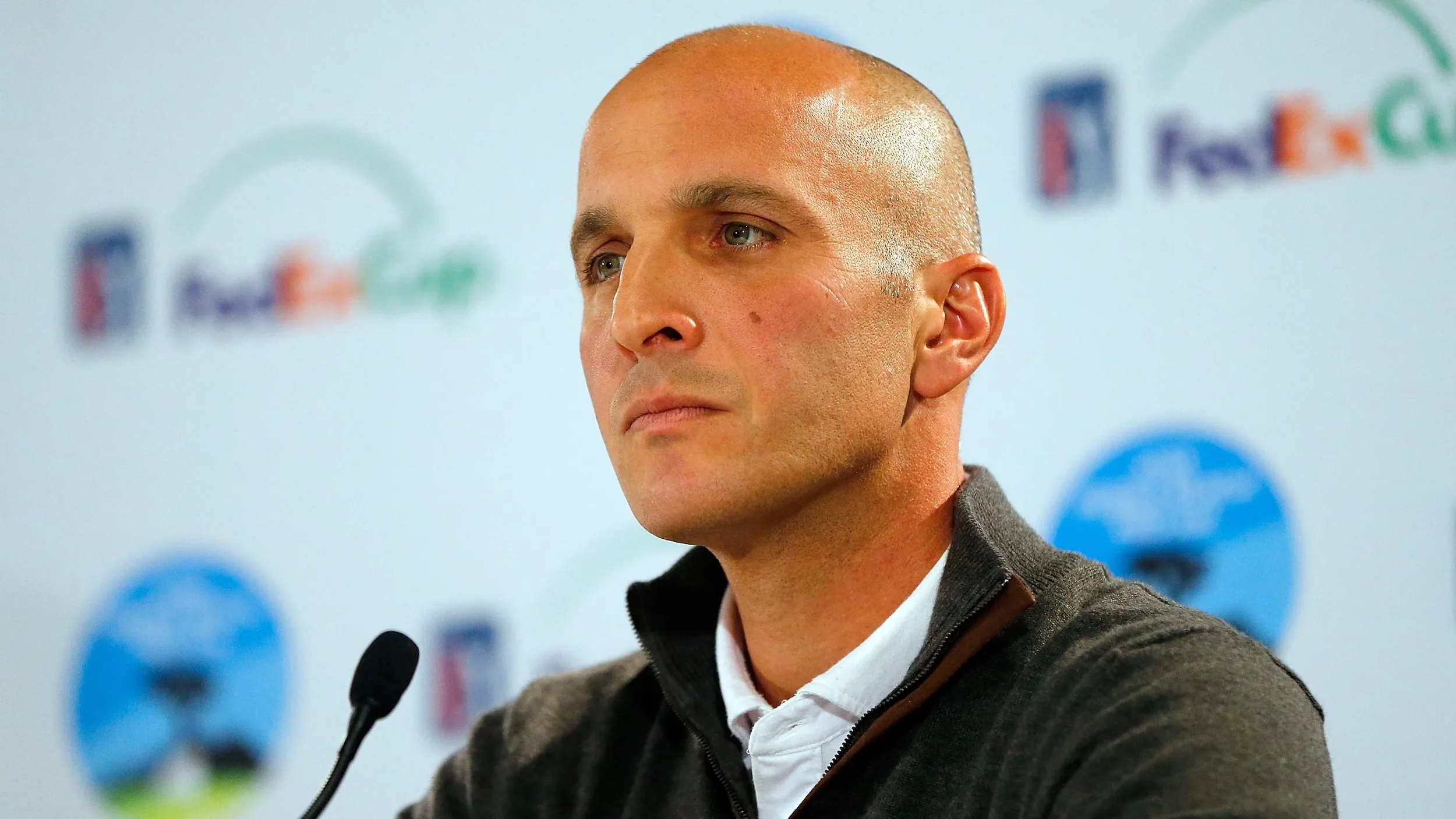
Notre Dame AD Pete Bevacqua stands with sec, big 10 for cfp expansion
The College Football Playoff expansion debate has reached a tipping point, and Notre Dame Athletic Director Pete Bevacqua has made clear exactly where the Fighting Irish stand. Bevacqua has aligned Notre Dame with the SEC, Big Ten and Big 12 in pushing for a 24-team playoff format — and in doing so, has positioned the Irish not just as a voice in the conversation, but as a program uniquely built to dominate regardless of how the playoff landscape ultimately unfolds.
Bevacqua Steps Into the Arena
The expansion conversation has been building for two offseasons now. Big Ten commissioner Tony Petitti lit the fuse last year with an aggressive push to double the current 12-team field. The Big 12 and ACC have since climbed on board, with commissioner Jim Phillips lending his voice to the chorus. Now Notre Dame has joined them, and Bevacqua's reasoning goes deeper than simply wanting more teams in the field.
"I think in this day and age with what universities are investing in football, it's a very expensive sport," Bevacqua said. "You need to give more teams hope. The way things are structured now, everything points to the CFP. It's a measure of success. It's important in the tenure of a coach. We've seen firings when teams aren't going to make it to the CFP."
Bevacqua's vision extends beyond the present moment. He's thinking about the long-term health of college football as a whole — and what happens to the sport if the financial burden of competing at the highest level becomes unsustainable for programs outside the traditional powerhouse tier.
"My concern is that if more teams aren't given hope, that universities over the course of the next five, ten years will say, 'Hey, is the investment worth it?'" Bevacqua continued. "I would hate to see a college football landscape where there's only a handful of teams that can really give it a legitimate go year after year after year."
That is the voice of a man who understands that a thriving college football ecosystem benefits Notre Dame just as much as anyone. A sport with thirty programs genuinely competing for a title is a healthier, more marketable, more financially robust product than one with eight. Bevacqua sees the big picture — and he's right to.
The Strategic Genius of Notre Dame's Position
What makes Notre Dame's embrace of the 24-team format particularly shrewd is that it comes from a position of strength, not desperation. The Fighting Irish don't need a bigger playoff to survive. They need it to thrive — and there is a significant difference.
Consider what Marcus Freeman has built in South Bend. Notre Dame is scheduling some of the most demanding non-conference slates in the country, with home-and-home series against Alabama, Texas, BYU, Florida and Auburn on the books in coming seasons. The Irish aren't soft-scheduling their way into playoff consideration — they are earning it the hard way, against the best competition available. Ohio State plays Texas out of conference. Clemson has gone back-to-back against Georgia and LSU. Notre Dame belongs in that same conversation about programs willing to put their records on the line before conference play even begins.
That scheduling philosophy means one thing clearly: Notre Dame is building a program that can compete with anybody, anywhere, at any time. In a 12-team playoff, that makes the Irish a dangerous contender. In a 24-team playoff, it makes them a program that would enter the field battle-tested and ready while other programs that padded their records against cupcakes scramble to compete with legitimate title contenders.
Notre Dame wins in either world — and Bevacqua knows it.
Aligning With Power to Shape the Future
By stepping forward alongside the SEC and Big Ten — the two most powerful conferences in college football — Bevacqua has ensured that Notre Dame has a seat at the table where the sport's future gets decided. That is not a small thing for an independent program without a conference megaphone behind it.
The SEC and Big Ten generate the lion's share of college football's revenue and carry the most weight in playoff format negotiations. Notre Dame aligning with those conferences on the 24-team push isn't just a philosophical stance — it's a political calculation that keeps the Irish relevant in conversations that will shape the sport for the next decade. An independent program that sits on the sidelines of that debate risks being shaped by decisions made without their interests in mind. Bevacqua made sure that doesn't happen.
The revenue implications are also impossible to ignore. A 24-team playoff means more games, more television inventory, more distribution money and a bigger financial pie for participating programs. Notre Dame, with its own NBC television deal and massive national brand, stands to be one of the biggest financial beneficiaries of an expanded field. More playoff games means more Notre Dame on national television — and that is always good for the bottom line in South Bend.
A Program Built to Prosper at Any Playoff Size
Perhaps the most important element of Notre Dame's position is that Freeman and Bevacqua have constructed a program that doesn't need the playoff format to change in order to compete. Under Freeman, Notre Dame has already demonstrated it can reach the College Football Playoff and make deep runs in the current 12-team format. The roster investment, the recruiting infrastructure, the coaching staff and the scheduling ambition are all pointed at one goal — winning a national championship.
If the playoff stays at 12 teams, Notre Dame's brutal non-conference schedule and elite recruiting class position them as perennial contenders for one of those coveted spots. If it expands to 24, the Irish would enter as one of the most battle-tested programs in the field — a team that has been preparing to play anyone, not just survive a soft schedule long enough to sneak into an expanded bracket.
Either way, the programs that should be concerned about the playoff format are the ones that need a bigger field just to get in. Notre Dame is not one of those programs. Bevacqua is advocating for expansion from the high ground — as the AD of a program that will be in the conversation whether the field is 12, 16 or 24 teams.
The Bottom Line
Pete Bevacqua has made a bold, calculated and strategically sound move by aligning Notre Dame with the forces pushing for a 24-team College Football Playoff. His argument for the long-term health of the sport is genuine and carries real merit. His understanding of what expansion means for Notre Dame's brand, revenue and competitive positioning shows a leader thinking well beyond the next season.
Most importantly, Marcus Freeman is building exactly the kind of program that makes this position credible. Notre Dame isn't lobbying for a bigger playoff because they need a lifeline. They're supporting expansion because they intend to be one of the programs that makes every round of a 24-team field worth watching — and they're scheduling, recruiting and competing like it every single day.
The playoff may be changing. Notre Dame is ready for all of it.
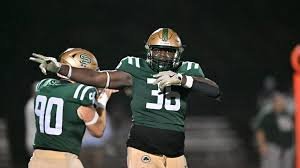
chicago’s elite Defensive Tackle David Folorunsho Brings Top-10 Talent to Notre Dame
Notre Dame has landed one of the most uniquely gifted defensive tackles in the 2027 recruiting class, securing a commitment from Chicago's David Folorunsho — a St. Patrick standout whose combination of explosive speed, raw power and positional versatility makes him precisely the kind of defensive lineman that transforms how a coordinator can build and deploy a front. And in a story woven together by deep Notre Dame relationships at every level of his development, Folorunsho's path to South Bend feels less like a recruiting victory and more like an inevitable homecoming.
Folorunsho chose Notre Dame over Miami, Georgia, Michigan and Texas Tech, handing first-year defensive line coach Charlie Partridge one of the most significant early recruiting wins of his tenure and giving the Fighting Irish a cornerstone piece for a defensive front that is being built to play multiple looks, confuse offensive lines and dominate from the inside out.
A Swiss Army Knife on the Defensive Front
The first thing that jumps off the film when you watch David Folorunsho is that he doesn't fit neatly into a single box — and that is exactly what makes him so dangerous, and so valuable to Notre Dame's defensive system.
At 6-3 and 285 pounds, Folorunsho has the size, anchor and power to line up as a true nose tackle and own the interior against the run. But what separates him from a conventional space-eater is the explosion and lateral athleticism that allow him to slide outside, line up over a tackle and win in ways that interior linemen simply aren't supposed to win. He can two-gap, he can shoot gaps, he can be a three-technique on one snap and a nose on the next. That ability to play multiple alignments without losing effectiveness is rare at any level of football — at the high school level, it is almost unheard of.
For Notre Dame's defensive staff, this versatility is not a bonus — it is the foundation of why they wanted Folorunsho so badly in the first place. The ability to present different fronts, shift alignments pre-snap and keep offensive lines off balance requires players who can execute in multiple roles without hesitation. Folorunsho is exactly that player. He gives defensive coordinators a true chess piece — someone who can be the answer to multiple problems on any given game plan.
Explosive Speed That Redefines What an Interior Lineman Can Do
What truly elevates Folorunsho into the conversation as a national top-10 prospect is a first step that simply does not belong on a 285-pound defensive tackle — and yet there it is, every single snap, blowing up offensive linemen before they can establish their sets.
His get-off is elite. The moment the ball moves, Folorunsho is already in the backfield mentally and closing on the quarterback or ball carrier physically. That kind of explosion draws immediate comparisons to former Notre Dame defensive line standouts Sheldon Day and Rylie Mills — players who combined interior size with an athletic profile that made them impossible to account for on a one-on-one basis. Folorunsho is cut from that same cloth.
That speed off the line translates directly into production. In his dominant junior season at St. Patrick, Folorunsho posted 55 tackles, 18 tackles for loss and five sacks — numbers that reflect a player who is not waiting for plays to come to him but actively hunting them down with first-step quickness that offensive linemen at the high school level simply cannot match. As he continues to develop that explosion under Notre Dame's elite strength and conditioning program, the production that made the entire country take notice will only grow.
His hands are equally impressive — fast, strong and violent at the point of contact. He doesn't just use his speed to get into the backfield; he uses his hands to win the leverage battle and finish plays with authority. The combination of an elite first step with fast, powerful hands is what allows Folorunsho to rack up tackles for loss against double teams, against chip blocks, against every scheme an offensive coordinator has thrown at him. He finds a way to win.
Power That Anchors the Run Defense
Speed and versatility tell only part of the Folorunsho story. The other half is the kind of raw, physical power that allows Notre Dame to line him up in the middle of the field and simply dare opposing offenses to run at him.
Folorunsho's ability to anchor against double teams, absorb contact without losing ground and still make plays at the point of attack gives Notre Dame's defensive front a true run-stuffing anchor when the game plan calls for it. He is not a finesse player who disappears when the line of scrimmage becomes a phone booth — he thrives in that environment just as much as he does in open-field pursuit.
That balance of speed and power is what gives Notre Dame's defensive staff the freedom to be genuinely creative with their front structures. They can ask Folorunsho to be a disruptive, gap-shooting interior pass rusher on one series and a two-gap run-stopper on the next. Offensive coordinators cannot simply account for one dimension of his game — they have to prepare for all of them, and that is an enormous advantage for a Notre Dame defense that wants to make life as complicated as possible for opposing offenses.
The Notre Dame Brotherhood That Brought Him Home
David Folorunsho's commitment to Notre Dame is not simply the result of a great recruiting pitch. It is the product of relationships built over years by people who love Notre Dame deeply and poured that love into a young man who was watching and absorbing all of it.
The head coach at St. Patrick is Tom Zbikowski — a name that needs no introduction in South Bend. Zbikowski was one of the most celebrated safeties in Notre Dame history, a hard-hitting, instinct-driven defender whose toughness and competitive fire defined his Irish career. As the head coach guiding Folorunsho's development at St. Patrick, Zbikowski brought Notre Dame's standard of toughness, discipline and preparation to the program every single day. Folorunsho didn't just hear about what it means to be a Notre Dame football player — he was coached by one, shaped by one and held to that standard throughout his high school career.
The Notre Dame thread runs even deeper at St. Patrick. School president Dan Santucci is himself a former Notre Dame starter and a teammate of Zbikowski's with the Fighting Irish. The culture inside St. Patrick's walls — the standard of excellence, the pride in academics, the understanding of what Notre Dame football demands — is not incidental. It is baked into the institution by men who lived it. Folorunsho has been immersed in that environment from the moment he arrived at St. Patrick, long before Notre Dame's coaching staff ever made a formal offer.
And then there is Kerry Neal of WIN Performance, Folorunsho's trainer — a man whose fingerprints are all over the physical transformation and athletic development that turned a three-star prospect into a consensus Top-10 national recruit almost overnight. Neal's work with Folorunsho refined the explosiveness, built the functional strength and honed the technical skills that made the entire country take notice after his junior season. The elite first step, the violent hands, the ability to play with leverage and power at 285 pounds — Neal had a major hand in building all of it. Notre Dame isn't just getting a great player; they're getting a great player who has been developed by an elite trainer who understood exactly how to maximize his gifts.
Together, Zbikowski, Santucci and Neal form a triangle of trusted, Notre Dame-connected mentors who shaped David Folorunsho at every level — on the field, in the weight room and within the walls of his school. When Notre Dame came calling, Folorunsho wasn't hearing about the program for the first time. He already knew what it stood for. He had been living it.
Charlie Partridge Wins Big in Year One
The significance of this commitment for first-year defensive line coach Charlie Partridge cannot be overstated. Landing the No. 2 defensive tackle in the country — the No. 9 overall prospect nationally according to Rivals and On3 — against Georgia, Michigan, Miami and Texas Tech in his very first recruiting cycle at Notre Dame is a statement that echoes across the entire college football landscape. Partridge didn't need a grace period. He identified the right player, built the right relationships and delivered one of the biggest defensive line commitments Notre Dame has seen in years.
A Class That Keeps Getting Better
Folorunsho becomes the 17th commitment in Notre Dame's 2027 recruiting class, joining a group that already features quarterback Champ Monds, running backs Lathan Whisenton and Isaiah Rogers, wide receiver Jackson Coleman, tight end Titus Hawk, offensive linemen Olu Olubobola, Jackson Hill, James Halter and Richie Flanigan, defensive end Aidan O'Neil, linebacker Amarri Irvin, cornerbacks Xavier Hasan and Ace Alston, safety Zayden Gamble, nickel John Gay III and long snapper Sean Kraft.
Adding a consensus Top-10 national prospect with Folorunsho's unique skill set doesn't just deepen the class — it changes the ceiling of what this Notre Dame defense can become.
The Bottom Line
David Folorunsho is the rare defensive tackle who can do everything — stop the run with power, rush the passer with elite speed and line up in multiple alignments without losing a step. He is a versatile, explosive, physically dominant interior defender who gives Notre Dame's defensive staff the freedom to be as creative and multiple as any front in college football.
He is also a Chicago kid who was raised in a Notre Dame household by a Notre Dame coaching legend, developed by an elite trainer in Kerry Neal, and supported by a school president who wore the same Notre Dame uniform. When David Folorunsho commits to the Fighting Irish, it isn't just a recruiting win. It is a family reunion — and Notre Dame's defensive front of the future is better for it.
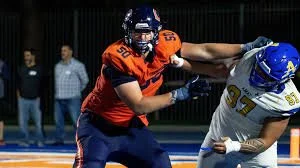
Joe Rudolph and Notre Dame Flip OT Jackson Hill From UCLA
Joe Rudolph didn't have to go after Jackson Hill. That is the first thing you need to understand about this commitment — and it is the most important context for everything that follows.
Notre Dame's offensive line coach already had three quality commitments locked in for the 2027 class. He has five-star target Albert Simien scheduled for an official visit on June 19th. He signed six offensive linemen just a year ago. By any conventional measure of roster construction, Rudolph had room to be patient, selective and conservative with the next offensive line commitment in this class.
Instead, he went to California, identified a 6-7, 300-pound three-star prospect playing at Chaminade Prep, made a conviction call that the recruiting services had this one wrong — and didn't stop until Jackson Hill flipped his commitment from UCLA and chose Notre Dame.
That decision tells you everything about how Joe Rudolph evaluates offensive linemen and why his track record of developing players that others overlooked is one of the most quietly elite résumés in college football coaching.
Rudolph Made a Conviction Call — Not a Desperation Move
The easiest way to misread this commitment is to assume Notre Dame added Hill because they needed bodies or because the elite targets weren't materializing. Neither is true, and Rudolph's own actions prove it.
Simien, one of the most coveted offensive line prospects in the entire 2027 class, is still very much in play for Notre Dame with a June official visit on the schedule. Rudolph is not closing the door on elite five-star additions to this class — he is pursuing them aggressively at the same time he committed Hill. That simultaneity is the key. This was not an either-or decision driven by scarcity. It was a both-and decision driven by genuine belief in what Jackson Hill can become.
When an offensive line coach of Rudolph's caliber pursues a prospect while elite alternatives are still available and actively being recruited, that pursuit is a statement. It means Rudolph watched the film, saw something real and decided that waiting on rankings to catch up to his evaluation was a luxury Notre Dame couldn't afford — because eventually someone else was going to see what he saw, and by then Hill would already be committed somewhere else.
Rudolph saw it first. He moved first. That is what separates elite evaluators from everyone else.
The Rudolph Track Record — Turning Upside Into Production
To fully appreciate why this commitment makes sense, you have to understand the history Joe Rudolph brings to offensive line evaluation — because his track record of identifying players whose rankings dramatically understated their actual ceiling is not a coincidence. It is a philosophy.
Throughout his coaching career at Wisconsin, Pittsburgh and now Notre Dame, Rudolph has consistently identified offensive linemen that recruiting services rated as good-not-great prospects and developed them into legitimate NFL-caliber players. The pattern is unmistakable to anyone who has followed his career closely. Rudolph does not simply recruit the rankings — he recruits the player, the frame, the athleticism and the coachability. He asks one central question when he evaluates an offensive line prospect: what does this player become when I get three years of elite coaching, elite strength training and elite competition into his body?
That question produces very different answers than a recruiting service snapshot of a 17-year-old's current production level. And time and again, Rudolph's answers have been proven right when the players he believed in reach their junior and senior seasons and the rest of the country finally sees what he saw years earlier.
Jackson Hill is the latest player to benefit from that evaluation process — and if Rudolph's track record means anything, Hill's three-star ranking will feel like a distant memory long before his Notre Dame career is finished.
What Rudolph Sees in Hill That the Rankings Don't Capture
So what exactly did Joe Rudolph see when he watched Jackson Hill that convinced him to go all-in on a three-star prospect while five-star targets remained on the board?
Start with the foundation that cannot be faked and cannot be coached — the physical profile. At 6-7 and 300 pounds, Hill already possesses the frame that NFL offensive line scouts put at the very top of their evaluation criteria. Length is the single most non-negotiable physical attribute for a developmental offensive tackle, and Hill has it in a way that only a handful of prospects in any given recruiting class possess. Those long arms allow him to strike pass rushers before they can get into his body, create natural leverage advantages in the run game and give coaches the raw material to build a finished product that can hold up against elite college pass rushers for four years.
But Rudolph didn't fall in love with Hill's size alone. What truly separated Hill in Rudolph's evaluation is the athleticism that lives inside that massive frame — and the proof of it comes from the most unexpected place imaginable.
Jackson Hill plays catcher in baseball. Let that sink in for a moment. A 6-7, 300-pound athlete who lines up behind home plate, receives pitches at full velocity, blocks balls in the dirt, controls a running game and makes throws to every base is not just big. He is a legitimate multi-sport athlete whose body moves with a coordination and quickness that his size has no business producing. The quick-twitch hand-eye coordination required to catch at a high level translates directly to an offensive lineman's most critical skill set — active, fast, coordinated hands that can punch, redirect and sustain blocks against elite competition.
That dual-sport athleticism tells Rudolph something the film alone might not fully communicate — that Hill's body is not done developing, his coordination is already advanced beyond what his football experience reflects and his ceiling as an offensive lineman has not yet come close to being reached.
Add to that a powerful run-blocking foundation already in place, the football IQ to potentially play both tackle and guard at the college level and the academic profile that attracted offers from Penn and Dartmouth alongside his Power Four football offers — and what Rudolph saw was not a three-star offensive tackle. He saw a Power Four starter hiding inside a recruiting ranking that hadn't caught up to reality yet.
The Positional Upside That Makes Hill Even More Valuable
One of the most underappreciated elements of Hill's commitment is what his positional flexibility means for Notre Dame's offensive line depth over the next four years.
His natural size and length make him an obvious developmental tackle — the kind of player you project to protect the blind side as he refines his technique and adds functional strength. But Rudolph has also identified a realistic path where Hill moves inside to guard, where his 6-7, 300-pound power frame would make him one of the most physically imposing interior blockers in the ACC. A guard with Hill's size and athletic profile is a mauler in the run game — the kind of interior presence that creates movement at the line of scrimmage and gives a rushing attack a completely different dimension.
That flexibility to develop Hill at multiple positions is a luxury for Rudolph as he constructs the offensive line room around the 2027 class. It means Hill isn't locked into a single role before he ever takes a college snap. It means Rudolph can put him where the offense needs him most as the depth chart evolves. And it means that even if the tackle spots ahead of him are filled with elite talent, Hill's value to the program doesn't diminish — it simply finds a different expression.
The Class Context — Building With Depth and Range
Understanding why Rudolph went after Hill also requires understanding the broader 2027 offensive line class Notre Dame is assembling — because this group is being built with a specific philosophy in mind.
Olu Olubobola is the crown jewel — an elite, nationally-ranked New Jersey tackle whose offer list reads like a who's who of college football royalty. James Halter brings physicality and toughness from Pennsylvania. Richie Flanigan adds size and length from Wisconsin. And now Hill contributes a high-ceiling developmental profile with rare physical tools from the West Coast.
Rudolph is not building a one-dimensional offensive line class of interchangeable prospects. He is building a room with range — elite recruits with proven rankings alongside high-upside players whose ceilings may ultimately be just as high, or higher, than the stars suggested. That is how championship offensive line rooms get built. Not by chasing the same profile over and over, but by identifying different kinds of value and trusting your evaluation process to sort out who becomes what.
With Simien's official visit still on the calendar, this class could add another elite headline name before the 2027 cycle is complete. But Rudolph's willingness to commit Hill now — before that visit, while Simien is still in play — tells you he sees Hill's value as independent of any other decision. Hill earned this commitment on his own merits, on his own timeline, through Rudolph's own evaluation process.
That is the highest compliment an offensive line coach can pay a prospect.
The Bottom Line
Joe Rudolph went after Jackson Hill because Joe Rudolph trusts his eyes over a ranking, his evaluation over a database and his understanding of what a 6-7, 300-pound multi-sport athlete can become over what he currently is on a recruiting service's board.
The three-star label on Hill's profile will not survive contact with Notre Dame's strength program, Rudolph's coaching and the kind of elite competition that accelerates development faster than any recruiting service can track. It never does when Rudolph makes a conviction call on a high-upside offensive lineman that others have undervalued.
Jackson Hill chose Notre Dame over UCLA because the pull of South Bend and the belief of one elite offensive line coach proved stronger than a prior commitment. Notre Dame went after Jackson Hill because Joe Rudolph saw a future starter that the rest of the country hasn't fully discovered yet.
History suggests Rudolph is right. It usually does.
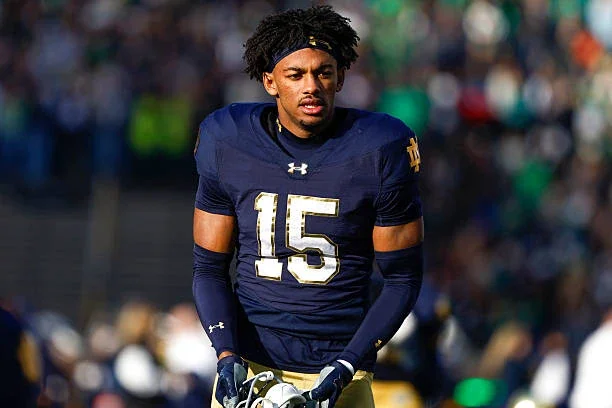
Leonard moore could give notre dame first jim thorpe award
Not every star arrives with fanfare. Not every player who ends up changing a program's defensive identity does so with a five-star recruiting ranking, a top-10 national profile and the weight of enormous expectations pressing down on his shoulders from the moment he steps on campus. Some players arrive quietly, get to work and let the field do the talking — and by the time the rest of the world catches up to what they already are, the transformation from unknown to undeniable is already complete.
That is the Leonard Moore story. And as he enters what could be his final season in South Bend, it is one of the most compelling individual journeys in Notre Dame football.
Moore wasn't heralded when he arrived at Notre Dame. He wasn't the centerpiece of a signing class headline or the subject of breathless recruiting coverage. He came to South Bend without the noise that typically surrounds players of his caliber — and then he went out and became the best cornerback in college football. Quietly, completely and undeniably.
Now, as he prepares for his third season with the Fighting Irish, the entire country has caught up to what those inside Notre Dame's program recognized long ago. Leonard Moore has been added to the Jim Thorpe Award watch list — and he isn't just on it. He is the front-runner to take it home.
The Arrival Nobody Saw Coming
When Leonard Moore came to Notre Dame, the recruiting spotlight was pointed elsewhere. He did not arrive as the kind of prospect that generates national recruiting coverage or sends fan bases into celebration mode at the moment of commitment. He was not a household name in the recruiting world. He was a Texas native with talent that hadn't yet been fully discovered, quantified or celebrated by the recruiting services that shape early national narratives.
What he was, to those who watched him closely enough, was a cornerback with the physical tools, the competitive instincts and the natural feel for the position that you simply cannot manufacture through coaching alone. The 6-2, 195-pound frame with the length and athleticism to match up with elite wide receivers at the college level. The feet. The instincts. The way he processed routes before they fully developed, the way he competed on the ball and the way he made the position look natural in a manner that only truly gifted players ever do.
Notre Dame saw it. They offered. Moore came to South Bend without the fanfare — and then the work began.
A Star Takes Shape
The first signs that something special was developing came early in Moore's freshman season. Those who watched closely enough saw a cornerback whose instincts were ahead of his experience, whose physical tools were already operating at a level that made experienced offensive players uncomfortable and whose competitive drive was evident on every snap regardless of the score, the opponent or the moment.
But it was his 2025 season that turned what insiders quietly believed into something the entire country could no longer ignore. Moore started 10 games and delivered a performance so comprehensive, so statistically dominant and so consistently elite that the sport's most respected evaluators were left searching for superlatives.
He led Notre Dame with five interceptions — tied for sixth most in the entire country. He added 31 tackles, seven pass breakups and a forced fumble while missing only six tackles all season — a number that reflects the complete cornerback he had become, not just the ball hawk the highlights suggested. He allowed only three receiving touchdowns across the entire season. And he did it all while being one of the most scouted, game-planned-against cornerbacks in college football — a player that every offensive coordinator in the country was specifically scheming to avoid.
The signature moments punctuated the statistical dominance. A 46-yard pick-six against Syracuse that changed the momentum of the game and announced Moore's big-play capability to a national audience. A two-interception performance against Boise State that earned him both the Walter Camp FBS Defensive Player of the Week and Jim Thorpe Award Defensive Back of the Week honors simultaneously — two of the sport's most prestigious weekly recognitions landing in the same hands on the same weekend.
Notre Dame finished the season ranked No. 1 in the country in total interceptions with 21. Moore, the cornerback who arrived without a headline, hauled in five of them.
The Numbers That Turned Heads Nationally
When the season ended and the evaluation process began in earnest, the numbers that emerged from Moore's 2025 campaign were not the kind that generate polite acknowledgment. They were the kind that stop conversations.
PFF ranked Moore first among all starting Power Four cornerbacks in coverage grade at 91.4 and first in overall defensive grade at 90.9 — the top marks at the position across the entire landscape of major college football. Those grades reflect not one great game or one great stretch of games but a full season of elite performance sustained against the best competition the sport offers.
The number that perhaps best captures what Moore had become by the end of 2025 is the target rate — opponents threw at him on only 11.5 percent of his coverage snaps. Offensive coordinators and quarterbacks made a collective, conscious decision across the entire season to route their passing games away from Leonard Moore's side of the field. That is the ultimate testament to a cornerback's dominance. You can only measure a player's full impact when you account for the plays that never happened because of him — and Moore's 11.5 percent target rate tells you the plays that never happened numbered in the dozens.
The season earned him unanimous All-American honors — the kind of recognition that requires every major selector to arrive at the same conclusion independently. For a player who arrived at Notre Dame without the recruiting world's attention, unanimous All-American status represents one of the most complete turnarounds in modern college football recruiting history. He went from under the radar to unanimously the best in the country. The arc of that journey is remarkable.
The Jim Thorpe Watch List — And Why Moore Is the Front-Runner
The Jim Thorpe Award watch list announcement confirmed what the preseason evaluations had been building toward all offseason. Leonard Moore belongs in the conversation for the most prestigious individual honor a defensive back can win in college football — and he doesn't just belong in that conversation. He leads it.
Moore was a Thorpe Award finalist after his 2025 campaign, becoming the first Notre Dame cornerback to reach that stage since Bobby Taylor in 1993. No Fighting Irish cornerback has ever won the award. The history of that gap — more than three decades without a Notre Dame corner reaching the Thorpe podium — makes Moore's opportunity in 2026 feel genuinely significant, not just for his personal legacy but for the program's.
ESPN's Heather Dinich named Moore the lead candidate for the award in the network's Way-Too-Early Top 25 rankings, pointing to his unanimous All-American honors, his nation-leading PFF coverage grade and the five interceptions that defined his 2025 campaign. Beyond the Thorpe, Moore carries legitimate front-runner status for the Bronko Nagurski Trophy — the defensive equivalent of the Heisman Trophy — and the Chuck Bednarik Award, which recognizes college football's top defensive player regardless of position.
Three of the sport's most significant individual defensive awards. One player's name near the top of every list. The player who arrived at Notre Dame without a recruiting headline is now the player that every preseason award conversation builds around.
Former Notre Dame safety Xavier Watts brought the Nagurski Trophy home to South Bend after his dominant 2023 season. Moore now has the opportunity to make it back-to-back Nagurski winners from Notre Dame — a back-to-back run that would say something profound about what Marcus Freeman's program has built on the defensive side of the ball.
What Back-to-Back No. 1 Rankings Actually Mean
PFF has ranked Moore the No. 1 returning cornerback in the country heading into 2026 — the second consecutive season they have done so. Every major outlet including CBS Sports, Athlon Sports, Sporting News, FOX Sports and ESPN has echoed that assessment, identifying Moore as one of Notre Dame's most important returning players and one of the premier defensive players in the sport.
Back-to-back No. 1 cornerback rankings from PFF are not handed out carelessly. They reflect a sustained standard of excellence that separates elite players from one-year wonders — the ability to perform at the highest level not just when the element of surprise is working in your favor but when every opposing offense has had a full offseason to study your tendencies, design routes against your technique and find whatever exploitable weakness might exist in your game.
Moore held that No. 1 ranking in 2025 when opponents came after him with a full scouting report. He held it when teams specifically designed plays to attack him. He held it when the margin for error shrinks because every opposing coordinator knows exactly where you line up and how you play. And when the offseason evaluations were complete, PFF gave him the No. 1 ranking again — because nothing they saw in a full season of trying to find a weakness changed their fundamental assessment of what Leonard Moore is.
A Defense Made Better By His Presence
Moore's individual excellence cannot be separated from what it has meant for Notre Dame's defense as a collective unit. When a cornerback locks down his side of the field with the consistency that Moore demonstrated throughout 2025, the structural benefits ripple across the entire defensive system.
Safeties can rotate toward the opposite side with greater confidence. Linebackers can play downhill more aggressively knowing the deep outside is protected by a cornerback who rarely needs help. Pass rushers get critical fractions of a second longer to reach the quarterback because the corner on Moore's side has already eliminated his receiver as a viable option. Notre Dame's leap to No. 1 in the country in interceptions with 21 total picks was not independent of what their best cornerback was doing every single week. It was deeply connected to it.
A defense takes on the identity of its best player. In 2025, Notre Dame's defense took on the identity of a unit that simply did not give up big plays in the passing game — and Leonard Moore was the primary reason why.
The Final Chapter in South Bend
As Moore prepares for what could be his third and likely final season with the Fighting Irish before the NFL comes calling, the shape of his Notre Dame legacy is already remarkable. A player who arrived without recruiting fanfare has become a unanimous All-American, a two-time PFF No. 1 ranked returning cornerback, a Thorpe Award finalist and the preseason front-runner for every major individual defensive award in college football.
The journey from unheralded arrival to the top of every preseason board is the kind of story that programs build cultures around — proof that development, coaching and competitive drive can take a player without a five-star label and turn him into something the entire country agrees is the best at his position.
But Moore isn't finished writing that story. He has one more season in blue and gold, one more opportunity to add to a legacy that already exceeds anything the recruiting services predicted when he arrived in South Bend, and one very specific piece of history within reach.
No Notre Dame cornerback has ever won the Jim Thorpe Award. Leonard Moore arrived at Notre Dame without anyone predicting he would be the one to change that.
At this point, nobody would be surprised if he does exactly that.
The quietest arrival. The loudest statement. The best cornerback in America — and he has one more season to make history in South Bend.
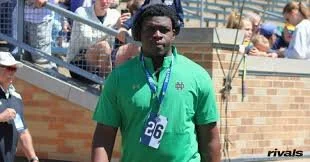
Notre Dame Built an Instant Connection With Elite Tackle Olu Olubobola and Won Big Recruiting battle
Some recruiting victories are built over years of relationship-building, endless in-home visits and a slow, methodical courtship that eventually tips in one program's favor. And then there are moments like this one — where Notre Dame identified one of the most athletically gifted offensive tackle prospects in the entire country, extended an offer, built a genuine and deep connection in a matter of weeks and walked away with a commitment that programs like Ohio State, Texas, LSU, Michigan and Florida State were pursuing for far longer.
Jersey City, N.J./St. Peter's Prep standout Oluwasemilore Olubobola has committed to Notre Dame, choosing the Fighting Irish over Miami and Texas A&M — and the story of how this recruitment unfolded is as impressive as the prospect himself. Notre Dame didn't just land a five-star offensive tackle. They did it faster, more decisively and more convincingly than anyone thought possible when the offer was first extended in late March.
This is what elite program building looks like at its very best.
Six Weeks, One Visit, One Decision
The numbers that frame this recruitment are almost hard to believe when you lay them out in sequence. Notre Dame didn't offer Olubobola until March 19th — at which point programs like Ohio State, Texas, LSU, Oregon, Florida, Michigan, Florida State, Penn State, Tennessee, Auburn and dozens of other elite programs had already been recruiting him for months. The Irish entered the race behind nearly everyone.
From that March offer, Notre Dame had exactly one opportunity to get in front of Olubobola in person — a visit for the Blue-Gold Game on April 25th. One visit. Not a home visit followed by an official visit followed by multiple campus trips over the course of a year. One single opportunity to show Olubobola what Notre Dame's offensive line program looks like up close, what the campus feels like on a football weekend and what Joe Rudolph's development pipeline has produced for the elite tackle prospects who came before him.
Notre Dame made that one visit count in a way that changed everything. Coming out of the Blue-Gold weekend, the Irish still appeared to have ground to make up. But something had clearly shifted inside the relationship — something genuine and real that the Notre Dame staff recognized and immediately accelerated. By early May, Notre Dame had gone from late entry to the clear frontrunner. Shortly after, Olubobola made it official.
Six weeks from offer to commitment. One campus visit. A decision that beat out programs that had been recruiting him for a year or more.
That is not a coincidence. That is connection.
What Notre Dame Did Right — Building Real Relationship at Warp Speed
The most important question surrounding this commitment isn't what Olubobola brings to Notre Dame — it's how Notre Dame built a bond strong enough in six weeks to beat programs with far longer head starts.
The answer lies in what the Irish staff prioritized from the moment the offer went out. Notre Dame didn't just sell Olubobola on rankings, facilities or conference affiliations. They sold him on something more personal and more powerful — a genuine belief in who he is as a player, a student and a person, communicated with an authenticity and urgency that prospects at this level immediately recognize as real.
Joe Rudolph and the Notre Dame staff made Olubobola feel like he wasn't just a recruiting target — he was exactly who Notre Dame needed, specifically and uniquely, in this class. That distinction matters enormously to elite prospects who have every program in America telling them how great they are. When a coach can articulate precisely why you fit, what you will become under their development system and what your specific role in the program's future looks like, it cuts through the noise in ways that months of generic recruiting communication never can.
The Blue-Gold Game visit did the rest. There is simply no substitute for standing on Notre Dame's campus, feeling the weight of the tradition, watching the program operate at close range and imagining yourself inside it. Olubobola took that visit and came away with something that six weeks of phone calls and text messages couldn't fully deliver — a visceral, personal understanding of what Notre Dame means. That understanding accelerated everything.
The Athletic Profile That Made Every Program in America Take Notice
To fully appreciate the magnitude of what Notre Dame has secured, you have to understand exactly what kind of athlete Oluwasemilore Olubobola is — because his physical and athletic profile is the kind that offensive line coaches spend entire careers searching for and rarely find at this stage of development.
Start with the frame. At 6-6 and 295 pounds, Olubobola is already built like a finished college offensive tackle before he has taken a single college snap. That size and weight at his age, combined with the room his frame still has to develop, gives Notre Dame's strength and conditioning staff an extraordinary foundation to work with. But size alone is common enough among highly recruited offensive tackle prospects. What makes Olubobola genuinely special — what makes him a top-20 national prospect and the No. 1 player in the state of New Jersey — is what that 6-6, 295-pound body can actually do.
Olubobola moves with an athletic fluidity that has no business existing in a player his size. His feet are nimble and quick, processing lateral movement with an ease and natural rhythm that you typically find in skill position players, not massive offensive tackles. That footwork is not the product of years of technique work — it is native athleticism, the kind that shows up on film immediately and makes experienced evaluators lean forward in their chairs. Light feet at 295 pounds is a gift. Olubobola has it in abundance.
His length is equally elite, and what separates Olubobola from other long-armed tackle prospects is that he already knows how to use it as an active weapon. He strikes pass rushers before they can get into his frame, extending with timing and coordination that creates a natural barrier most defenders at the high school level simply cannot overcome. That early hand usage, combined with elite length and nimble footwork, gives Notre Dame a left tackle prospect who already has the foundational athletic tools to compete at the highest level of college football.
In the run game, Olubobola's explosiveness off the line is immediately evident. He doesn't ease into contact — he attacks it, driving his legs through the point of contact with powerful lower body mechanics and finishing blocks with the kind of physicality that moves defenders off the ball. His burst off the snap combined with his power through contact makes him a legitimate force in the ground game right now, with a ceiling that has barely been touched.
His change of direction skills round out an athletic package that is genuinely rare at his position. Olubobola doesn't lumber from one assignment to the next — he redirects, adjusts and moves in space with a smoothness that tells you his athleticism extends well beyond the straight-line power game. In pass protection, that lateral agility is everything when an edge rusher tries to counter inside or set up a speed-to-power conversion. Olubobola already has the natural movement skills to handle both.
The technical refinements — particularly in the finer points of pass protection hand placement and anchor depth — will come with Rudolph's coaching. But here is the essential truth about developing elite offensive tackles: you can coach technique, you can refine hand usage, you can install protection schemes. You cannot manufacture the athletic foundation that Olubobola already has. That foundation is what makes everything else teachable — and what makes his ceiling as a college offensive tackle genuinely limitless.
Five Years Running — A Standard That Doesn't Slip
Olubobola's commitment extends Notre Dame's remarkable streak of landing a five-star offensive tackle in five consecutive recruiting classes — a run of elite tackle recruiting that stands as one of the most impressive position-specific streaks in college football.
That streak doesn't happen by accident, and it doesn't happen because Notre Dame is simply throwing more resources at offensive tackle recruiting than everyone else. It happens because Joe Rudolph has built a reputation, a development track record and a relationship style that elite offensive tackle prospects trust — and because Notre Dame as an institution offers something that no purely football-based pitch can replicate. The combination of elite football development, genuine academic prestige and a program culture built on brotherhood creates a package that keeps landing at the top of the list when elite offensive tackle prospects make their final decisions.
Olubobola becomes the latest in that line — and if the development trajectory of the five-star tackles before him is any indication, he will not be the last.
A 2027 Offensive Line Room Built for Dominance
With Olubobola committed, Notre Dame's 2027 offensive line class now has three pieces that fit together with genuine intentionality. Olubobola anchors the left side with elite athleticism and a top-20 national profile. Pennsylvania standout James Halter brings physical toughness and right tackle upside from Pittsburgh Central Catholic. Wisconsin lineman Richie Flanigan projects inside with the size and temperament to develop into a power interior blocker.
Three different players. Three different profiles. Three different roles. One cohesive vision from Joe Rudolph about what this offensive line room needs — and the recruiting execution to go get it in a single class.
The New Jersey thread adds another dimension worth celebrating. With defensive end Aidan O'Neil already committed, Notre Dame now holds commitments from both the No. 1 and No. 3 players in the state of New Jersey in the 2027 class. Locking up the top talent from one of the most talent-rich states in the country on both sides of the ball reflects a regional recruiting dominance that has real long-term implications for the program.
Olubobola becomes the 15th overall commitment in Notre Dame's 2027 class, joining a group that already features quarterback Champ Monds, running backs Lathan Whisenton and Isaiah Rogers, wide receiver Jackson Coleman, tight end Titus Hawk, defensive end Aidan O'Neil, linebacker Amarri Irvin, cornerbacks Xavier Hasan and Ace Alston, safety Zayden Gamble, nickel John Gay III and long snapper Sean Kraft.
The Bottom Line
Notre Dame identified one of the most athletically gifted offensive tackle prospects in the 2027 class late, moved with precision and purpose, built a genuine connection in a matter of weeks and walked away with a commitment over programs that had been recruiting Oluwasemilore Olubobola for far longer.
The athletic package Olubobola brings to South Bend — the elite length, the nimble feet, the explosive power, the natural change of direction at 295 pounds — is exactly the kind of foundation that Joe Rudolph's development system turns into NFL-caliber offensive tackles. Notre Dame has done it five years in a row now.
The connection was instant. The talent is elite. The fit is perfect.
And once again, Notre Dame found a way to win.
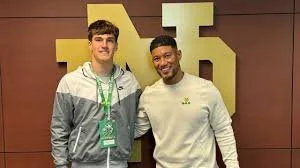
2027 wr Jackson Coleman Became a Must-Have for Notre Dame and mike brown
There are recruits that programs pursue because a position need exists and a prospect fits the profile. And then there are recruits that a coaching staff identifies, locks onto and refuses to let go of because the film reveals something that transcends positional need — a player whose combination of physical tools, competitive instincts and football character makes him exactly the kind of person you build an offense around for four years.
Jackson Coleman is the second kind of recruit. The moment wide receivers coach Mike Brown got his eyes on Coleman's junior film from Highlands Ranch, Colo./Valor Christian, the evaluation process ended and the pursuit began in earnest. What Brown saw on that film — the length, the deceptive speed, the run-after-catch ability and a blocking presence that most wide receivers at any level never develop — made Coleman a priority take for the Notre Dame staff almost immediately.
The result was a recruitment that moved at a pace that reflected exactly how highly Brown and the Irish staff valued this prospect. From first in-person evaluation to scholarship offer in 24 hours. From offer to official Blue-Gold Game visit in days. From visit to commitment shortly after. Notre Dame didn't just want Jackson Coleman. They made sure he knew it — and they closed before anyone else could catch up.
From Film to Priority — How Brown Identified Coleman
The recruiting trail that led Notre Dame to Jackson Coleman tells you everything about how Mike Brown approaches the evaluation process. Coleman was not a nationally hyped prospect with a five-star label and a waiting list of blue-blood programs competing for his signature. He was a prospect whose junior production — 45 receptions, 975 yards, nine touchdowns and a 21.7 yards-per-catch average — had begun generating interest from elite programs, but whose three-star ranking still significantly understated what the film actually showed.
Brown got to Colorado on April 15th to see Coleman in person. Twenty-four hours later the scholarship offer was extended. That timeline is not coincidental — it is the direct result of a coach who watched the film, saw a priority-level prospect hiding behind an incomplete recruiting profile and moved with the urgency that kind of evaluation demands.
Oregon had been building a relationship with Coleman since January and was considered the frontrunner before Notre Dame entered the picture. Miami came in during early March. Auburn followed. Michigan offered a week before the Irish. None of those programs had the combination of genuine connection and decisive action that Notre Dame brought once Brown identified Coleman as a must-have target for the 2027 class.
When Coleman visited South Bend for the Blue-Gold Game on April 25th, the visit confirmed everything Brown had seen on film. The commitment followed shortly after, and Notre Dame had flipped a recruitment that Oregon had been leading for months — not because of facilities or conference affiliation but because Mike Brown made Jackson Coleman feel like the exact player Notre Dame needed, specifically and genuinely, in this class.
That kind of targeted, conviction-driven recruiting is how you beat programs with longer head starts. Brown saw Coleman first — clearly and completely — and never stopped pushing until the commitment was secured.
The Film Doesn't Lie — What Makes Coleman Special
Pull up Jackson Coleman's junior film and the first thing that registers — before you look at anything else, before you check any statistics or rankings — is the sheer physical presence he brings to the wide receiver position. At 6-4 and 195 pounds with a frame that still has significant room to grow, Coleman projects as the kind of boundary receiver that defensive coordinators game plan around specifically because there is simply no clean answer for what he brings to the outside.
But the size alone is only the beginning of the Coleman evaluation. What makes his film genuinely compelling — what turned Mike Brown from an evaluator into a recruiter in the span of a single tape session — is everything that lives inside that 6-4 frame.
Deceptive Speed That Changes the Entire Defense
Coleman ran a personal best 10.67 in the 100 meters as a sophomore — elite timed speed for a receiver of any size, let alone one who stands 6-4. But what makes Coleman's speed so valuable as a football player is not just the number attached to it. It is how deceptively that speed presents on the field.
Coleman does not look like a 10.67 receiver when he lines up. He does not telegraph his speed in the way that purely one-dimensional deep threats do — the kind that defenses identify immediately and double-cover into irrelevance. Coleman's speed reveals itself in a way that catches defenders off guard, appearing to accelerate past coverage at moments when defensive backs think they have him under control. That deceptive quality — the ability to look slower than you are and then suddenly be gone — is one of the most dangerous traits a wide receiver can possess because it eliminates the defensive adjustment that pure speed invites.
On Coleman's junior film, you see that deceptive speed create separation in multiple ways. It shows up on vertical routes where he appears to be running at three-quarter speed before suddenly pulling away from coverage in the final ten yards. It shows up after the catch, where a defender who thinks he has an angle to make a tackle suddenly finds Coleman accelerating past the point of contact and turning what looked like a seven-yard gain into a 20-yard play. And it shows up in the run game — which brings us to another dimension of Coleman's game that makes his film so compelling to elite offensive coaches.
Run After Catch Ability That Turns Completions Into Explosions
The 21.7 yards-per-catch average that Coleman produced as a junior is the statistical fingerprint of a receiver who does not simply catch the football — he weaponizes it. That number reflects a player who consistently turns receptions into significant gains through a combination of speed, vision, contact balance and competitive drive after the ball is in his hands.
Coleman's run-after-catch ability on film is immediately evident and consistently impressive. He catches the ball with his hands away from his body — a fundamental that many receivers struggle to develop — which allows him to transition into his run immediately without the wasted motion of tucking the ball into his body first. His vision after the catch is advanced for a prospect his age, showing the ability to identify leverage, set up blocks and choose running lanes that maximize yardage on every touch.
His contact balance is equally noteworthy. At 195 pounds with a 6-4 frame, Coleman is not a small receiver who goes to the ground on first contact. He absorbs hits, maintains his footing through contact and keeps churning for additional yards in a way that reflects both physical toughness and a competitive temperament that does not accept easy tackles. That combination of initial separation, acceleration after the catch and contact balance through contact is what turns a good receiving performance into a 21.7 yards-per-catch junior season.
The playoff performances put an exclamation point on what the regular season film suggested. In three consecutive postseason games Coleman delivered 100-plus yard performances — five catches for 144 yards and two touchdowns in the first round, eight catches for 161 yards in the state championship game. Big-game production against the best-prepared defenses a state tournament offers is the most honest measure of what a prospect truly is — and Coleman passed that test emphatically and repeatedly.
A Devastating Blocker Who Changes the Run Game
Here is the element of Jackson Coleman's game that separates him most clearly from the wide receiver prospects who share similar size and speed profiles — and the element that likely accelerated Mike Brown's evaluation from interest to priority fastest.
Jackson Coleman is a devastating blocker in the run game.
In an era where wide receiver blocking has become increasingly devalued — where skill position players are celebrated almost exclusively for their pass-catching production and their run-blocking contribution is treated as an afterthought — Coleman brings a physicality and commitment to the blocking game that immediately jumps off the film and marks him as a different kind of receiver entirely.
Coleman engages blocks with the kind of effort and physicality that offensive coordinators notice immediately because it is so rare. He does not go through the motions on running plays where the ball is going away from him. He seeks contact, sustains blocks downfield and finishes with the aggressive mentality of a player who understands that blocking is not a concession to the run game but an expression of competitive character. His size and length make him a natural fit for perimeter blocking assignments — sealing the edge on outside runs, cutting off pursuit angles on screen plays and creating the kind of downfield blocking that turns 10-yard gains into 20-yard gains on a consistent basis.
For a Notre Dame offense that demands complete receivers who contribute on every snap regardless of whether the ball is coming their way, Coleman's blocking ability is not a supplemental skill. It is a foundational one — and it makes him significantly more valuable to the program's offensive system than his receiving production alone would suggest.
The Perfect Complement to Notre Dame's 2027 Receiver Board
Understanding why Coleman became a priority take for Mike Brown also requires understanding the broader 2027 wide receiver recruiting picture for Notre Dame — because Coleman does not just fill a position need in this class. He fills a specific role within the receiver room that complements the more explosive, dynamic playmakers still on Notre Dame's recruiting board.
The Irish are actively pursuing some of the most electric wide receiver prospects in the 2027 class — receivers with elite burst, separation quickness and the kind of short-area explosion that creates mismatches in the slot and on quick-game concepts. Those receivers represent a different profile than what Coleman brings — and that difference is precisely the point.
Coleman's combination of 6-4 boundary size, deceptive deep speed, devastating blocking and run-after-catch ability gives Notre Dame's receiver room a physical complement to the more dynamic, explosive prospects the Irish are chasing elsewhere on the board. A receiver room that pairs Coleman's boundary presence and physical tools with the quickness and explosion of Notre Dame's other 2027 targets creates a diverse, multi-dimensional group that no defensive coordinator can solve with a single coverage concept.
You cannot play Coleman with the same coverage you would use against a smaller, quicker slot receiver. You cannot press the quicker, more explosive receivers the same way you would press Coleman. The combination forces defensive coordinators into impossible compromises — and that is exactly the kind of receiver room construction that produces explosive, balanced passing offsets at the college level.
Coleman is the foundation of that construction in the 2027 class — the physical, complete receiver whose presence on the boundary makes every other receiver on the roster more dangerous by his mere existence on the field. Mike Brown recognized that complementary value immediately when he watched the film, and it elevated Coleman from a prospect of interest to a must-have priority target before the evaluation was finished.
What Notre Dame Is Getting — The Complete Picture
Jackson Coleman arrives in South Bend as a prospect whose three-star label will feel like a distant footnote long before his Notre Dame career reaches its peak. What the Irish are actually getting is a 6-4 boundary receiver with deceptive 10.67 speed, 21.7 yards-per-catch junior production, three consecutive 100-plus yard playoff performances, advanced run-after-catch instincts and a blocking commitment that reflects the character of a complete football player.
He joins a 2027 class that continues to build toward something genuinely special — quarterback Champ Monds, running backs Lathan Whisenton and Isaiah Rogers, offensive linemen James Halter and Richie Flanigan, defensive end Aidan O'Neil, linebacker Amarri Irvin, cornerbacks Xavier Hasan and Ace Alston, safety Zayden Gamble, nickel John Gay III and long snapper Sean Kraft all already committed and the class continuing to grow with each passing week.
As the 13th commitment in Notre Dame's 2027 class, Coleman gives the Irish their first wide receiver — and does it with a prospect who brings dimensions to the position that go far beyond what the recruiting rankings currently reflect.
The Bottom Line
Mike Brown watched Jackson Coleman's junior film and saw a priority target. He moved to Colorado on April 15th, extended the offer on April 16th and had Coleman committed to Notre Dame within two weeks — flipping a recruitment Oregon had been leading for months in the process.
The film justified every bit of that urgency. A long, athletic boundary receiver with deceptive speed that defensive backs consistently underestimate, run-after-catch instincts that turn completions into explosions, a devastating blocking presence that makes him valuable on every single snap and a postseason track record that proves he performs best when the games matter most.
Jackson Coleman is not just a wide receiver commitment for Notre Dame's 2027 class. He is the physical foundation of a receiver room that Mike Brown is building to be as complete, as versatile and as dangerous as any in the country.
The recruiting services will catch up eventually. They always do — right around the time the player they undervalued is making plays in January when everything is on the line.
For Jackson Coleman, that moment is coming. And Notre Dame will be ready for it.
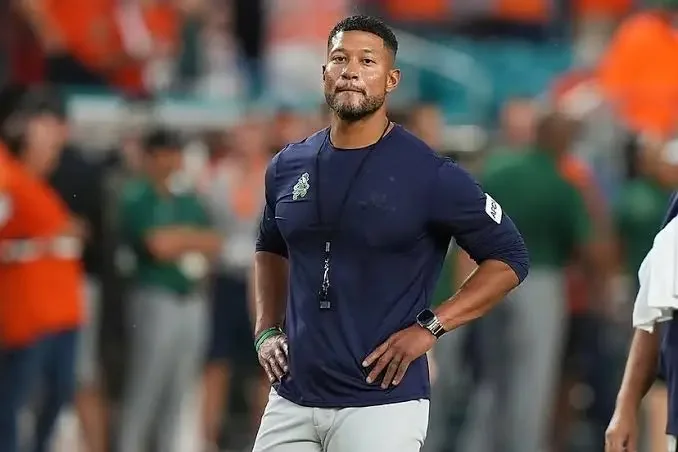
notre dame was counted out, but now the irish are coming to collect
There's a moment every great team knows. The moment the door gets slammed in your face — not because you weren't good enough, but because someone in a back room decided you weren't their kind of good enough. It's the moment that separates pretenders from dynasties. It's the moment that either breaks a program or builds a legend.
For Notre Dame, that moment came on December 7, 2025.
The selection committee looked at a 10-win Fighting Irish squad that had dominated opponents all season and said: not good enough. They handed a playoff spot to a three-loss Alabama team instead. No explanation would ever fully satisfy. No argument would change the outcome.
But Notre Dame didn't need an explanation. They needed motivation.
"Leave No Doubt."
That's the motto. That's the mission. That's the battle cry of a program that has been running on controlled rage ever since that December morning. And if you watched them this spring, you already know — this isn't a team that's moved on. This is a team that's been marinating in that slight every single day since it happened.
Athlon Sports writer Steven Lassan knows what this Irish squad is capable of, and he's not mincing words: Notre Dame's Revenge Tour is the No. 1 storyline in college football heading into 2026.
"With 15 starters returning from last year's 10-win squad, along with a favorable schedule, leaving no doubt doesn't just mean a trip to the playoff," Lassan explained. "The Fighting Irish clearly have their sights set on ending a national title drought that dates back to 1988. The goal in '26 isn't just to take a spot in the field — Marcus Freeman's team is set for a national-title-or-bust campaign."
The Receipts Are Already There
Here's what the committee chose to overlook.
For the first time since 1966, Notre Dame won at least nine regular season games — every single one by double digits. Their offense averaged 42.0 points per game and 7.3 yards per play, both modern program records. They were physically imposing, technically sound, and relentless from opening kickoff to final whistle.
Redshirt freshman quarterback CJ Carr shattered the program's passer rating record in his first year as a starter. A freshman. He tied for second nationally in yards per pass attempt at 9.4 and threw 24 touchdowns. And he's only getting started.
Defensively? Yes, the Irish got punched early — giving up 98 combined points in their first three games while adjusting to a new coordinator. But what happened next is what defines a real program: they locked in, bought into the system, and held opponents to just 12.6 points per game over the final nine matchups. That's not a defense that collapsed under pressure. That's a defense that figured it out and went on a run.
Just like every great team that got overlooked does.
The Infrastructure of a Champion
What makes this Notre Dame squad different from previous revenge tour attempts isn't just talent — it's stability.
For the first time in Marcus Freeman's tenure, both his offensive coordinator and defensive coordinator are returning. Mike Denbrock enters year three running the offense. Chris Ash enters year two commanding the defense. These aren't coordinators still learning the roster. These are coaches who know exactly what they have and exactly how to use it.
"Carr's progression into one of the nation's elite quarterbacks is why Freeman's program can win it all," Lassan noted. "There's no shortage of talent at receiver with Jaden Greathouse and Jordan Faison returning, along with former highly touted prospects Quincy Porter and Mylan Graham arriving from Ohio State."
On defense, eight starters return — including All-American cornerback Leonard Moore. This unit doesn't need a transition period. It needs a postseason run.
Freeman himself is heading into year five. He's not a new coach still finding his footing anymore. He's a proven leader with a roster full of players who have played meaningful football, a chip on their shoulder the size of a playoff bracket, and an entire offseason to get ready for what's coming.
The Schedule Is a Statement, Not a Gift
Some will say Notre Dame has a favorable schedule. Some fanbases will point to the October gauntlet — potentially four ranked opponents in the final stretch of the regular season — and call it tough.
Call it whatever you want. Notre Dame is calling it an opportunity.
Because once you get into the 12-team playoff, every game is win or go home. The schedule doesn't matter anymore. The rankings don't matter. The committee's opinions don't matter. All that matters is who's left standing.
The Revenge Tour officially kicks off September 6 at Lambeau Field against Wisconsin. But the groundwork? That was laid back in December, in a quiet room somewhere, when a group of fighters watched someone else's name get called and decided they had one response:
Watch what happens next.
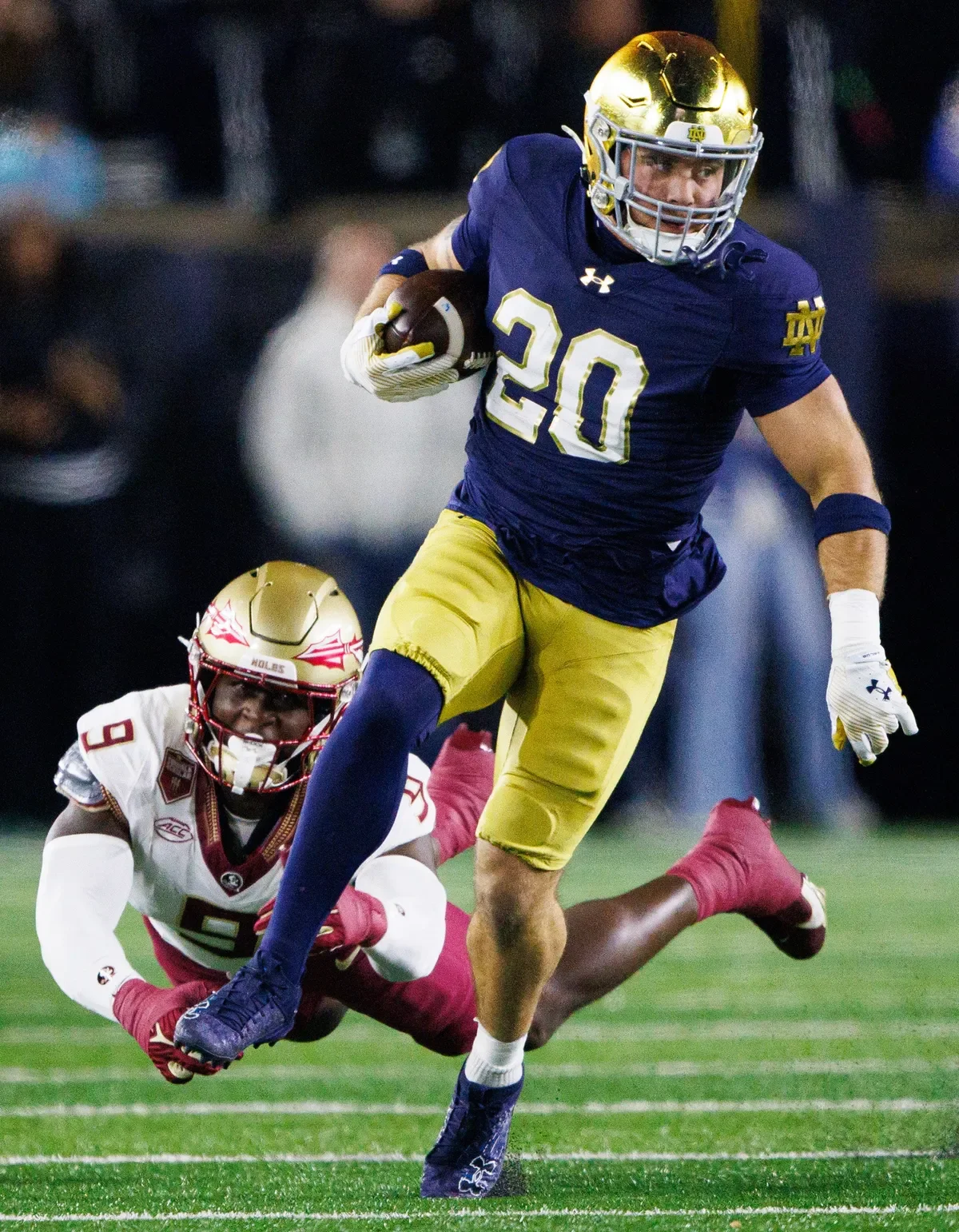
usa today ranks notre dame 2nd in post spring poll
USA Today has spoken — and the verdict on Notre Dame heading into the 2026 season is about as emphatic as a preseason ranking can be. Analysts Erick Schmidt and Paul Myerberg have tabbed the Fighting Irish as the No. 2 overall team in the country in their Post-Spring Top 25, trailing only Ohio State and ranking ahead of Texas, Georgia and Indiana in a list that reflects a program operating at the absolute peak of its modern era.
The ranking is not a gift or a projection built on hope. It is a recognition of something concrete — a Notre Dame roster that returns an experienced starting quarterback, a proven offensive supporting cast, a defense that kept its best players and a coaching staff with all three coordinators back for the first time in Marcus Freeman's tenure. When you stack those ingredients together and evaluate them honestly against every other program in the country, No. 2 is not a stretch. It might even be conservative.
Here is the full case for why Notre Dame belongs exactly where USA Today put them — and why 2026 could be the year everything comes together.
CJ Carr — The Heisman Front-Runner Nobody Should Be Sleeping On
Every conversation about Notre Dame's 2026 ceiling begins and ends with CJ Carr — and every conversation about the 2026 Heisman Trophy race should begin and end there too.
Carr enters his second season as Notre Dame's starting quarterback with something that no other signal caller in the country can claim in quite the same way — a full season of starting experience at Notre Dame, in a system he now owns completely, with the weapons around him upgraded and the continuity of returning coordinators giving him the most stable offensive environment of his college career. That combination of experience, continuity and talent elevation is precisely the formula that produces Heisman Trophy-caliber seasons.
In his first full season as a starter in 2025, Carr demonstrated command, poise and playmaking ability that immediately announced him as one of the premier quarterbacks in college football. He managed Notre Dame's offense with the kind of veteran intelligence that first-year starters rarely possess — reading defenses pre-snap, going through progressions efficiently and delivering the football with accuracy and timing in the most critical moments of the most critical games. The Carr-Faison connection that developed throughout 2025 became one of the most reliable quarterback-receiver partnerships in the sport, and that chemistry only deepens entering 2026 with a full offseason of concentrated work behind it.
What elevates Carr's Heisman candidacy beyond simply returning a quality starter is the trajectory. The jump from a first-year starter finding his footing to a second-year starter who knows every concept, trusts every receiver and operates from a position of complete offensive authority is one of the most dramatic developmental leaps in college football. Carr has already shown he can win games and manage a complex offense. In 2026, with the supporting cast around him upgraded on every level, the expectation is that he takes the next step — from excellent game manager to dominant offensive force — and the tools surrounding him make that leap entirely realistic.
The Heisman Trophy watch list will have many names on it when the 2026 season begins. CJ Carr should be at or near the top of every legitimate conversation about who wins it.
A Backfield Built to Replace Elite Production
The departure of Jeremiyah Love — selected No. 3 overall by the Arizona Cardinals in the NFL Draft — leaves the most significant void Notre Dame needs to fill on offense heading into 2026. Love was one of the most dynamic running backs in college football, a unanimous All-American whose production and big-play capability defined Notre Dame's ground attack for two seasons.
But the Irish are not rebuilding the backfield from scratch. They are reloading it with proven talent that has been waiting for exactly this opportunity — and the players stepping into expanded roles bring legitimate credentials of their own.
Nolan James Jr. returns as the most experienced back in Notre Dame's room, a proven contributor who has demonstrated the vision, patience and contact balance to be a productive starter at the Power Four level. His ability to operate within Notre Dame's zone-blocking scheme, find cutback lanes and move the chains in critical short-yardage situations gives the Irish a reliable foundation in the backfield that Carr can lean on in the most important moments of games.
Aneyas Williams brings a complementary dimension to the backfield that gives offensive coordinator Tim Rees genuine flexibility in how he deploys the ground game. Williams's quickness, acceleration and ability to create in space provide a contrast to James's between-the-tackles style — giving Notre Dame a two-back approach that can attack defenses horizontally as effectively as it attacks them vertically. The combination of James's power and patience with Williams's quickness and space creation gives Notre Dame's ground game the kind of range that makes it genuinely difficult to defend with a single schematic approach.
Together, James and Williams represent a backfield that does not replace Love's individual brilliance but provides Notre Dame's offense with enough combined production, versatility and proven capability to keep the ground game a legitimate threat on every snap. That is all Carr and the passing game need — a running back room that keeps defenses honest and prevents them from loading the box against Notre Dame's receivers.
A Wide Receiver Room Transformed by Experience and Elite Portal Additions
Jordan Faison returns as Notre Dame's established No. 1 wide receiver — the team's leading receiver in 2025 with 40 receptions, 640 yards and four touchdowns — and does so as a completely different player than the one who led the team statistically last season. His offseason decision to give up lacrosse and commit entirely to football signals a level of investment and focus that should translate directly into elevated production in 2026. Faison gives Carr exactly what a second-year starter needs more than anything — a proven, trusted target who knows the offense, runs precise routes and makes the right play after the catch every single time.
Jaden Greathouse returns alongside Faison after a 2025 season that saw him emerge as one of Notre Dame's most explosive playmakers in the postseason. Greathouse's combination of separation quickness, yards-after-catch ability and big-play capability gives the Irish a legitimate second receiving threat that defenses cannot bracket without leaving Faison in one-on-one coverage outside. Two proven, experienced receivers at the top of the depth chart entering the season is a luxury Notre Dame has not had in recent memory.
The addition of Mylan Graham from Ohio State via the transfer portal elevates what was already a strong receiver room into one of the most complete groups in the country. Graham arrives with Big Ten experience, proven production at an elite program and the kind of physical tools that made him a highly recruited prospect out of high school. His ability to contribute immediately in a complementary role — taking advantage of the attention that Faison and Greathouse command from opposing secondaries — gives Carr a third legitimate receiving option that stretches defenses in ways that create opportunities for everyone on the field.
The combination of Faison's established No. 1 production, Greathouse's explosive playmaking and Graham's experienced portal addition gives Notre Dame's receiver room a depth and versatility that rivals any group in college football heading into 2026.
A Defense That Returns Its Best Players — And Added Elite Talent
If the offensive case for Notre Dame's No. 2 ranking is compelling, the defensive case is even stronger — because what Marcus Freeman's defense is returning in 2026 is not simply a group of experienced players. It is a collection of proven, dominant performers at every level of the field, supplemented by transfer additions that address the few areas where reinforcement was needed.
Leonard Moore — The Best Cornerback in America
The foundation of Notre Dame's defensive identity in 2026 is a player who has already been discussed at length in every preseason publication that covers college football seriously — and for good reason. Leonard Moore is the best cornerback in the country. Full stop.
Moore returns after a 2025 season in which he ranked first among all starting Power Four cornerbacks in both coverage grade at 91.4 and overall defensive grade at 90.9 according to PFF. He led Notre Dame with five interceptions — tied for sixth most in the entire country — while adding 31 tackles, seven pass breakups and a forced fumble across 10 starts. Opposing quarterbacks targeted him on only 11.5 percent of his coverage snaps — a testament to the reputation he built as a cornerback that the entire country's offenses chose to scheme away from rather than challenge.
PFF has ranked Moore the No. 1 returning cornerback in the country for the second consecutive season. ESPN has named him the lead candidate for the Jim Thorpe Award. He is a legitimate front-runner for the Bronko Nagurski Trophy and the Chuck Bednarik Award. In a defense returning significant production across all three levels, Moore is the crown jewel — the player that every offensive coordinator game plans around specifically and still cannot consistently solve.
Drayk Bowen — The Defensive Engine
While Moore commands the attention of opposing passing games on the outside, Drayk Bowen commands the interior of Notre Dame's defense with the kind of instinctive, physical presence that makes the entire system function at its highest level. Bowen is one of the most complete linebackers in college football — a player who processes information quickly, fills gaps with authority, covers enough ground to be a factor in pass defense and brings a physicality to the run game that sets the tone for how Notre Dame's defense operates on any given Saturday.
His return for 2026 gives Notre Dame's linebacker corps a proven leader and production anchor that younger players in the group can develop around. Bowen's ability to quarterback the defense from the second level — making pre-snap adjustments, communicating coverage calls and reacting to offensive formation changes with veteran intelligence — is as valuable as his individual statistical contribution and perhaps more so in a defense that returns significant personnel but needs someone to tie all the pieces together.
Adon Shuler — A Safety Making His Move
Adon Shuler enters 2026 as one of the most intriguing players on Notre Dame's entire roster — a safety whose athletic profile and instinctive play have been building toward a breakout season that the 2026 campaign is set up to deliver. Shuler's combination of range, closing speed and ball-hawking instincts in the deep middle of the field gives Notre Dame's secondary a versatile, playmaking presence that complements Moore's dominance on the outside in a way that makes the entire pass defense more difficult to attack from any angle.
His ability to rotate into coverage, support the run from the second level and create turnovers in the deep part of the field gives Notre Dame's defensive staff the flexibility to disguise coverage looks and present offenses with pre-snap pictures that become something entirely different after the snap. That kind of safety versatility is invaluable in a modern college football landscape where offenses are increasingly sophisticated in their ability to identify and attack predictable coverage structures.
Boubacar Traore — Pressuring the Quarterback
Boubacar Traore returns as one of Notre Dame's most important pass rush weapons — a player whose combination of athleticism, first-step quickness and relentless motor makes him a consistent threat to disrupt opposing quarterbacks on every passing down. In a 2026 defensive front that has added significant reinforcement through the transfer portal, Traore's returning production and established role give the Irish a proven disruptive presence that new additions can build around rather than having to establish from scratch.
His ability to win one-on-one matchups against offensive tackles, create pressure from multiple alignments and finish plays in the backfield gives Notre Dame's defensive line a dynamic, production-proven element that elevates the entire group's ceiling. Opposing offensive coordinators cannot simply account for the new additions on Notre Dame's defensive front without also accounting for Traore — and that collective burden on an offensive line makes everyone on the Irish front more dangerous.
Bryce Young and the Transfer Portal Additions Transform the Front Seven
Notre Dame's returning defensive core is impressive enough on its own. Add the transfer portal additions and the front seven becomes one of the most formidable groups in the country.
Bryce Young arrives as the leader of a defensive line that also added Francis Brewu from Pittsburgh and Keon Keeley from Alabama — two transfers whose production and credentials at elite programs give Notre Dame's defensive front an immediate infusion of experienced, proven talent that addresses the depth and pass rush concerns that any program faces when losing contributors to graduation or the NFL.
Brewu brings interior disruption capability from a Pittsburgh program that regularly produces NFL-caliber defensive linemen. Keeley arrives from Alabama with the pedigree and physical tools that made him one of the most coveted defensive line recruits in his class — and Notre Dame gets the benefit of Alabama's development infrastructure having already invested significant time and resources into maximizing his potential.
Together with Traore and the returning pieces up front, Young, Brewu and Keeley give Notre Dame a defensive line rotation that can go deep into games without losing effectiveness — matching the physical demands of a Power Four schedule snap for snap, series for series, against the best offensive lines the sport produces.
Christian Gray and DJ McKinney Complete an Elite Secondary
Behind Moore, Notre Dame's secondary is anchored by Christian Gray — a versatile, proven defender whose ability to play multiple positions in the back end gives defensive coordinator Al Golden the flexibility to present different looks without sacrificing production at any individual spot.
The addition of DJ McKinney from Colorado via the transfer portal completes what USA Today identified as potentially the biggest strength on Notre Dame's entire roster. McKinney arrives with starting experience, proven production against Power Four competition and the physical and athletic profile to step in immediately and contribute at a high level alongside Moore and Gray. A secondary that starts Moore, Gray and McKinney — with Shuler patrolling the deep middle — is as complete and as dangerous a group of defensive backs as any program in the country can put on the field in 2026.
The Continuity Factor — Why This Year Is Different
Every element of Notre Dame's 2026 roster case is amplified by something that has never existed before in Marcus Freeman's tenure — complete continuity at the coordinator level. All three coordinators return for the first time under Freeman, bringing with them the accumulated institutional knowledge, player relationships and schematic sophistication that only develops when a coaching staff stays together long enough to truly master their system.
Carr does not have to learn a new offensive system. Moore does not have to rebuild trust with a new defensive coordinator. The entire roster — from the most experienced starters to the youngest contributors — enters 2026 operating within a framework they already know, already trust and already know how to maximize. That continuity is worth several wins over the course of a season, and in a college football landscape where coordinator turnover is constant and relentless, Notre Dame's stability entering 2026 is a genuine competitive advantage.
The Bottom Line
USA Today ranked Notre Dame No. 2 in the country after spring practice — and the case for that ranking is as strong as any program in America can make. A returning Heisman-caliber quarterback in CJ Carr. A backfield reloaded with Nolan James Jr. and Aneyas Williams. A receiver room elevated by Jordan Faison's leadership, Jaden Greathouse's explosion and Mylan Graham's portal addition. A defense returning Leonard Moore, Drayk Bowen, Adon Shuler and Boubacar Traore while adding Bryce Young, Francis Brewu, Keon Keeley and DJ McKinney to an already elite group.
Stack all of it together under three returning coordinators with a head coach entering his fifth season and the program's deepest, most talented roster to date — and No. 2 in the country is not just defensible.
It might be the most honest thing USA Today has published all offseason.
2027 qb Champ Monds Commitment adds to growing Notre Dame Quarterback Legacy
Every elite program thinks about quarterback succession. The best ones solve it before it becomes a problem — identifying the right player, building the right relationship and securing the commitment before the need becomes urgent. Notre Dame has done exactly that with the commitment of Champ Monds, the 6-2, 225-pound signal caller from Vero Beach, Florida whose decision to choose the Fighting Irish over Ohio State, Florida State and Florida does more than fill a roster spot in the 2027 recruiting class.
It secures the future of the most important position on Notre Dame's football team at exactly the right moment.
CJ Carr has been everything Notre Dame hoped he would be as a starting quarterback — and if his 2026 season matches the trajectory his first year as a starter established, the NFL Draft conversation surrounding him will be impossible to ignore when the season ends. The possibility of Carr departing for the NFL after 2026 is real, it is reasonable and it is something the Notre Dame coaching staff is planning around right now. Champ Monds is the answer to that planning — a quarterback with the arm talent, accuracy, anticipation and competitive character to step into one of college football's most prestigious roles and thrive from the moment his number is called.
Notre Dame didn't just land a quarterback recruit. They secured the future of the position — and they did it with their first choice, on their first offer, through a relationship built with the kind of genuine connection that defines everything great about how Marcus Freeman's program operates.
Planning for the Future — Why the Timing of This Commitment Matters
The quarterback position at Notre Dame operates on a different timeline than most programs because of the standard the Irish hold themselves to. Notre Dame does not patch the position with portal solutions or recruit quarterbacks without genuine conviction about their long-term fit in the program. They identify the right player, invest in the relationship and commit to a vision of what that quarterback can become under elite coaching and development.
With CJ Carr entering his second and likely final season as Notre Dame's starter in 2026, the quarterback room's future beyond this season requires a clear plan. If Carr's 2026 campaign produces the kind of Heisman-caliber performance that the preseason projections suggest is coming — and every indicator points toward exactly that — the NFL Draft will come calling with the kind of urgency that is impossible to turn down. Notre Dame needs to be ready for that moment with a quarterback already in the building who has the tools, the preparation and the relationship with the coaching staff to step into the role without a transition period.
Champ Monds is that quarterback. He arrives in South Bend in 2027 with a full senior season at Vero Beach behind him, a relationship with quarterbacks coach Gino Guidugli already deeply established and a physical and mental profile that projects as one of the most complete quarterback prospects to come through Notre Dame's program in recent memory. The timing of his arrival — potentially stepping in immediately after Carr's departure — is not coincidental. It is exactly the succession plan a program with Notre Dame's standards builds when it is operating at the highest level of organizational foresight.
The Arm, The Accuracy, The Anticipation — What the Film Reveals
To understand why Notre Dame made Champ Monds their first call and only quarterback target in the 2027 class, you have to watch the film — because what Monds does on a football field reveals a quarterback whose physical tools and mental processing are operating well ahead of where most high school signal callers are at the same stage of development.
The Arm
Monds is built like a quarterback. At 6-2 and 225 pounds as a high school signal caller, he carries the kind of physical foundation that college strength programs accelerate rather than create from scratch. The arm strength that comes with that frame is immediately evident on film — Monds throws with the kind of velocity and carry that allows him to fit throws into windows that smaller-armed quarterbacks simply cannot access.
His ability to drive the ball into tight coverage, zip passes over the middle against zone defenders and deliver the football on rhythm without taking velocity off the throw to compensate for questionable mechanics reflects a quarterback whose arm is already a genuine weapon rather than a tool he is still learning to fully utilize. The deep ball is equally impressive — Monds shows the ability to change arm angles, layer throws over coverage and drop the football into the back shoulder of receivers on go routes with the kind of touch and placement that separates elite passers from quarterbacks who simply throw the ball hard.
For a program that has developed quarterbacks at an elite level and understands exactly what arm profile is needed to succeed in a Power Four offense against elite college defenses, Monds's arm strength registered immediately as a priority-level trait — one that cannot be developed through coaching but can be refined and weaponized with the right instruction.
The Accuracy
The statistics that define Champ Monds's high school career are built on a foundation of exceptional accuracy — and the numbers tell a story that the film confirms on every snap.
As a true freshman at Vero Beach, Monds completed 67.5 percent of his passes while throwing 23 touchdowns against just five interceptions. Four of those five interceptions came in his first two starts — the predictable adjustment period of a freshman signal caller navigating the speed and complexity of varsity football for the first time. What happened after those first two games is the number that matters most: one interception in the next ten games. The adjustment was total, immediate and self-correcting in a way that reflects a quarterback who processes his mistakes analytically rather than emotionally and refuses to repeat them.
His sophomore season pushed the accuracy numbers to an entirely different level. In limited action before an injury ended his year prematurely, Monds completed 81.4 percent of his passes — a completion percentage that reflects not just accurate throwing but the kind of precise, timing-based delivery that comes from a quarterback who trusts his reads, trusts his receivers and delivers the football on schedule rather than waiting for routes to fully develop before committing to the throw.
That 81.4 percent completion rate is particularly meaningful because it was produced against defenses that were game-planning specifically to stop Monds and a Vero Beach offense that was averaging 51.3 points per game. Defenders knew what was coming. They prepared specifically for Monds. And he completed more than eight of every ten passes he attempted anyway. That is not a system completion percentage inflated by scheme — that is a quarterback whose accuracy is genuine, repeatable and built on sound mechanical foundations.
The Anticipation
The most difficult quarterback trait to evaluate on film — and the one that most directly predicts success at the college and professional levels — is anticipation. The ability to process defensive coverage pre-snap, identify where the ball needs to go before the snap, read post-snap rotations and deliver the football to the right place at the right time before the window closes is what separates quarterbacks who can execute in high school from quarterbacks who can execute at Notre Dame, in primetime, against the best defenses college football produces.
Monds shows genuine anticipation on film in a way that is rare for a high school quarterback his age. He does not hold the ball and wait for receivers to come open — he anticipates the opening, begins his throwing motion before the receiver has fully separated and delivers the football into space rather than to a stationary target. That anticipatory release is the mechanical expression of pre-snap read quality — and Monds demonstrates it consistently enough that it reflects an ingrained processing habit rather than an occasional lucky read.
His dual-threat ability amplifies the anticipation element by forcing defenses into the kinds of structural compromises — pulling linebackers off coverage assignments, holding safeties in run-fit responsibility — that create the openings his anticipation allows him to exploit immediately and efficiently. As a freshman, Monds rushed for 502 yards and nine touchdowns — not as a scrambler looking for broken plays but as a designed threat who added a genuine rushing dimension to the Vero Beach offense that defenses had to account for on every snap.
The combination of arm strength, accuracy and anticipation in a 6-2, 225-pound frame is the profile that NFL scouts and elite college coaches identify as the foundation of a starting quarterback at the highest levels of the sport. Notre Dame identified it in Champ Monds from the moment the evaluation began — and everything that followed in this recruitment reflects just how highly they valued what they saw.
Gino Guidugli and the Relationship That Won the Room
The most important element of any quarterback recruitment — more important than facilities, depth charts or conference affiliations — is the relationship between the prospect and the quarterbacks coach who will be responsible for his development. Elite quarterbacks choose the coach they trust most to make them better, and the program that coach represents becomes the destination regardless of what anyone else in the recruitment offers.
In Notre Dame's case, that coach is Gino Guidugli — and the relationship he built with Champ Monds from the moment Notre Dame entered this recruitment is the foundation upon which everything else was constructed.
Guidugli is a quarterback developer whose track record and communication style resonates with the kind of intelligent, process-driven signal caller that Monds's film suggests he is. From the first conversation between the two, a genuine connection developed — not the transactional kind that recruiting generates between programs and prospects who are simply going through the motions of a recruitment, but the authentic kind where a young quarterback recognizes a coach who genuinely understands the position, communicates development with clarity and specificity and makes a compelling case for what the prospect can become under his instruction.
Notre Dame made Monds their first offer at the quarterback position in the 2027 class — and Guidugli was central to that decision. His evaluation of Monds's film aligned with the staff's conviction that this was the right quarterback for this class, and his ability to build a relationship quickly once the offer was extended accelerated a recruitment that might otherwise have taken months longer to resolve.
The campus visits that followed were equally important. Monds made the trip to South Bend and experienced Notre Dame's campus, program and culture up close — and each visit deepened both the relationship with Guidugli and the conviction that Notre Dame was the right place for his development. There is something that happens when a quarterback prospect walks into Notre Dame's quarterback room, sits across from the coaching staff and begins to visualize himself developing within that system. For Monds, that vision became compelling enough to choose the Irish over Ohio State, Florida State and Florida — programs with enormous resources and legitimate development track records of their own.
The relationship Guidugli built with Monds is not just the reason Notre Dame won this recruitment. It is the foundation for everything that Monds's Notre Dame career will become — the coaching relationship through which his arm strength gets refined, his anticipation gets developed and his understanding of the game gets elevated to the level required to succeed as a starting quarterback at Notre Dame.
From Recruit to Recruiter — Monds's Role in Building the 2027 Class
The moment a quarterback of Champ Monds's caliber commits to a recruiting class, his role in that class changes immediately and fundamentally. He stops being a target and starts being a weapon — the most powerful recruiting tool a coaching staff can deploy is a committed quarterback who is genuinely excited about his program and genuinely invested in bringing the best possible teammates to join him.
For Notre Dame's 2027 class, Monds's commitment creates a dynamic that simply did not exist before he made his decision. Every offensive skill player on Notre Dame's 2027 recruiting board — every wide receiver, tight end and running back the Irish are pursuing — now has the opportunity to build a relationship with the quarterback they will be playing alongside. That relationship is one of the most powerful closing tools in recruiting because it transforms an abstract commitment decision into something concrete and personal. A wide receiver who commits to Notre Dame in the 2027 class is not just choosing a program — he is choosing to play for Champ Monds, to build chemistry with Champ Monds and to develop the kind of quarterback-receiver partnership that defines great offenses.
Monds understands this dynamic and embraces it. His genuine excitement about Notre Dame, his relationship with the coaching staff and his personal investment in the success of the 2027 class make him an organic and authentic recruiter for the program in a way that cannot be manufactured or coached. When Monds reaches out to a wide receiver on Notre Dame's board, that conversation carries a weight and authenticity that no assistant coach's recruiting call can fully replicate.
The wide receivers, tight ends and skill players on Notre Dame's 2027 recruiting board are about to discover that Champ Monds is not just a committed quarterback. He is one of the most compelling reasons to choose Notre Dame — a signal caller with elite physical tools, a championship pedigree from Florida's most competitive high school football environment and a genuine, personal investment in assembling the best possible class around him.
For a Notre Dame 2027 class that already features running backs Lathan Whisenton and Isaiah Rogers, wide receiver Jackson Coleman, offensive linemen James Halter and Richie Flanigan, defensive end Aidan O'Neil, linebacker Amarri Irvin, cornerbacks Xavier Hasan and Ace Alston, safety Zayden Gamble, nickel John Gay III and long snapper Sean Kraft — Monds's commitment as the 12th overall pledge gives the class its most important piece and its most powerful recruiting voice going forward.
The Bottom Line
Champ Monds committed to Notre Dame as the staff's first choice, first offer and only quarterback target in the 2027 class — and what he brings to South Bend goes far beyond a scholarship decision.
He brings a strong arm that can access every area of the field. He brings accuracy that produced a 67.5 percent completion rate as a true freshman and 81.4 percent in limited sophomore action. He brings anticipation and football intelligence that reflect a quarterback processing the game at a level well beyond his years. He brings a relationship with Gino Guidugli built on genuine trust and a shared vision of what his development at Notre Dame can become.
And he brings the timing that Notre Dame needed most — arriving in South Bend in 2027 at precisely the moment the program may need a new face of the quarterback position, ready to step in with the foundation already built and the future already bright.
CJ Carr is building toward something special in 2026. Champ Monds is building toward something special in South Bend for years beyond that.
Notre Dame's quarterback future is in excellent hands. Both of them.
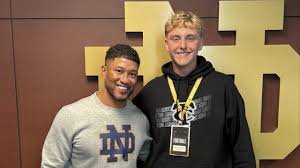
notre dame offers ‘28 illinois OL joseph frierdich
This past weekend was full of big-time visitors to South Bend and 2028 offensive lineman Joseph Frierdich of Carbondale (Ill.) Carbondale Community was one of those talented players who came to experience what Notre Dame had to offer and he got what he came for as they extended an offer to him.
When he arrived on campus, the 6-7 260-pounder held three offers from Illinois, Arizona, and Wisconsin. He was in contact with the staff leading up to his visit, which he eagerly looked forward to because of the history and tradition of Notre Dame. Getting an offer this past weekend wasn’t a thought, but it is a moment that will always stands out as a once in a lifetime opportunity.
“The visit was great,” Frierdich told LL. “We got a chance to sit in the team meeting and get up close and personal during practice. We had a great campus tour and got to see and learn about the history and tradition.
“The offer was unexpected,” Frierdich continued. “This honestly feels amazing. They just gave me a once in a lifetime opportunity. I had a meeting with them (Coach Rudolph and Delaney) and that’s when they offered me.”
Frierdich is very well aware of the rich history of offensive line play and development at Notre Dame, and getting a chance to watch offensive line coach Joe Rudolph and assistant offensive line coach Rob Delaney operate during practice confirmed for him that the staff knows what they’re doing.
“The practice was great,” Frierdich said. “Everything ran smoothly and the all of the players looked like they were having a lot of fun competing. The o-line looked good.
“The way the coaches coached stood out for me,” Frierdich continued. “They said things in a way that was very understandable and professional, and I like that in a coach. I think it’s the best way for players to learn. Their coaching style is awesome.”
It’s still early in his recruiting process, but the talented lineman saw enough during his visit to place the Irish firmly at the top heading into the summer, with a return to South Bend already penciled in.
“As of right now, Notre Dame is my top school,” Frierdich said. “The next thing I need to do is get some more visits in and hopefully go to some games in the future. I already have a visit (Irish Invasion) set up for the beginning of June. I’m excited about all of this.”
His length and athleticism jump of the screen as you watch film, whether stifling opponents with blocks in the run game or stretching the middle of the field as pass-catching tight end. He makes plays on the other side of the line of scrimmage as well. His talents are not limited to the gridiron, as the two-sport athlete shines in track and fields in the discus and shot-put.
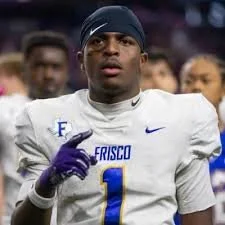
2027 Speedy Athlete Brennen Lacey Can See Himself At Notre Dame
The Fighting Irish were looking for explosive playmakers and 2027 ATH Brennen Lacey of Frisco (Texas) Frisco became one of their target after receiving an offer from running backs coach Je’Juan Seider back in February. Since then, the Irish have added two running back commitments from Lathan Whisenton of Waco (Texas) Midway and Isaiah Rogers of Springfield (Mass.) Springfield Central. After that, it was clear to many of the top running backs that visited South Bend during the spring, like Tre Segarra, immediately shifted gears seeing that 2027 ball-carrier quota was filled.
The all-around weapon posted 812 all-purpose yards and 10 touchdowns in 9 games as a junior playing running and wide receiver. So, when Lacey became a surprise visitor in South Bend this past weekend, it showed that there was still mutual interest despite commitments from Whisenton and Rogers. The staff made him feel like the visit would be well worth his time and they didn’t disappoint.
“I’ve always dreamed about playing at Notre Dame,” Lacey told IB. “The visit was great. I got to spend some time with Coach Seider and the recruiting staff and it felt better than I expected. I knew a lot about Notre Dame, but getting to feel in person was amazing. The people are really nice too.
“They’re recruiting me at running back and wide receiver,” Lacey continued. They talked to me about how they can use me and get the ball in my hands in the offense. They said they had a plan for me and I was able to see it.”
The 6-1 187-pounder runs a 4.32 in the 40 and that speed clearly translates to the gridiron as one views his film. During his visit, the biggest impact was time spent watching practice, where he was able to see himself in the offense as he watched the running backs, wide receivers and one player in particular. He also got a chance to meet meeting some of the players afterwards.
“The practice was great,” Lacey shared. “They play fast and I like how they get the ball to a lot of different guys on offense. There were a lot of guys making plays, and one of the guys that stood out for me was Bubba Frazier. I think our game is kind of the same.
“I got to talk to some guys after practice,” Lacey continued. “We were just talking about the school and how things are on campus. I know the history and tradition and I love the campus, but I wanted to know what it was like. It’s an amazing place and I’m blessed to be in this position.”
When he was offered, the Irish staff shared how they loved his big play capability and versatility as a runner and pass-catcher. He’s a great athlete that is just beginning to scratch the surface as a running back after starting at wide receiver as a sophomore. The Fighting Irish just produced a Heisman finalist running back (Jeremiyah Love) that was viewed as a great athlete coming out of high school and Lacey is a big fan that has experienced the culture that helped develop him.
“The staff kept telling me I was a fit for Notre Dame,” Lacey explained. “They like my versatility. I know they can develop me because I watch Jeremiyah Love a lot. He’s the number one guy I watch to take things from for my game.”
Lacey is currently a three-star according to 247 Sports but holds major offers from programs like Florida State, Miami, Ohio State, and Kentucky amongst others.
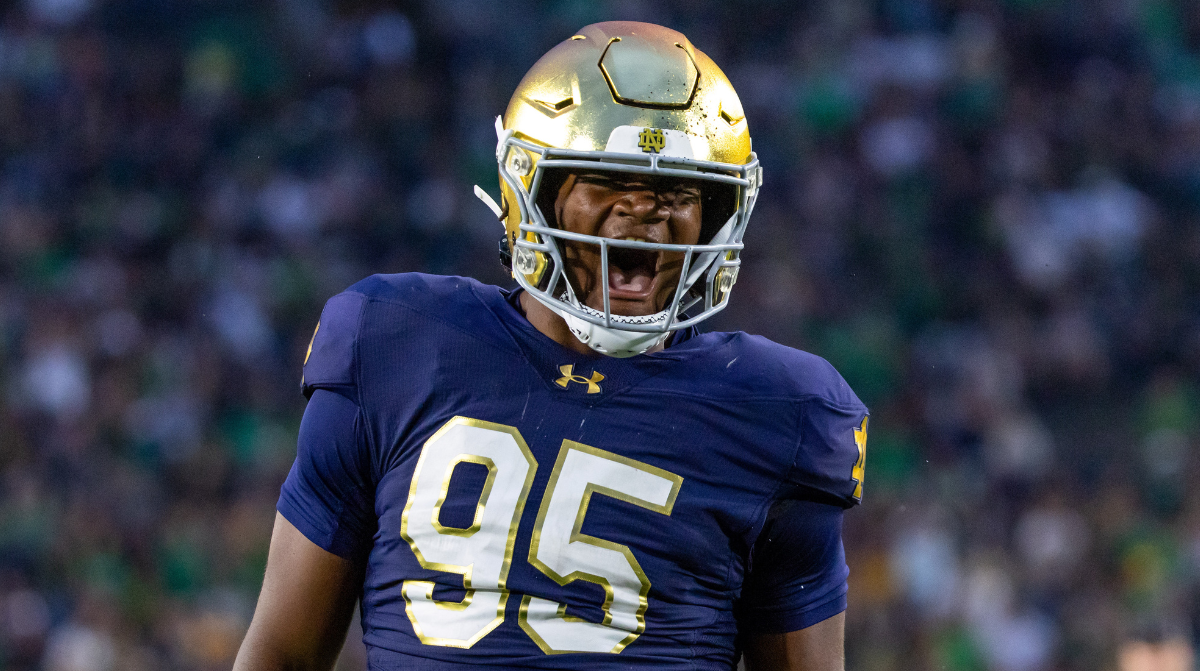
Bryce young sees the benefit of better technique
Notre Dame's defensive line continued to improve against the run and pass over the past two seasons. At the conclusion of the 2025 regular season, they led the country in total pressures and played a major role in the Irish rattling off 10-straight victories to end the year. The departure of Al Washington eventually led to the hiring of defensive line coach Charlie Partridge, who is known as a great teacher and developer on the college and NFL level. Junior Bryce Young was incredibly physically gifted when he arrived in South Bend, and injuries pressed him into service as a true freshman. Since then, heavy expectation have followed him, and he somewhat met them in 2025, trailing only senior Boubacar in pressures.
Young has taken to being challenged by the teaching and focused approach to technique from Partridge this off-season and he's seeing the benefits with each rep and practice.
“Yeah, he’s challenged me in so many places. There's always areas I can grow. But I would say one of the things is consistency in my pass rush and the run game, consistently getting that crush we need on the edge in terms of pass rush. The details, like getting my hips in position to be able to counter or make a move, all that. It all ties into seconds off the clock that I can get back there faster.”
Yeah, I would say there's definitely a learning curve at first, but once it starts clicking, it clicks. What he's teaching is really sound stuff, because he's had a lot of experience everywhere, and I appreciate his knowledge, and I'm taking it into account and being consistent with what he's telling me, and I've seen it already pay off.”
The talented edge rusher still has profound respect for former defensive line coach Al Washington, who recruited and coached him during his first two years in South Bend before heading down south to coach in the NFL for the Miami Dolphins. He excited about what he’s learning from Partridge, but he gives both shared responsibility for his success and growth.
"First of all, I want to thank Coach Washington for everything he’s done. He helped me a lot as a player and on this journey. He’s given me so much insight and I’m extremely grateful for that. Adding Coach Partridge to my journey has been great too. He has so much knowledge of the game. He’s been in the game forever. He knows things and he’s telling me things he’s seen from his many years of experience that I’m actually seeing on the field and I can apply it. It’s really cool."
Young has spent a lot of time this spring battling new starting left tackle, Will Black. Marcus Freeman said one of the reason he’s been happy with how much further ahead they’ve been in early practice, was because of the depth of talent that’s been acquired that’s allowed his team to go “best on best”. That has created a fast paced, competitive atmosphere that makes everyone better. Both are physical freaks and seen as candidates for breakout seasons, and Young has taken notice of how they’re making each other better.
"Will is great. We compete every day. He is definitely helping me get better and I’m helping him get better. So the collaboration is there and also being a good teammate. We’re talking to each other after each rep and ask each other what do you feel I have to work on. He has all the athletic traits. He’s a freak of nature, he's huge and quick out of his set. It’s been great to have someone like that to go against every day."
The collective pass rush that Coach Partridge has his guys focused and the added talent on the interior of the defensive line should put Young and Traore in more 1-on-1 situations on the edge, and that could lead to both guys having their best seasons in a Fighting Irish uniform.
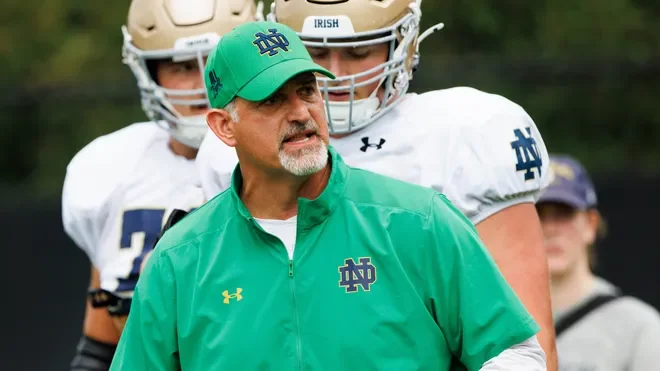
joe rudolph may have his best 5-man combo on the offensive line
Joe Rudolph has done an amazing job recruiting size, length and talent to the Notre Dame offensive line room. His efforts may lead to the Joe Moore Award returning to South Bend next winter, if things go as planned. Entering spring practice, the first unit has been freshman left tackle Will Black, junior left guard Anthoine Knapp, junior center Joe Otting, junior right guard Sullivan Absher and Sophomore right tackle Guerby Lambert. Senior center Ashton Craig is expected to make a full recovery from the leg injury that ended his 2025 season prematurely, and junior guard Charles Jagusah is still dealing with complications from surgery to remedy his injured left arm due to a ATV accident last summer. Despite missing two highly talented linemen this spring, the early returns from coaches and players signal great things ahead for the group.
Rudolph spoke to the media on Wednesday and began with sharing how pleased he’s been with the right side of the first unit, which features Guerby Lambert being moved from right guard to right tackle, and Sullivan Absher replacing him at the right guard spot.
“Those two guys really kind of called each other out about guys that they are confident in, guys that they really look to for leadership, guys that they really trust. and that's always a unique situation when you can kind of create that or build that into your five-line. And then it would have been easy to leave Knapp outside and Guerby inside. What was just the basis of moving them around, too? Guerby has a real comfort on the right side of the line, which is cool.”
Knapp has always been a devastating run blocker and will serve as a more than comparable replacement for former left guard standout Billy Schrauth, who is preparing to be selected in the upcoming NFL Draft. Freshman Will Black came to South Bend with a lot of buzz as a 5-Star in the 2025 class, and head coach Marcus Freeman said there some early growing pains that he had to endure and overcome to begin reaching his full potential. He’s a natural tackle with great length and athleticism that should benefit from being next to a veteran like Knapp, who was ranked as top returning offensive tackle in college football before being moved inside,
With all of the movement this spring, Rudolph has been impressed with the performance of the Black-Knapp combo on the left side and the performance of the line as a whole.
“Knapper, we felt, has done a great job playing left. But we thought to get each guy in maybe the spot that would allow them to shine the most would be the chance to move Knapp in and create a good competition at the left, which Will's done a great job of, but there's still good competition there. And really what you don't know is how the guys will embrace it. And there's a lot of differences, right? It's like, I've been really good here, and now you want me to move here. And Anthony's just embraced it, and he wants to know the intricacies of the position and the differences. And that's really kind of created it. And then what you can't anticipate is how well they work together, the pre-snap communication, how they work in the meeting room, how they talk, their plan, their trust for one another. So I've been impressed by it.”
Another bright spot this spring has been the performance of freshman guard Matty Augustine, who can play both guard and tackle for coach Rudolph. The Irish have 4-5 experienced linemen that have the flexibility to play multiple positions and that should allow a group that has suffered from injuries over the last three seasons to maintain a dominant level of play throughout the 2026 season.
Charlie Partridge looking to turn up the pressure
The impact of new defensive line coach Charlie Partridge was on display as several Irish defensive linemen met with the assembled media after their seventh practice. Before they walked to the podium, their new leader shared his thoughts on how he’s re-shaping how the front four has been challenged to focus on consistently pass rushing collectively. .
Last season, the Irish sacked opposing quarterbacks 43 times and hurried them 210 times, but they were key moments in games where they allowed open lanes for players like Texas A&M quarterback Marcel Reed to scramble for first downs. Partridge has set the tone for his position room by setting a focus for each day.
“We're leaning in on pass rush lanes. I know Coach Freeman talked about that the other day with the media group.”
“That's something we've put a big emphasis on while still pass rushing aggressively, pass rushing together as a unit. Because so many times, if you don't pay attention to that, you may have somebody have a great rush and win on one side, but if you're not in good lanes on the other, it was for naught. So we put a big focus on that, and today's focus, like I said, was aggressively attacking our keys in the run.”
As he learns his athletes, Partridge has been able to lean on the familiarity he has with defensive coordinator Chris Ash to help with his transition. The relationship is built on mutual respect with an understanding that disagreement is not about personal feelings. They haven’t worked together since 2013, when they were both on the Arkansas Razorback staff. However, they’ve always been in contact with one another, including last season when he was a defensive line coach in the NFL for the Indianapolis Colts.
“It's kind of what I said when I got here, guys. I mean, me and Chris, our background goes so much. We've been through so much together in the football world that we can argue or discuss things that maybe we don't see the same way, and there's no feelings. You don't have to worry about hurting each other's feelings. Even if we get to a point where we're maybe arguing about something, it's all about getting together and getting on the same page, and then it's very, very healthy. He hasn't let me down one bit.”
“It's been a while since we've worked together. Last time we were together was Arkansas in 2013. Yeah, it was 2013, so it's been a while, but we talk all the time, and he's exactly what I knew he would be.”
With returning edge rushers like Boubacar Traore and Bryce Young, and the additions of defensive tackle transfers Francis Brewu and Tionne Gray. the Fighting Irish are working hard during spring practices to have four pass rushing threats that should lead to a more disciplined and consistent rush for opposing offenses. The linebacking corp added 13.5 sacks last season, but that number could decrease if the plans being laid by Partridge and his players continue to manifest through the rest of spring and fall camps into the regular season.
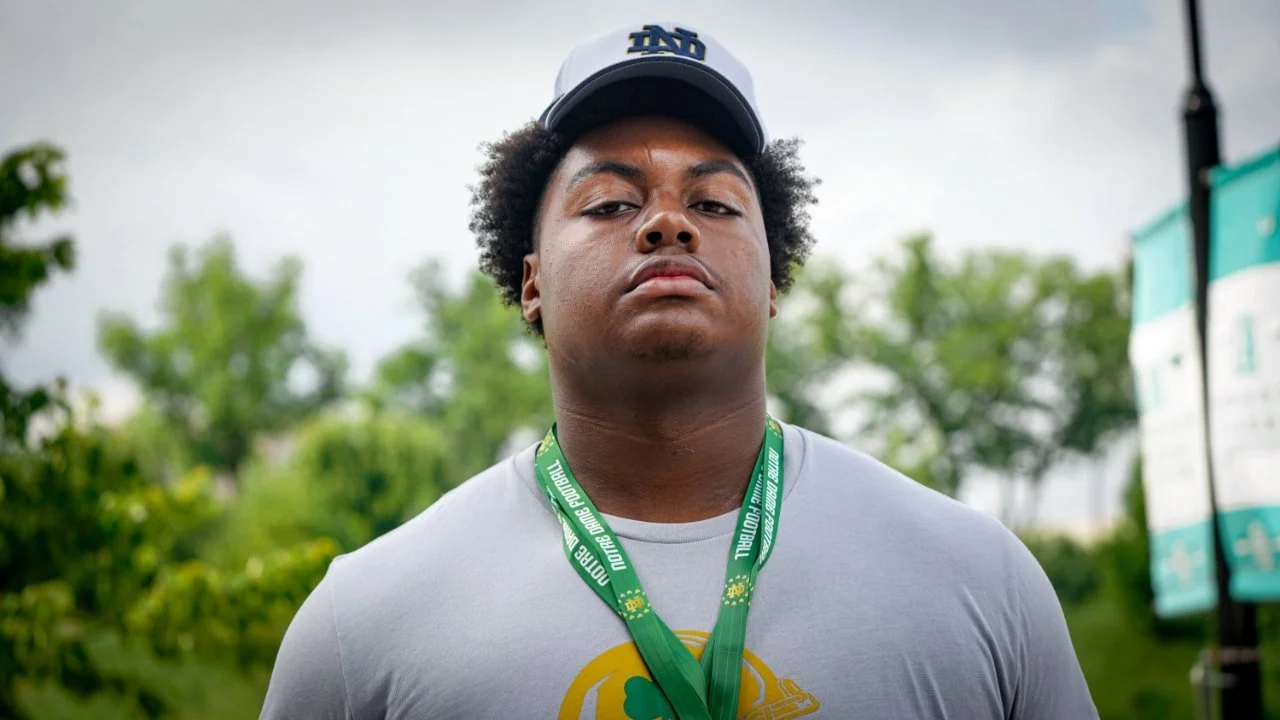
Brayden Parks Visit This Weekend Could Be The Start Of Great Things In Chicago
It was a crisp October Friday evening on the south side of Chicago as I stood on the home sideline at Gary Little Stadium, and I was approached by a Crusaders’ staffer that noticed my credentials. He began to inquire about who I was there to see and immediately started sharing information about the players I mentioned. He was effusive in his praise for the character of players like 2027 DL King Liggins, 2028 DE Kameron McGee, and 2028 TE Jack McNamara. As he began to wrap up his comments about 2027 4-star DT Brayden Parks of Chicago (Ill.) Brother Rice, he mentioned that a certain coach (former defensive line coach Al Washington) for the Fighting Irish had visited during the week and told the Brother Rice coaching staff that he was going to do whatever it took to get Brayden Parks. At that moment, I felt that the Fighting Irish were without a doubt the team to beat for Parks.
Since that evening, the Irish defensive coaching staff has gone through some twists and turns leading to three new assistants on that side of the ball. The changes put some top targets in a holding pattern as they waited to see who the new coaches would be. The 6-3 305-pounder was disappointed that changes were being made, but he was patient and confident that the next man was going to be a good coach.
“I wasn’t worried about it,” Parks told LL. “I just wanted to see who it would be. Coach (Marcus) Freeman and Coach (Nick) Sebastian were talking to me a lot, and I talk to Coach (Charlie) Partridge a lot now, so we’re building a good relationship.”
The Fighting Irish made the recent top 8 schools list for the 164th ranked player according to 247 Sports, and they are joined by Michigan, Ohio State, Georgia, Illinois, Oregon, Miami, Georgia and Tennessee. He plans to visit all of those schools this spring, with Notre Dame getting the first crack on his spring visit tour this weekend, and it will be a chance for Parks to get a better grasp on everything he’s learned about Charlie Partridge to this point.
“I have a lot of respect for him (Partridge),” Parks shared. “He’s developed a lot of guys in college and the NFL just like me, so he knows what it takes to get there. I know we’re going to spend some 1 on 1 time together, so I’m excited about that.”
This weekend will be Parks’ fourth visit to South Bend, so he’s very comfortable with the campus, fanbase, and culture. His relationship with Charlie Partridge is important, but he’s going to use the practice to see how the defensive linemen are responding to the coaching.
“The practice will show me a lot,” Parks explained. “I want to see how his guys react to how he’s coaching and how they work together and get better.”
The Fighting Irish remain at the top of his remaining suitors because he values everything the program has to offer on and off the field. His recruitment in the home stretch with some of the best defensive line coaches in the country like Oregon’s Tony Tuioti, Ohio State’s Larry Johnson, and others preparing to make their pitch heading into the summer and official visits. Parks will return to South Bend for his official visit June 12-14.
“Notre Dame has everything,” Parks continued. That’s why they’ve always been one of my top schools. Relationships and development are what I’m looking at. I’m going to make another cut after my spring visits and then take my officials. I’ll make a decision after.”
His recruitment signals a more intensified effort when it comes to securing elite talent from the Chicagoland area. It seems like the words of former Irish defensive line coach (Al Washington) have been passed like a baton to the entire coaching and recruiting staff, and this weekend will be another step towards doing whatever it takes to get Brayden Parks in the 2027 class.
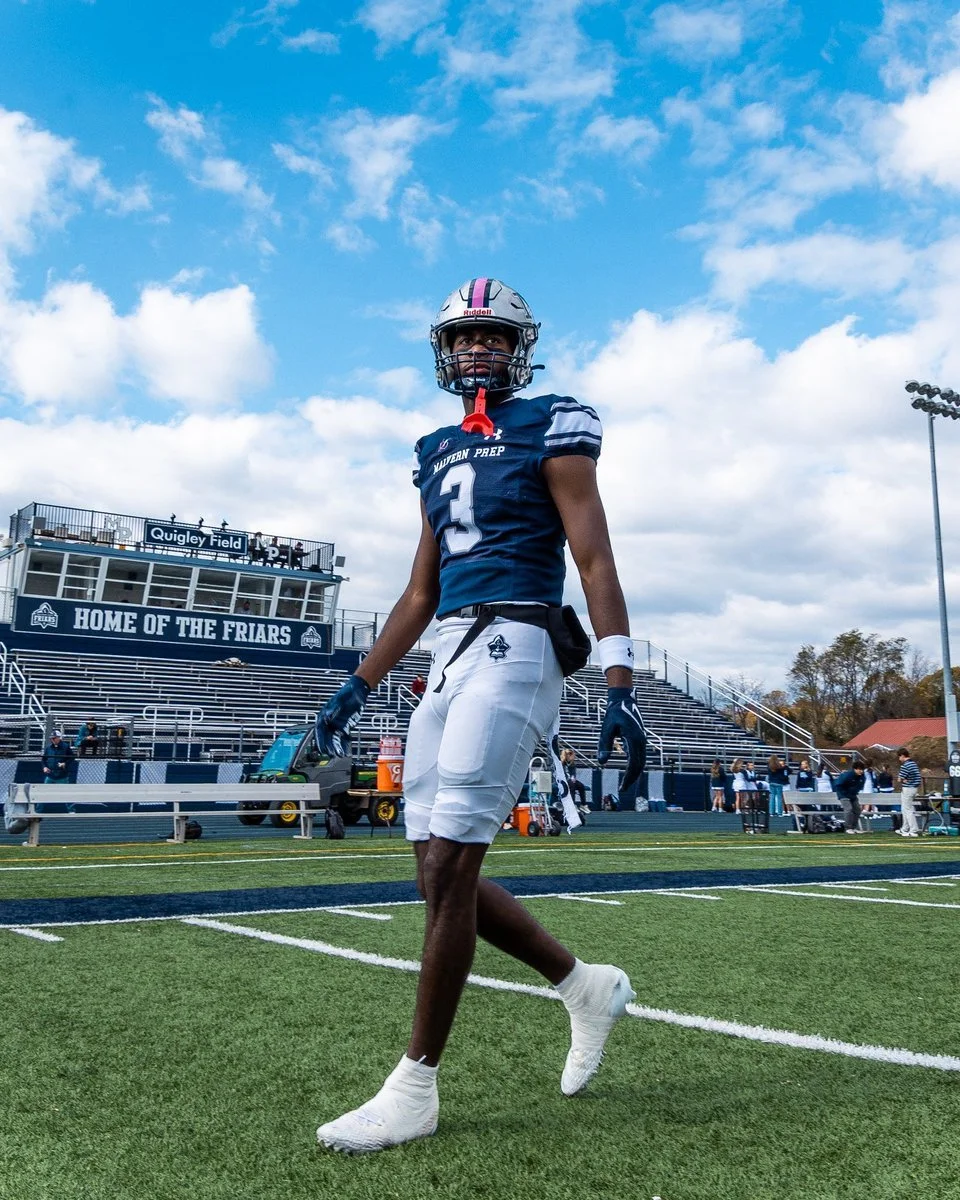
2027 4-Star WR Cade Cooper Is A Program Changer On And Off The Field
The Fighting Irish coaching staff scoured the country during the January contact period connecting with a tons of elite targets during in-home and school visits. After one of those visit to Malvern Prep from wide receiver coach Mike Brown, 2027 6-3 192-pound wide receiver Cade Cooper of Malvern (Pa.) was energized, and jumped on the road the next day heading to South Bend for an impromptu unofficial visit that led to a film session with Coach Brown and eventual offer that has the Penn prep star still raving according to Malvern Prep head coach Dave Guereira.
“He still raves about the Notre Dame trip,” Guereira told LL. “His talents, character and the way he was raised is well-suited to Notre Dame. He fits with the way the overall culture of academics and athletics are stressed. Part of it was Coach (Marcus) Freeman and wanting to be part of doing something special. He fell in love with it.”
Coach Guereira fell in love with the talented pass-catcher the first time he saw him on the gridiron in 7th grade at St. Thomas Catholic. He was taller than the other kids, but his movement made what can sometimes be a difficult projection process much easier.
“I remember seeing at St. Thomas in 7th grade,” Guereira said. “He was taller than all of the other kids and you have to project where a kid is going to end up as a junior. But, when I saw him move, he was like a baby deer running. He was so fluid and physical for his frame. I was super impressed.
“We play the hardest schedule in the state,” Guereira continued. “So, we need guys that physically and mentally strong in our program. Parents see us as a college and NFL factory, which we are, but we work really hard to find out about the families and character of the kids that we take. We don’t want talented kids that don’t fit our culture.”
Since that day, he’s still impressed every day with how the unquestioned leader of the Friars’ handles his business in the classroom, the wide receiver room, the community and in front of his teammates. He’s already the best wide receiver in the state, but the Friars are excited about what he’s going to bring to their defense in the fall.
“He’s so athletic and getting better, Guereira explained. “I’m impressed by his dedication to the craft of the game. He’s a sponge and wants to know everything from everybody. I’m excited for people to see him as a full-time safety this year. He’s the unquestioned leader of out team and he does it both ways. He leads by example and not afraid to say what needs to be said to his teammates when it’s needed. He’s the hardest worker in our program and that helps us as coaches tremendously.
“He works even harder off the field,” Guereira continued. “He’s a great student, and a great human being. He’s so honest and empathetic with his teammates and in the community.”
As the 4-star receiver’s recruitment speeds to the decision stage, Guereira remains ready when called upon by the family for his consultation and wisdom. He’s been through this process with plenty of top targets over the years and his involvement depends on the individual player.
“Cade and his family are doing a great job,” Guereira shared. “They know exactly what they want and he has a lot of great options. Whenever they ask me something, I give my honest assessment. The one thing I told him is to trust his gut. You’re the one that has to get up for 5 am workouts, so you better go where it feels right.”
But, this process is one that has him ecstatic about his athlete’s future and a bit somber about Malvern Prep’s future without him.
“I don’t want to think about it,” Guereira replied. “He means so much to me personally and I’m going to miss our relationship and what he stands for. This program is going to miss him a lot, because his impact on the coaches has been even greater. You have once in a lifetime talents, but the combination of talent and people at that level doesn’t happen often. That’s who he is.
“He helped the culture,” Guereira continued. “We don’t call them 50-50 balls anymore. We just say,” Cade has it.”
Cooper has a strong connection on the current Irish roster in 7 on 7 teammate and Notre Dame safety Joey O’Brien, that aids in the level of comfort he felt back in January, and will continue during his March 28th spring visit and return for his official visit June 12-14.
The Fighting Irish staff led by Mike Brown have done an incredible job making Cooper and his family feel prioritized, and that puts them right at the top amongst others like Penn State, Ole Miss, Virginia Tech, Virginia and Wisconsin.
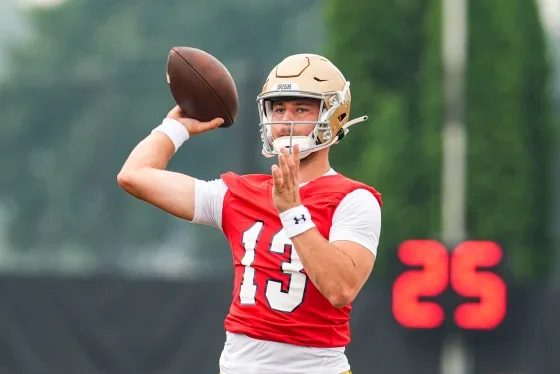
returning qb and coordinators give marcus freeman a better feeling this spring
For the first time since 2020, Notre Dame will have a returning starter under center. as quarterback CJ Carr returns to become the face of the Irish offense heading into a very important spring practice schedule. Carr had an impressive start to his 2025 season, but leveled off towards the end of the season. Despite disappointing late season performances, he threw for 2,741 yards and completed over 66 percent of his passes with 24 touchdowns, and seven interception. Head coach Marcus Freeman recently sat down with On3's JD Pickell and talked about his confidence in what he’s seen from his second year signal-caller.
"It's exciting," Freeman stated. "It's my first time having a returning starting quarterback along with all three coordinators returning as well. There's a level of comfort knowing who they are as people, knowing that they know the schemes, knowing who CJ Carr is and the work ethic that he puts in as well as the work our coaches put in. There's a level of confidence we have but we still have to continue to do the work."
According to FanDuel, Carr is currently the favorite to win the Heisman and widely considered one of the best returning quarterbacks according to several outlets. Multiple outlets project Carr to be the number one quarterback in college football with a chance of being a top 10 pick in the 2027 NFL Draft. The off-season buzz matches the buzz generated by his arrival during bowl practices for the 2023 Tony The Tiger Sun Bowl. Since then, the sound coming from his talent and preparation have been unavoidable.
"He's prepared," Freeman answered when asked about Carr. "From the moment he stepped on campus, he's prepared to be the starter. It's just a reflection of the way he was raised, being obviously a coach's kid and a coach's grandson. He prepares tremendously. That's the one thing you appreciate about CJ Carr is there is no finish line for him and that's what I'm excited for."
Now, the pressure ratchets up for Carr and offensive coordinator Mike Denbrock, who will also have the same conductor for his offense returning for the first time since returning prior to the 2024 season. Both Freeman and Denbrock have high expectations for their quarterback, and his maturity is greatly needed as the offense loses almost 73 percent of it’s production with players like Jeremiyah Love, Jadarian Price, Eli Raridon, and others leaving for the NFL. The passing game must take a step forward with Carr becoming the focal point of the offense.
"The thing that you're seeing him do now is him truly let his leadership shine," Freeman explained. "He's making the guys around him better. You see him getting the wide outs, tight ends and the running backs together saying, 'Okay, we're going to throw on Saturdays at this time and you have to be there. Then they're going to watch film at this time and they have to be there. He is always looking for ways to improve."
Defensive coordinator Chris Ash has continuity in the coaching staff with the hiring of Charlie Partridge, Aaron Henry and Brian Jean-Mary. All three coaches had existing relationships with Ash and understand how he wants things communicated to the players. That may have been difficult with the previous staff that had coached under former defensive coordinator Al Golden. Going into his second year, Ash has a better feel for what the players can do and the defense should benefit from it.”
"Every year before this, I was spending time with a certain side of the ball trying to make sure we understand what the new scheme was," Freeman stated. "You're trying to figure out how we're going to script practice to get enough reps for this quarterback competition. Every year is different, but this one's different. I don't need to go spend a whole bunch of time figuring out what we're doing on offense, defense and special teams because the coordinators are back."
Marcus Freeman has an early season hurdle to get over in the form of his team getting off to slow starts, and the continuity flowing from his quarterback and coordinators has him extremely confident about the Fighting Irish being able to fulfill his mantra for the season. “Leave No Doubt”.
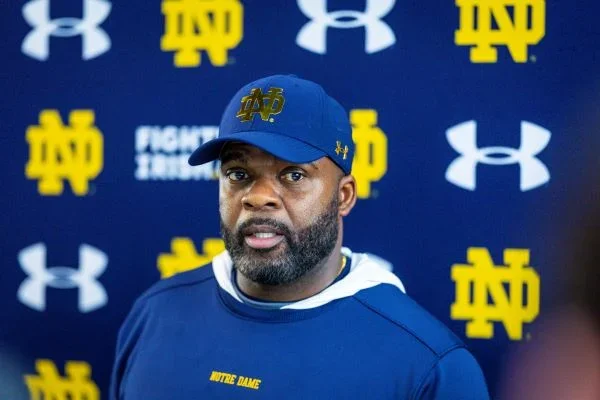
brian jean-mary loves talent and experience in lb room
While at Michigan and other stops like Tennessee in his coaching career, Brian Jean-Mary has consistently developed tough minded linebacker room that were good against the run and the pass. Now, he brings that magic to South Bend to replace former linebackers coach Max Bullough who returned to Michigan State, his alma mater, to be the co-defensive coordinator and linebackers coach for Pat Fitzgerald.
He was the last hire of three new defensive assistants for head coach Marcus Freeman along with new defensive line coach Charlie Partridge and new defensive backs coach and co-defensive coordinator Aaron Henry. The linebacker room that he inherits is not short on talent or experience with five players totaling more than 100 snaps in 2025, and that’s something that has Jean-Mary excited.
"I had a little bit of an idea of what we were doing defensively and watched player wise some crossover tape," Jean-Mary explained. "I always admired from afar and now that I'm here, every new coach is going to try to dive into the film and try to learn as much as you can about the system. You have to build trust with the players and they have to get to know me the same way I have to get to know them. They've done a great job of opening themselves up and letting me pour into them. It's been great."
The Notre Dame defense got off to a slow start last season, but managed to remain stout against the run for the second straight season, giving up 98.9 rushing yards per game (9th in the nation) and 3 yards per rush (7th in the nation). That type of production from a unit that found a better footing in Chris Ash’s defense with each game is a great foundation, and a little pressure for the veteran coach.
"It's one of the best jobs in the country," Jean-Mary stated. "It's a blessing to be in a situation where we know what the expectations are every week; we know what the expectations are at the end of the year. Some people look at that as pressure. There's only certain schools that have that type of pressure. So when the standard is to be the best, that's a challenge for us as coaches and that's what you want to be a part of. I've been at those other places where the challenge is to just have a good season. I know that's not the case here."
One of the biggest advantages that he brings to the Irish staff is the relationship he has with some of the top 2027 and 2028 recruits that began while he was at Michigan. The 2027 board suffred the loss of Ellis McGaskin once Max Bullough left for Michigan State, but connections with players like Kaden Henderson, Noah Roberts, Roman Igwebuike and Brayton Feister immediately upgraded the board for the Irish.