
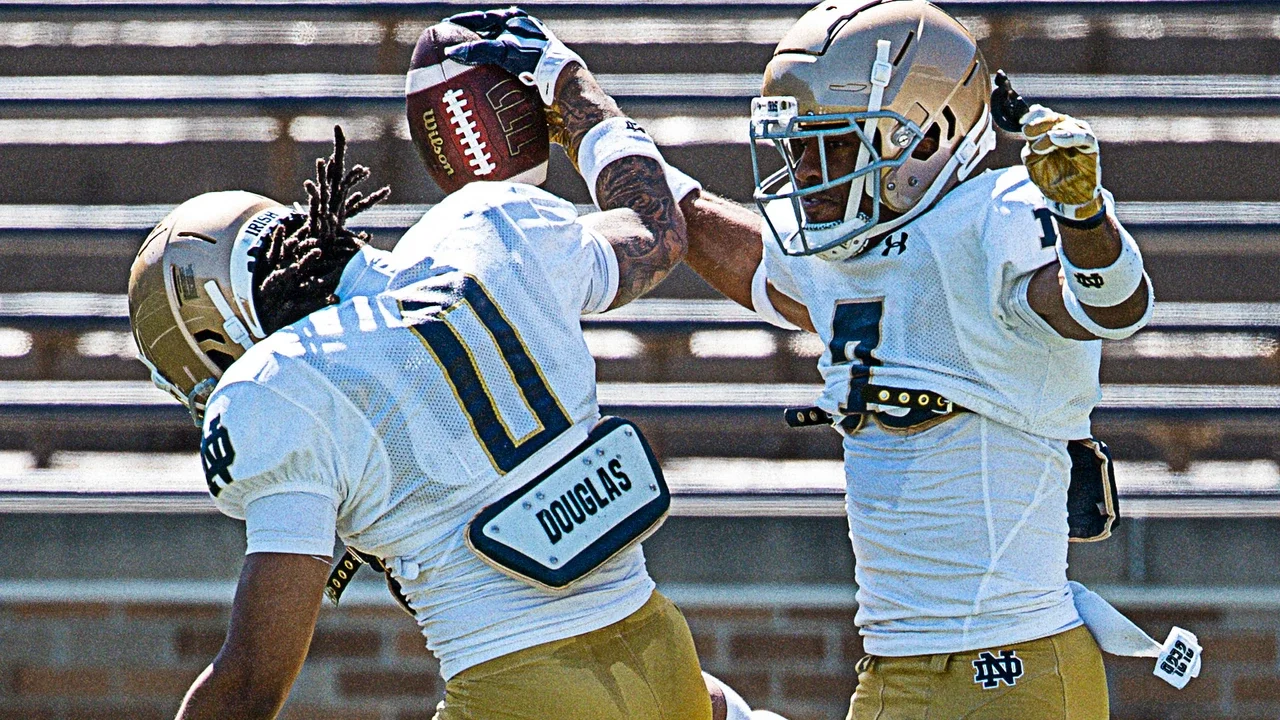
fall camp Position Battles on offense
Notre Dame is 42 days from kicking off its 2026 season against Wisconsin at Lambeau Field, and for the first time in Marcus Freeman's tenure, fall camp won't be defined by a quarterback competition. CJ Carr locked down the job a year ago and started all 12 games as a true freshman. But the absence of drama at quarterback doesn't mean fall camp will be quiet. Several other spots on this offense are wide open, and the players fighting for them have already left a data trail this spring worth digging into.
Running Back
Junior Aneyas Williams enters fall camp as the presumptive lead back, and the numbers back up why. Over two seasons behind Jeremiyah Love and Jadarian Price, Williams has piled up 58 carries for 443 yards, 20 catches for 212 yards and seven total touchdowns, a career average north of 7.5 yards per carry. His 2025 season alone saw him rush for 224 yards and five touchdowns on 24 carries, a 9.3 yards-per-carry average, to go with two catches for 40 yards. He backed that up this spring: despite being limited for most of camp by an elbow injury, Williams led the team in rushing at the Blue-Gold Game and found the end zone, then followed it up with 38 yards on 10 carries, a touchdown and three catches out of the backfield in the spring finale.
The real intrigue is what happens behind him. Redshirt sophomore Kedren Young was a top-100 recruit out of Lufkin, Texas, and looked like a potential difference-maker as a true freshman before a torn ACL wiped out his entire 2025 season. As of late March, Young was seven months into recovery, had just begun running again and was targeting a return to game shape by summer workouts. Position coach Ja'Juan Seider has been careful with his timeline, but the belief inside the building is that a healthy Young could push Williams for the top job rather than settle for a complementary role. Some evaluators see his combination of size, power and explosiveness as the element capable of pushing this running back room from good to excellent if he's fully healthy.
Behind those two, the picture is murkier. In that same Blue-Gold Game, true freshman Jonaz Walton emerged as a legitimate factor, rushing for 33 yards on 11 carries with a touchdown of his own, with Williams and Walton combining for the bulk of the workload. Redshirt freshman Nolan James Jr. and newcomer Javian Osborne round out a room that is as deep as it is unsettled, meaning fall camp reps could carry real consequences for who's active on gamedays.
Boundary Receiver
With Malachi Fields gone, Notre Dame is turning to a boundary receiver competition built almost entirely around transfer talent and physical upside. Ohio State transfer Quincy Porter arrives as a former five-star recruit who was rated the No. 13 overall player nationally and the No. 2 receiver in the 2025 class, and at 6-foot-4 with a rare wingspan, he profiles exactly like the boundary target Notre Dame's staff covets. His production at Ohio State was limited by the depth chart, not lack of talent: he played roughly 57 offensive snaps as a freshman behind Jeremiah Smith, Carnell Tate and Brandon Inniss, one of the most talented receiver rooms in the country, finishing with four catches for 59 yards. Notably, Smith himself, one of the best receivers in college football, called Porter the "next one" at Ohio State before Porter ever left Columbus.
Redshirt sophomores Micah Gilbert and Cam Williams round out the competition, and while their spring production hasn't generated the same buzz, both have the size and physical tools the staff wants at the position. Given the uncertainty, offensive coordinator Mike Denbrock may lean toward a rotation rather than naming a clear-cut starter, which would make fall camp less about crowning a No. 1 and more about establishing snap share.
Slot Receiver
Few storylines are as tied to injury history as the slot receiver competition between Jaden Greathouse and Ohio State transfer Mylan Graham. Greathouse was electric during Notre Dame's 2024 College Football Playoff run, but 2025 was almost entirely lost to a hamstring injury: he played in only a handful of games and finished with just four receptions for 73 yards on the year, a steep drop from his 2024 season total of 43 catches for 576 yards and three touchdowns.
That opening is exactly what Graham capitalized on. A former five-star recruit who saw limited playing time in two years at Ohio State, Graham arrived at Notre Dame and, due to Greathouse's lingering hamstring issue, became the No. 1 slot receiver throughout spring practice, quickly turning into a go-to target for CJ Carr. Scouting notes from the spring were also quick to push back on a perceived weakness from his Ohio State tape: the drop issues some had flagged around Graham simply didn't show up this spring, as he looked like a sure-handed receiver throughout camp. That performance has fueled real hype that Graham could emerge as Notre Dame's top overall receiver in 2026, not just its top slot option.
Greathouse, for his part, is healthy again and has taken on more of a leadership role in the receiver room this offseason. But until he proves he can stay on the field for a full season, an uncomfortable question hangs over the position: is this actually a two-man competition, or is it Graham's job to lose?
Tight End
Redshirt junior Cooper Flanagan looks like the only true lock at any offensive skill position outside quarterback and running back. Flanagan missed almost all of 2025 recovering from an Achilles injury, but before that, he was already establishing himself as one of Notre Dame's best run-blocking tight ends, having played 262 snaps across 13 games in 2024, mostly as a blocker, and graded out by Pro Football Focus as one of the team's highest-rated run blockers over Notre Dame's final four games of that season.
With Eli Raridon off to the NFL, the receiving production at tight end is now up for grabs, and recent Notre Dame history suggests it's realistic for someone in this room to break out. Analysts have pointed to a clear pattern: Notre Dame tight ends have historically taken a modest role in year one before erupting the following season, as Raridon himself went from 11 catches for 90 yards and two touchdowns in 2024 to 32 receptions for 482 yards in 2025. Flanagan is the most likely candidate to follow that path in the run game, but the pass-catching questions are wide open behind him. Redshirt freshman James Flanigan flashed as a blocker last season but has yet to record his first collegiate catch, Arkansas transfer Ty Washington profiles as more of a steady depth option, and true freshman Ian Premer and Jack Larsen give the staff even more bodies to evaluate. Fall camp will likely determine less "who starts" and more "who earns the No. 2 tight end reps behind Flanagan.
Backup Quarterback
There's no competition atop the quarterback depth chart, marking the first time in Freeman's tenure Notre Dame enters a season with an established returning starter. But the No. 2 job is a legitimate three-way battle between redshirt freshman Blake Hebert and true freshmen Noah Grubbs and Teddy Jarrard, none of whom has thrown a competitive pass in college. Hebert did get spring game reps, connecting on an 8-yard touchdown pass during the Blue-Gold Game, giving him a small but real head start over the two true freshmen heading into camp. But Grubbs made his own case this spring, flashing some genuinely impressive throws mixed in with the expected freshman miscues. That combination of upside and inconsistency is exactly what you'd expect from a true freshman, but it's also enough to suggest he'll have a real shot at pushing Hebert for the No. 2 job once fall camp begins. It's an unusual dynamic: the most consequential backup quarterback battle of Freeman's tenure so far, decided entirely without a single game snap to lean on for any of the three competitors.
The Bottom Line
Without a quarterback competition to dominate headlines, this year's fall camp battles are more spread out, but arguably carry just as much weight for how Notre Dame's offense will look in September. The running back room has its floor set with Williams but a real ceiling if Young returns to form. The receiver competitions are shaped almost entirely by two Ohio State transfers who are already outproducing expectations. And the tight end room has its anchor in Flanagan, but no clarity behind him. All of it will get sorted out over the next six weeks, and how it shakes out will go a long way toward determining whether Notre Dame's offense takes a step forward or take a step back from a 2025 team that fell just short of the Playoff.
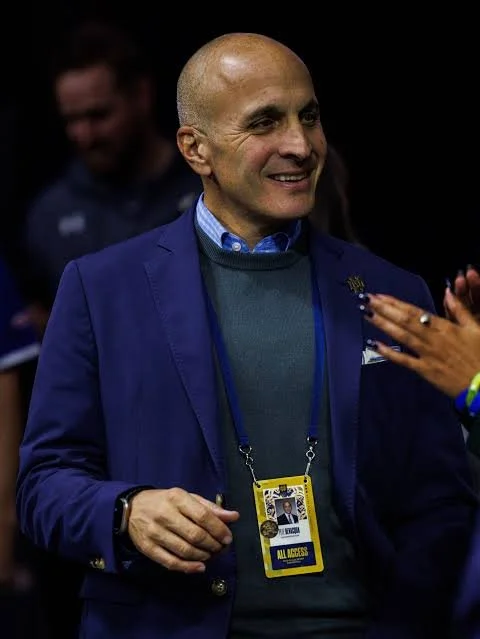
The Patch on the Sleeve: notre dame fans have been debating
For nearly a century, Notre Dame Stadium has been defined as much by what isn't there as by what is. No billboards lining the concourse. No corporate signage bolted to the scoreboard. No names on the backs of jerseys. In a sport that has otherwise been wallpapered in advertising since the 1990s, Notre Dame turned the absence of ads into its own kind of brand: a promise that some things are bigger than a sponsorship check.
That promise just got its first real test. On July 28, 2026, Notre Dame announced a six-year partnership with SoFi worth a reported $18 to $20 million per year, the largest jersey patch deal in college sports history. For the first time ever, a corporate logo, not a school crest, not an apparel brand, will appear on Fighting Irish uniforms across every sport.
The reaction from the fan base has been immediate, loud and split right down the middle.
To understand why this feels different to so many Notre Dame fans, you have to understand what the program has spent decades protecting. Notre Dame Stadium's lack of advertising isn't an accident or an oversight. It's a deliberate policy, one the university has pointed to for years as proof that Notre Dame plays by different rules than everyone else. Fans in South Bend didn't just tolerate that restraint. Many built their entire relationship with the program around it.
So when the patch was announced, the backlash wasn't really about a two-inch square of fabric. One fan summed up the sentiment on social media by joking the school could rebrand itself as "SoFightingIrishAreForSale." Sports radio host Chris "Mad Dog" Russo took a similar tone on air, arguing that this kind of move belongs to programs like Ohio State, not to a team defined by Knute Rockne, Lou Holtz and a century of mythology. The underlying complaint isn't really financial. It's existential. If Notre Dame will put a bank's logo on the jersey, what, fans are asking, is actually still off-limits?
There's also a symbolic irony that hasn't been lost on critics: Notre Dame has always resisted putting player names on the backs of jerseys, treating the program and the "Notre Dame" lettering across the chest as bigger than any individual. Now the front of that same jersey carries a financial company's name instead. To skeptics, that's not a neutral change. It's a value statement about what the university considers sacred and what it doesn't.
But plenty of Notre Dame fans, and the university itself, would argue that comparing a jersey patch to stadium advertising misunderstands what tradition Notre Dame actually promised to protect.
Notre Dame Stadium is treated as hallowed ground, and it still is. There is no in-stadium advertising, no ribbon boards flashing sponsor logos, no naming-rights deal attached to the building itself, and nothing in this agreement changes that. The university drew that line publicly and held it even while negotiating the SoFi deal, which suggests the stadium wasn't a bargaining chip at all. It was simply never on the table. The jersey patch lives in a completely different category: it's a uniform element, not a stadium fixture, and it follows a format that has become standard across almost the entire sport. Ohio State signed a similar deal with Chase the same week. Other blue bloods have already normalized the practice. In that light, Notre Dame isn't leading a race to commercialize college football. It's arriving several years late to a race that had already been run.
Viewed that way, the apparel line is arguably the one place Notre Dame could expand revenue without touching anything sacred. The stadium stays untouchable. The uniform, on the other hand, is simply a product, one that happens to be worth more right now than it has ever been. Notre Dame's national television deal, its independent status, its 39 national championships and a fan base that spans the country rather than a single region have made the Fighting Irish brand more valuable today than at almost any point in program history. A patch that would be worth a fraction as much on a regional program's jersey commands a premium on Notre Dame's precisely because the brand itself has never been cheapened. In that sense, the timing isn't a coincidence. It's Notre Dame recognizing that its uniform, not its stadium, is the asset built for this exact moment, and cashing in on it while the value is at its peak.
There's also a financial argument that's hard to dismiss. College athletics has entered an era of revenue sharing, NIL payments and rising costs across every sport, not just football. An $18 to $20 million annual infusion doesn't just pad a marketing budget. It can fund scholarships, financial literacy programs and walk-on support across all 26 of Notre Dame's varsity programs, many of which will never generate their own sponsorship revenue. Framed that way, the patch isn't a betrayal of the "student-athlete first" identity Notre Dame has always claimed. It's arguably a more efficient way to fund it.
Even some fans who dislike the patch on principle have landed here. Commentary from Notre Dame-focused outlets has noted that a small, contained logo may be an easier trade-off to accept than the alternatives: rising ticket prices, donor pressure or cuts to smaller sports that don't generate revenue on their own.
The honest answer is that both readings can be true at once, and that's exactly why the reaction has been so split.
The jersey patch does represent a real boundary crossed. Notre Dame spent decades marketing its restraint as part of its identity, and this is the first time a non-apparel corporate brand has ever appeared on a Fighting Irish uniform. Pretending that's a trivial change ignores how deliberately the university built its brand around not doing exactly this.
At the same time, the university does appear to be drawing a new, more modern line rather than erasing the old one. Stadium advertising, the more sacred and more visible tradition, remains untouched. The no-names-on-jerseys policy remains untouched. What changed is the uniform's front, in a format nearly every major program has already adopted, tied to a fund explicitly built around scholarships and athlete development rather than pure advertising revenue.
Whether that distinction holds probably depends less on financial logic and more on how the deal actually plays out. If the SoFi patch is the only visible change, and Notre Dame Stadium stays free of the in-venue advertising that defines Saturdays at most other programs, this may end up looking like a narrow, well-managed compromise rather than the start of a slide. If this is instead the first of several corporate logos that creep onto the jersey, the scoreboard, the tunnel or the field itself over the next few years, fans who are uneasy right now will have been right to worry.
For a program built on the idea that some things shouldn't be for sale, the SoFi deal isn't proof that Notre Dame has abandoned that idea. It's proof that the university found the one asset it could monetize without touching the thing it actually considers untouchable. The stadium remains hallowed ground. The jersey, at a moment when the Notre Dame brand has never been worth more, became the revenue play instead. Whether that's a reasonable modernization or the first crack in the dam is a question Notre Dame fans will likely keep arguing about for a long time, and one only the next few years of decisions will really answer.
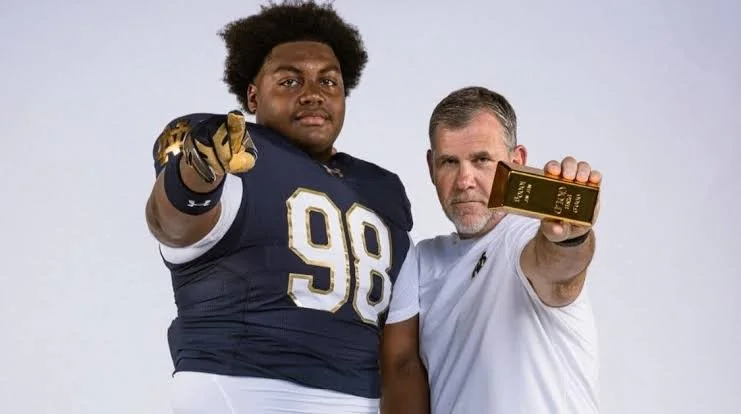
4-star DT Brayden parks chooses notre dame over oregon
For nearly three years, Brayden Parks was one of the most coveted names on Notre Dame's board. On Thursday, that pursuit finally came to an end when the four-star Brother Rice defensive tackle put pen to paper — or, in this case, made his announcement on a CBS Sports special — and chose the Fighting Irish over Oregon in one of the more drawn-out recruitments of the 2027 cycle.
Speaking with Irish Breakdown afterward, Parks summed up just how long the process had felt: "Everything feels like a relief, honestly. I've been going through this recruiting process since my freshman year — coaches reaching out, trying to contact my family, all that. But now that it's over, I feel relieved. From that camp last year until now, man, it feels like it's finally come true."
But to understand why this commitment means so much to Notre Dame's program, you have to go back to where it started: a performance at Irish Invasion that first turned heads in South Bend, and a coaching relationship that very nearly didn't survive to see the finish line.
Long before Parks became a household name in recruiting circles, Notre Dame's staff had circled him as a priority target. That belief was reinforced during his showing at Irish Invasion in the summer of 2025, Notre Dame's marquee on-campus recruiting camp. Evaluators who watched him that day came away convinced that his twitch and explosiveness at his size — he was already pushing 305 pounds — put him in a different tier than most interior linemen his age. It's the kind of performance that gets internally referenced for years afterward whenever a staff needs a reminder of why a prospect was worth fighting for.
That early standout showing set the tone for what would become one of the more significant recruiting battles of the cycle, and it cemented a truth that would hold for the better part of two years: Notre Dame was not going to let Brayden Parks leave the board without a fight.
The Washington-Sebastian Connection
At the heart of Notre Dame's pursuit was the relationship Parks built with then-defensive line coach Al Washington and defensive line assistant Nick Sebastian. Washington, who joined Marcus Freeman's original 2022 staff after previously coaching linebackers at Ohio State and Michigan, built a reputation as one of the more respected recruiters in the country — he was later recognized as a top-10 recruiter nationally for his work on the 2026 class. Sebastian, who followed Washington to South Bend from Columbus that same year, became just as central to the Chicagoland pipeline, playing a lead role in landing five-star edge Rodney Dunham for the 2026 class.
For a Chicago prospect like Parks, that combination mattered. Washington and Sebastian weren't just recruiting him from a distance — they were regulars in the building at Brother Rice, familiar faces who built the kind of trust that's hard to replicate overnight. It's the kind of groundwork that had Notre Dame firmly entrenched as the perceived frontrunner for much of Parks' recruitment, well before his final decision ever became a two-team race.
Parks himself made that clear speaking with Irish Breakdown after his announcement, describing just how far back the relationship went: "I've been talking to Coach Washington since my freshman year, the first time I went out there. He's been there since I started this whole thing." When Washington's move to the NFL came up, Parks didn't hesitate to speak well of it: "I'm happy for him. It's a huge step up in his career. I'm grateful for what he did, and Coach P picked up right where he left off."
A Crack in the Foundation
Then came January.
In the span of about a week, Notre Dame's defensive staff was gutted by the NFL. Secondary coach Mike Mickens left for the Baltimore Ravens on January 25. Days later, Washington — who had just been shifted from defensive line coach to linebackers coach following Max Bullough's departure — announced he was leaving to coach linebackers for the Miami Dolphins under new head coach Jeff Hafley. It marked the third defensive assistant Notre Dame lost to the NFL in a matter of weeks, and it meant the Irish would be replacing position coaches at every level of the defense heading into 2026.
Freeman moved quickly to stabilize the room, hiring veteran defensive line coach Charlie Partridge to take over up front. But for a recruitment as relationship-driven as Parks', Washington's exit still mattered. It didn't sever the pipeline — Sebastian stayed on and remained a constant presence — but it did open a window that programs like Oregon were happy to climb through. Over the following months, the Ducks built real momentum, and at various points the industry buzz around Parks trended firmly in Oregon's direction. Ohio State and Michigan also lingered in the periphery of the process without ever fully displacing the top two.
What had once looked like it might be a formality turned into a genuine dogfight. The last several months of Parks' recruitment played out like an endurance test rather than a sprint — visits, momentum swings, and a decision date that kept extending as both Notre Dame and Oregon dug in for the long haul.
Closing the Gap
When Washington left, he didn't just leave behind a coaching vacancy — he left behind a standard. Sources close to the program had made clear that Washington and Notre Dame were prepared to do whatever it took to land Parks, and it fell on Charlie Partridge to carry that same energy into the final stretch without missing a beat.
Partridge didn't waste time trying to build something from scratch. But it wasn't a one-way effort. Rather than treating the coaching change as something that put the burden of relationship-building entirely on the new guy, Parks did his own homework on Partridge before they'd even met in person — digging into his background, his coaching stops, his track record in the NFL. It's a small detail, but it says a lot: Parks wasn't just being recruited by Notre Dame at that point, he was actively buying in. That kind of initiative from a prospect is often as telling as anything a coaching staff can do, and it's part of why the Irish never fully lost their footing even after Washington's departure.
That effort paid off in a memory Parks says he'll carry for a while. Recalling the first time the two actually met in person, he told Irish Breakdown: "The first time I actually met him, we were in my head coach's office taking a picture, and he tried to demonstrate a double-team drill — next thing you know, he slipped and busted his head open on the TV. That's one of those long-lasting memories me and Coach P will have forever."
Partridge and Sebastian didn't let the momentum stay with Oregon for long. Notre Dame hosted Parks for a pivotal official visit in June, part of a loaded weekend built around several of the program's top remaining defensive line targets for the cycle. By July, Parks had trimmed his list to two: Notre Dame and Oregon.
He set his commitment date for Thursday, July 23, and after weeks of speculation that could have gone either way, he chose the Irish.
By the Numbers
Recruiting services have tracked Parks closely throughout his high school career, and while individual grades have varied slightly by outlet, the four-star consensus has been consistent for over a year:
247Sports: Ranked him among the top defensive linemen in the 2027 class and the No. 7 prospect in Illinois, with 247Sports' individual metric rating him even higher than the industry composite.
Rivals: Slotted him as the No. 185 overall prospect, the No. 22 defensive lineman, and the No. 7 player in the state of Illinois in its industry ranking.
ESPN: Included Parks in its national recruiting rankings as one of the top interior defensive line prospects in the cycle, maintaining a recruiting profile that tracked his offer list as it grew to more than 40 schools.
On the field, MaxPreps logged Parks with 44 total tackles, six tackles for loss and two sacks as a junior in 2025 across 13 games, helping anchor a Brother Rice defense that won the CCL/ESCC Blue title and an IHSA 7A state championship. He was named the conference's Defensive Player of the Year for his efforts — a testament to an interior presence that scouts describe as disruptive against both the run and the pass, with an advanced hand-usage package for a player his age.
The Scene at Brother Rice
The energy inside the athletic building on commitment day was hard to miss. The school's top-ranked baseball team was in the middle of a summer league game outside, and the football team had just wrapped its final practice of the summer session before the state-mandated dead period ahead of fall camp. Walking past the locker room, players were still peeling off practice gear, showering, and changing into shirts and ties for the ceremony — more than a few of them trading excited chatter about Notre Dame and Marcus Freeman as they made their way toward the school's forum.
Throughout the process, Marcus Freeman was a steadying influence for Parks, and it went beyond what the program could offer on the field. Parks pointed to what Notre Dame provides outside of football as a major factor in his decision, and Freeman stood out among the other head coaches recruiting him for the way he showed genuine care for him as a person, not just as a football player. "Coach Freeman is a great person in general. He's a player's coach — he cares more about the person than the football player. That's one of the reasons I wanted to play for a guy like that. He cares about you and your family, not just when things are good, but whatever you're going through."
By the time the forum filled with teammates, coaches, administrators and family, the moment carried a weight that went beyond recruiting. The Brother Rice community is still grieving the loss of 2026 graduate and former football player Patrick Noonan, who died in a car accident on July 18 — just days before Parks' announcement. It was the kind of backdrop that made clear this was about more than one player's decision; it was a program and a school leaning on each other.
Parks took the moment in stride, thanking God, his parents, his sister, extended family, coaches, teachers and teammates before revealing the news — unzipping his jacket to show the Notre Dame logo underneath, officially closing the book on one of the more hard-fought recruitments in recent Chicago history. Asked what Fighting Irish fans should expect from their newest commit, Parks kept it simple: "They're getting a smart, disciplined, dominant defensive lineman."
What It Means Going Forward
Parks becomes the latest piece in what's shaping up as one of the more talented defensive line hauls of the Freeman era. He also arrives with family ties to the program, adding another layer to a recruitment that, in the end, came full circle back to where it started — with the relationships Notre Dame built long before the rest of the country came calling.
Parks' commitment also puts into focus just how much ground Notre Dame has made up in Chicago under Freeman. He joins St. Patrick's David Folorunsho and Mount Carmel's Roman Igwebuike as three of the best defensive prospects to come out of the city in this cycle — all of them products of programs that compete within the same Chicago Catholic League football alignment. Landing all three gives the Irish a defensive haul that's arguably the best in the entire 2027 class, and it's the kind of local sweep Notre Dame hasn't been able to pull off in years.
That matters because Notre Dame needed exactly this kind of moment. For a stretch under Freeman, the program had drifted to the outside looking in on some of Chicago's premier talent, watching top-tier recruits build relationships elsewhere before the Irish ever got a real shot. Parks' commitment — paired with Folorunsho and Igwebuike — signals that the hard work Freeman and his staff have put in has shifted the calculus. Notre Dame is no longer playing catch-up in its own backyard; it's back to being the offer Chicago kids grow up dreaming about.
The early returns for 2028 back that up. Notre Dame is already involved with several of the top uncommitted prospects in the Chicagoland area, and the brand is shining brightest with two names that happen to be Parks' own teammates at Brother Rice: five-star edge Kameron McGee and four-star tight end Jack McNamara. Both have been building relationships with the Irish staff, and having their own guy already in South Bend only strengthens Notre Dame's hand.
And Parks doesn't plan on sitting back and watching it happen from a distance. He made clear after his announcement that he considers this a homecoming, and that recruiting his own teammates to join him at Notre Dame is very much part of the plan.
But this moment wasn't just significant for Notre Dame. It carried just as much weight back home at Brother Rice.
For years, the standard in the Chicago Catholic League has been Mt. Carmel, the program Casey Quedenfeld and the Crusaders have been chasing since he took over. Brother Rice's rise — capped by last fall's IHSA 7A state championship — has started to close that gap, and Parks has become the face of that ascension. A recruit of his caliber, drawing this level of national attention, is a signal that Brother Rice can now stand toe to toe with the league's traditional powerhouse rather than living in its shadow.
Parks is also, by a wide margin, the highest-rated recruit to come through the program in recent memory, and the reaction inside the forum made clear how much that means to the people around him. When he pulled back his jacket to reveal the Notre Dame logo, the room didn't just applaud politely — it erupted, teammates and classmates included, a reflection of just how beloved he is inside that building and how much his teammates had been waiting for this moment right alongside him.
It wasn't a clean, wire-to-wire recruitment. Washington's departure tested it, Oregon pushed it to the brink, and the final months demanded patience from a coaching staff that refused to let go. But for Notre Dame — and for Brother Rice — Brayden Parks was always worth the fight.
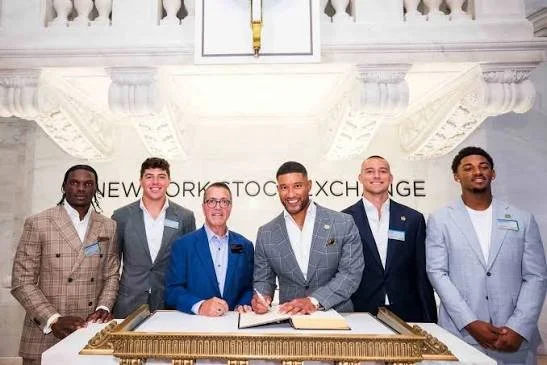
Notre Dame hits Wall Street: Freeman, Carr, Moore Kick Off NYC Media Blitz
Notre Dame football's biggest names traded South Bend for the concrete canyons of Manhattan this week, launching a whirlwind New York media tour that opened in the most on-brand way possible for a program synonymous with tradition: ringing the bell at the New York Stock Exchange.
Head coach Marcus Freeman was joined on the trading floor by quarterback CJ Carr, cornerback Leonard Moore, linebacker Drayk Bowen and safety Adon Shuler for the closing bell ceremony, where the group used the moment to remind the Big Apple who was in town with a "Let's Go Irish" chant that got much of the floor chanting along, with a Notre Dame banner draped behind them as a backdrop. It capped a day that had already included stops on ESPN doing a variety of interviews before the group made its way to the Exchange.
The quartet's trip to New York was no accident. Notre Dame announced that quarterback CJ Carr, linebacker Drayk Bowen, safety Adon Shuler and cornerback Leonard Moore would represent the program on its annual media tour around the city's major outlets, with appearances lined up on shows like ESPN's SportsCenter and NFL Network's Good Morning Football. As one Notre Dame outlet noted, the group also doubles as a strong hint at this year's leadership structure — Bowen and Shuler return as captains from 2025, while Carr and Moore, both just second-year players last season, were too young to hold the title but easily could have.
Carr, the presumptive Heisman frontrunner, got the first big spotlight moment, sitting down with Rich Eisen to walk through his path to South Bend — including the story of his father initially hiding Michigan's offer letter from him, and how it was former offensive coordinator Tommy Rees who recruited him hardest and showed him the most love, a pull that, combined with Marcus Freeman's own recruiting effort, ultimately landed Carr with the Irish over his grandfather Lloyd Carr's alma mater. Carr also used the sit-down to frame the mindset for the upcoming season, discussing how Notre Dame plans to keep using the disappointing end to 2025 as motivation heading into 2026.
The tour continued into Friday morning, when Freeman and Moore stopped by the Today Show. Asked about the "Here Come the Irish" refrain that blares over the loudspeaker as Notre Dame takes the field — now also the title of the program's in-house Peacock series — Freeman kept it simple: "It was there before I got there. As you take the field, they play over the loudspeaker 'Here Come the Irish.' We take the field, so I think it's pretty simple to make that the title of the show."
Freeman was also asked what it's been like having a camera crew shadow the program for that same series, and admitted the adjustment took some time. "Yeah, it took some convincing to think about all the cameras, the mics and the distractions. We really started to implement it last spring. It was a good trial run and it became like they were a part of the team, you didn't notice they were there. They feel like they were part of the staff and I think everybody kind of dropped their guards and it just became natural," he said.
The New York swing comes on the heels of a spring in which Moore made headlines of his own, telling reporters in South Bend that Notre Dame was on something of a "revenge tour" after last year's College Football Playoff snub. Moore said the defensive backs took a lot of the blame following Notre Dame's loss to Miami, in which Hurricanes quarterback Carson Beck completed 20 of 30 passes for 205 yards and two touchdowns without an interception, and didn't sugarcoat how Freeman responded. "He told us we was weak, we was soft," Moore said, "all that type of stuff. It's serious to him, too. That's something he's not used to seeing from us."
Freeman, for his part, waved off any notion that revenge is the operative word internally, preaching focus on the present instead. "We spend too much time daydreaming about Miami, we're going to lose to Wisconsin," he said, referencing Notre Dame's Sept. 6 season opener. "You've got to focus on the task right at hand. That's no different than saying, can we go back to the national championship? If we want to focus on the national championship, we're going to lose the opportunity we have right here. It's my job to make sure I'm directing the focus where it needs to be."
With the bell-ringing and morning show circuit behind them, the group's New York run is expected to continue over the next several days, with more national appearances on tap as Notre Dame — with a Heisman-caliber quarterback, an All-American cornerback and a coach determined to keep the noise pointed forward rather than backward — begins building the case for a 2026 season with, in Freeman's words, no doubt left to leave.
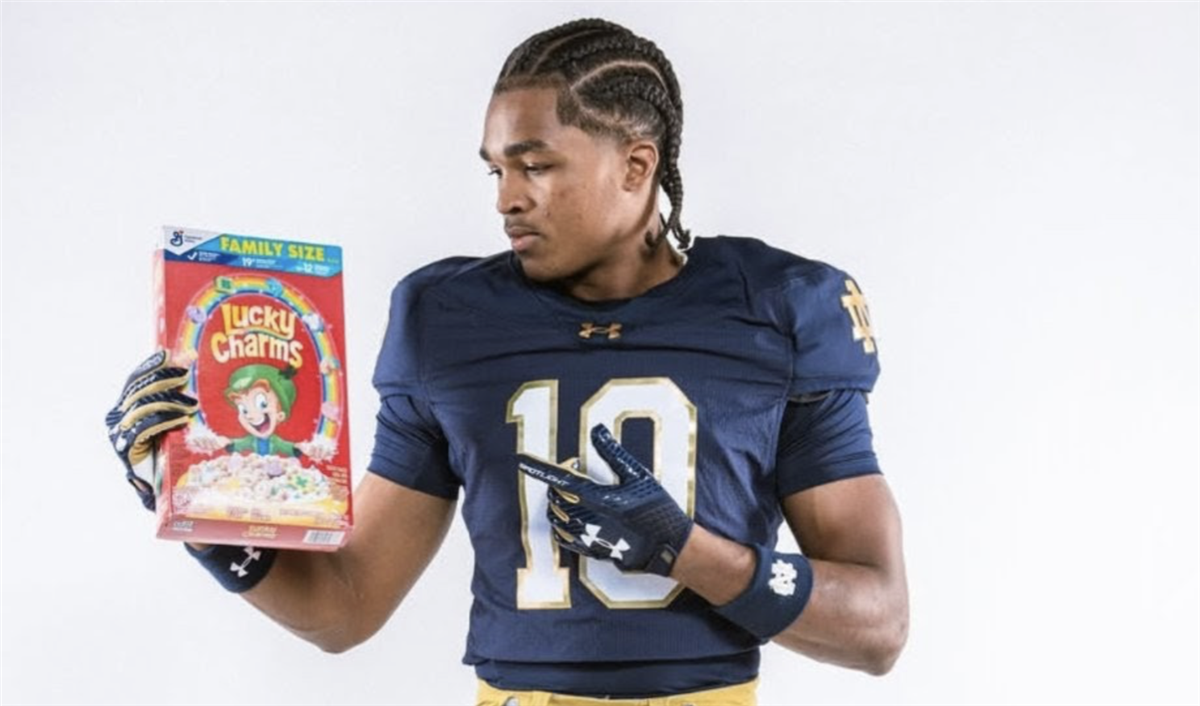
Four-Star Chicago Linebacker Roman Igwebuike Commits to Notre Dame
Notre Dame football landed one of its most important remaining targets in the 2027 recruiting class on Saturday when four-star linebacker Roman Igwebuike, a standout at Mount Carmel High School in Chicago, announced his commitment to the Fighting Irish on the CBS Sports College Football YouTube channel.
The 6-foot-3, 220-pound Igwebuike chose Marcus Freeman's program over a finalist group that included Clemson, Indiana, Missouri and Tennessee, capping a recruitment that also drew serious interest from Ohio State, Oregon, Michigan, Georgia and dozens of other blue bloods. He becomes Notre Dame's 22nd commitment in the 2027 cycle and the lone linebacker in a class already ranked No. 2 nationally.
Explaining his decision, Igwebuike pointed to the culture Freeman has built in South Bend as much as anything else. "Just the culture and the program!" Igwebuike said of his commitment to Notre Dame. "Also playing for a ex-linebacker as my head coach is a big deal to me. The community and off-the-field success told me it was right. The way they take care of their players and their networking is unmatched."
A recruitment that had to be rebuilt from scratch
Igwebuike's path to South Bend was anything but a straight line, and the shift didn't happen until relatively late in the process. Notre Dame's original offer came last October while he was on campus for the Boise State game, but the relationship never gained real traction under then-linebackers coach Max Bullough, who departed the program after the 2025 season and had made little meaningful push for the Chicago native during his tenure. For a prospect fielding calls from nearly every major program in the country, Notre Dame was, for a time, an afterthought rather than a priority.
That changed in January 2026, when the Irish hired Brian Jean-Mary — previously Michigan's linebackers coach — to run the position room. Jean-Mary made Igwebuike a target from his very first weeks on staff, and paired with Freeman's own credibility as a former college linebacker, Notre Dame walked back into the recruitment with a fundamentally different pitch than the one it had offered six months earlier.
Igwebuike took five official visits over a roughly six-week stretch: Indiana in May, Clemson at the end of May, Missouri in early June, Notre Dame on June 12, and Tennessee on June 19. The June 12 trip to South Bend proved to be the turning point. It was during that visit that Igwebuike and the new staff had the direct conversations needed to clear up exactly where he stood — addressing head-on the uneven communication of the previous regime and making clear that, under Jean-Mary and Freeman, he wasn't just a name on a board but the room's top target. Notre Dame had already hosted him once before, in April during jersey scrimmage weekend, but the official visit in June was where the Chicago native said he found clarity on where he wanted to play his college football.
The production behind the profile
Igwebuike's MaxPreps career profile tells the story of a player who has started for Mount Carmel every year of high school and grown into the role. He debuted as a freshman outside linebacker in 2023 at 6-foot-2, 215 pounds, helping the Caravan to a 13-1 record and a No. 2 state ranking. As a sophomore in 2024, still 6-foot-2 and 215 pounds, he moved into the middle linebacker spot and helped Mount Carmel to an 11-3 finish and a No. 3 state ranking.
The breakout came as a junior in 2025, when Igwebuike — now up to 6-foot-3 and 225 pounds — anchored the middle of a Mount Carmel defense that went a perfect 14-0 and won the Illinois Class 8A state championship. He finished the season with 115 tackles, 13.5 tackles for loss, seven sacks, 17 quarterback pressures, three forced fumbles, one fumble recovery, two interceptions and three pass breakups, production that earned him first-team all-conference honors in the Chicago Catholic League Blue and helped push him into four-star territory nationally.
What it means for the class
The commitment fills a real hole on Notre Dame's board — it's the program's first linebacker pledge in the 2027 cycle since previous commit Amarri Irvin flipped to Virginia Tech — and gives Jean-Mary his first signature win since taking over the room. It also carries symbolic weight for a staff intent on tightening its grip on Chicago recruiting: Igwebuike joins defensive lineman David Folorunsho as the second Illinois pledge in the class, keeping two of the Chicago Catholic League's best defenders committed close to home.
With Igwebuike now in the fold, Notre Dame will look to hold his commitment through a long runway to signing day — a stretch during which programs like Clemson and Tennessee, both of whom hosted him for official visits, are unlikely to fully step away. But after a recruitment that needed a full coaching change to get back on track, the Irish have their answer at linebacker, and a Chicago pipeline that's showing real signs of life.
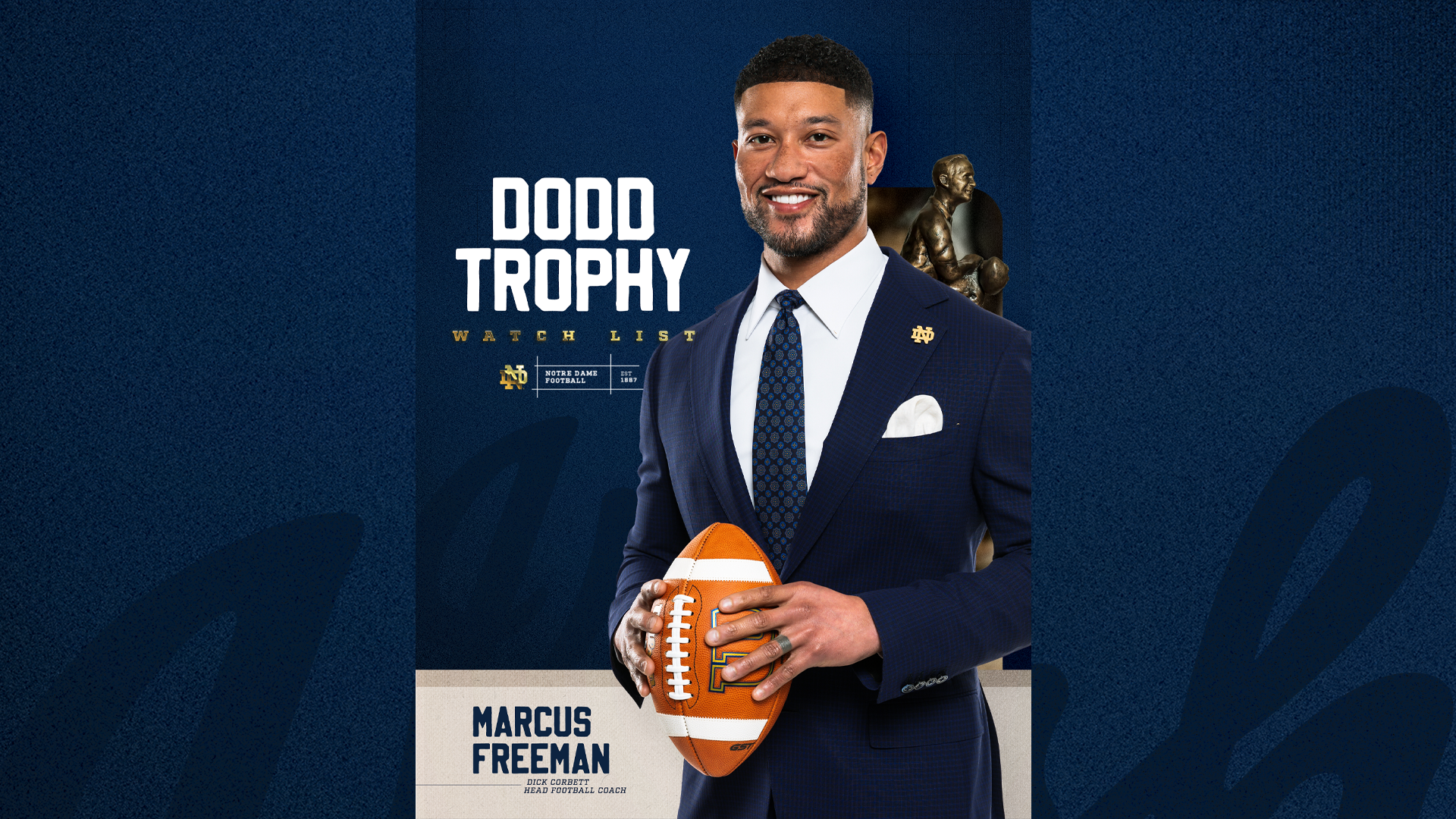
Marcus Freeman Named to 2026 Dodd Trophy Watch List
Notre Dame head football coach Marcus Freeman has been named to the 2026 Dick Corbett Dodd Trophy Watch List, the award's selection committee announced. It marks the second consecutive year Freeman has landed on the list, having won the honor outright in 2024.
The Dodd Trophy recognizes the head coach of a team that combines success on the field with a commitment to scholarship, leadership and integrity — the three pillars that defined the coaching philosophy of the award's namesake, legendary Georgia Tech coach Bobby Dodd. Freeman is one of four coaches on this year's watch list who have previously won the award, joining Indiana's Curt Cignetti (2025), Willie Fritz (2022) and Kirk Ferentz (2015).
Freeman enters his fifth season at the helm of the Fighting Irish with a 43-12 overall record, including a 5-2 mark in postseason play. Notre Dame has posted three consecutive seasons of at least 10 wins under his leadership, and his 43 victories are the most by any head coach through his first four seasons in program history.
A résumé already full of hardware
Freeman's nomination continues what has become a well-stocked trophy case built almost entirely on the strength of his 2024 campaign, when he led Notre Dame to a program-best 14-2 record, a 13-game winning streak and a berth in the CFP National Championship Game — a 34-23 loss to Ohio State that still marked the program's highest final AP ranking (No. 2) since 1993. That season alone netted Freeman a sweep of the sport's top individual coaching honors: the 2024 Dodd Trophy, the Paul "Bear" Bryant Coach of the Year Award, the George Munger College Coach of the Year Award, the National Coalition of Minority Football Coaches' College Coach of the Year honor, the Ted Ginn Sr. Coach of the Year Award from the National Alliance of African American Athletes, and recognition as honorary head coach of the 2024 AFCA Allstate Good Works Team.
The path to that peak wasn't linear. Freeman's first season in 2022 began with him becoming the first Notre Dame head coach to open a career with three losses, before the Irish rattled off nine wins in their next eleven games — highlighted by a 35-14 upset of No. 4 Clemson — to finish 9-4 and cap the year with a Gator Bowl win over South Carolina. Year two brought a reversal of fortune: Notre Dame opened 2023 with four straight wins and finished 10-3, punctuated by a 48-20 rout of Heisman winner Caleb Williams and USC. His third season delivered another gut-check moment, a stunning home loss to Northern Illinois as heavy favorites, but Freeman steadied the program to reel off ten straight wins and reach the College Football Playoff, a run that included victories over Indiana, Georgia and Penn State before the national title game appearance.
Individually, Freeman has now collected six major national coach of the year honors in just four seasons on the sideline, all stemming from that 2024 season, and has been a semifinalist or watch-list honoree in the years since as Notre Dame has sustained its success — including a combined 26-4 record over the past two seasons, a stretch that also drew interest from multiple NFL teams during the offseason.
Players thriving under his watch
Freeman's coaching accolades have been matched by what his players have accomplished. He coached 2025 Heisman Trophy finalist running back Jeremiyah Love, who also became Notre Dame's first-ever Doak Walker Award winner as the nation's top running back. Love was joined by junior cornerback Leonard Moore as a unanimous All-American in 2025, making Notre Dame one of just three programs nationally to produce multiple unanimous All-Americans that season. A year earlier, safety Xavier Watts earned consensus All-America honors for the second time in his career, making him just the second Irish player since 1993 to be a two-time consensus honoree. Freeman has also developed breakout freshmen, including safety Tae Johnson, who earned FWAA Freshman All-America recognition.
Team success by the numbers
The 2025 Fighting Irish were among the nation's best across the board, finishing second in scoring offense (41.8 points per game), fourth in interceptions (21), fourth in turnover margin (+1.08), fifth in net punting (43.32), eighth in yards per pass completion (14.11), eighth in sacks allowed per game (1.00), ninth in blocked punts (2) and ninth in passing efficiency defense (108.80).
The Dodd Trophy winner is typically announced later in the season after the watch list is trimmed down through the fall. Freeman's inclusion adds another line to an already crowded résumé, and reinforces Notre Dame's standing as a program built for sustained contention as it heads into the 2026 season.
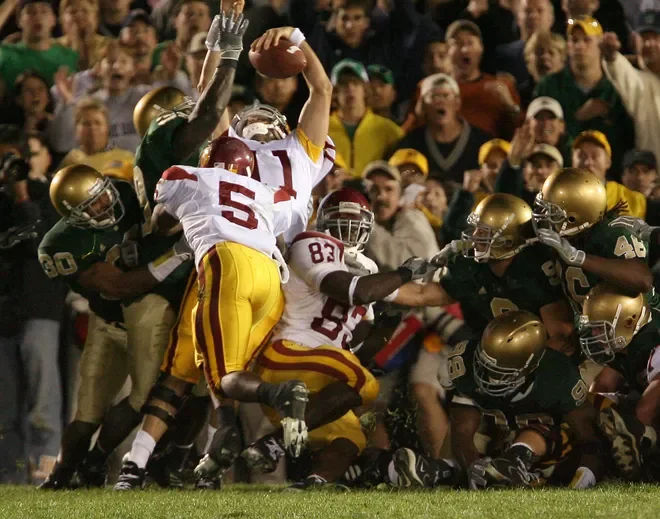
Notre Dame's Greatest Games Since 2000
When Fox Sports' Joel Klatt ranked his top college football games since 2000, he put the 2005 Notre Dame–USC "Bush Push" game at No. 1 — and it's easy to see why the topic sparked a real "I remember watching it" reaction. That game alone is a masterclass in what makes a great football game: constant lead changes, a Heisman winner, a bitter rivalry, and an all-time controversial finish. But it's far from the only Notre Dame game from the last 25 years that belongs in the conversation. Here's a look at some of the games that define the Irish's modern era.
The Heartbreak: USC, 2005 — "The Bush Push"
This is the one that still stings, and the one that still gets brought up on podcasts two decades later. Unranked, four-and-one Notre Dame — in year one under Charlie Weis — hosted a USC team riding a 27-game win streak with two Heisman winners in the backfield. The lead changed hands throughout, with the Irish up 31-28 in the final minutes. USC drove into range, appeared to be stopped short of the goal line as time expired, and then Reggie Bush shoved quarterback Matt Leinart into the end zone on the game's final play — a shove that wasn't a penalty under the rules at the time. USC escaped 34-31. It remains one of the most replayed, most argued-about finishes in the sport's history, and it's the game most associated with Notre Dame in any "greatest games" conversation since 2000.
The Statement Win: Oklahoma, 2012
Notre Dame's 2012 season is remembered for the eventual national title game loss to Alabama, but the game that actually made that season feel real was a road win over Oklahoma. It was widely seen as the moment that vaulted the Irish from "surprising and undefeated" to legitimate national title contender — the win that made the rest of the country start taking Brian Kelly's team seriously. Notre Dame ran the table the rest of the regular season on the strength of that statement.
The Signature Upset: No. 1 Clemson, 2020
If Bush Push is Notre Dame's most famous loss of the era, the 2020 double-overtime win over top-ranked Clemson is arguably its most famous modern win. With Trevor Lawrence out due to COVID-19 and freshman D.J. Uiagalelei starting in his place, Notre Dame jumped out early, survived a furious Clemson rally that forced overtime, and then rode three touchdown runs from Kyren Williams — including the eventual game-winner — to a 47-40 victory. It ended Clemson's 36-game regular-season winning streak and gave Notre Dame its first win over an AP No. 1 team since 1993. Fans stormed the field in the middle of a pandemic; it was, by most accounts, the loudest Notre Dame Stadium had been in over a decade.
The Blowout Statement: USC, 2017
Not every great game has to come down to the final play. Notre Dame's 49-14 demolition of USC in 2017 stands out simply because of how rare it is for both programs to be ranked in the top 15 at the same time, as they were that October — the first time that had happened since the 2006 meeting. The Irish took control early and never let up, and it remains one of the most convincing wins of the rivalry's modern stretch.
The Road Classic: LSU, 2014 Music City Bowl
Notre Dame limped into this game on a four-game losing streak with Brian Kelly's job security being questioned nationally, a seven-point underdog against an LSU team with Leonard Fournette in the backfield. Instead, the Irish took the opening drive down the field for a touchdown and held on for a 31-28 win that's remembered less for the stakes and more for simply being an excellent, hard-fought football game at a moment the program badly needed one.
The Defensive Grind: Stanford, 2012
Before the Oklahoma win vaulted Notre Dame into title contention, the Irish had to get through Stanford — and they did it in overtime, 20-13, with a goal-line stand that's become one of the most replayed defensive sequences of the Kelly era. It wasn't flashy. It was Notre Dame playing exactly the kind of physical, run-the-ball, control-the-clock football that had, for years, been Stanford's own signature — and beating the Cardinal at their own game.
Why These Games Still Matter
What ties all of these together isn't just the final score — it's that each one reflects something bigger about where the program stood at that moment. Bush Push was Notre Dame announcing it was ready to compete with the sport's best again under a new coach. Oklahoma and Stanford in 2012 were the turning point that took the Irish to a national title game. LSU in 2014 was survival. Clemson in 2020 was proof the program could still win the biggest possible regular-season game against a genuine blueblood.
Twenty-five years in, it says something about Notre Dame's place in the sport that a Fox Sports analyst's list of the best games since 2000 — a list covering hundreds of games across every conference — still runs straight through South Bend.
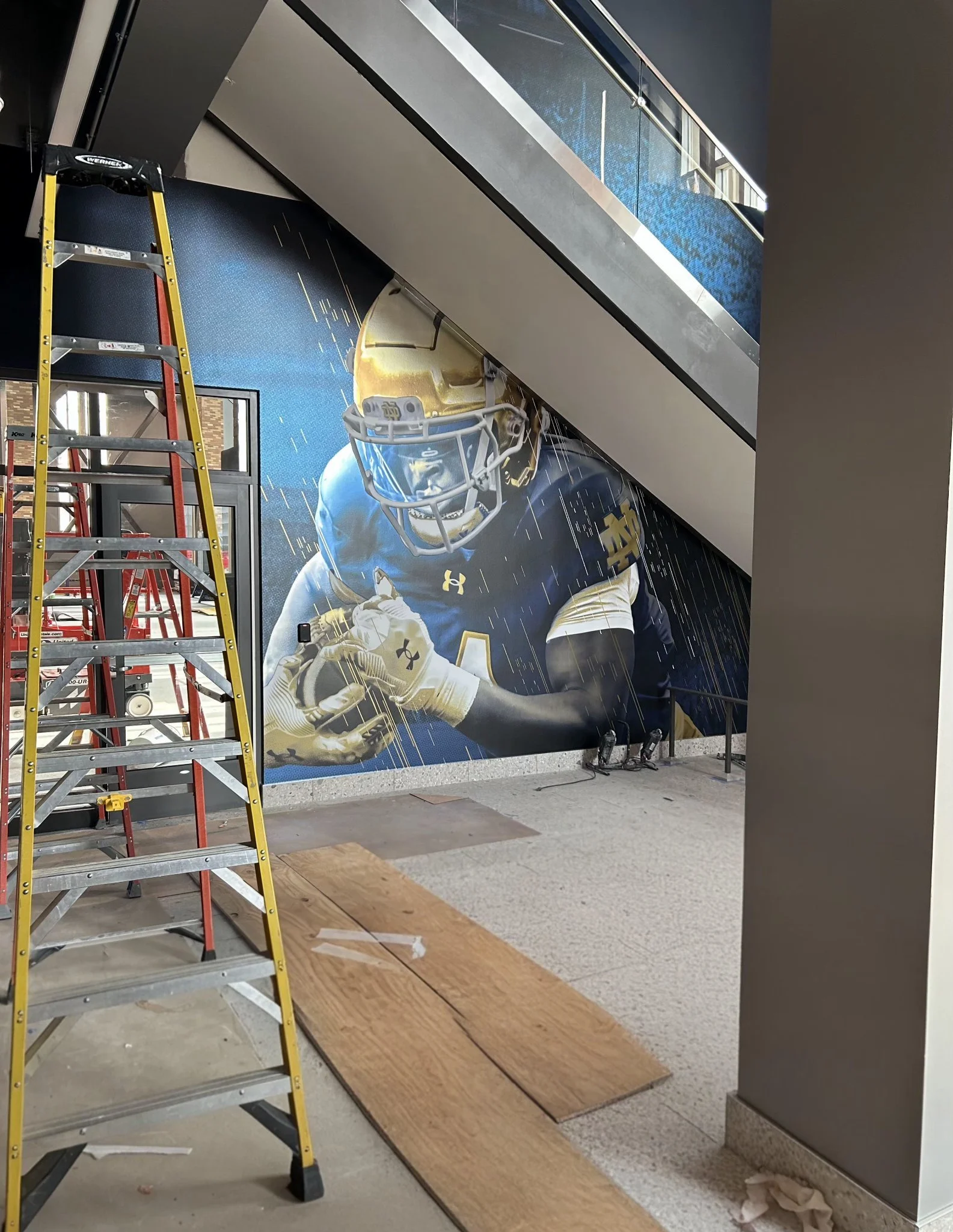
Shields Family Hall: How Notre Dame's New Football Home Reshapes the Program — On the Field and Off
When Notre Dame broke ground on the Jack and Kathy Shields Family Hall in the spring of 2024, it wasn't just another shovel-in-the-dirt photo op. It was a statement. Set to open this fall on Courtney Lane, the 150,000-square-foot facility represents a nearly 50% increase in football-dedicated space over the current Guglielmino Athletics Complex — and it arrives at a moment when facilities have become one of the clearest battlegrounds in college football's arms race.
What's Actually Inside
Shields Hall isn't just bigger locker rooms and shinier weight equipment. According to the university, the building will house advanced training and sports medicine facilities, an equipment room built around body-scanning and fabrication technology, and — maybe most notably — an on-site player nutrition area designed to let the program prepare meals directly rather than trucking them in from elsewhere on campus, as has been the case for years.
That last piece matters more than it might sound. Notre Dame athletic officials have talked about wanting the nutrition space to "foster community between teams and model healthy eating," which points to a broader philosophy: this building isn't just about building bigger, faster players. It's about building an environment players actually want to spend time in.
The project is being funded by a group of former Irish players led by ex-linebacker Jack Shields, along with fellow former players Pat Eilers and Dave Butler. That detail carries its own weight — it's not corporate money or a naming-rights deal with an outside company. It's alumni who played the game reinvesting in the infrastructure of the program that shaped them.
The On-Field Case: Closing the Facilities Gap
For years, Notre Dame's brass — including former AD Jack Swarbrick and head coach Marcus Freeman — have insisted facilities weren't the reason the program hadn't broken through to a national title. But "not the reason we're losing" and "not worth fixing" are two different things, and the athletic department has clearly decided this is a lever worth pulling.
Consider the timeline: the $400 million Crossroads renovation of Notre Dame Stadium in 2018, the Irish Athletics Center indoor practice facility in 2020, and now Shields Hall. That's a decade-plus of continuous, deliberate investment. Athletic director Pete Bevacqua has framed it directly — the goal is putting Notre Dame's infrastructure "on par with the big-hitting programs across the country, and then some."
Notably, Notre Dame officials reportedly toured Clemson's football facility before playing the Tigers, a small but telling detail — measuring yourself against the programs you're trying to beat, then building past them.
The Recruiting Angle
This is where a building starts to translate into actual roster talent. All-American cornerback Ben Morrison put it plainly at the groundbreaking ceremony: recruits notice. He spoke about how the Irish Athletics Center influenced his own decision to come to Notre Dame, closing his remarks with a simple line — facilities do matter.
That's not just a player being polite for the cameras. In modern recruiting, five-star prospects and their families are touring multiple campuses, often within days of each other, and physical impressions matter — the weight room, the nutrition setup, the sense that a program is investing in you specifically for the next four or five years. A tired, cramped, hand-me-down facility sends one message. A brand-new, purpose-built space with body-scanning tech and an in-house culinary operation sends another. Shields Hall gives Notre Dame's coaching staff a tangible, walkable answer to the "why here" question that comes up on every visit.
The Part Worth Watching: Notre Dame's Unusual Campus Culture
Here's where Notre Dame's situation is genuinely different from most of its Power Four peers, and it's worth sitting with for a second.
At a lot of major programs, football players increasingly operate in something close to a separate ecosystem — their own dorms, their own dining, their own daily orbit that barely intersects with the broader student body. Notre Dame has historically resisted that model. Its student-athletes live in the dorm system, eat in the dining halls, sit in the same classrooms, and are woven into campus life in a way that's become something of a point of pride for the university — part of the broader "student-athlete" identity Notre Dame likes to sell as central to its brand.
Shields Hall, by design, pulls more of a player's day-to-day life — training, meals, recovery, treatment — onto a self-contained football campus. That's the right move competitively. It's also a structural shift away from the integration that's long made Notre Dame's culture distinct.
None of this means Notre Dame is abandoning that identity overnight. But it's a dynamic worth monitoring as the building comes online this fall: as football life becomes more self-contained and professionalized, does the historic closeness between athletes and the broader student body hold, or does it quietly start to erode? Programs that have gone further down this road elsewhere have sometimes found that the more insulated an athletic operation becomes, the harder it gets to maintain that everyday connection to campus life — even when no one intends for that to happen.
For a program that has long branded itself as different from the professionalized model of college football, that tension between building a championship-level operation and preserving what makes Notre Dame Notre Dame is one of the more interesting subplots to watch once the doors open.
Bottom Line
Shields Hall is a clear, tangible investment in on-field performance and a legitimate recruiting weapon — the kind of facility that shows up in a highlight reel during an official visit and closes the gap with programs Notre Dame is chasing. But its bigger, quieter story might be about the second-order effects: what happens to Notre Dame's uniquely integrated culture as the football program becomes more self-contained. Worth watching once the building opens its doors this fall.
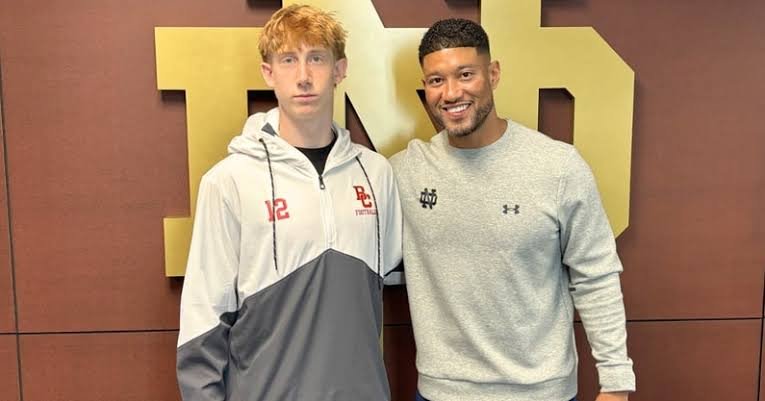
‘28 4-star qb trey tagliaferri decommits
Notre Dame thought it had solved its quarterback puzzle for the 2028 class. Instead, the Irish are right back where they started — and the way it unraveled has raised real questions about how the staff handled the position this cycle.
A Commitment That Barely Lasted a Week
Trey Tagliaferri, a four-star quarterback out of Bergen Catholic in Oradell, New Jersey, visited South Bend on June 21 and silently committed to Notre Dame that weekend. He made it public on June 25, telling reporters the visit had sealed the deal. "Great people, a great place and a place that seems like really a family and all together," he said of the program at the time.
Six days later, on July 1, Tagliaferri reversed course and announced his decommitment. It's one of the shortest-lived pledges in recent Notre Dame recruiting history, and it left head coach Marcus Freeman, quarterbacks coach Gino Guidugli and the offensive staff needing to regroup at the sport's most important position.
Tagliaferri is no afterthought of a recruit. In 11 games during his first year as a starter, he completed 131 of 211 passes (62 percent) for 2,215 yards with 29 touchdowns against just three interceptions, adding a rushing score as well. He picked up All-State third-team and All-Bergen County first-team honors and enters his junior year rated anywhere from a three-star, No. 19 quarterback on 247Sports to a four-star, top-15 passer on the 247Sports Composite and Rivals industry rankings — a consensus top-20 quarterback nationally with 34 offers to his name.
The Oklahoma Connection
The most telling detail in this saga is who benefited from it. Almost immediately after Tagliaferri walked back his Notre Dame commitment, Rivals' prediction model shot to a 93.3 percent likelihood he ends up at Oklahoma, as Steve Wiltfong of On3/Rivals logged crystal ball picks sending him to Norman. Sooner Illustrated reported that Oklahoma "had quite a bit to do" with the flip, having pushed hard for Tagliaferri even while he was technically committed to the Irish.
That tracks with reporting on how this recruitment actually developed. Tagliaferri has been fond of Oklahoma for a long time, and the Sooners likely would have been the favorite from the jump had they pursued him earlier. Before Notre Dame entered the picture, there was real doubt about whether Oklahoma even viewed Tagliaferri as a lock at the position. Once he was off the board with the Irish, though, Oklahoma suddenly got serious — and once he was back on the market, the Sooners moved fast.
It's a pattern college football has seen before: a recruit uses a competing commitment to force a program's hand, then leverages that offer to get the outcome he wanted from his actual top choice all along. Whether or not that was the calculated intent here, the optics line up. Tagliaferri picked Notre Dame over Oklahoma and Penn State when he committed on Father's Day weekend — and then, less than a week later, all signs point to Oklahoma anyway.
Odd Timing From the Start
Beyond the flip itself, the timeline raises questions about Notre Dame's approach at quarterback this cycle. When Tagliaferri committed, the Irish still had active offers out to two other 2028 passers: Kingston Preyear, the No. 44 overall prospect and a top-five quarterback nationally who had visited South Bend and left with strong impressions of the program, and Lukas Prock, a Hun School (Princeton, N.J.) product with 39 offers who threw for over 4,300 yards as a sophomore.
The Irish staff reportedly made a deliberate call to lock in Tagliaferri rather than wait on Preyear, who had opted to keep his recruitment open a bit longer. Notre Dame has typically preferred to secure its quarterback target well ahead of schedule — the program has made a habit of getting its 2028-caliber signal-callers on board early, mirroring how it wrapped up commitments from Champ Monds and Teddy Jarrard in advance of their own cycles. Taking the more "available" quarterback in Tagliaferri, rather than continuing to build with a higher-ranked target like Preyear who still had Notre Dame near the top of his list, is now looking like a curious decision in hindsight — the staff prioritized getting a name in the class over letting a stronger recruitment play out.
It's also not the first time Notre Dame has been burned by uncertainty at the position. The program's experience with Deuce Knight in the 2025 cycle reportedly shaped this year's approach, pushing the staff toward wanting a "safer," lower-maintenance commitment. Instead, Tagliaferri turned into the exact kind of instability the staff was trying to avoid.
Where Does That Leave Notre Dame?
The Preyear outcome is a complicating factor for any plan to simply pivot back to him. Around the same time Tagliaferri was reversing course, Preyear announced he had trimmed his list to three finalists — Alabama, Florida and Vanderbilt — with a commitment date set for July 10. Notre Dame did not make the cut. Preyear had, in fact, been a silent Notre Dame commit earlier in the process, but his father reportedly encouraged him to slow down and gather more information before locking anything in, and that pause ultimately steered him toward an SEC-only finalist list. In other words, the quarterback many assumed would be Notre Dame's fallback option has already moved on, and it looks like a straight three-team race in his home region from here.
That leaves Prock as the more realistic in-house target still on the board, along with whatever new names the staff evaluates over the rest of the summer. Notre Dame does have other quarterbacks already ticketed for the program in future classes — Blake Hebert, Noah Grubbs, Teddy Jarrard and Champ Monds are all part of the pipeline — which takes some of the sting out of an empty spot in the 2028 class for now. But after landing and then immediately losing its presumptive 2028 quarterback, and watching its other top target trim Notre Dame off her list days later, the Irish staff is facing a real choice: continue chasing Prock and whichever late-emerging names surface, or take a step back entirely and re-evaluate the board at the position before committing to anyone else this cycle.
Given how quickly Tagliaferri's commitment came together and how quickly it fell apart, patience may be the more valuable asset than speed the next time around.
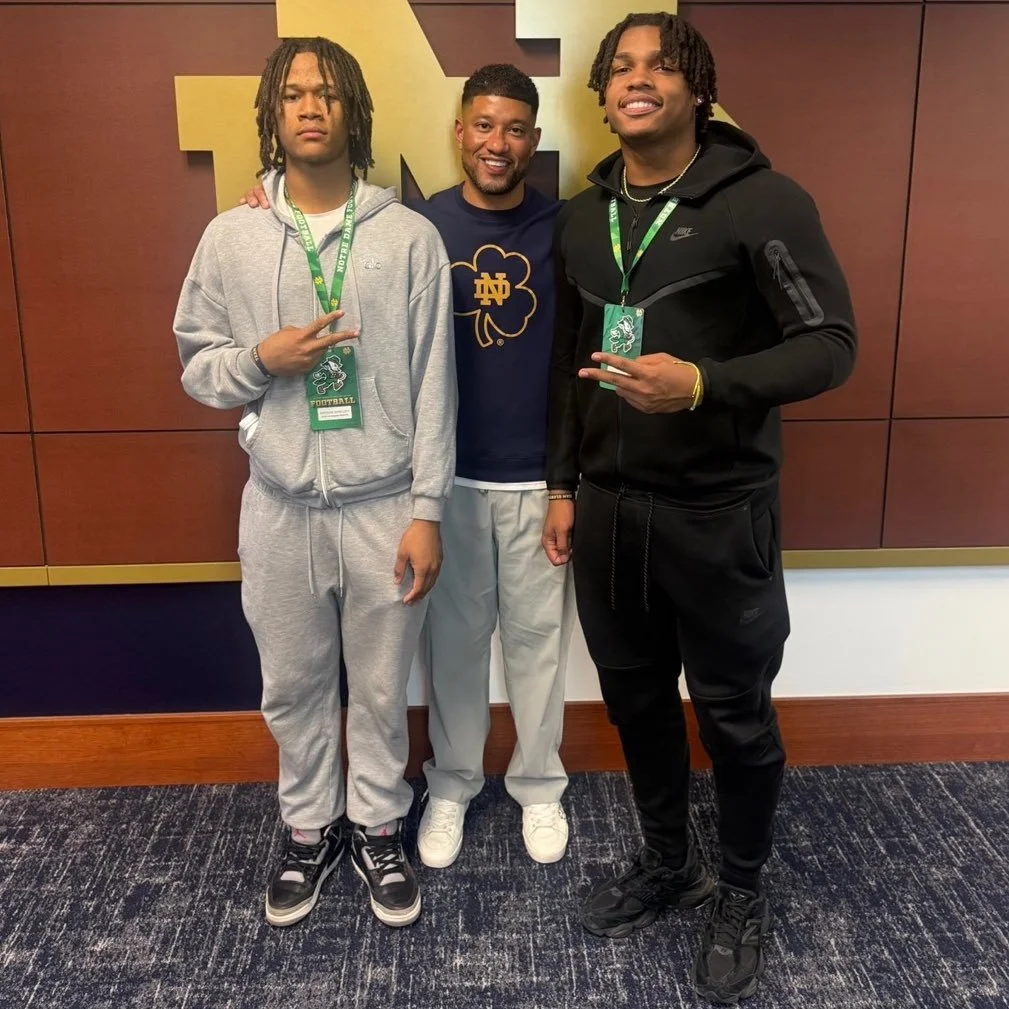
‘28 5-star edge darreion prescott has notre dame in top 8
Illinois has been producing it’s fair share national-level defensive line prospects lately, and Darieon Prescott of Bolingbrook (Ill.) Bolingbrook is another one of those impressive recruits that the Irish staff has focused on. The 2028 edge rusher has built one of the most impressive recruitments in the country over the past year, and this week he took the next major step by trimming his list down to a top eight — with Notre Dame firmly in the mix after a string of standout visits to South Bend.
The 6-foot-5, 220 pounder tallied 65 tackles, 14 tackles for loss, 5 sacks, 8 pass breakups, 26 quarterback pressures, 3 forced fumbles, 2 fumble recoveries, and 2 blocked kicks for the Bolingbrook Raiders. That kind of all-around production — stopping the run, rushing the passer, and even affecting special teams — is a big reason he was named to the MaxPreps Freshman All-America team as a first-year player and has continued to climb recruiting boards ever since.
Notre Dame Visits
Notre Dame’s recruitment of Prescott picked up serious steam this spring. He was originally slated to spend a weekend visiting Texas A&M and Nebraska before swinging back through South Bend later in April, but he shifted those plans to get back to Notre Dame earlier than scheduled. He told Irish Breakdown he wanted to see the Irish practice again, soak in the program’s culture, and reconnect with the staff — a sign of just how much South Bend had already grabbed his attention.
That trip included extended one-on-one time with head coach Marcus Freeman, who left a lasting impression on Prescott both as a coach and as a person, as well as a personal sit-down with first-year defensive line coach Charlie Partridge. Prescott said watching Partridge coach the edge group in practice — and then talking through technique and expectations with him afterward — was one of the most important parts of the visit. He left calling Notre Dame “a great place”, while noting he was already planning to return to campus for the Blue-Gold spring game and potentially again over the summer.
Prescott followed through on that plan. He was back on campus in South Bend two weeks ago, just ahead of Notre Dame’s final official visit weekend of the month, giving the staff one more extended look with him and his family ahead of the start of Bolingbrook’s summer prep for the season. Combined with his earlier trips, it marked at least his third documented visit to campus in a matter of months — a pace few other schools on his list have matched, and one that helped push the Irish into his final eight less than two weeks later.
“I always enjoy my time at Notre Dame,” Prescott said. “They always make me feel like a priority and show and we’ve been talking about getting back there over the summer, and my schedule allowed it to happen.
“I got a chance to build relationships,” Prescott continued. “I spent time with the coaches and the conversation with Coach P (Charlie Partridge) was really good. We talked about more than football, and I got to hear more about his plans for me in the scheme.”
The Top 8
Those visits have paid off for the Fighting Irish as Prescott announced his top eight schools on social media, and Notre Dame made the cut alongside a loaded group of blue bloods:
Notre Dame, Alabama, Ohio State, Georgia, Oregon, Texas, Texas A&M and Miami
For a staff working to keep one of the state’s best players close to home, being included in that final group is a significant win — especially with the DL coaching relationship Prescott has already built with Partridge and Freeman.
“All of the schools are great programs,” Prescott shared. “Notre Dame was always a high contender in my top schools early on and that hasn’t changed. I have great respect for Coach Freeman and Coach P, and our talks let me know that they know what it takes to make it. The people there are always amazing and I can see myself playing football and going to school there.”
What’s Next
Prescott is still just entering his junior year, which means there’s plenty of recruitment left to play out — including a likely return trip to Notre Dame in the fall for a game day visit. Notre Dame has a leg up in this now 8-team race to the finish and the staff led by Charlie Partridge seem committed to going above and beyond to show Prescott how they feel about his fit with the Fighting Irish.
Where He Ranks:
Prescott’s ranking varies slightly by service, but he’s a consensus five-star-caliber talent across the industry:
247Sports
Composite: No. 18 nationally, No. 5 among edge rushers, No. 1 in Illinois (.9930 rating)
247Sports individual rankings: No. 7 nationally, No. 3 among edges, No. 2 in Illinois
ESPN
85 grade, No. 34 nationally, No. 7 among edge defenders, No. 2 in Illinois
On3 / Rivals
On3 Industry ranking: 94.80 rating, No. 18 overall, No. 5 at his position, No. 1 in the state
Rivals: 93 rating, No. 24 overall, No. 5 among edges, No. 2 in Illinois
Whichever service you look at, the theme is the same — Prescott is regarded as a top-25 national prospect and one of the two or three best pure edge rushers in the 2028 class, with a legitimate case as the top overall recruit in Illinois.
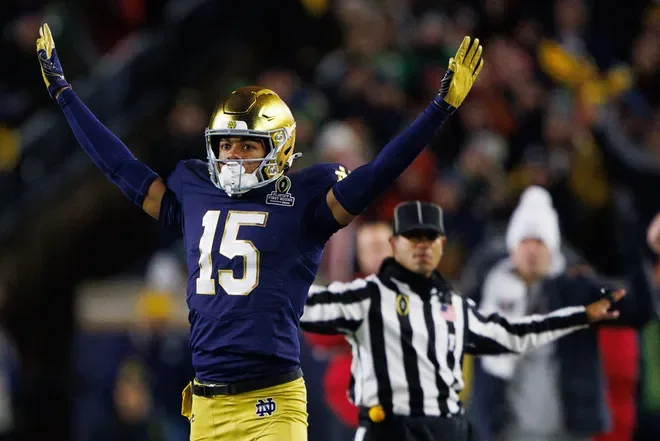
Three Irish Named to Walter Camp Preseason All-America Team
Notre Dame will head into the 2026 season with three players already carrying preseason All-America recognition. Offensive lineman Anthonie Knapp, safety Leonard Moore and defensive back Kyngston Viliamu-Asa were all tabbed for the Walter Camp Preseason All-America Team, the organization announced Tuesday from New Haven, Connecticut. Knapp and Moore were tapped for the first team, while Viliamu-Asa landed on the second team.
Founded in 1889, Walter Camp fields the oldest All-America team in college football and remains one of the five organizations whose selections factor into a player's consensus and unanimous All-America status. With three honorees on this year's list, Notre Dame is one of only six programs nationally to place at least that many players on the preseason team — an early signal of how much talent is returning to South Bend this fall.
Anthonie Knapp
Knapp picks up his first Walter Camp preseason nod after starting along Notre Dame's offensive line in 27 games across the last two seasons. He was a driving force behind a rushing attack that ranked among the most efficient in the country a year ago, with the Irish averaging 5.7 yards per carry — tied for third-best in the FBS. Notre Dame topped 200 rushing yards per game and averaged 7.3 yards per play behind Knapp's work up front, underscoring just how much the ground game leaned on his group.
Leonard Moore
Moore returns to the first team for a second consecutive year after a breakout, unanimous All-American campaign. In 10 starts, he paced the Irish with five interceptions — tied for seventh-most nationally — while adding 31.0 total tackles, a forced fumble and seven pass breakups. His signature moment came against Boise State last October, when he came away with three takeaways (two interceptions and a forced fumble) to go with six solo tackles, a performance that earned him both Walter Camp FBS Defensive Player of the Week and Jim Thorpe Award Defensive Back of the Week honors. Moore was also named to the Lott Impact Trophy Watch List last month.
Kyngston Viliamu-Asa
Viliamu-Asa earns his first career preseason All-America honor after a productive sophomore season that saw him appear in 11 games, including two starts, before a late-season injury ended his year early. The Inland Empire, California, native still finished fourth on the team with 48.0 total tackles, adding 7.5 tackles for loss, three sacks, an interception, two pass breakups and five quarterback hurries. Like Moore, he was named to the Lott Impact Trophy Watch List in May.
With this trio already drawing national recognition before a snap of the 2026 season, Notre Dame's offensive and defensive fronts look poised to anchor another competitive campaign under Marcus Freeman.
notre dame offers 2028 rb xander edwards
Notre Dame has officially extended an offer to 2028 running back Xander Edwards, with Marcus Freeman and his staff picking up the legacy recruit over the weekend. The offer continues a trend that has defined the Freeman era — Notre Dame football has continuously prioritized both Fighting Irish legacies and NFL sons, with players like Bryce Young, Devin Fitzgerald, Kaydon Finley, James Flanigan, Jerome Bettis Jr. and Elijah Burress all landing with the Irish as recruits in recent years. Betting on genetics has been a constant under this staff.
But this offer is about much more than bloodlines. Xander Edwards is the seventh-rated running back in the 2028 cycle according to the 247Sports composite ratings, and Notre Dame is undeniably a top destination for running backs right now. With Notre Dame running backs coach Je'Juan Seider being notably patient and selective with his offers in this cycle, the decision to extend one to Edwards says everything about how highly the staff views his fit in South Bend's backfield of the future.
The Legacy Connection
Edwards is the son of former Notre Dame great Marc Edwards, who rushed for 1,591 yards and 27 touchdowns in four seasons from 1993 to 1996. The elder Edwards also played nine seasons in the NFL, including for the 2001 Super Bowl champion New England Patriots. Inheriting his father's elite size and physical mentality, Xander has spent his early high school career carving out his own legacy in the talent-rich state of Florida.
The Production Backs Up Every Bit of the Hype
Edwards was already a notable performer for the Bolles School as just a freshman two years ago — in 12 games, he rushed for 558 yards and eight touchdowns, an average of 7.2 yards per carry, while adding 46 receiving yards on four catches.
It was his sophomore season that turned him into a national name. As the featured back for Bolles School in 2025, Edwards exploded for 2,629 yards and 44 touchdowns on just 265 carries — an average of just under 10 yards per carry — while also hauling in 17 receptions for 211 yards through the air. That includes a game against Baldwin where he scored his eighth rushing touchdown of the night, a feat that, per NFHS record books, would make him the first Florida high school football player ever to accomplish.
Per MaxPreps, Edwards has piled up 3,187 career rushing yards on a 9.3 yards-per-carry average, ranking him among the national stat leaders at the position.
The Size-Speed Profile Notre Dame Covets
At a listed 6-2, 220 pounds, Edwards carries the kind of frame that immediately stands out at the high school level — and the testing numbers back up that he's not just a big back, but an explosive one. Edwards has been clocked with a 4.80 in the 40-yard dash, a 4.65 shuttle and a 28.5-inch vertical — numbers that reflect legitimate speed and explosiveness for a back already pushing 220 pounds as a sophomore.
That combination of breakaway speed and bruising, between-the-tackles size is exactly what makes Edwards such an intriguing complement to the other running backs already on Notre Dame's 2028 board. Acely Brown and Zaiden Jernigan each bring their own distinct skill sets to the position, and Edwards' size-speed profile would round out a backfield class with real positional diversity — a power-and-burst combination back who can both punish defenses inside and outrun them to the second level, pairing alongside backs with different stylistic strengths to give Notre Dame's offensive staff multiple ways to attack a defense out of the same personnel grouping.
A Crowded, High-Profile Recruitment
More than 35 teams have offered Edwards, including Florida, Florida State, Georgia, Indiana, Miami, Michigan, North Carolina, Ohio State, Penn State, Vanderbilt, Virginia Tech, West Virginia and Wisconsin, among many others. Miami has reportedly been at the top of his recruitment following a Legends Camp experience, and On3's industry prediction data currently shows Florida and USF among the schools drawing the most buzz, with Notre Dame now squarely entering that conversation following the offer.
The Rankings Across the Industry
Edwards' rapid rise on the recruiting trail is reflected across every major service. On the 247Sports Composite, Edwards is rated a four-star prospect — the No. 117 overall player in the country, the No. 7 running back nationally, and the No. 17 player in the state of Florida for the 2028 class. He is rated a four-star and top-150 overall prospect by every major recruiting platform. On3 has him as the No. 141 player nationally and the No. 8 running back in the class, with a composite-style rating of .9532 placing him at No. 117 nationally and No. 7 at his position — essentially mirroring the 247Sports numbers. ESPN's recruiting database lists Edwards similarly among the class's premier running back talents.
The Bottom Line
It's by no means a guarantee that Notre Dame ends up landing Edwards after this offer, but the fit is hard to ignore. Notre Dame isn't perfect when it comes to recruiting sons of former Fighting Irish players, but it lands those commitments a lot more often than it misses.
With Je'Juan Seider's patient approach finally yielding an offer to one of the most explosive backs in the 2028 class, and with Edwards' size-speed combination offering a natural complement to fellow 2028 targets Acely Brown and Zaiden Jernigan, Notre Dame's running back room of the future is starting to take shape — and a legacy name with elite production and a frame built for the position is now squarely in the mix to be a part of it.
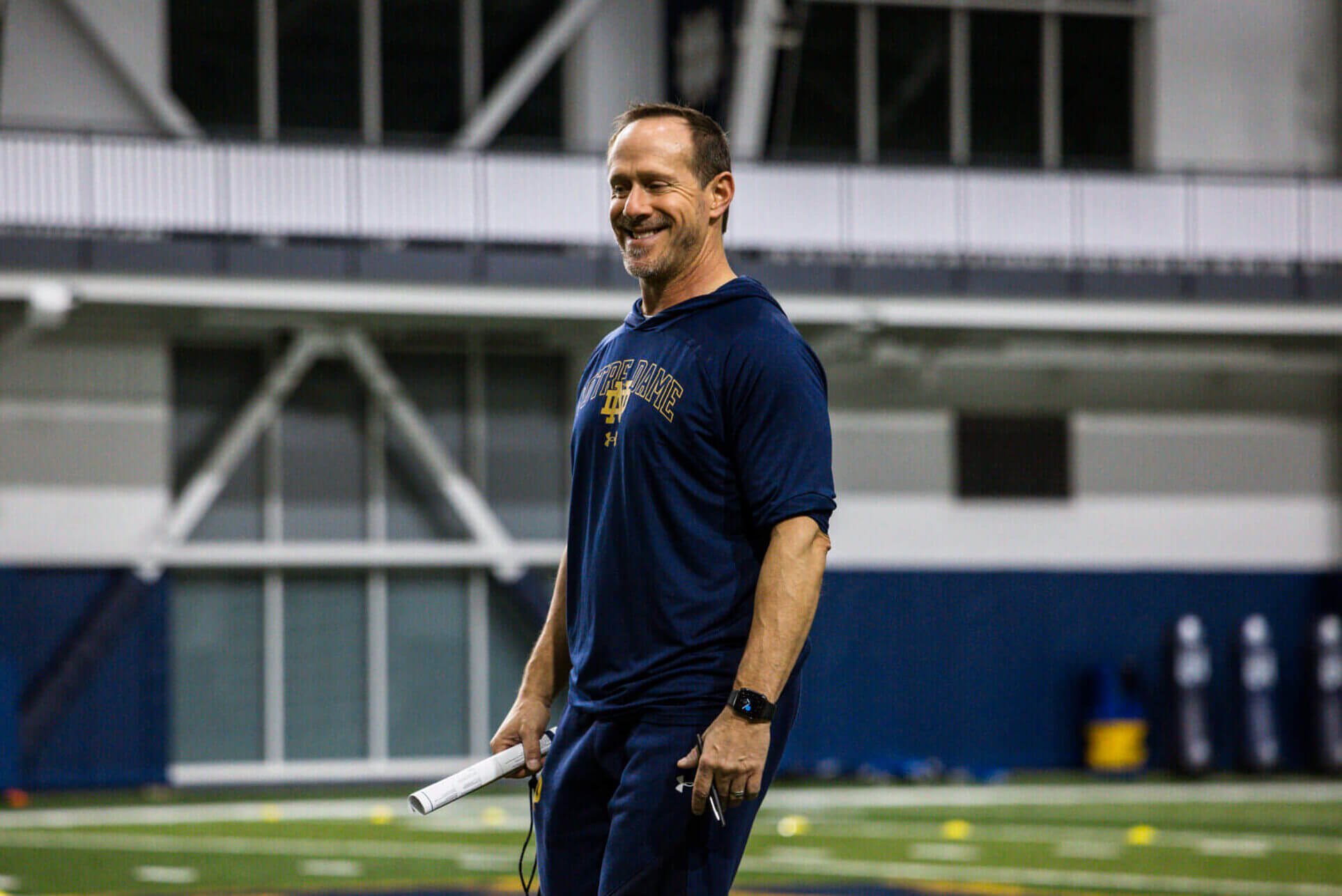
Loren Landow wins nsca award after transforming Notre Dame
Notre Dame Trematerra Family Director of Football Performance Loren Landow has been named the recipient of the 2026 National Strength and Conditioning Association Impact Award, the organization announced Friday morning — a national honor that arrives at a moment when the transformation he has overseen in South Bend has become impossible to ignore.
Awarded since 1997, the NSCA Impact Award recognizes an individual who has made significant contributions that have impacted a segment of the overall strength and conditioning field. For Landow, the recognition caps a career of elite-level athlete development — but it also shines a national spotlight on exactly what has changed inside Notre Dame's program since he walked through the door in January of 2024.
"I'm deeply honored to receive the NSCA Impact Award," Landow said. "Any impact I've made throughout my career is a reflection of the incredible athletes, coaches, mentors, and colleagues who have trusted me, challenged me, and inspired me. I've been fortunate enough to surround myself with so many outstanding people, and this recognition is as much a testament to them as it is to my own contributions. I'm truly grateful for the opportunity to serve this profession and the recognition of this award."
The Results Since January 2024 Tell the Story
The most direct and undeniable evidence of Landow's impact at Notre Dame is the record. Since his arrival in January of 2024, Notre Dame has compiled an outstanding 24-4 overall record, including an appearance in the College Football Playoff National Championship game — a level of sustained success that represents one of the best two-year stretches in modern Notre Dame football history.
That kind of record is never the product of one single factor, but the timing is impossible to overlook. Landow's hire marked a fundamental shift in how Notre Dame approaches the physical development, conditioning and durability of its roster — and the results on the field followed almost immediately. A program that has long preached a line-of-scrimmage, physically dominant identity under Marcus Freeman finally had the performance infrastructure to match that vision, and the transformation has shown up everywhere from health and availability to fourth-quarter execution to the program's ability to compete physically with the most talented rosters in the country.
What Changed Inside the Program
Landow's career-long specialty has always been bridging the gap between collegiate development and professional-level performance training — and that is precisely the standard he imported to Notre Dame's strength and conditioning operation. His résumé prior to South Bend includes preparing countless NFL Draft prospects for the Combine and Pro Days, the most scrutinized athletic evaluation events in professional sports, along with coaching more than 70 NFL All-Pro players and more than 25 first-round selections over the course of his career.
Before Notre Dame, Landow served as head strength and conditioning coach for the Denver Broncos from 2018 to 2023, working daily with professional athletes whose bodies and performance windows are their livelihood. He also owns and directs Landow Performance in Centennial, Colorado, where he has trained thousands of athletes across the NFL, NHL, MLB, UFC and WNBA, in addition to Olympic medalists and world record holders.
That is the standard of training, programming and athlete management that Landow brought to South Bend in January 2024 — and the strides have been visible across every dimension of the program since.
Durability and availability have been a hallmark of Notre Dame's roster over the past two seasons in a way that was not always the case previously. A program that wants to compete deep into the College Football Playoff every year needs its best players on the field in November, December and January — not just September — and the conditioning and injury-prevention programming Landow has implemented has been a critical factor in keeping Notre Dame's roster healthier and more available through the most physically demanding stretches of the season.
Physical dominance in the trenches has become a defining characteristic of Notre Dame football under Freeman, and the strength gains, explosiveness training and functional power development that Landow's program emphasizes are foundational to that identity. The offensive and defensive line improvements that have become a central storyline of Notre Dame's roster construction are inseparable from the physical preparation infrastructure that supports them every single day in the weight room.
Speed and explosiveness across the roster — the kind of timed, measurable athletic development that NFL teams scout for at the Combine — has become a more pronounced trait of Notre Dame's roster since Landow's arrival, a direct reflection of his background preparing draft prospects for the exact testing metrics that NFL evaluators prioritize.
A professional-caliber culture of training has taken hold inside Notre Dame's program, with players now operating under the same developmental philosophy and competitive standards that Landow used to prepare All-Pro players and Olympic medalists. That cultural shift — treating every Notre Dame player with the individualized attention and rigor of a professional athlete — has elevated the baseline expectation for what it means to be physically prepared as a Fighting Irish football player.
A National Award That Reflects a Program-Wide Transformation
The NSCA's recognition of Landow is a credit to an entire career of elite athlete development — but for Notre Dame fans, it also serves as external validation of something the program has felt internally since the moment he arrived. The Fighting Irish are stronger, faster, more durable and more physically dominant than they were before January 2024, and the 24-4 record with a national championship game appearance is the clearest possible evidence of what that transformation has produced on the field.
Marcus Freeman's vision for a line-driven, physically imposing Notre Dame program required a strength and conditioning infrastructure capable of delivering on that vision at the highest level. Landow has done exactly that — and the NSCA Impact Award is national recognition of a strength program transformation that Notre Dame has been experiencing in real time for the past two years.
five-Star Edge Abraham Sesay Commits to Notre Dame
Charlie Partridge has done it again — and this time, the commitment that landed in South Bend is one that will reverberate across the entire 2027 recruiting landscape.
Abraham Sesay, the five-star edge rusher from Exton, Pa./Downingtown East, has committed to Notre Dame, choosing the Fighting Irish over a finalist group that included LSU, Penn State and Florida State. The 6-foot-4½, 225-pound pass rusher is ranked the No. 27 overall player and No. 6 edge rusher in the class according to the Rivals Industry Ranking — and joins a Notre Dame defensive line class that is rapidly becoming one of the most celebrated position-group recruiting hauls the program has assembled in decades.
The commitment came just two days after Sesay's official visit concluded — a weekend so comprehensive, so genuine and so convincing that the decision required no further deliberation. Notre Dame showed Sesay exactly who they are, exactly what they are building and exactly why South Bend is the right place for a five-star edge rusher with his combination of physical tools, competitive character and academic standards.
The answer was clear. Sesay committed. And Notre Dame's defensive line future just got significantly more dangerous.
The Production
Before the recruiting rankings, before the official visits and before the national attention that comes with being one of the most coveted pass rushers in the 2027 class, Abraham Sesay earned every bit of his recruiting profile the old-fashioned way — by dominating on the field against some of the best competition Pennsylvania high school football provides.
As a junior at Downingtown East, Sesay produced 13 sacks and over 80 tackles — numbers that transformed his recruitment from a regional conversation into a national one almost overnight. After a stretch of campus trips and a near-finalized board, Sesay had narrowed his list to five schools following his breakout junior season, with programs from every major conference competing for his signature.
The production tells only part of the story. Sesay is a multi-sport athlete who also participates in track and field and basketball — a detail that matters enormously in the evaluation of an edge rusher because it speaks directly to the natural athleticism, body control and competitive temperament that translates most powerfully to the pass rush position at the college level. A 6-5 edge rusher who runs track and plays basketball is not just a football player who happens to be tall. He is an elite athlete who plays football — and that distinction changes everything about the ceiling projection.
Sesay earned first-team all-state honors at defensive end for his junior season efforts, along with first-team all-league and county recognition at both defensive end and tight end — a dual recognition that reflects both his defensive dominance and the kind of versatile athleticism that elite college programs covet at the edge position.
The film
Pull up Abraham Sesay's film and the first thing that registers — before the statistics, before the recruiting ranking and before the offer list — is the physical profile. At 6-5 and 225 pounds with a frame that projects to carry significantly more weight as he develops under Notre Dame's strength and conditioning program, Sesay is built like the kind of edge rusher that keeps offensive coordinators awake at night.
Sesay has plus length with arms over 33 inches along with 10.25-inch hands — measurements that give him the kind of natural leverage advantage that most edge rushers spend years in a college weight room trying to manufacture. That length is not a passive attribute on Sesay's frame. It is an active weapon — the kind that allows him to keep offensive tackles at arm's length, disrupt their punch timing and win the initial engagement before blockers can establish their sets.
He explodes out of his stance with impressive burst, quickly threatening the edge and forcing offensive tackles into uncomfortable positions. His combination of size and speed allows him to win with raw athleticism, often beating blockers before they can properly set their feet.
Sesay shoots out of both a two and three-point stance with little wasted motion as he builds speed and cuts down escape paths for both quarterbacks and running backs. He efficiently redirects with his agility and play recognition. That ability to operate effectively from multiple stances gives Notre Dame's defensive staff the flexibility to deploy him in a variety of alignments without asking him to sacrifice his effectiveness — a versatility that elite edge rushers bring to defensive fronts and that makes the entire unit more difficult to scheme against.
Sesay tends to win with speed on the corner but can also play through contact, and further mass will only help improve his block destruction. He is already finding success on stunts and should offer some value as a situational interior rusher, especially as he adds weight.
Perhaps the most exciting physical element of Sesay's profile is what happens when his speed meets power at the point of contact. Sesay is a twitchy, fluid mover who looks to have the movement patterns suited for bending around the edge. He is loose and flexible in his lower body, flashes good first step quickness and easily converts speed to power — punching above his weight from a power perspective and capable of walking offensive tackles back to the quarterback with his bull rush.
A speed-to-power conversion at 6-5 with 33-inch arms is one of the most dangerous combinations an offensive tackle can face — and Sesay already does it naturally, before years of Notre Dame strength development have had the chance to add functional mass and power to a frame that is still growing into its full potential.
The Visit That Made Everything Official
Sesay arrived on campus for his official visit with a clear purpose — to use the weekend as a direct comparison tool against every other school at the top of his list. By the time the visit concluded, the comparison had produced a decisive and unambiguous answer.
The current players made the first impression. Bryce Young, Ebenezer Ewetade and Rodney Dunham — three of Notre Dame's most impactful defensive line contributors — spent significant time with Sesay during the visit, walking him through what it actually looks like to be a defensive lineman in Notre Dame's program. They showed him the culture of the room, the standard the program demands and what a player with his talent can become under Partridge's coaching. The message was direct — Sesay would be a great addition to the defensive line room and to the Fighting Irish program. Coming from players already living the experience, that message landed with an authenticity that no coaching staff pitch can replicate.
Partridge sees Sesay similarly to current star Boubacar Traore — playing off the edge and doing what No. 5 has done and what No. 5 is going to do. For a prospect evaluating his developmental path at the college level, hearing a position coach articulate a specific, vision-driven comparison to one of the program's most productive pass rushers is exactly the kind of concrete development promise that transforms interest into commitment.
The fellow official visitors added another compelling dimension to the weekend. Sesay raved about the other recruits on campus — describing them as amazing people whose character and quality immediately reflected the standard Notre Dame maintains in the kinds of individuals it recruits and wants in the program. Seeing the caliber of person that Notre Dame attracts reinforced that the commitment he was considering was about more than football — it was about the teammates, the community and the environment he would be surrounded by for four years.
The new facility tour gave Sesay a tangible look at the investment Notre Dame is making in its football future. The renderings of the finished product showed him not just where the program is right now but where it is going — the financial commitment, the administrative support and the vision of what Notre Dame football's infrastructure will look like throughout his college career. Seeing that investment communicated something that words alone never fully deliver — Notre Dame is serious about competing at the absolute highest level for a very long time.
And then there was Marcus Freeman — present not for the scheduled moments where head coaches traditionally appear, make their pitch and move on, but for the entire visit. Sesay specifically highlighted the combination of great education and resources, along with amazing football development, as central to his decision — and Marcus Freeman's genuine care for the program as a key factor in his choice. Freeman put in the work to get to know every family on campus personally — a level of head coach investment that Sesay specifically noticed and specifically valued because it is not the standard at every program he visited.
Charlie Partridge Closes Another Elite Pass Rusher
The Sesay commitment is the latest and perhaps most significant testament to what Charlie Partridge has built at Notre Dame in a remarkably short time. Notre Dame beat out Duke, Florida State and LSU for Sesay, with Partridge serving as a key piece whose long-time reputation for defensive line development gave Sesay the confidence that his path to elite college pass rusher ran through South Bend.
Partridge did not just win this recruitment with a facilities tour or a depth chart presentation. He won it with a relationship — built through multiple visits, genuine football dialogue and the kind of specific, vision-driven development promise that only coaches who truly understand the position at the highest level can make credibly. The extended conversations Sesay had with Partridge during the official visit proved just how strong the relationship between coach and prospect had become — and that relationship is now the foundation upon which Sesay's Notre Dame career will be built.
An impressive Defensive Line Class
Sesay's commitment pushes Notre Dame one step closer to their best overall defensive line recruiting haul in decades. He joins David Folorunsho — the No. 9 overall player and No. 2 defensive lineman nationally according to Rivals — as the second five-star defensive line commit in Notre Dame's 2027 class. Sesay will also join edge rushers Aidan O'Neil and Jackson Vaughn in what is becoming a loaded edge class, with all three commits embracing the competition that the room will demand.
Three edge rushers with legitimate pass rush credentials, complemented by Folorunsho's interior dominance — the defensive line class Notre Dame is assembling in 2027 reflects exactly the kind of trench-first, talent-driven recruiting philosophy that Marcus Freeman has preached since his first day as head coach.
Sesay becomes the 19th overall commitment in Notre Dame's 2027 recruiting class — and arguably the most impactful defensive addition yet in a class that keeps growing in both size and quality.
The Bottom Line
Abraham Sesay produced 13 sacks and over 80 tackles as a junior at Downingtown East. He earned first-team all-state, all-league and all-county honors on both sides of the ball. He brings a 6-5 frame with 33-inch arms, an explosive first step, elite speed-to-power conversion and a relentless motor that makes him a havoc-creator on every passing down. He is a five-star prospect, the second-ranked edge rusher in the 2027 class according to Rivals, and the No. 3 player in the state of Pennsylvania.
He chose Notre Dame over LSU, Penn State and Florida State — because of Charlie Partridge's development vision, because of what current players showed him the room can become, because of Marcus Freeman's genuine personal investment in every family on campus and because of what Notre Dame offers on and off the field that no other program on his list could fully match.
As Sesay himself said about Notre Dame — it is the combination of great education and football, the Notre Dame brand, the long history, the tradition and the great moral values. That is a great place to be able to play.
Abraham Sesay is a Fighting Irish. Charlie Partridge is building something historic in Notre Dame's defensive line room.
And the 2027 class just got its most explosive pass rusher yet.
Notre Dame's 2026 Offensive Line Has the Makings of Joe Rudolph's Best Unit Yet
Marcus Freeman's vision for Notre Dame football has always started in the same place. Before the skill positions, before the quarterback, before the coordinators and the scheme and the recruiting rankings — it starts in the trenches. It starts with the offensive line setting a physical tone that makes everything else the Fighting Irish want to do on offense not just possible but inevitable.
That vision has been building toward something in South Bend. The recruiting has been elite. The talent in the room has been undeniable. And now, entering 2026, the pieces are finally aligned in a way that makes the question not whether Notre Dame's offensive line can be great — but whether this specific group, with this specific configuration, in this specific season, can be the best offensive line Joe Rudolph has assembled since arriving at Notre Dame in 2023.
The answer depends significantly on two players — Will Black and Guerby Lambert, a pair of bookend tackles with tremendous upside whose development in 2026 could define not just this season but the entire trajectory of Rudolph's Notre Dame tenure. If Black and Lambert fulfill the expectations that their physical profiles and recruiting pedigrees have always suggested were coming, this offensive line has the talent, the experience and the positional construction to be a genuinely dominant unit — the kind that powers a rushing attack, protects an elite quarterback and gives an offensive coordinator with Mike Denbrock's résumé everything he needs to operate at the highest level.
Everything starts up front. In 2026, Notre Dame's offensive line has the chance to prove that the vision and the reality are finally the same thing.
Experience
The foundation of Notre Dame's 2026 offensive line case is a combination that championship units are built on — experienced interior players providing stability and continuity alongside new starting tackles with the kind of upside that changes what a unit can become at its ceiling.
Anthonie Knapp returns with two years of starting experience, now settled into the left guard position where his power, anchor and starting-caliber development project most powerfully. Ashton Craig — healthy and back from the injury that kept him out of spring practice — anchors the unit at center, the position most responsible for the communication and cohesion that separates good offensive lines from great ones. Sullivan Absher brings redshirt junior experience and genuine competitive hunger to right guard, a player who has waited for exactly this starting opportunity and arrives with the kind of chip-on-the-shoulder energy that produces the best seasons of college careers.
The experienced interior trio of Knapp, Craig and Absher gives Notre Dame's offensive line a proven, battle-tested core that first-year starting tackles can build around rather than carry. That structural advantage is enormous — because it means Black and Lambert do not have to be immediately dominant in order for the unit to function at a high level. They need to develop, grow and improve as the season progresses while the interior handles the communication load and sets the physical tone that the entire unit runs through.
That is the exact formula that produces breakthrough offensive line seasons — proven interior stability giving young, high-ceiling tackles the space to develop without the unit's effectiveness depending entirely on their immediate mastery of the position.
starting LT Will Black
The most consequential individual decision in Notre Dame's 2026 offensive line construction is Will Black's installation as the starting left tackle — and everything about Black's physical profile suggests it is exactly the right decision at exactly the right time.
Black arrived at Notre Dame as a five-star recruit whose combination of length, athleticism and raw pass protection tools projected to the blindside tackle position from the moment he stepped on campus. The left tackle spot is where his ceiling is highest, where his physical tools are most naturally expressed and where his development under Rudolph's coaching has always been pointed. Putting him there in 2026 — committing to the position, committing to the growing pains that come with first-year starting experience and committing to the long-term development arc that makes the short-term challenges worthwhile — is the kind of coaching conviction that separates programs building for championships from programs managing for comfort.
The growing pains will come. First-year starting left tackles in the Power Four face a learning curve against elite edge rushers that even the most talented players cannot fully avoid. Black will have moments in 2026 where that curve is visible — moments where an elite pass rusher wins a rep, where a coverage sack happens because the protection broke down outside and where the raw tools have not yet been fully refined into finished technique.
But the ceiling at the end of that developmental process is what makes every one of those moments worth the investment. A Will Black who has navigated a full season of left tackle starting experience against Power Four competition — processing different pass rush moves, learning to handle speed-to-power combinations and building the confidence that only comes from sustained starting-level repetitions — is the kind of blindside tackle that makes Notre Dame's offensive line genuinely elite for two or three more years beyond 2026.
The investment begins now. The return on that investment will define what Notre Dame's offensive line becomes.
Starting Rt Guerby Lambert
If Black's story in 2026 is about a talented young player stepping into the most demanding position on the offensive line for the first time, Lambert's story is about a proven, elite-recruited player finally getting to play where his ceiling has always been highest.
Lambert is a five-star recruit who arrived at Notre Dame with the physical tools — the length, the athleticism, the power and the frame — of an elite college right tackle. The right tackle position is where Lambert's profile projects most naturally, and 2026 represents the first time in his Notre Dame career that he steps into that role as the full-time, unambiguous starting right tackle without positional questions complicating his preparation or his identity within the unit.
That clarity matters more than it might initially appear. A five-star tackle who knows exactly where he is playing, who his running mate is at right guard and what his specific assignments and responsibilities are within the unit's blocking scheme is a significantly more effective player than one navigating positional uncertainty on top of the normal competitive demands of Power Four starting experience. Lambert enters 2026 with that clarity for the first time — and the results of a full season at right tackle in his natural position could be exactly what his recruiting profile always suggested was coming.
Together, Black on the left and Lambert on the right give Notre Dame something the offensive line has not had since Joe Alt and Blake Fisher anchored the 2023 unit — a pair of bookend tackles whose individual ceilings, if realized, make the entire offensive line a different and more dangerous entity than the sum of its experienced interior parts.
Alt and Fisher are starting in the NFL right now. The standard has been set. Black and Lambert have the talent to approach it. Whether they do in 2026 is the central question of Joe Rudolph's defining season.
Fueling the Rush — Two Seasons of Production That Demand Protection
The case for Notre Dame's offensive line dominance in 2026 is not built on projection alone. It is built on a foundation of sustained rushing production over the past two seasons that reflects a ground game operating at a high level even when the offensive line's performance has been inconsistent — and that should produce even more explosive results when the line reaches the potential that the 2026 configuration makes possible.
Over the past two seasons, Notre Dame has established itself as one of the most consistent rushing offenses in the country, grounding its attack in a zone-blocking scheme that rewards intelligence, footwork and the ability to move defenders off the line of scrimmage. The production has been there even through the injury disruptions and positional uncertainty that have complicated Rudolph's previous two seasons — which means the floor of what this rushing attack can do is already established at a high level.
Now pair that established rushing foundation with the most positionally sound offensive line configuration Rudolph has built since 2023 — and add the most dynamic running back room Notre Dame has had in recent memory.
Aneyas Williams enters 2026 as the featured back in a backfield that has been reloaded with genuine talent after the departure of Jeremiyah Love to the NFL. Williams brings a quickness, burst and space-creation ability that makes him a natural fit for the zone-blocking concepts Notre Dame runs — a runner who understands how to set up blocks, identify cutback lanes and accelerate through holes before defenders can close them. His ability to threaten defenses horizontally as well as vertically gives the ground game a dimension that forces defensive coordinators to honor the perimeter before crashing the interior — creating the kind of pre-snap conflict that makes Notre Dame's inside zone and power concepts more effective than they would be against a purely downhill running threat.
The offensive line's job is to create the environment where Williams's natural abilities can be fully expressed. With Black and Lambert protecting the edges, Knapp and Absher controlling the interior gaps and Craig directing the unit's communication from the center position, the blocking structure that Williams runs behind in 2026 has the potential to be the most effective the Irish have fielded in years.
When an offensive line dominates up front and a dynamic back like Williams is running behind it, rushing attacks do not just produce yards — they produce explosive plays, favorable down-and-distance situations and the kind of physical momentum that changes the entire complexion of a football game. Notre Dame's rushing attack has the ingredients for exactly that kind of production in 2026.
Protecting CJ Carr — The Most Important Assignment on the Roster
As important as the ground game is to Notre Dame's offensive identity, the offensive line's most critical assignment in 2026 is the one that directly determines whether the Irish passing offense reaches its enormous potential — protecting CJ Carr.
Carr enters his second season as Notre Dame's starter with the full benefit of a year of starting experience behind him, a deepened understanding of the offense and the weapons around him upgraded on every level. The wide receiver room is better. The tight end group is more experienced. The running back room gives him a genuine dual-threat dimension to work with in the passing game. The continuity of returning offensive coordinator Mike Denbrock and the same system Carr operated in throughout 2025 gives him a pre-snap processing advantage that second-year starters with returning coordinators enjoy in ways that are difficult to quantify but impossible to miss in the way they play.
But none of those advantages mean anything if Carr is running for his life on every passing down. The difference between a good quarterback and a great quarterback — between a solid season and a Heisman Trophy season — is almost always a function of how much time the offensive line gives him to go through progressions, identify coverage rotations and deliver the football to the right place with the timing and accuracy that his skill set demands.
Clean pockets do not just protect quarterbacks. They elevate them. When a quarterback can step into his throws, trust that his blindside is protected and operate through his full progression without the pressure of an unblocked defender bearing down on him, the entire passing game functions at a higher level. Routes develop more fully. Timing throws hit their windows. Check-downs become available when the primary read is covered. The entire mental processing load that second-year quarterbacks are still refining becomes more manageable when the physical environment the offensive line creates allows that processing to happen without the distortion of pressure.
Black and Lambert protecting Carr's edges in 2026 — if they perform at the level their talent suggests they can — give Notre Dame's quarterback an environment where his Heisman candidacy can develop naturally and fully. That is the assignment. Everything else the offensive line accomplishes in 2026 runs through whether they can consistently give CJ Carr the clean pocket he needs to maximize the talent surrounding him.
Mike Denbrock's Blueprint — Why Second-Year Quarterbacks Thrive Under His System
The offensive line's assignment in 2026 does not exist in isolation — it exists within the context of an offensive system designed by coordinator Mike Denbrock whose track record with second-year starting quarterbacks is one of the most compelling and relevant data points in Notre Dame's 2026 offensive preview.
Denbrock's résumé with second-year quarterbacks traces directly to the most celebrated quarterback performance in recent college football history. At LSU in 2023, Denbrock was the offensive coordinator for Jayden Daniels's Heisman Trophy season — a campaign in which Daniels, operating in his second year within a system that had been built around his strengths, produced one of the most statistically dominant quarterback performances the sport has ever seen. Daniels threw for 3,812 yards and 40 touchdowns while rushing for 1,134 yards and 10 more scores — numbers that earned him the Heisman Trophy and announced him as the most complete offensive player in college football.
The pattern that produced Daniels's Heisman season is directly applicable to what Carr and Notre Dame are building toward in 2026. A quarterback who has a full season of starting experience in the system. An offensive coordinator who has had a full offseason to study that quarterback's strengths, identify the plays and concepts that maximize his skill set and build a game plan philosophy that puts him in positions to succeed. A supporting cast that is upgraded from the previous season. And an offensive line assignment that is clearer, more positionally sound and more capable of providing protection than the one that existed in the quarterback's first year as a starter.
Denbrock has done this before. He has taken a second-year starting quarterback, built a system around his specific strengths and produced the kind of Heisman-caliber performance that changes careers. The offensive line's role in that process — keeping Carr clean, controlling the line of scrimmage in the run game and giving Denbrock's system the physical foundation it needs to operate at its ceiling — is the most direct and consequential contribution the unit can make to Notre Dame's 2026 championship aspirations.
If the offensive line delivers, Denbrock has everything he needs. If Denbrock has everything he needs, Carr has everything he needs. And if Carr has everything he needs — with the receiver room, the running back room and the system surrounding him in 2026 — the ceiling of what Notre Dame's offense can produce is genuinely limitless.
The Best Offensive Line of the Rudolph Era?
Stack all of it together — the experienced interior anchored by Knapp, Craig and Absher, the bookend tackle upside of Black and Lambert, the rushing production foundation that the past two seasons have established, the dynamic running back room led by Williams and the Denbrock-Carr connection that mirrors the blueprint that produced a Heisman Trophy at LSU — and the case for Notre Dame's 2026 offensive line being the best unit Rudolph has assembled at Notre Dame becomes genuinely compelling.
The standard was set in 2023 when Alt and Fisher gave Notre Dame two future NFL starters at the bookend positions. That unit is the measuring stick. Whether the 2026 group can approach or exceed that standard depends on Black and Lambert fulfilling the expectations their talent demands and the experienced interior delivering the consistency and physicality that championship offensive lines produce week after week.
The ingredients are there. The configuration is right. The assignment is clear. The supporting cast surrounding the offensive line — from Carr to Williams to the upgraded receiver room — gives the unit's performance a direct and immediate impact on Notre Dame's national championship aspirations.
This is Joe Rudolph's defining season. And for the first time in his Notre Dame tenure, he has the right players in the right places to make the definition one that every Fighting Irish fan will be proud of when the 2026 season is complete.
Will Black and Guerby Lambert. Protect the edge. Control the line of scrimmage. Fulfill the potential. Give CJ Carr the time to be great.
Do those things — and this offensive line does not just have the chance to be the best unit of the Rudolph era at Notre Dame.
It has the chance to be something that Notre Dame fans remember for a very long time.
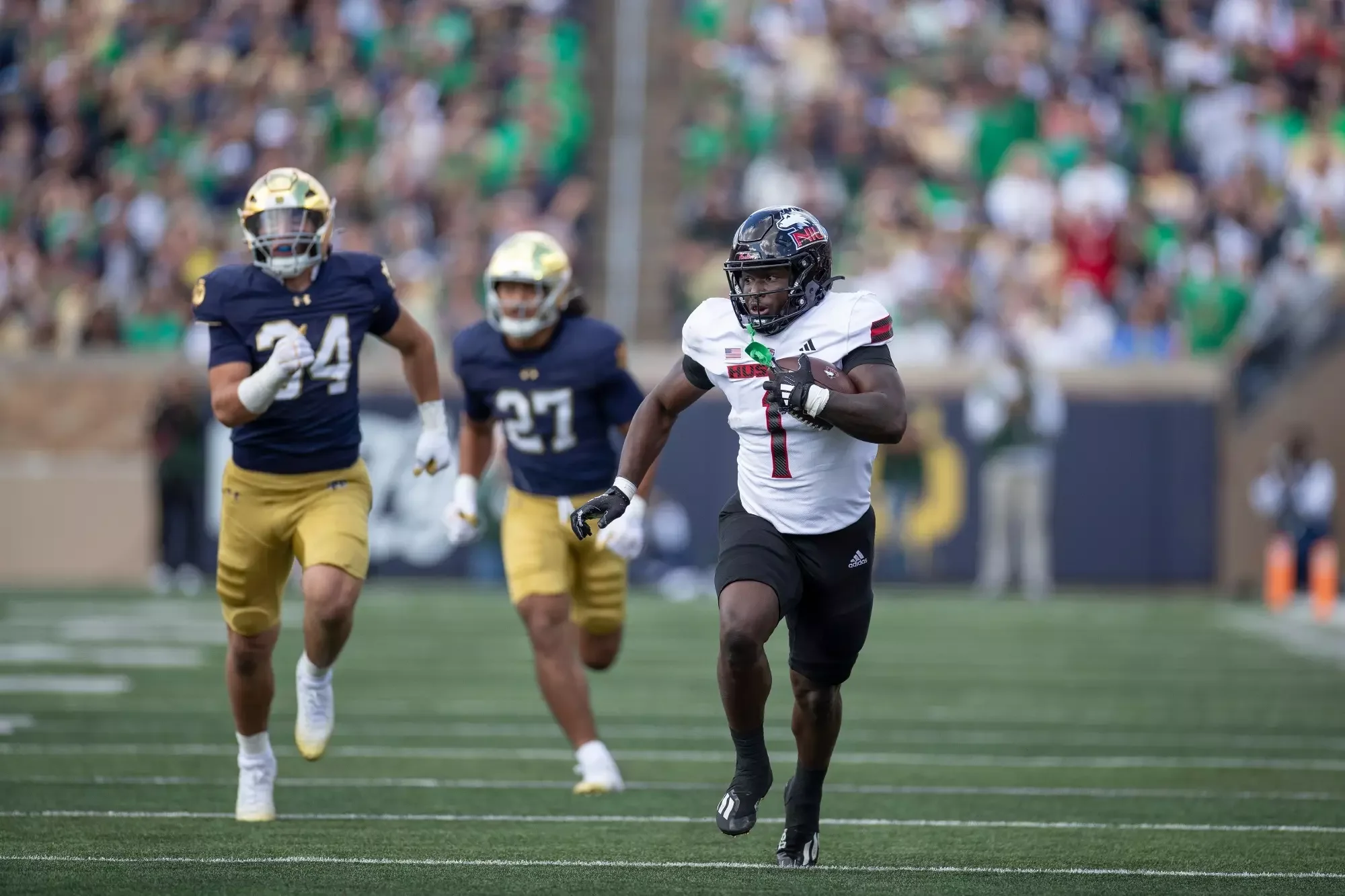
Notre Dame's Most Painful and Embarrassing Losses-fan’s perspective
From gut-punch defeats to head-scratching upsets, these are the losses Irish fans can never forget
Every Notre Dame fan carries a mental list. The losses that still sting when you think about them too long, the ones that changed the trajectory of a season — or a program — and the ones so unexpected they still feel like a fever dream years later. The Lucky Lefty Podcast recently opened that wound for their audience, and the responses painted a vivid picture of decades of Irish heartbreak.
The conversation surfaced losses across multiple eras, each carrying its own specific flavor of pain.
The Embarrassments
Northern Illinois in 2012 sits near the top of almost every fan's embarrassment list — and for good reason. Notre Dame was riding the wave of an undefeated run toward a national championship appearance, and the NIU loss came at the worst possible time for the program's credibility. As one listener put it, every squirrel gets a nut eventually, but this particular nut cost the Irish dearly in terms of national perception.
The Stanford loss under Marcus Freeman's early tenure carries a different kind of embarrassment — not just because of the defeat itself but because of the way it ended. David Shaw, coaching what turned out to be one of his final games, walked off the field with a smirk that said everything. A program that had been terrible that year had just handed Freeman one of the most stinging early losses of his tenure, and Shaw departed without so much as a handshake — walking slowly off the field as if he wanted every Notre Dame fan to absorb the moment fully. You can't fight the bully when he moves to another city. That slow walk became the enduring image of that afternoon.
The Michigan State fake field goal belongs in its own category entirely. Notre Dame's defense had every reason to expect it — the Spartans' kicker had missed two attempts from distance on the night, and the situation screamed fake. And yet when Michigan State ran it, the Irish fell for it completely. The image of Notre Dame defenders' faces in that moment — the sudden realization of what had just happened — captured something painfully familiar about Irish football in certain eras.
The Painful Ones
The 2014 Florida State game occupies a special place of pain for Notre Dame fans because of what it represented beyond the loss itself. The Seminoles were coming off a national championship, riding an unbeaten streak, and playing at home with full momentum. Notre Dame had the talent and the moment to make a genuine statement — and a controversial pass interference call late in the game swung the outcome. The what-if of that game lingers because the trajectory of Brian Kelly's program could have bent permanently in Notre Dame's favor with a victory. Instead, a fork in the road sent the program in a different direction.
The 2023 Ohio State loss — with ten men on the field — makes the embarrassing list for reasons that need no elaboration. Execution errors at the most basic level, on the biggest stage, against the most visible opponent. That one hurt in a way that felt institutional rather than situational.
The Northwestern Problem
Perhaps the most revealing discussion centered on a Northwestern loss that podcast co-host Malik Zaire experienced firsthand as a Notre Dame player. The pain wasn't simply that Notre Dame lost — it was how Northwestern played in that game. The Wildcats were dropping touchdowns, making plays that had no business happening against a Notre Dame roster with significantly superior talent. Trevor Siemian was throwing bombs. The Irish were getting beaten by a team that, as Zaire noted, probably could have won by more if they had simply caught every ball thrown their way. Losing to a team that wasn't at full capacity is its own particular brand of humiliating.
The Consistent Thread
What connects every loss on this list is not talent disparity — it is execution, circumstance and the painful randomness of college football applied to a program that carries enormous expectations into every single game it plays. Notre Dame fans don't just want wins. They want wins that match the standard the program sets for itself, and every loss on this list fell short of that standard in its own specific and memorable way.
The good news, as one podcast host noted, is that genuinely embarrassing losses — the kind where Notre Dame had no business competing — have been remarkably rare over the past 15 years. The 2012 Alabama national championship game is the only contest in that span where the outcome felt completely inevitable from the opening drive. Everything else has been competitive, consequential and winnable.
That is the standard Marcus Freeman is now carrying forward — and the 2026 season represents his best opportunity yet to ensure the painful losses remain in the past where they belong.
ESPN's College Football Future Power Rankings Have Notre Dame at the Top
When ESPN set out to rank all 68 Power Four programs in their future power rankings — evaluating quarterback situations, trench outlooks, roster management, star power and coaching staff quality with the kind of comprehensive rigor that separates serious analytical work from preseason speculation — the Fighting Irish came out on top.
Not second. Not in a group of three or four teams separated by fractions of evaluation points. First. Unambiguously, convincingly and with justification that holds up to scrutiny from every angle the evaluation touched.
This is not a sentimental ranking built on Notre Dame's brand, its history or the weight of its tradition. ESPN looked at what is actually on the field, what is being built in the recruiting pipeline, how the roster is being managed and who is coaching the program — and concluded that no program in the country is better positioned for sustained elite performance than Marcus Freeman's Notre Dame Fighting Irish.
The case begins with a quarterback whose growth and efficiency have already made him one of the most decorated signal callers in Notre Dame history. It runs through an offensive line that is finally deploying its elite talent in the right positions. It extends through a running back room with genuine dimension and a wide receiver group upgraded on every level. And it culminates in a defense that returns significant proven production while adding transfer portal talent to a revamped defensive staff that made the transition look seamless during spring practice.
Stack all of it together and the No. 1 ranking does not just make sense. It is the only honest conclusion.
CJ Carr — Growth, Efficiency and the Foundation of Everything
Every conversation about Notre Dame's 2026 ceiling begins in the same place — under center, with a redshirt sophomore quarterback whose growth from his first start to where he stands today represents one of the most impressive individual development arcs in college football.
CJ Carr did not arrive at Notre Dame's starting position through the transfer portal or through the kind of five-star recruiting coronation that precedes some quarterbacks before they ever take a college snap. He developed — through the program's system, under the coaching staff's instruction and through the accumulated experience of an entire season of starting at Notre Dame — into exactly what ESPN's Adam Rittenberg described as a national awards contender.
The statistical foundation that justifies that description is historically significant. Carr's 168.06 passer rating from the 2025 season was a Notre Dame program record — surpassing the previous mark held by Jimmy Clausen, a quarterback whose 2009 season is still discussed as one of the most polished individual performances in Notre Dame's quarterback history. Breaking a program record in your first year as a starter is not a product of circumstance. It is a product of genuine excellence sustained over the course of a full season against Power Four competition.
The efficiency numbers amplify the record even further. Carr completed 66.6 percent of his passes — fourth best single-season mark in Notre Dame program history across every era of Fighting Irish football. He threw 24 touchdowns against just six interceptions — and four of those six interceptions came in his first two starts, the natural adjustment period of a first-year starter navigating varsity speed for the first time. In his final ten starts of the season, Carr threw four interceptions across ten games — a turnover rate that matches the best decision-making quarterbacks in the country regardless of experience level.
The deep ball numbers are equally impressive and perhaps more revealing about what kind of quarterback Carr truly is. Eight touchdowns and zero interceptions on passes of 20 yards or more — a statistical combination that reflects both the arm talent to challenge defenses vertically and the decision-making discipline to never force throws in the most high-risk areas of the field. Zero interceptions on deep passes across an entire season is the kind of number that NFL scouts and Heisman voters notice immediately because it is so rare and so meaningful as a predictor of elite quarterback performance.
His yards-per-attempt average of 9.4 ranked second among all returning quarterbacks in the entire country — not second in the ACC, not second among independent programs, but second nationally among every returning signal caller in college football. That number reflects efficient, high-value passing that consistently moves the chains, creates explosive plays and maximizes the production value of every throw rather than accumulating yards through volume and check-downs.
The November elevation that Sporting News specifically cited in their No. 3 national quarterback ranking — a passer rating of 170.2 in the final month of the regular season — confirms what the full-season numbers suggest and then exceeds it. Carr was better in November than he was in September. He was better when the schedule was harder, the stakes were higher and the defensive preparation against him was most sophisticated. That late-season elevation is the single most reliable indicator that a quarterback's development is genuine, sustainable and pointed toward something significantly better in year two.
The growth from his first start against Miami in 2025 — when the country got its initial look at a talented but unproven first-year starter navigating an elite opponent in a high-pressure environment — to the polished, confident and statistically dominant quarterback who closed that season and walked into spring 2026 as the program's unquestioned leader is as dramatic an individual development arc as any quarterback in the country produced over the same period.
Entering 2026 with that foundation behind him — the record passer rating, the elite completion percentage, the zero deep-ball interceptions, the November elevation and a full offseason of development with Mike Denbrock building a system specifically around his strengths — Carr is not just one of the five best returning quarterbacks in the country. He is making a genuine and credible case to be the best. And the structure surrounding him in 2026 gives that case more supporting evidence than any other quarterback in college football can claim.
The Offensive Line — Elite Talent Finally in the Right Places
The offensive line evaluation is where ESPN's future power ranking for Notre Dame gets most specific and most optimistic — and for good reason. The unit that Joe Rudolph is sending onto the field in 2026 is the most thoughtfully constructed and positionally appropriate starting five he has assembled since his arrival in 2023, when Joe Alt and Blake Fisher gave Notre Dame a bookend tackle pair that now starts in the NFL.
The interior of this offensive line returns experienced, battle-tested starters whose collective knowledge of Notre Dame's blocking schemes and protection concepts gives the unit a communication and cohesion that young tackle prospects need around them to develop effectively. Ashton Craig returns at center as a legitimate Rimington Trophy contender — a distinction that reflects both the quality of Craig's individual performance and the critical importance of his role as the unit's communicator and pre-snap processor. Craig's ability to identify defensive alignments, make protection calls and ensure that every blocker on the unit is operating from the same information on every snap is the infrastructure that makes everything else on the offensive line function.
Anthonie Knapp returns at left guard — now settled into the position where Rudolph and the staff believe his ceiling is highest after two years of starting at left tackle. The move inside is not a demotion but a correction — putting a talented, experienced blocker in the alignment where his power at the point of attack, his ability to anchor against interior rushers and his two years of starting-caliber experience are most powerfully expressed. Knapp at left guard entering 2026 is a significantly more dangerous player than Knapp at left tackle — and the unit benefits immediately from having his experience and physicality deployed in the right place.
Sullivan Absher completes the interior at right guard with the competitive hunger of a redshirt junior who has waited for exactly this starting opportunity. Players who earn starting roles through development and patience rather than through recruiting star ratings tend to play with a chip-on-the-shoulder energy that makes them among the most consistently effective contributors on any offensive line — and Absher enters 2026 with every motivation to prove that the wait was worth it for both himself and the program.
The bookend tackles are where this offensive line's ceiling lives and where the most exciting development stories of the 2026 season will unfold. Will Black — a five-star recruit whose length, athleticism and pass protection tools have always projected to the blindside tackle position — takes over at left tackle for what should be a transformative first full season protecting Carr's blind side. The growing pains of a first-year starting left tackle against Power Four edge rushers are a normal and expected part of the development process — but the ceiling that Black is building toward as those growing pains accumulate into experience and confidence is the kind that changes what a program's offensive line can be for multiple seasons.
Guerby Lambert at right tackle is the complementary story — a five-star recruit from the 2024 class finally operating at the position where his physical profile projects most naturally for a full season as the unambiguous starting right tackle. Lambert's combination of size, length and athleticism gives Notre Dame a potential true bookend pair with Black on the left side — the first time since Alt and Fisher that Rudolph has had that configuration available — and the results of a full season with both tackles in their natural positions could finally deliver the dominant unit that the talent in this room has always suggested was possible.
The potential return of Charles Jagusah — a five-star recruit whose development has been delayed — adds yet another elite-recruited option to a depth chart that is already one of the deepest Rudolph has had since his arrival. The depth and quality of this offensive line room entering 2026 is genuinely exceptional — and the configuration finally matches the talent with the positional assignments that maximize every player's individual ceiling.
The Running Back Room — Dynamic Talent Ready to Carry the Load
The departure of Jeremiyah Love — the No. 3 overall pick in the NFL Draft — is the most significant personnel loss Notre Dame faces on offense heading into 2026. Love was one of the most dynamic running backs in college football, a unanimous All-American whose big-play capability and consistency defined Notre Dame's ground attack across two seasons and made him one of the most celebrated players in the program's recent history.
But the Irish are not rebuilding the backfield. They are reloading it — with a group of talented, complementary backs whose collective skill set gives Mike Denbrock's offense a multi-dimensional ground game that can attack defenses in ways that a single-back approach never allows.
Aneyas Williams steps into the featured role with the physical tools, competitive instincts and playmaking ability to make the transition from Love to the next era of Notre Dame running back excellence as smooth as the talent in the room allows. Williams's combination of acceleration, vision and contact balance gives the Irish a back who can operate effectively in Notre Dame's zone-blocking scheme — identifying cutback lanes, setting up blocks and accelerating through holes before defenders can close them with the quickness that makes him a natural fit for the concepts Denbrock calls most frequently.
Williams's versatility as a receiver out of the backfield adds a dimension to Notre Dame's passing game that forces defensive coordinators to honor the check-down and screen game on every snap — pulling linebackers and safeties into coverage assignments that open the intermediate passing windows where Carr's accuracy and anticipation are most devastating. A running back who can genuinely threaten defenses both between the tackles and in the passing game is one of the most valuable offensive assets any coordinator can have — and Williams brings both dimensions to Notre Dame's 2026 backfield.
The depth behind Williams gives Denbrock genuine flexibility in how he deploys the ground game. Multiple capable backs with different physical profiles and running styles creates the kind of schematic variety that keeps defensive coordinators from settling into comfortable run defense adjustments — because the same blocking scheme produces different looks when different runners are operating behind it.
The collective expectation for Notre Dame's 2026 running back room is not to replace what Love provided individually but to provide what the room as a whole can produce collectively — and the talent assembled gives the Irish offense every reason to believe that collective production will be more than sufficient to keep the ground game a genuine threat that defenses must account for on every single snap.
The Wide Receiver Room — More Weapons Than CJ Carr Has Ever Had
If the offensive line case for Notre Dame's No. 1 ranking is built on positional construction and the running back case is built on dynamic talent filling a significant departure, the wide receiver case is the most straightforwardly exciting component of the entire offensive evaluation — because the group Carr is throwing to in 2026 is simply better than any receiver room he has had available in his Notre Dame career.
Jordan Faison returns as the established and proven No. 1 option after leading Notre Dame with 40 receptions, 640 yards and four touchdowns in 2025 — the team's leading receiver, produced while sharing a room with Malachi Fields and Jaden Greathouse. Faison's decision to give up lacrosse and commit entirely to football this offseason is the kind of singular focus investment that produces significant statistical leaps — and the Carr-Faison connection that produced 40 catches in a season where Fields was the projected No. 1 option is primed to become something even more dominant when Faison enters 2026 as the unambiguous first read with an undivided preparation investment behind him.
Jaden Greathouse brings the explosive playmaking dimension that makes Notre Dame's receiver room genuinely dangerous rather than simply functional. Greathouse's combination of separation quickness, yards-after-catch capability and big-play instincts — demonstrated emphatically in Notre Dame's 2024 postseason run — gives Carr a receiver who can take a short completion and turn it into a long gain, a slant route and turn it into a crossing score and a go ball and create the kind of contested-catch opportunity that changes field position in an instant. Pair Greathouse's explosion with Faison's reliable production and Notre Dame presents opposing secondaries with a No. 1 and No. 2 receiver combination that is as difficult to defend as any in the country.
The transfer portal additions elevate the room from very good to genuinely elite. Mylan Graham arrives from Ohio State with Big Ten starting experience, proven production at one of the most demanding programs in college football and the physical tools that made him a highly coveted recruit before his time at Ohio State. Graham does not need to be the No. 1 receiver or carry the production load to be enormously valuable — he needs to be a legitimate third option who punishes defensive coordinators for the coverage attention they devote to Faison and Greathouse. With the coverage bracket that those two demand, Graham will see single coverage against the best corner available on a given defense — and his Ohio State-tested talent gives him every tool to make opposing teams pay for that coverage decision.
Quincy Porter provides additional receiving depth from the same Ohio State program — another experienced, proven pass catcher who brings Big Ten competition reps to a Notre Dame receiver room that needed exactly this kind of experienced depth to complement its returning talent.
Three legitimate receiving threats with different physical profiles, different route-running styles and different strengths within the passing game — backed by experienced portal additions who contribute immediately and meaningfully to the room's depth and versatility. The receiver room Carr inherits in 2026 is the best he has ever had and one of the most complete groups in college football heading into the season.
The Defense — Proven Production Returns, Elite Additions Bolster the Front
While the offensive case for Notre Dame's No. 1 ranking builds from quarterback to skill positions to the line, the defensive case begins and ends with a simple and powerful truth — the production that made Notre Dame's defense one of the best units in the country late in the 2025 season is returning at a remarkably high rate, and the additions made through the transfer portal have addressed the few areas where reinforcement was genuinely needed.
Leonard Moore is the centerpiece of everything Notre Dame does defensively in 2026 and the most important returning player on the entire roster. The best cornerback in college football — PFF's No. 1 ranked returning cornerback for the second consecutive season — enters 2026 as the consensus Thorpe Award favorite after earning first-team unanimous All-America honors in 2025. Moore's 91.4 coverage grade and 90.9 overall defensive grade led all Power Four starting cornerbacks. He led Notre Dame with five interceptions while being targeted on only 11.5 percent of his coverage snaps — the ultimate testament to a cornerback so dominant that the entire country's offenses chose to scheme away from him rather than challenge him.
With Moore locking down one side of the field, the rest of Notre Dame's secondary carries a freedom and flexibility that makes the entire defensive system more dangerous. Christian Gray returns as a proven secondary contributor whose versatility allows defensive coordinator Chris Ash to present multiple coverage looks without sacrificing quality at any individual position. The addition of DJ McKinney from Colorado via the transfer portal gives the secondary a third proven option — a player with starting experience against Power Four competition who slides into a complementary role alongside Moore and Gray and completes what ESPN identified as potentially the biggest strength on Notre Dame's entire 2026 roster.
Adon Shuler returns at safety with the kind of range, instincts and ball-hawking ability that make him one of the most exciting developmental stories in Notre Dame's defensive backfield. His presence in the deep middle — rotating into coverage, supporting the run and creating the kind of turnover opportunities that change field position and momentum — gives Ash's secondary a complete, complementary set of pieces that no passing game can attack with a single schematic approach.
The linebacker corps is anchored by Drayk Bowen — one of the most complete linebackers in college football and the defensive engine that makes Notre Dame's second level function at its highest capacity. Bowen's combination of run-stopping physicality, coverage range and pre-snap processing intelligence gives the entire defense a communicator and lead tackler who elevates every player around him. His return alongside the developing linebacker talent around him gives Brian Jean-Mary — veteran defensive assistant now overseeing the linebacker group — proven production to build around from day one.
The Defensive Line — Transfer Additions Transform an Already Talented Front
The most dramatic and consequential roster construction development on Notre Dame's defensive side heading into 2026 is the transformation of the defensive line through a combination of proven returning contributors and high-impact transfer additions that address the program's most critical pass rush needs.
Boubacar Traore returns as Notre Dame's most dangerous and most disruptive pass rush weapon — a junior edge whose combination of first-step quickness, motor and technical pass rush arsenal makes him a consistent threat to influence every passing down. Traore's presence gives Ash's defensive front a proven, established disruptive force that new additions can complement rather than replace — the difference between addition by addition and addition by multiplication when it comes to what a defensive line can become collectively.
Bryce Young returns as a versatile and experienced contributor whose ability to line up in multiple positions along the defensive front gives Ash the flexibility to create different alignments and present different problems to opposing offenses without sacrificing individual quality at any spot. Young's experience and positional versatility are the kind of foundational traits that make an entire defensive line unit more difficult to prepare for — because the combinations he enables on the front are more numerous and more creative than a less flexible roster allows.
Jason Onye provides senior-level experience and established production at the defensive tackle position — a player whose understanding of what Notre Dame's defensive system demands and what elite college football competition requires gives the younger contributors on the defensive line a standard to measure themselves against and a guide to follow in the most demanding preparation moments of the week.
The transfer additions are where the defensive line story becomes genuinely transformative. Francis Brewu arrives from Pittsburgh with a national reputation as one of the most physically dominant interior defensive linemen in the transfer portal — a player whose combination of power, leverage and relentless effort at the point of attack gives Notre Dame's front an interior disruptive presence that immediately elevates the entire unit's run-stopping and pass-rushing capability. Brewu's Pittsburgh experience against ACC competition means his transition to Notre Dame's defensive system is not a leap into the unknown but a progression within a competitive environment he already understands.
Keon Keeley arrives from Alabama with the pedigree and physical tools that made him one of the most coveted defensive line recruits in his class — and the development infrastructure of Alabama's program having already invested significant time and resources into maximizing his potential. Keeley gives Notre Dame an edge presence whose ceiling, if fully realized under Ash's system and Partridge's coaching, could be the most disruptive individual defensive line performance the Irish have produced in years.
Tionne Gray from Oregon rounds out the transfer additions with starting experience and proven production from a Pac-12-level program — a player whose senior eligibility makes him the most immediately impactful of the three portal additions in terms of on-field availability and competitive readiness.
A New Defensive Staff That Hit the Ground Running
The most compelling subplot of Notre Dame's defensive preparation heading into 2026 is the transition to a reshaped defensive staff — and how smoothly that transition appears to have gone during spring practice despite the significant personnel changes that coordinator Chris Ash made to his unit this offseason.
Aaron Henry joins the staff to coach defensive backs, reuniting with Ash in a configuration that the coordinator knows and trusts from previous stops in his coaching career. The comfort and communication between Henry and Ash — built on an existing professional relationship — eliminates the adjustment period that typically accompanies new staff additions and allows the defensive back group to benefit from coaching cohesion from the very first practice of the spring.
Charlie Partridge takes over the defensive line — a coach whose recruiting track record and development philosophy give Notre Dame's front seven a proven leader whose ability to maximize pass rush talent and interior disruption is already on display in the 2027 recruiting class, where he landed the No. 2 defensive tackle in the country in David Folorunsho during his first recruiting cycle.
Brian Jean-Mary's oversight of the linebackers completes a defensive staff whose collective experience and internal cohesion make the transition from the previous staff configuration feel less like a rebuild and more like a refinement.
The spring practice reports that emerged from the new defensive staff's first extended look at the roster were encouraging across the board — a unit that absorbed significant coaching change, integrated transfer additions and developed communication between new coaches and returning players with a smoothness that reflects both the quality of the coaches Ash brought in and the leadership of the veteran players already in the building.
A defensive staff transition that goes well in the spring is not a guarantee of autumn dominance — but a transition that goes poorly in the spring is almost always visible in September. Notre Dame's spring went well. The foundation for what this defense can become in 2026 under its new coaching configuration is as solid as any rebuilt staff could reasonably hope to establish in a single spring session.
The Bottom Line — No. 1 is Not a Gift. It Is a Grade.
ESPN evaluated 68 Power Four programs. They looked at quarterback situations, trench outlooks, roster management philosophies, collections of star power and coaching staff quality. They graded every program with the analytical rigor that separates meaningful future power rankings from preseason popularity contests.
Notre Dame came out No. 1.
Not because of history. Not because of brand. Not because of 11 national championships and one of the most famous stadiums in American sports. Because of CJ Carr's historically efficient first year and the second-year leap that every indicator supports. Because of an offensive line finally deploying its elite bookend talent in its natural positions. Because of a dynamic, versatile running back room. Because of a receiver group more talented and more experienced than any Carr has had available. Because of Leonard Moore being the best cornerback in America and Drayk Bowen being one of the best linebackers. Because of Brewu, Keeley and Gray transforming a defensive line that was already talented. Because of a new defensive staff that transitioned smoothly and a head coach who turned down the NFL to keep building something in South Bend.
Phil Steele has Notre Dame No. 1 in his preseason rankings. ESPN has Notre Dame No. 1 in their future power rankings.
The program that Marcus Freeman has built did not get to the top of those lists by accident.
It earned every spot.
Notre Dame 2027 Linebacker Recruiting — Brian Jean-Mary's Chance to Build Something Special
With two official visitors on the way and Amarri Irvin already committed, the Irish linebacker class could become one of the best in recent memory
Notre Dame's 2026 linebacker recruiting class is building toward something that could redefine the position group in South Bend for years to come — and the man at the center of it all is linebackers coach Brian Jean-Mary, who is closing in on a group that Lucky Lefty co-host Shaun Davis and Malik Zaire are already calling potentially game changing if the remaining pieces fall into place.
The foundation is already in place. Amarri Irvin, the Florida linebacker who committed to Notre Dame earlier in the cycle, gives Jean-Mary a proven cornerstone to build around. Irvin's presence alone signals that the Irish are recruiting the position at an elite level in this class — but what comes next could elevate the group from very good to genuinely special.
Two linebacker prospects are scheduled for official visits to Notre Dame, and the Irish coaching staff is pushing hard to close on both. One prospect that had been in the conversation — Noah Glover — came off the board earlier this month when he committed to Miami, removing himself from Notre Dame's official visit list. But the two remaining targets represent the kind of talent that, if signed alongside Irvin, would give Notre Dame a linebacker trio capable of competing with any group assembled nationally in this recruiting cycle.
Jean-Mary's ability to close on these two visitors is the central question surrounding Notre Dame's linebacker recruiting between now and signing day. If he lands both, the trio with Irvin becomes one of the most celebrated linebacker hauls in Notre Dame's recent recruiting history — a group that could be mentioned alongside the program's best position-specific classes of the past decade.
The linebacker position has been a focal point of Notre Dame's defensive identity under Marcus Freeman, whose background as a defensive coordinator and linebackers coach gives him a particular investment in the position group's development and recruiting. Jean-Mary carries that torch forward in 2026 — and based on the talent currently in play and the official visits on the calendar, he appears to be carrying it at exactly the right height.
The official visits will tell the story. Notre Dame has done the work to get these prospects on campus. Now comes the closing — the part of the recruiting process where relationships, vision and the weight of Notre Dame's football tradition either win the room or don't.
Based on everything surrounding this class so far, the Irish coaching staff appears ready to win the room.
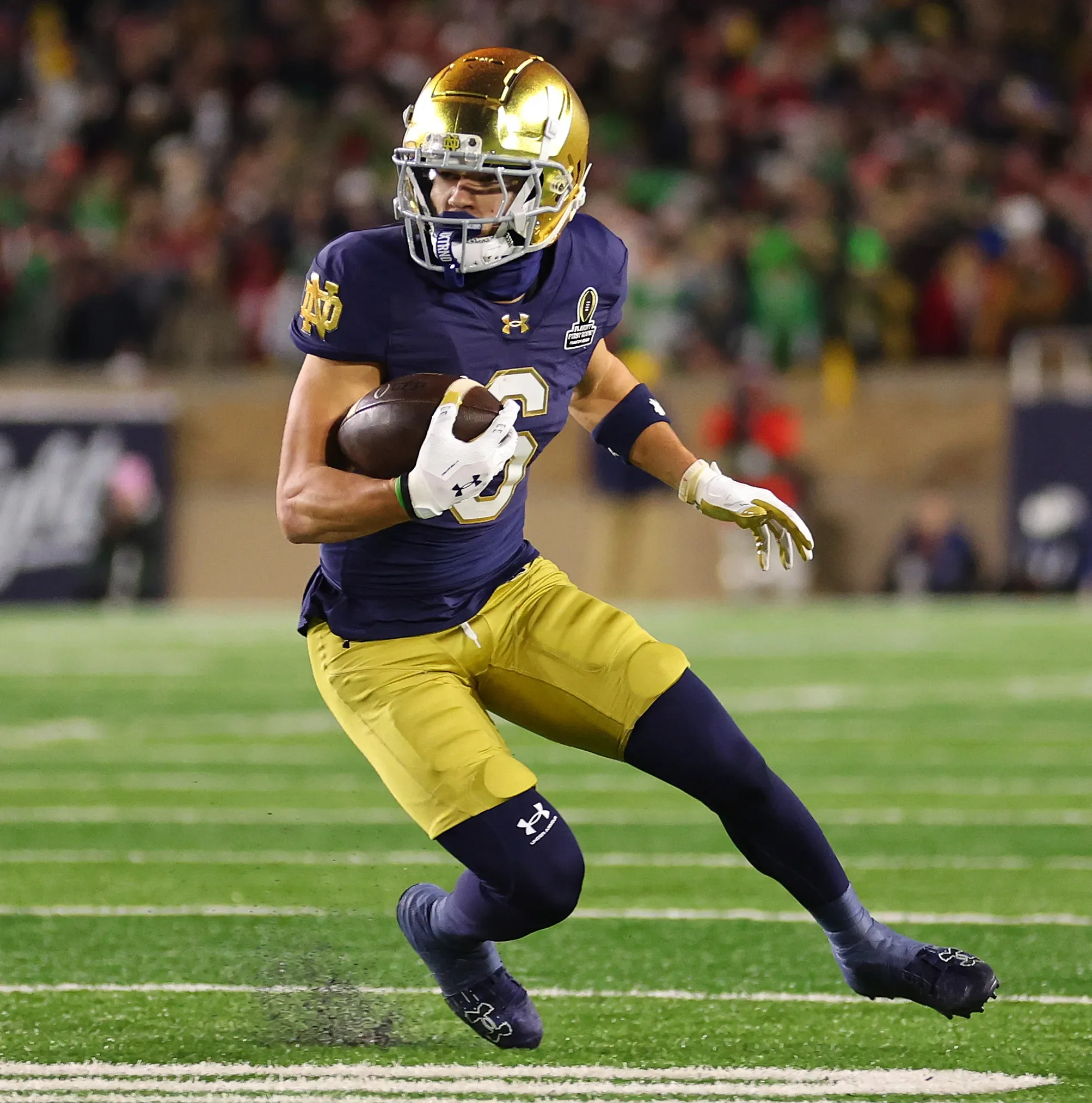
Jordan Faison's Growth Sets the Stage for a 2026 Breakout at Notre Dame
Breakout seasons don't materialize from thin air. They are built — rep by rep, season by season, through a progression of growth that is visible in the numbers if you know where to look and patient enough to watch the arc develop over time rather than demanding immediate results.
Jordan Faison's arc at Notre Dame is one of the most clearly defined and statistically compelling progression stories in college football heading into 2026. Look at the numbers across each season he has played and the trajectory is unmistakable — a receiver who has gotten measurably, undeniably better every single time he has stepped on a college football field, against better competition, in bigger moments, with higher stakes surrounding every performance.
Now, entering 2026 as Notre Dame's established No. 1 wide receiver and quarterback CJ Carr's most trusted target, everything Faison has built across three seasons of steady statistical growth is pointed directly at one destination — a breakout season that the numbers have been predicting for anyone paying close enough attention.
The progression is real. The breakout is coming. And the story of how Jordan Faison got here is worth telling in full.
Where It Started — A Walk-On With Zero Catches and One Moment
The baseline of Faison's progression at Notre Dame is important context for everything that follows — because where he started makes where he is going that much more remarkable.
Faison arrived at Notre Dame as a walk-on. Not a three-star recruit who needed development time. Not a portal addition brought in for a specific role. A walk-on — a player who had to earn everything from scratch against a roster filled with recruited talent that arrived with built-in advantages in opportunity and visibility.
Through the first several weeks of his freshman season in 2023, Faison had zero catches. Not a breakout waiting to happen, not a player on the verge — zero production, zero statistical footprint, zero reason for the outside world to pay attention.
Then came Louisville. Two catches, 48 yards, one touchdown — and a trajectory that changed permanently from that moment forward. In the final six games of that regular season, Faison went from invisible to indispensable, finishing with 17 catches for 274 yards and three touchdowns once he got going. His freshman year closed with a five-catch, 115-yard, one-touchdown performance against a ranked Oregon State team in the Sun Bowl — a statement game that planted the flag for everything that was coming.
The foundation had been laid. The progression was about to begin in earnest.
2024 — The Injury-Interrupted Proof of Concept
The 2024 season was supposed to be the year Faison announced himself to the wider college football world on a full-season scale. Injuries had other plans — limiting his overall regular season production and forcing a level of patience and resilience that tested his commitment to the process.
But here is what the 2024 numbers reveal when you look at them honestly — even in an injury-hampered season, Faison produced when he was healthy, and when the playoffs arrived and his health returned, he delivered the kind of performances that proved the Sun Bowl was not a one-game sample of his ceiling.
Against Indiana and Georgia in back-to-back playoff games, Faison recorded 11 catches for 135 yards — producing at exactly the moment Notre Dame needed its receivers most, on the biggest stage the college football regular season offers, against playoff-caliber defenses that had spent weeks preparing specifically for Notre Dame's offense.
The 2024 season's most important contribution to Faison's progression was not statistical. It was the proof that he could be relied upon in high-stakes moments, that the Louisville and Sun Bowl performances were character revelations rather than flukes and that when his body allowed him to play at full capacity, the production followed immediately and emphatically.
That proof set the stage for what 2025 was about to become.
2025 — The Statistical Leap That Changed the Conversation
If 2023 planted the seed and 2024 proved the concept despite limited opportunity, then 2025 was the season Jordan Faison's progression announced itself to the entire country with a clarity that could not be dismissed, debated or explained away.
Forty receptions. 640 receiving yards. Four touchdowns. Notre Dame's leading receiver — not a portal addition, not a five-star recruit, not the player anyone had projected to lead this offense statistically when the season began.
The numbers represent a genuine statistical leap that reflects every element of Faison's growth as a receiver. More receptions than any season before. More yards than any season before. More touchdowns in a single full campaign than his career suggested was coming. And all of it produced while sharing a receiver room with Malachi Fields — a four-year Virginia transfer who arrived specifically to be the go-to target — and Jaden Greathouse, who had been one of the most talked-about receivers in the program entering the season.
Faison outproduced them both. Not because the opportunity fell to him by default but because he earned it, week after week, with performances that proved he was the most reliable and productive weapon in Carr's passing arsenal.
The weekly production in 2025 told the story of a receiver operating with a consistency and confidence that only comes from genuine development. Five receptions for 33 yards and a touchdown against Miami in the season opener — no easing into the season, no waiting for momentum to build. Five catches for 105 yards and a touchdown against Purdue two weeks later — back-to-back productive performances that established a standard rather than teasing one. Seven catches for 89 yards against Arkansas on the road — producing in an environment where receivers are routinely neutralized by crowd noise, hostile atmospheres and game-plan-specific coverage. Six catches for 83 yards against Boise State — maintaining production against a defense built specifically to take away big plays in the passing game.
Then the regular season finale — three catches for 68 yards and a touchdown against Stanford on the road — a closing performance that mirrored the Sun Bowl statement from his freshman year and confirmed that Faison's best games consistently come when the moment is largest.
The Carr-Faison Connection — Chemistry Built Over Time
Numbers tell one part of the Faison story in 2025. The other part is the relationship that developed between him and quarterback CJ Carr throughout the season — a connection that grew more precise, more instinctive and more productive as the weeks accumulated and the two players built the kind of shared football language that only develops through sustained repetition and genuine trust.
Carr arrived in 2025 as a first-year starter navigating all the challenges that come with that transition — learning to manage game speed, make pre-snap reads under pressure and build the kind of confidence in his receivers that allows a quarterback to throw with conviction into tight windows against elite coverage. Faison became his anchor in that process.
The Carr-Faison connection worked because Faison gave his quarterback something every first-year starter desperately needs — a receiver who ran precise routes, found soft spots in zone coverage with intelligence rather than just athleticism, presented a reliable and consistently available target and made the right play after the catch to maximize every opportunity. Carr learned he could trust Faison in any situation, against any coverage and in any field position — and that trust, built game by game throughout 2025, is now entering 2026 as one of Notre Dame's most valuable offensive assets.
A quarterback and his No. 1 receiver entering their second full season together with an established connection and a full year of shared starting experience is a luxury Marcus Freeman has never had in his tenure at Notre Dame. Carr and Faison have it now — and what that chemistry can produce with a full offseason of work behind it is one of the most exciting questions surrounding Notre Dame's 2026 offense.
The Decision That Unlocks the Next Level
Before the statistical case for a 2026 breakout can be fully made, the offseason decision that makes it possible deserves its own recognition — because Jordan Faison made a choice this spring that speaks directly to how seriously he is approaching this opportunity.
Faison gave up lacrosse. Completely. Fully committed to football as the singular focus of his athletic life going forward.
For a multi-sport athlete, that decision carries real weight. It means every offseason hour that was previously divided between two sports is now directed entirely toward football. Every training session, every film session, every route-running repetition, every moment spent deepening his understanding of the offense and strengthening his connection with Carr — all of it now happens in the undivided context of a player who has chosen football as his complete identity.
The technical refinements that decision enables — sharper route running, more refined release packages against press coverage, deeper route tree development and the kind of receiver-quarterback timing work that only accumulates through concentrated repetition — are exactly what separate a very good college receiver from a great one. Faison has invested in all of it this offseason, and reports from South Bend suggest it is already showing up in the way he is operating within Notre Dame's offensive system.
The player who led Notre Dame in receiving in 2025 while still splitting his attention between two sports is now a full-time football player preparing for what could be his final season in South Bend. That combination of established production and elevated preparation is a genuinely dangerous thing for opposing defenses.
Reading the Progression — What the Numbers Say About 2026
Pull back and look at Jordan Faison's statistical arc across his Notre Dame career and the trajectory draws itself.
A walk-on with zero catches who finished his freshman year with 17 receptions, 274 yards and three touchdowns in six games once he got going — including a 115-yard Sun Bowl performance against a ranked opponent. An injury-hampered sophomore season that still produced 11 catches for 135 yards in two playoff games when his health returned. A junior season that produced 40 receptions, 640 yards and four touchdowns as the team's leading receiver — with consistent weekly production against a diverse slate of competition that included road games, playoff-caliber defenses and opponents that specifically schemed to take him away.
Each season has been better than the one before it. Each opportunity has been maximized more completely than the previous one. Each stage of the progression has revealed a receiver who is not just adding statistical volume but genuinely improving as a route runner, a contested-catch threat, a yards-after-catch contributor and a football intelligence that allows him to manipulate coverage in ways that create opportunities for himself and for the receivers around him.
The natural extension of that arc — a returning No. 1 receiver, a full offseason dedicated entirely to football, a second season of genuine chemistry with his starting quarterback and a role in the offense that is now unambiguously his — points toward one thing.
A breakout season. The kind that turns a compelling progression story into a national conversation about one of the best receivers in college football.
The Stage Is Set
Marcus Freeman has never entered a season with a returning No. 1 wide receiver. He has never had all three coordinators return simultaneously. He has never had a returning starting quarterback with a full season of starting experience already behind him. In 2026, he has all three — and Jordan Faison is the player who ties them together most directly.
Carr knows where Faison will be. Faison knows what Carr needs. The offense knows how to use them together. And Faison has spent an offseason investing everything he has into becoming the best version of himself as a receiver before what could be his final opportunity to make a definitive statement in South Bend.
The progression from walk-on afterthought to Notre Dame's leading receiver to preseason No. 1 target entering 2026 is one of the best individual development stories in Marcus Freeman's tenure. The numbers back every word of it.
Now comes the breakout. The progression has been building toward it for three years.
In 2026, Jordan Faison is ready to arrive — completely, definitively and on the biggest stage Notre Dame has to offer.
Notre Dame AD Pete Bevacqua stands with sec, big 10 for cfp expansion
The College Football Playoff expansion debate has reached a tipping point, and Notre Dame Athletic Director Pete Bevacqua has made clear exactly where the Fighting Irish stand. Bevacqua has aligned Notre Dame with the SEC, Big Ten and Big 12 in pushing for a 24-team playoff format — and in doing so, has positioned the Irish not just as a voice in the conversation, but as a program uniquely built to dominate regardless of how the playoff landscape ultimately unfolds.
Bevacqua Steps Into the Arena
The expansion conversation has been building for two offseasons now. Big Ten commissioner Tony Petitti lit the fuse last year with an aggressive push to double the current 12-team field. The Big 12 and ACC have since climbed on board, with commissioner Jim Phillips lending his voice to the chorus. Now Notre Dame has joined them, and Bevacqua's reasoning goes deeper than simply wanting more teams in the field.
"I think in this day and age with what universities are investing in football, it's a very expensive sport," Bevacqua said. "You need to give more teams hope. The way things are structured now, everything points to the CFP. It's a measure of success. It's important in the tenure of a coach. We've seen firings when teams aren't going to make it to the CFP."
Bevacqua's vision extends beyond the present moment. He's thinking about the long-term health of college football as a whole — and what happens to the sport if the financial burden of competing at the highest level becomes unsustainable for programs outside the traditional powerhouse tier.
"My concern is that if more teams aren't given hope, that universities over the course of the next five, ten years will say, 'Hey, is the investment worth it?'" Bevacqua continued. "I would hate to see a college football landscape where there's only a handful of teams that can really give it a legitimate go year after year after year."
That is the voice of a man who understands that a thriving college football ecosystem benefits Notre Dame just as much as anyone. A sport with thirty programs genuinely competing for a title is a healthier, more marketable, more financially robust product than one with eight. Bevacqua sees the big picture — and he's right to.
The Strategic Genius of Notre Dame's Position
What makes Notre Dame's embrace of the 24-team format particularly shrewd is that it comes from a position of strength, not desperation. The Fighting Irish don't need a bigger playoff to survive. They need it to thrive — and there is a significant difference.
Consider what Marcus Freeman has built in South Bend. Notre Dame is scheduling some of the most demanding non-conference slates in the country, with home-and-home series against Alabama, Texas, BYU, Florida and Auburn on the books in coming seasons. The Irish aren't soft-scheduling their way into playoff consideration — they are earning it the hard way, against the best competition available. Ohio State plays Texas out of conference. Clemson has gone back-to-back against Georgia and LSU. Notre Dame belongs in that same conversation about programs willing to put their records on the line before conference play even begins.
That scheduling philosophy means one thing clearly: Notre Dame is building a program that can compete with anybody, anywhere, at any time. In a 12-team playoff, that makes the Irish a dangerous contender. In a 24-team playoff, it makes them a program that would enter the field battle-tested and ready while other programs that padded their records against cupcakes scramble to compete with legitimate title contenders.
Notre Dame wins in either world — and Bevacqua knows it.
Aligning With Power to Shape the Future
By stepping forward alongside the SEC and Big Ten — the two most powerful conferences in college football — Bevacqua has ensured that Notre Dame has a seat at the table where the sport's future gets decided. That is not a small thing for an independent program without a conference megaphone behind it.
The SEC and Big Ten generate the lion's share of college football's revenue and carry the most weight in playoff format negotiations. Notre Dame aligning with those conferences on the 24-team push isn't just a philosophical stance — it's a political calculation that keeps the Irish relevant in conversations that will shape the sport for the next decade. An independent program that sits on the sidelines of that debate risks being shaped by decisions made without their interests in mind. Bevacqua made sure that doesn't happen.
The revenue implications are also impossible to ignore. A 24-team playoff means more games, more television inventory, more distribution money and a bigger financial pie for participating programs. Notre Dame, with its own NBC television deal and massive national brand, stands to be one of the biggest financial beneficiaries of an expanded field. More playoff games means more Notre Dame on national television — and that is always good for the bottom line in South Bend.
A Program Built to Prosper at Any Playoff Size
Perhaps the most important element of Notre Dame's position is that Freeman and Bevacqua have constructed a program that doesn't need the playoff format to change in order to compete. Under Freeman, Notre Dame has already demonstrated it can reach the College Football Playoff and make deep runs in the current 12-team format. The roster investment, the recruiting infrastructure, the coaching staff and the scheduling ambition are all pointed at one goal — winning a national championship.
If the playoff stays at 12 teams, Notre Dame's brutal non-conference schedule and elite recruiting class position them as perennial contenders for one of those coveted spots. If it expands to 24, the Irish would enter as one of the most battle-tested programs in the field — a team that has been preparing to play anyone, not just survive a soft schedule long enough to sneak into an expanded bracket.
Either way, the programs that should be concerned about the playoff format are the ones that need a bigger field just to get in. Notre Dame is not one of those programs. Bevacqua is advocating for expansion from the high ground — as the AD of a program that will be in the conversation whether the field is 12, 16 or 24 teams.
The Bottom Line
Pete Bevacqua has made a bold, calculated and strategically sound move by aligning Notre Dame with the forces pushing for a 24-team College Football Playoff. His argument for the long-term health of the sport is genuine and carries real merit. His understanding of what expansion means for Notre Dame's brand, revenue and competitive positioning shows a leader thinking well beyond the next season.
Most importantly, Marcus Freeman is building exactly the kind of program that makes this position credible. Notre Dame isn't lobbying for a bigger playoff because they need a lifeline. They're supporting expansion because they intend to be one of the programs that makes every round of a 24-team field worth watching — and they're scheduling, recruiting and competing like it every single day.
The playoff may be changing. Notre Dame is ready for all of it.